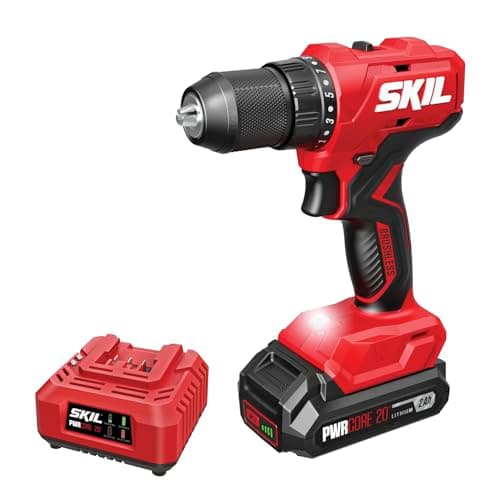
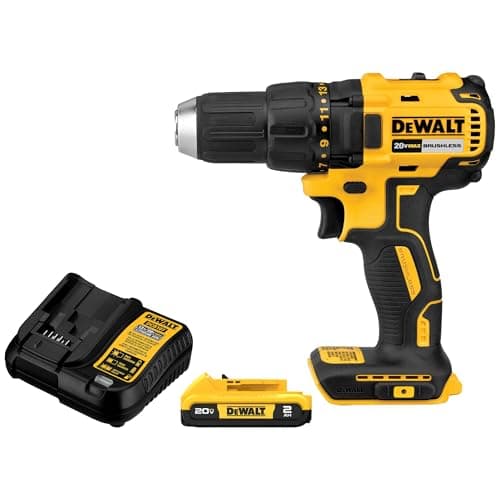
The first cordless tool a woodworking shop should buy is a drill/driver on a platform it intends to stay on, and the DEWALT DCD777D1 kit is the safe answer. It is for anyone starting from nothing: a brushless motor, a published 340 UWO of torque, a 1/2 in. single-sleeve ratcheting chuck, and a 2.0 Ah battery and charger in the box — on 20 V MAX, which is the biggest cordless platform in most American garages, so every battery you buy later has somewhere else to go. The budget pick is the SKIL DL6280B: a published 400 in.-lb., 17 clutch settings, 0 to 450 RPM in low gear and 1.83 lb, with a battery in the box for less than most bare tools cost.
The ranking below is not by tool quality. It is by whether the cord was the problem in the first place, because that is the only question that matters when you are deciding where battery money goes. Prices come from our live price layer, last checked November 23, 2026.
Buy the platform, not the tool
This is the whole decision and nearly every buying guide gets to it last. A cordless tool is a tool plus a battery plus a charger, and the batteries are the expensive, perishable part. Buy a second platform and you own two chargers, two sets of packs on two different shelves, and two sets of packs ageing in parallel whether you use them or not.
So the sequence is: pick the platform, then buy tools on it. For most readers in North America that means DEWALT 20 V MAX or Milwaukee M18, because the tool range is widest and the batteries are on every shelf. Makita 18 V LXT is the third. The small-brand platforms are a real saving on the first tool and a real constraint by the fifth, which is the honest trade the SKIL pick represents: SKIL publishes a strong specification at a low price on a significantly smaller ecosystem.
One note on torque figures, because they are not comparable. DEWALT publishes 340 UWO (unit watts out, a power measure) for the DCD777 and no inch-pound figure at all; SKIL publishes 400 in.-lb. for the DL6280B. Those two numbers measure different things and cannot be ranked against each other, which is why this page does not try. Our cordless drill roundup works through that field properly.
The four tools where losing the cord genuinely changes the work
The drill/driver. Obvious, and still first. A drill is used in short bursts, in awkward positions, inside half-assembled carcases, and the cord is in the way for all of it. There is no argument for a corded drill in a furniture shop.
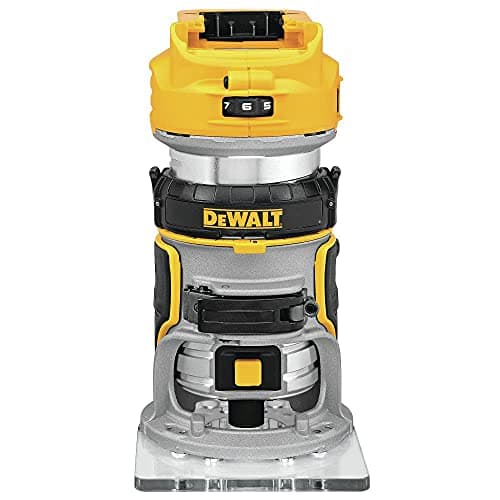
The compact router. The DEWALT DCW600Bis the one that matters most on this list after the drill, because a trailing lead across a workpiece is exactly where a cord does the most damage — it catches the edge mid-pass and the bit leaves a mark you cannot sand out. DEWALT publishes 16,000 to 25,500 RPM, a 1/4 in. collet, dual LEDs and a depth-adjustment ring, brushless, on a fixed base. It is a bare tool and the plunge base is a separate purchase, and the 1/4 in. collet means the big rail-and-stile and panel-raising bits are out. For edge profiling, hinge mortises and template work it is the right tool. Our router roundup covers the full-size machines that collet rules out.
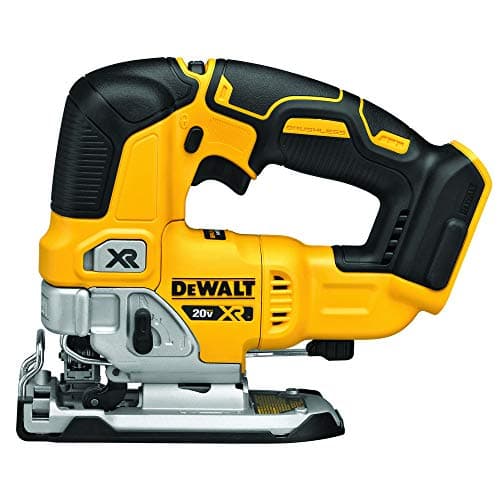
The jigsaw. The DEWALT DCS334B is a barrel-grip brushless jigsaw at a published 3,200 strokes per minute. The barrel grip puts your hand level with the blade instead of above it, which is the single biggest control improvement available on a jigsaw, and a jigsaw is used in thirty-second bursts where dragging out a cord is most of the job. Bare tool again.
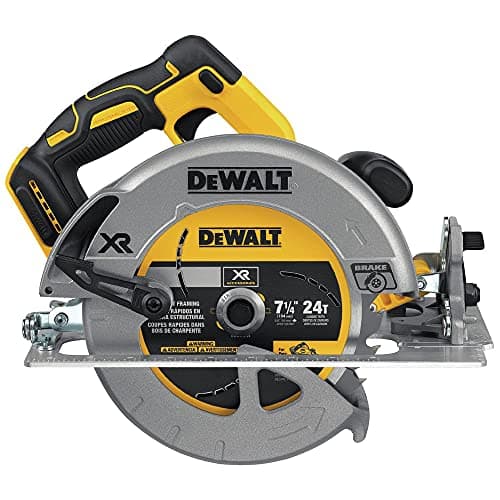
The circular saw. The DEWALT DCS570Bis a full 7-1/4 in. blade cutting a published 2-9/16 in. at 90 degrees, with a brushless motor, an electric brake and a 57-degree bevel. That depth clears a nominal 2x, which a 6-1/2 in. cordless saw does not. This is the tool for breaking sheets down on a driveway or in a garage with one outlet, and it wants a high-capacity pack rather than the 2.0 Ah one that comes in a drill kit. Two honest cautions: DEWALT's own retailer copy gives the no-load speed as 5,200 RPM in one place and 5,500 in another and we could not reconcile the two, and at least one dealer now lists the bare tool as discontinued by the manufacturer even though stock was live when we checked. Our circular saw roundup has the corded alternatives, which cost half as much and never fade.
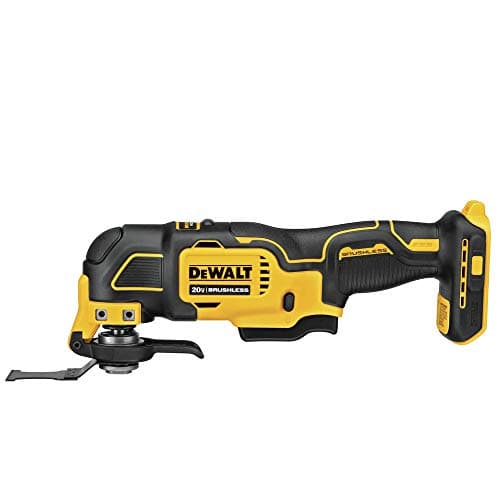
The oscillating multi-tool is the fifth, and it is a different argument: the DEWALT DCS354B at a published 2-1/3 lb and 11-1/5 in. long is a tool you use to trim a shim behind a fitted cabinet or a dowel in an assembled carcase, which are jobs where there is nowhere to plug anything in. DEWALT publishes a universal accessory adapter, so cheap generic blades fit and the blade bill stays sane. Our multi-tool roundup covers that field.
And the tools that should stay corded
This is the part of the page that saves you money.
Sanders. Sanding is a long, continuous, high-draw job, which is the worst possible duty cycle for a battery. A corded random-orbit sander costs a fraction of a cordless one and never slows down. Our sander buying order is all corded for exactly this reason.
Table saws, planers, jointers, bandsaws and drum sanders. All of these are stationary and all of them are near a wall. Cordless versions exist and solve a problem a shop does not have.
Brad nailers, with one exception.A pneumatic brad nailer costs a fraction of a cordless one and weighs half as much — a published 2.2 lb against roughly 5 lb with a battery fitted. The exception is a shop with no compressor and no wish for one, where the cordless tool is genuinely cheaper than the compressor plus hose plus floor space. Our nail gun page works that comparison through with the published figures.
Shop vacuums and dust extraction. Cordless extractors are for job sites. A shop vac that runs out of battery halfway through a clean-up is worse than a cord.
Side by side, as published
| Tool | Platform | Published headline spec | Battery included? | Is the cord the problem? |
|---|
| DEWALT DCD777D1 drill | 20 V MAX | 340 UWO, 7.6 in. front to back | Yes — 2.0 Ah + charger | Yes |
| SKIL DL6280B drill | PWR CORE 20 | 400 in.-lb., 0-450/0-1,700 RPM, 1.83 lb | Yes — 2.0 Ah + charger | Yes |
| DEWALT DCW600B router | 20 V MAX | 16,000-25,500 RPM, 1/4 in. collet | No — bare tool | Yes, badly |
| DEWALT DCS334B jigsaw | 20 V MAX | 3,200 SPM, barrel grip, brushless | No — bare tool | Yes |
| DEWALT DCS570B circular saw | 20 V MAX | 7-1/4 in., 2-9/16 in. at 90 deg., 57 deg. bevel | No — bare tool | Only away from outlets |
| DEWALT DCS354B multi-tool | 20 V MAX | 0-18,000 OPM, 2-1/3 lb, 11-1/5 in. | No — bare tool | Yes |
Every figure above is the manufacturer's own published number for the exact model we link. Two gaps are stated rather than filled: DEWALT publishes 340 UWO for the DCD777 and no inch-pound torque figure, so it cannot be compared with SKIL's 400 in.-lb. on the same axis, and DEWALT publishes no oscillation angle for the DCS354B, which is the figure that actually predicts a multi-tool's cutting speed. We did not measure a torque, time a charge or run a battery down — there is no lab here, which the methodology page states plainly.
What to buy, in order
Starting from nothing, on the platform with the widest range: the DEWALT DCD777D1 kit, because the battery and charger are in the box and the packs will fit the next four tools. The same thing on the tightest budget, accepting a smaller ecosystem: the SKIL DL6280B, which is also the lightest tool here. Second tool, and the one where the cord does the most visible damage to your work: the DCW600B compact router. Third: the DCS334B jigsaw. After that, buy cordless only when you can name the cord as the problem — and buy corded for anything that runs for twenty minutes at a time.
Two more things worth knowing. Bare tools are the right purchase once you own packs and the wrong one before: four of the six tools here ship without a battery, and a 20 V MAX pack and charger cost more than some of the tools. And batteries age whether you use them or not, so two packs you actually cycle beats four that sit on a shelf. If you are building a shop from scratch, our beginner woodworking tool list puts this purchase in order against everything else, and workshop power requirements covers the corded half of the same question.