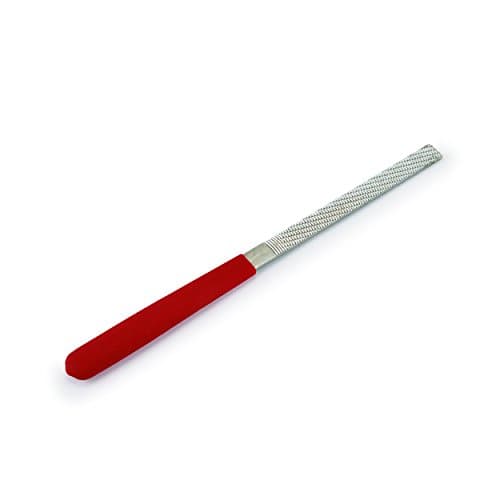
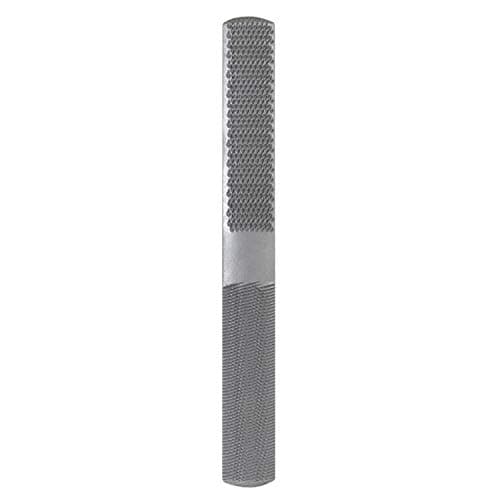
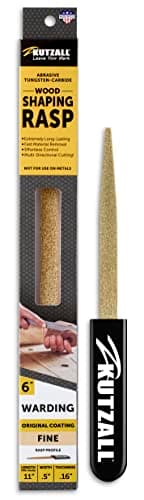
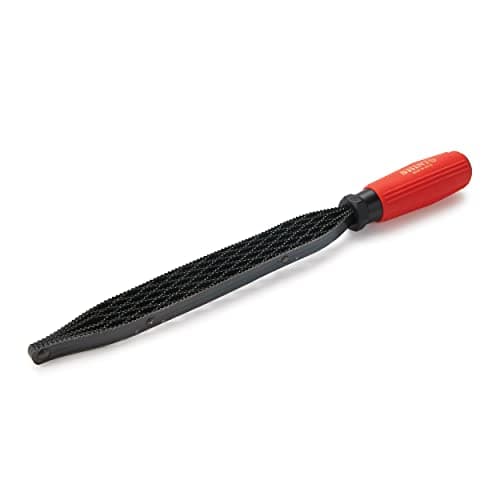
A rasp is what you reach for when the shape is not flat, not straight, and not reachable by any machine you own. Chair legs, cabriole curves, the inside of a handle, the transition where two shapes meet — the places a plane cannot sit and a sander cannot follow. It is one of the last genuinely irreplaceable hand tools.
The category divides cleanly into two jobs. Removal: coarse rasps and saw rasps that take wood away fast and leave a torn surface. Refinement: fine rasps and files that leave a surface close to finished, but work slowly. A shop that shapes anything needs one of each, and trying to do both jobs with one tool is why people find rasps frustrating.
Within removal, the interesting split is between traditional stitched rasps and saw rasps. A stitched rasp has individual raised teeth — hand-stitched on the expensive ones, machine-punched on the affordable ones — and the randomness of hand stitching is what stops it leaving tracks. A saw rasp is a crosshatch of hacksaw blades riveted together, which sounds crude and removes material at a rate that embarrasses conventional rasps. For the money, a saw rasp is the most capable removal tool most shops can buy.
For refinement, the standout is the Japanese shear-cut file, which has rows of fine, angled teeth that slice the fibers rather than tearing them. It leaves a surface close to a plane cut on shapes no plane can touch, and it is the tool that stops your curved work looking sanded.
How to choose a rasp
Grade: what the cut number means
Rasps are graded by how coarse the teeth are — bastard, second cut and smooth in the traditional naming. Coarser removes faster and tears more; finer refines but takes forever on bulk. A shop that owns two should have a coarse one for shaping and a second-cut or fine one for cleaning up. If you can only own one, second cut is the useful middle.
Shape: flat, half round, and why half round wins
A half-round rasp has a flat face and a curved face, which means one tool works both convex and concave surfaces. That is why it is the standard cabinet-maker's shape. Flat-only tools — including most saw rasps — cannot get into an inside curve, so they need a half-round partner if your work has any.
Hand-stitched versus machine-cut
Hand-stitched rasps have teeth placed by hand, so their spacing is irregular. That irregularity is functional: regular rows leave regular tracks, and random teeth do not. Hand-stitched rasps are expensive because the process is skilled and slow. Machine-cut rasps are far cheaper and leave a more regular scratch pattern that you then have to sand out — which for most work is a perfectly acceptable trade.
Handles matter more than you expect
Most traditional rasps ship without a handle and have a sharp tang. Fit one. A rasp used without a handle is uncomfortable within minutes and genuinely capable of hurting your palm, and control suffers because you cannot push properly.
Using a rasp so it does not tear the work
Rasps cut on the push stroke, so lift on the return — dragging back scrapes the teeth over the work and dulls them. Work at a slight skew rather than straight along the grain, which gives a cleaner cut. And stay well off your line: a coarse rasp removes more than you expect, and the last millimeter should be taken by a finer tool, a card scraper or sandpaper.
Keep the teeth clear. A clogged rasp burnishes instead of cutting, and the usual culprit is resinous softwood or damp stock. A file card or a stiff brush clears it in seconds; leave it clogged and you will conclude the rasp is blunt when it is not.
Rasping is also one of the dustiest hand operations there is, with fine particulate raised right under your face. It is worth wearing a mask — see our respirator roundup— for anything more than a few strokes.
Segmenting by work and budget
Occasional shaping: a combination rasp-and-file tool. Four surfaces for very little money, and enough for the odd handle or eased corner.
Regular curved work: a saw rasp for removal plus a half-round cabinet rasp for the shapes it cannot reach. That pair covers nearly everything.
Furniture that shows the shape: add a fine shear-cut file. It is the difference between a curve that looks sanded and one that looks cut.
Abrasive material: if you shape MDF, plywood edges or anything with glue in it, a carbide-coated rasp survives what destroys cut steel teeth.
How we ranked these
From published manufacturer specifications (length, shape, cut grade, tooth construction), the makers' documentation and the pattern in owner feedback read at volume. We have not measured removal rates or surface roughness — we do not run a lab, per our methodology page. Prices come from the live price feed.