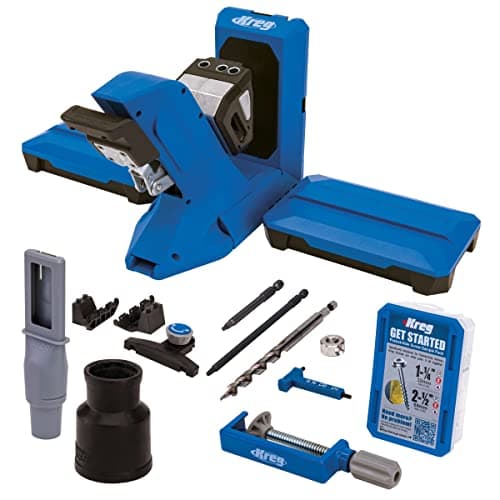
A pocket-hole jig drills an angled hole so a screw pulls two boards tight — the fastest strong joint in woodworking, and invisible from the front. For most people the honest answer is a Kreg jig; the brand's clamping and enormous accessory ecosystem are a real advantage. The only decision that matters is which tier you need.
The tiers split cleanly by how much you'll use it. The compact 320 is for occasional repairs and small builds; the portable 520PRO is the value sweet spot for most hobbyists; the bench-style 720PRO, with its automatic clamp and docking station, pays off only if you're building face frames and cabinets in volume. Spending up to the 720PRO for a handful of pocket holes a year is money you should put toward wood instead.
Pocket screws are the right joint for cabinets, face frames, shop furniture and anywhere the joint will be hidden and speed matters. They're the wrong joint when the joinery is meant to be seen — that's what our dovetail jig roundup is for.
The short answer
#ad · Live prices from the Amazon Product API, as of Sep 19, 2026. Where we have no verified live price, we show none — we would rather leave a gap than print a number that has rotted.
In detail
Best overall
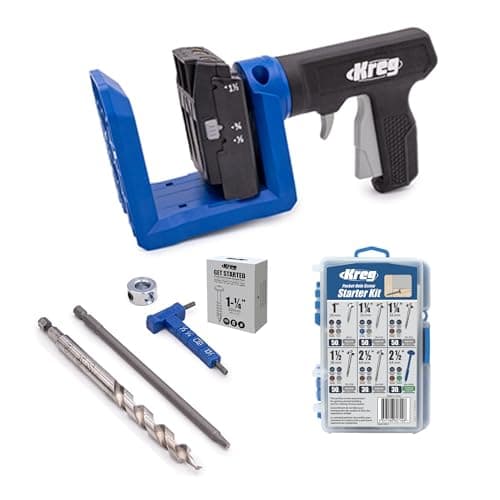
Kreg 720PRO Pocket-Hole Jig
Auto-clampDocking stationMaterial stops1/2–1.5 in stock
The pocket-hole jig to buy if you'll use it a lot. An automatic clamp grips any thickness and sets the drill guide in one motion — fast and repeatable.
- Speed
- 10
- Clamping
- 9
- Ecosystem
- 10
- Portability
- 7
- Value
- 7
Pros
- +Automatic clamp adjusts to stock thickness with no knob-fiddling
- +Docking station with storage and stops speeds up batch work
- +The most refined jig in Kreg's very deep ecosystem
Cons
- −Priciest of the Kreg jigs
- −More jig than an occasional user needs
Don't buy this if…
…you'll drill a few pocket holes a year — the 320 or 520PRO does the same joint for much less.
Best value
Kreg 520PRO Pocket-Hole Jig
PortableGripMaxx baseFoldable1/2–1.5 in stock
The value sweet spot. Portable, foldable, with an anti-slip base and enough features for almost anyone — the one most hobbyists should buy.
- Speed
- 8
- Clamping
- 8
- Ecosystem
- 10
- Portability
- 9
- Value
- 9
Pros
- +Anti-slip base holds work steady without a separate clamp
- +Folds up small and travels well
- +Covers the full range of stock thicknesses most projects use
Cons
- −Manual clamping, unlike the 720PRO's automatic action
- −No big docking station for batch production
Don't buy this if…
…you build face frames and cabinets all day — the 720PRO's auto-clamp and docking station pay off at that volume.
Best compact/budget
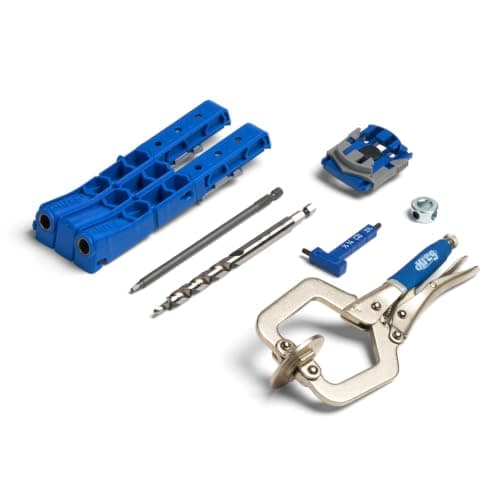
Kreg 320 Pocket-Hole Jig
2-hole guideCompact1/2–1 1/2 in stockFace clamp included
The compact, cheap way into the Kreg system. A two-hole jig you clamp to the work — perfect for occasional repairs and small builds.
- Speed
- 6
- Clamping
- 7
- Ecosystem
- 10
- Portability
- 10
- Value
- 8
Pros
- +Small and cheap — great for a drawer you keep in a toolbox
- +Uses the same reliable Kreg drilling geometry
- +Clamps anywhere on the work, including mid-panel, and this listing includes the Classic 2 in. face clamp
Cons
- −Slower than the bench-style jigs for repeated holes
- −Fewer built-in stops and guides
Don't buy this if…
…you're doing production runs — the repeated clamping gets old fast, and a bench jig is worth it.
Best non-Kreg
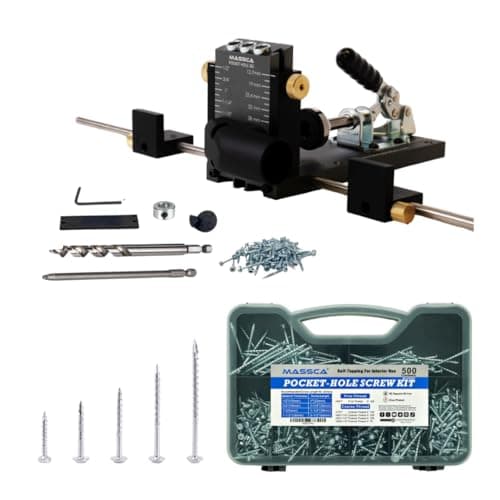
Massca M2 Pro Pocket-Hole Jig
Aluminum bodyTwin-holeAdjustableBundle incl. screws
The strongest non-Kreg option. An aluminum-body twin-hole jig that undercuts Kreg on price while doing the same core job well.
- Speed
- 8
- Clamping
- 7
- Ecosystem
- 6
- Portability
- 8
- Value
- 9
Pros
- +Solid aluminum construction feels sturdy
- +Drills two holes at once to speed things up
- +Often bundles screws and accessories for the price
Cons
- −Smaller accessory ecosystem than Kreg
- −Resale and jig-to-jig compatibility lag the market leader
Don't buy this if…
…you value the huge Kreg ecosystem of add-ons and guides — staying in that system has real convenience value.
Best rock-bottom price
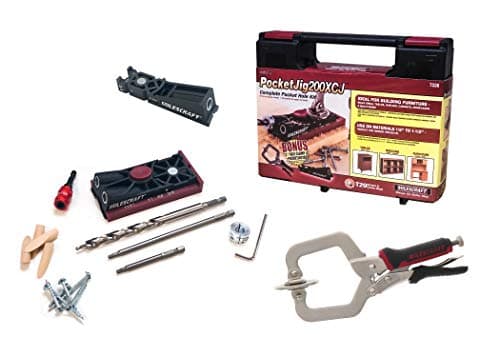
Milescraft PocketJig200 Kit
Clamp-on3-holeBit incl.Bundle
The rock-bottom entry. A clamp-on three-hole jig with the bit and a few screws — enough to see if pocket-hole joinery fits your work.
- Speed
- 6
- Clamping
- 6
- Ecosystem
- 5
- Portability
- 8
- Value
- 8
Pros
- +About as cheap as pocket-hole jigs get
- +Comes with the step bit and starter screws
- +Fine for the occasional shelf or repair
Cons
- −Basic build and clamping
- −Not as precise or durable as the Kreg jigs
Don't buy this if…
…you expect to use it regularly — spend a little more on a Kreg 320 or 520PRO for a jig you won't outgrow in a month.
How to choose a pocket-hole jig
Match the jig to your volume, not to the feature list. If you drill a few pocket holes a year, the 320 does the same joint as the flagship for a quarter of the price. If you build cabinets on weekends, the 520PRO's anti-slip base and portability hit the sweet spot. If you're running face frames in batches, the 720PRO's automatic clamp — it grips any stock thickness and sets the drill guide in one motion — genuinely speeds the work up.
Why Kreg dominates, and when to look elsewhere
Kreg's advantage isn't the drilled hole — anyone can make that — it's the clamping and the ecosystem of jigs, screws, and accessories that all work together. That said, the aluminum-bodied Massca M2 is a genuinely solid non-Kreg option that undercuts on price, and it's the pick if you don't care about staying inside the Kreg system.
Buy the right screws
Pocket-hole joints rely on the correct screw: coarse-thread for softwoods and plywood, fine-thread for hardwoods, and the right length for your stock thickness. The jig sets the hole; the screw does the holding, so don't cheap out on it.
How we picked
We do not run a testing lab
We researched published manufacturer specifications, manuals and spec sheets, ran the arithmetic those specs support, and read owner reviews at volume, then scored each tool against a published rubric. The scores are judgments from documented research — they are not measurements we took, because we do not have a lab and we are not going to pretend we do. Where a number came from a manufacturer's document, we name it and link it in Sources.
Questions
Are pocket-hole joints strong enough for furniture?+
For most casework — cabinets, shelving, face frames, shop furniture — yes. Pocket screws create a strong mechanical joint that holds well, especially with glue. They're less suited to joints under heavy racking load or where the end grain is doing the work, but for the vast majority of hobby furniture they're more than adequate.
Do I need a special drill bit and screws for pocket holes?+
Yes. Pocket-hole jigs use a stepped drill bit that comes with the jig, and pocket-hole screws with a self-tapping tip and a flat washer head. Using standard screws in a pocket hole tends to split the wood or pull through.
What's the difference between the Kreg 320, 520PRO and 720PRO?+
The 320 is a compact two-hole jig you clamp to the work — cheapest, best for occasional use. The 520PRO is a portable jig with an anti-slip base — the value pick for most hobbyists. The 720PRO is a bench jig with an automatic clamp and docking station — worth it only for high-volume work.
Can I use a pocket-hole jig on plywood?+
Yes, and it's one of the best uses for it — pocket screws are excellent for assembling plywood cabinets and shelving. Use coarse-thread screws sized for the plywood thickness, and set the jig's drill-guide depth to match.
Receipts
We do not run a testing lab, and we do not pretend to. Our picks come from published manufacturer specifications and manuals, the arithmetic those specs support, and owner reviews read at volume. Where we could not verify something, we say so on the page rather than quietly leaving it out. Read our full method.