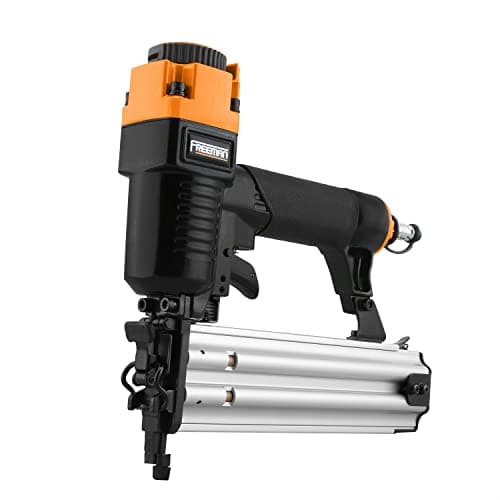
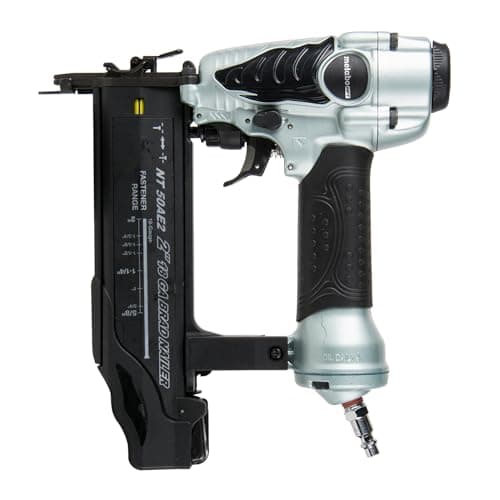
For woodworking, the nail gun to buy first is an 18-gauge brad nailer, and the one to buy is the Metabo HPT NT50AE2. It is for anyone building furniture, cabinets, boxes and jigs, where the nail holds the joint while the glue cures and the hole has to disappear under a finish. Metabo HPT publishes 2.2 lb, a 100-brad magazine, 5/8 to 2 in. brads and a 70-120 psi range — and the weight is the specification that matters, because your other hand is holding the joint in register. The budget pick is the Freeman PBR50Q, the cheapest nailer here and the only one that drives a 3/8 in. brad, with a seven-year limited warranty attached to it.
If you are nailing door casing and baseboard rather than furniture, you want a heavier gauge and the answer changes to the Metabo HPT NT65MA4. If you own no compressor and do not want one, it changes to the DEWALT DCN680B. Prices beside each pick come from our live price layer rather than from this article, last checked November 23, 2026.
Gauge is the whole decision
Nail gauge is the thickness of the nail, and it runs backwards: a higher number is a thinner nail. That one number decides how much the nail holds, how big a hole it leaves and whether the hole needs filling. Everything else — brand, cordless or pneumatic, magazine capacity — is secondary, and getting the gauge wrong is the mistake that makes people buy a second nailer within a year.
18 gauge (brad nails) is the woodworking gauge. The nail is thin enough that the hole closes up under a coat of finish and often needs no filler at all, and it is strong enough to hold a mitre or a face frame while the glue does the real work. It will not hold a joint on its own, and that is fine, because in furniture the glue is the joint. This is the nailer to buy first and the one most woodworkers never need to supplement.
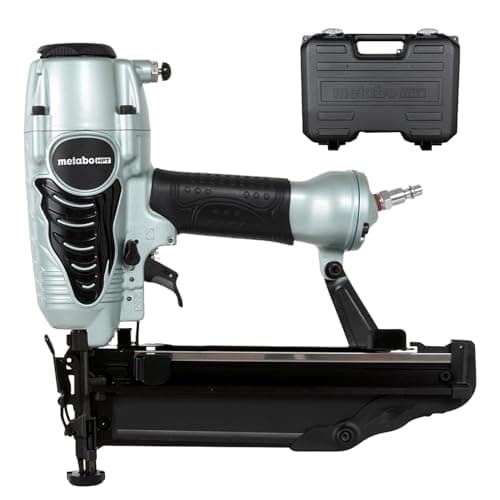
16 gauge (finish nails) is the first nail that holds a joint without glue. Metabo HPT publishes 1 to 2-1/2 in. for the NT65M2S at 3.7 lb, which is half a pound lighter than the 15-gauge tool and noticeably easier to place accurately. This is the nailer for face frames that will carry weight, for shop fixtures, and for trim where the hole will be painted.
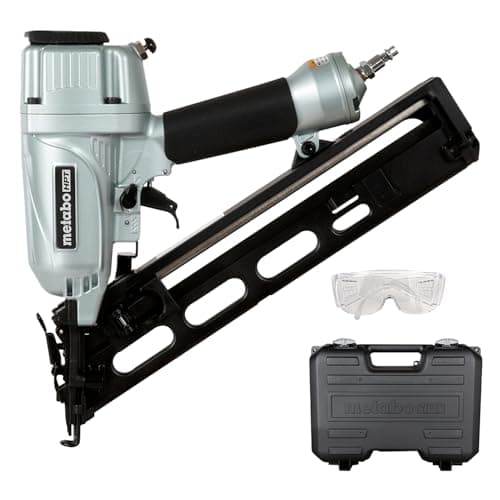
15 gauge (angled finish nails) is a trim gauge rather than a furniture gauge. The nail is appreciably thicker than a 16, and the 34-degree angled magazine on the NT65MA4 is the reason the gauge exists: it reaches into an inside corner where a straight magazine fouls on the adjacent wall. Metabo HPT publishes 1-1/4 to 2-1/2 in., a 100-nail capacity and 4.2 lb. The cost is the hole, which is too big to vanish under a clear finish.
There are heavier gauges — framing nailers at 0.113 in. and up — and they have no place in a furniture shop. If you are reading a woodworking site, 18 gauge is your answer and 16 gauge is your second tool.
Pneumatic or cordless: an honest accounting
Three of the nailers here run on air and one runs on a battery, and the comparison is not the one the sticker price suggests.
A pneumatic nailer is the cheaper tool and the more expensive system. The NT50AE2 and the Freeman both cost less than a decent chisel set, but the honest price is the nailer plus a compressor, plus a hose, plus somewhere to keep both. If the compressor would exist only to feed the nailer, the cordless tool is genuinely the cheaper answer. If you already run air for other reasons, it is not close — buy the pneumatic.
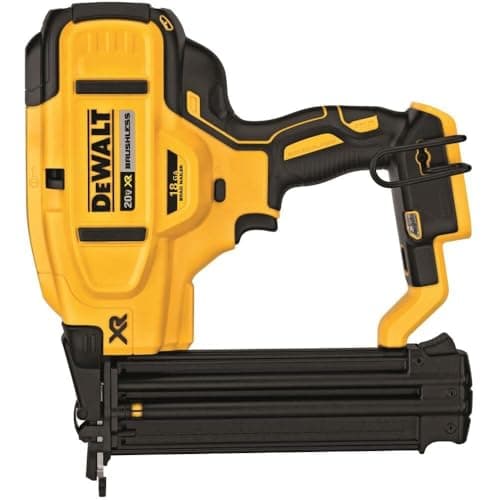
The DEWALT DCN680Bis the cordless route: 18 gauge, 5/8 to 2-1/8 in., a brushless 20 V MAX motor, tool-free depth adjustment and jam release, and a low-nail lockout that stops the dry-fire that dents the last piece of a project. It is sold bare, so a battery and charger are extra unless you already run the platform, and DEWALT publishes no weight for it — retailer listings put it around 5.3 lb, which is a lot of nailer compared with 2.2 lb of Metabo HPT.
If you do go pneumatic, the compressor matters more than the nailer. A brad nailer is a low-consumption tool, but a 15-gauge finish nailer is not: Metabo HPT publishes 0.045 cu. ft. per cycle at 100 psi for the NT65MA4, which is roughly double a brad nailer and more than the smallest quiet one-gallon compressors can sustain. Our air compressor roundup is where that side of the purchase sits, and quiet matters more than CFM in a garage shop.
The safety thing nobody puts in the spec table
Every tool here has a selective actuation switch, which means it can fire sequentially — nose down, then trigger — or on contact, where holding the trigger fires a nail every time the nose touches something. Contact or bump firing is faster and it is the trigger mode that OSHA and NIOSH associate with unintended discharges, because the thing the nose touches is sometimes a hand.
In a furniture shop there is almost never a reason to bump fire. Set the tool to sequential, leave it there, and keep your spare hand well behind the nose — particularly on the BOSTITCH-style low-travel noses that are ready to fire with the tip barely in contact. That is the single most useful sentence on this page and it costs nothing.
Side by side, as published
| Nailer | Gauge and range | Power | Published weight | Warranty |
|---|
| Metabo HPT NT50AE2 | 18 ga., 5/8-2 in. | Pneumatic, 70-120 psi | 2.2 lb | 5 years limited |
| Freeman PBR50Q | 18 ga., 3/8-2 in. | Pneumatic, 60-100 psi | Not published | 7 years limited |
| DEWALT DCN680B | 18 ga., 5/8-2-1/8 in. | 20 V MAX brushless (bare tool) | Not published | Per DEWALT cordless terms |
| Metabo HPT NT65M2S | 16 ga., 1-2-1/2 in. | Pneumatic (psi not published) | 3.7 lb | 5 years limited |
| Metabo HPT NT65MA4 | 15 ga., 1-1/4-2-1/2 in., 34 deg. | Pneumatic, 70-120 psi | 4.2 lb | 5 years limited |
Every figure above is the manufacturer's own published number for the exact model we link. The blanks are real: Freeman publishes no tool weight, which is the specification that most affects how a brad nailer handles, and DEWALT publishes neither a weight nor a magazine capacity for the DCN680B. We did not weigh a tool or measure air consumption — there is no lab here, which the methodology page says plainly.
What to buy, in order
One nailer, furniture and cabinets, compressor already in the shop: the Metabo HPT NT50AE2. The same job on the tightest budget, or in 1/4 in. stock where a 3/8 in. brad is the only nail that fits: the Freeman PBR50Q. No compressor and no desire for one: the DEWALT DCN680B, and price the battery before you compare it to anything. A second nailer for face frames and shop fixtures that must hold without glue: the NT65M2S in 16 gauge. Door casing and baseboard for a living: the NT65MA4, every time.
Our brad nailer roundup ranks the 18-gauge field in more depth, best finish nailer does the same for 15 and 16 gauge, and brad nailer vs finish nailer is the page to read if the gauge question is still the thing you are stuck on.