A bandsaw is the only machine in a small shop that cuts curves, resaws a board into two thinner boards, and does both without the kickback risk that makes a table saw frightening. It is also the machine whose price is most directly explained by one thing: how much steel or cast iron is in the frame.
Here is the mechanism. A bandsaw blade is a thin loop under tension, and tension tries to pull the two wheels together — which means it tries to bend the frame. A light frame flexes a little, tension drops, and the blade wanders in the cut. That is the entire story behind "cheap bandsaws will not cut straight". It is not the motor and it is not the blade guides; it is the frame giving up under the tension a wide resaw blade needs.
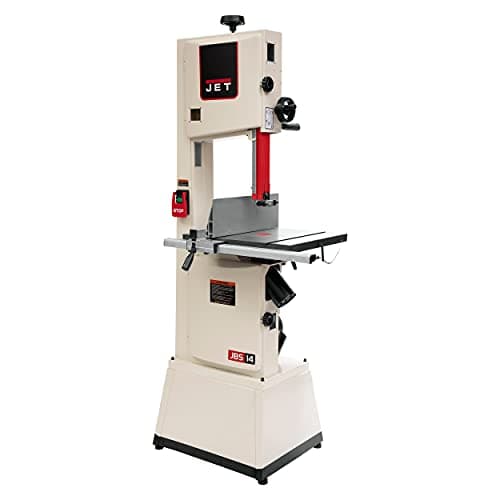
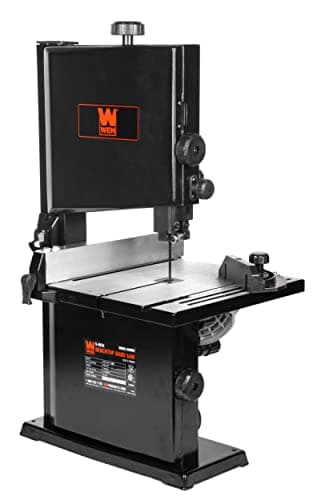
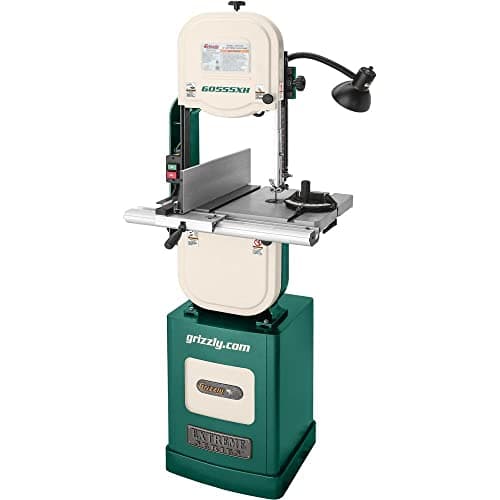
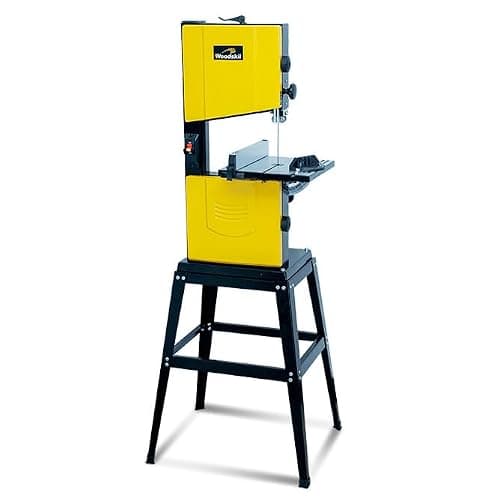
Which is why this roundup splits cleanly into two groups rather than five gradations. The 9- and 10-inch benchtop saws — the WEN BA3959 and the Woodskil — are curve-cutting machines. They handle thin stock, small parts, template work and jig-making beautifully, and they are the right answer for a shop that wants a bandsaw for shapes. The 14-inch machines — the JET JWBS-14SFX and the Grizzly G0555XH — are resaw machines. They have the frame to hold a 3/4-inch blade at real tension, and they will slice a 6-inch board into book-matched panels.
There is very little worth buying between those two groups. A 12-inch saw with a light frame gives you the footprint of the big saw and the capability of the small one. If your budget lands in the middle, buy the good small saw and save, rather than the compromised medium one.
Two things to budget alongside the saw. First, a better blade — the stock blade on virtually every saw at every price is a starter, and a good 3/8-inch blade for curves plus a wide resaw blade will improve your cuts more than any saw upgrade in the same money. Second, dust: a bandsaw throws fine dust downward into the lower wheel housing, and it needs a port connected to a collector or you will find sawdust in the cabinet for years.
What the numbers on a bandsaw actually mean
Throat depth (the "10-inch" or "14-inch" number)
This is the distance from the blade to the frame — the widest piece you can swing past the column. A 14-inch saw takes a 14-inch-wide workpiece. It is the number in the name and, for most woodworking, the least important of the three.
Resaw height
The distance from the table to the upper guides at full height — the tallest board you can stand on edge and cut through. This is the spec that decides whether a bandsaw can make thin stock from thick, which is one of the few things a bandsaw does that nothing else in a small shop can. Benchtop saws offer a few inches; 14-inch saws offer six or more, sometimes extended further with a riser block.
Motor power, in context
Power matters only for resawing. Cutting curves in 3/4-inch stock asks very little of a motor. Pushing a 3/4-inch blade through 6 inches of hard maple asks a great deal, and this is where a 1-3/4 HP machine pulls away from a 3.5-amp one. If you will never resaw, do not pay for the motor.
Blades: the upgrade that is not the saw
Blade choice changes a bandsaw's behavior more than any accessory. Narrow blades (1/8 to 1/4 inch) turn tight curves; wide blades (1/2 to 3/4 inch) track straight and resaw. Below about a 1/4-inch radius even the narrowest bandsaw blade binds, and the job belongs on a scroll saw instead. Fewer teeth per inch clear chips better in thick stock; more teeth leave a smoother cut in thin stock. A practical starting kit for a 14-inch saw is a 3/8-inch general-purpose blade and a 1/2- or 3/4-inch resaw blade; for a benchtop saw, a 1/4-inch blade covers nearly everything you will ask of it.
Tension and drift, briefly
Every bandsaw has a "drift angle" — the direction the blade actually wants to cut, which is rarely exactly parallel to the mitre slot. The fix is not force; it is to set the fence to the drift angle, or to resaw against a single-point fence that lets you steer. Learning this takes one afternoon and turns a frustrating saw into an accurate one.
By shop and budget
Curves, small parts, jigs and templates: the Woodskil 10-inch with a stand, or the BA3959 if bench space is all you have. You want to resaw and you have the floor: the JET JWBS-14SFX is the classic answer and the one most furniture shops end up owning. Resaw height is the whole reason you are buying: the Grizzly G0555XH, which is built and sold around exactly that.
What we could not verify
We have not cut test stock on these four saws. Throat depths, motor ratings, amperages and frame materials above are the manufacturers' published specifications. The frame-flex reasoning is a mechanical argument from those published specs, not a measurement we took.
What a bandsaw is not, and what it feeds
A bandsaw cuts from an edge inward and cannot begin a cut inside an uncut panel, because the blade is a welded loop with no free end to thread through a hole. If the shapes you want are enclosed, read bandsaw vs scroll saw before you buy either machine.
It is also the machine that feeds a lathe: a bandsaw is how a square blank becomes round enough to mount safely, and how a log becomes a bowl blank at all. The best wood lathes are ranked separately, and a bandsaw is the usual prerequisite rather than an accessory to them.