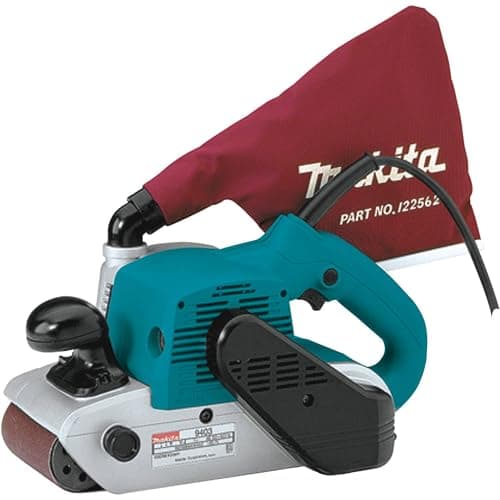
A belt sander is a stock-removal tool that happens to use sandpaper, and it should be bought and used as one. A continuous abrasive loop running at somewhere between 800 and 1,600 feet per minute takes wood off faster than any other handheld sander by a wide margin. That is the whole appeal. It is also why the belt sander has the worst reputation of any tool on this site: pointed at a finished surface it leaves gouges, dips and cross-grain scratches that take an hour with a random orbital sander to undo.
So the first question is not which belt sander, but whether you need one. If you own a benchtop planerand a jointer, most of what a belt sander does is already done better by the machines. If you do not — a first shop, a garage with a workbench and a circular saw — the belt sander is the cheapest way to flatten a glued-up top, level a proud joint, scribe a cabinet to a wall or clean up rough lumber, and it earns its place. That is the reader this page is written for.
What we ranked these on
Belt width. The two handheld sizes that matter are 3 x 21 in. and 4 x 24 in. The extra inch is not about power; it is about bridging. A 4 in. belt on a heavy body spans the low spots on a wide panel and takes down the high ones, which is how a belt sander flattens. A 3 in. belt on a light body tends to follow the surface, so it is better on edges, ends and small parts and worse on a tabletop.
Speed control. A single-speed sander runs flat out, and flat out is right for rough stock and wrong for veneered plywood, a thin edge or anything you care about. A variable-speed dial is the difference between a tool you use on hardwood only and one you use on the whole project. Two of the five below have one; one of them also has an auto mode that idles the belt until it touches wood.
Tracking and flatness.A belt that wanders off the rollers grinds the housing or the workpiece, and a platen that is not flat cannot sand flat. Every sander here has a tracking knob; the difference is how often you need to touch it and how well the tool stays put once set. Mass helps — the heaviest tool here is also the one that stays flattest.
Dust and noise.Belt sanders make coarse dust in volume and they are loud. A dust bag catches the heavy fraction; a vacuum port catches most of the rest. Only two makers here publish a noise figure, and the gap between them — 84 dB and 87 dB — is audible across an afternoon. Where a figure is not published we say so rather than guess.
Prices below are pulled live from Amazon and stamped with the date, so the number you see is today's and not one we typed in months ago. The field runs from well under fifty dollars for a light single-speed tool to a few hundred for the 4 x 24 in. Makita, with the benchtop belt-and-disc machine sitting, surprisingly, near the bottom of that range.
Handheld or benchtop?
They look like the same tool turned over, and they are not. A handheld sander goes to the work: panels, doors, anything assembled or too big to lift. A benchtop belt-and-disc sander stays put and the work comes to it: end grain, small parts, mitered ends, chamfers, anything you would otherwise clamp down and chase around with a handheld. For a small shop building boxes and furniture parts, the benchtop machine is used more often; for anyone flattening tops or fitting cabinets, the handheld is the one that matters. Both are on this page, and the benchtop machine is cheaper than most of the handhelds.
The short answer
| # | Product | Best for | Score | Price |
|---|
| 01 | Makita 9403 4 x 24 in. Belt SanderThe belt sander cabinetmakers keep for thirty years. A 4 x 24 in. belt on an 11 A motor at 1,640 ft/min flattens a glued-up panel in minutes, and Makita publishes 84 dB — quiet enough that you notice the silence when you switch to anything else. | Best overall | | $391.77·Amazon |
| 02 | | Best value | | $149.00·Amazon |
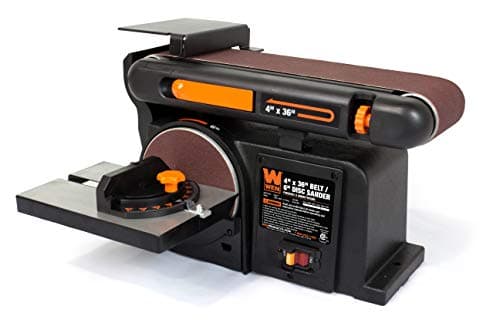
| 03 | WEN 6502T 4 x 36 in. Belt and 6 in. Disc SanderThe benchtop machine, and the one most small shops should actually buy. A 4 x 36 in. belt that tilts from horizontal to vertical, a 6 in. disc with a miter gauge, and a cast-iron base — for less than a mid-price handheld sander. | Best benchtop | | $110.00·Amazon |
| 04 | | Best cordless | | $229.00·Amazon |
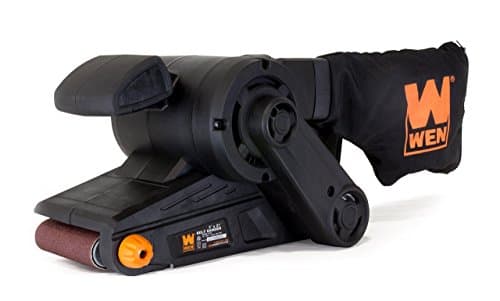
| 05 | WEN 6321 7 A 3 x 21 in. Belt SanderThe cheapest way to find out whether you need a belt sander at all. Six pounds, a 7 A motor, 820 ft/min, a lock-on switch and a dust bag, at a price that makes it the tool you are not afraid to use on rough lumber. | Budget pick | | $38.79·Amazon |
#ad · Live prices from the Amazon Product API, as of Sep 20, 2026. Where we have no verified live price, we show none — we would rather leave a gap than print a number that has rotted.
In detail
Best overall
Makita 9403 4 x 24 in. Belt Sander
4 x 24 in. belt11 A, 1,640 ft/min84 dB published12.6 lb
The belt sander cabinetmakers keep for thirty years. A 4 x 24 in. belt on an 11 A motor at 1,640 ft/min flattens a glued-up panel in minutes, and Makita publishes 84 dB — quiet enough that you notice the silence when you switch to anything else.
- Flattening power
- 10
- Control and tracking
- 8
- Dust and noise
- 9
- Build
- 10
- Value
- 7
Pros
- +A 4 in. belt bridges the high spots on a wide panel where a 3 in. belt digs a trough — this is the one to own if you glue up tabletops
- +1,640 ft/min is the fastest belt here, and with electronic speed control it holds that under load instead of bogging
- +Makita publishes 84 dB and calls it the quietest in its class; the field runs around 87 dB and up, which is a real difference over an afternoon
- +Labyrinth-sealed motor and bearings, and a 360-degree swiveling dust bag that stays out of your wrist
- +Sands flush on one side, so it reaches to the edge of an assembled carcase
Cons
- −Single speed — 1,640 ft/min is a lot of belt on veneered plywood or a thin edge, and there is no dial to tame it
- −12.6 lb is the heaviest handheld here; that mass is the point on a panel and a liability on anything vertical
- −The most expensive handheld on the page, by a wide margin over the 3 x 21 in. field
- −4 x 24 in. belts cost more per belt and come in fewer grits at the hardware store than 3 x 21 in.
Don't buy this if…
…your work is mostly edges, small parts or the occasional door — a 3 x 21 in. sander does that for a third of the money and half the weight.
Best value
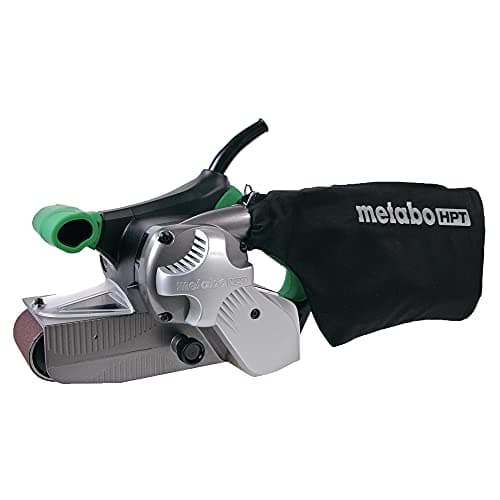
Metabo HPT SB8V2 3 x 21 in. Variable-Speed Belt Sander
3 x 21 in. belt9 A, 820-1,475 ft/min9.5 lb5-year limited warranty
The 3 x 21 in. sander with a real speed dial and a real warranty. 820 to 1,475 ft/min on a 9 A motor covers everything from softwood stock removal to a light pass on veneer, and Metabo HPT backs it for five years.
- Flattening power
- 7
- Control and tracking
- 9
- Dust and noise
- 7
- Build
- 8
- Value
- 9
Pros
- +Variable speed is the feature that makes a belt sander safe on thin material — dial down to 820 ft/min and it stops eating through veneer
- +9 A is more motor than most 3 x 21 in. sanders carry, and it shows when you lean on it in hardwood
- +9.5 lb is light enough to run on a vertical face or an edge without your shoulder giving out first
- +Left-side dust bag keeps the housing flush on the right, so it sands into an inside corner
- +Five-year limited warranty — the longest on the page
Cons
- −Metabo HPT publishes 87 dB, which is louder than the Makita and enough to make hearing protection mandatory
- −A 3 in. belt will follow the shape of a wide panel rather than bridge it — this is not a flattening tool
- −Belt tracking needs an occasional check; the knob is there, but it is not self-tracking
- −Cord length is not published, and a trigger lock-on is the kind of feature you want to read the manual about before you use it
Don't buy this if…
…you need to flatten glued-up panels. The 4 in. belt on the Makita bridges high spots this sander will follow.
Best benchtop
WEN 6502T 4 x 36 in. Belt and 6 in. Disc Sander
4 x 36 in. belt + 6 in. disc4.3 A, disc to 3,600 RPMBelt tilts 0-90 degCast-iron base
The benchtop machine, and the one most small shops should actually buy. A 4 x 36 in. belt that tilts from horizontal to vertical, a 6 in. disc with a miter gauge, and a cast-iron base — for less than a mid-price handheld sander.
- Flattening power
- 5
- Control and tracking
- 9
- Dust and noise
- 8
- Build
- 7
- Value
- 10
Pros
- +You bring the work to the machine, which is the right way round for small parts, end grain and anything you would otherwise clamp and chase with a handheld
- +The disc with the included miter gauge trues an end square or to an angle far faster than a block plane, and the belt tilted vertical does long edges
- +Cast-iron base damps the vibration that makes cheap benchtop sanders walk across the bench
- +2-1/4 in. dust port fits a shop vac hose with an adapter — and a stationary sander is the one sanding tool you can actually connect
- +Cheaper than every handheld here except the WEN 6321
Cons
- −WEN publishes no belt speed and no weight for it, so we cannot compare it on either figure and neither can you
- −4.3 A is a small motor — lean on the disc and it slows; this is a finesse machine, not a stock-removal one
- −It takes a permanent piece of bench, and it cannot follow you to the workpiece
- −The disc runs at one speed and it is fast; a light touch is mandatory or end grain scorches
- −Two-year warranty against five on both Metabo HPT tools
Don't buy this if…
…you need to sand something you cannot lift — a tabletop, a door, a built-in. A benchtop sander only works on parts that come to it.
Best cordless
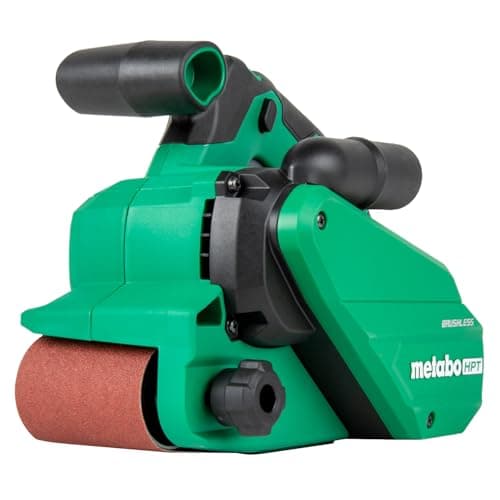
Metabo HPT SB3608DAQ4 36V MultiVolt Cordless 3 x 21 in. Belt Sander (Tool Only)
3 x 21 in. belt36V MultiVolt, brushless400-1,475 ft/min, 5 speeds + auto7.7 lb tool only
The cordless belt sander for people who already own the batteries. A brushless motor with five speeds plus an auto mode that slows the belt until it loads, 400 to 1,475 ft/min, and 7.7 lb before the pack goes on.
- Flattening power
- 6
- Control and tracking
- 10
- Dust and noise
- 7
- Build
- 8
- Value
- 6
Pros
- +400 ft/min at the bottom of the range is the slowest belt on the page — slow enough to ease an edge on plywood without going through the face veneer
- +Auto mode idles the belt until it meets the work, which stretches a pack and cuts the noise between passes
- +No cord to snag on a panel edge, which is the thing that ruins more belt-sanded surfaces than any spec on the sheet
- +Left-side dust bag and an included elbow adapter for a vacuum hose
- +Five-year tool-body warranty, the same as the corded SB8V2
Cons
- −Tool body only — no battery, no charger, and MultiVolt packs are not cheap; unless you already own them this is the most expensive sander here by a distance
- −Metabo HPT publishes no noise figure, so we cannot compare it to the 84 dB and 87 dB corded tools
- −A 36V pack adds real weight to a 7.7 lb body; the corded SB8V2 is the lighter tool in the hand
- −Belt sanding is a high-draw job and a battery is a finite one — flattening a panel is still a corded task
Don't buy this if…
…you are not already on the Metabo HPT MultiVolt platform. Buying a battery and charger to run one sander is the wrong order of operations.
Budget pick
WEN 6321 7 A 3 x 21 in. Belt Sander
3 x 21 in. belt7 A, 820 ft/min6 lb2-year warranty
The cheapest way to find out whether you need a belt sander at all. Six pounds, a 7 A motor, 820 ft/min, a lock-on switch and a dust bag, at a price that makes it the tool you are not afraid to use on rough lumber.
- Flattening power
- 5
- Control and tracking
- 6
- Dust and noise
- 6
- Build
- 6
- Value
- 9
Pros
- +Six pounds — light enough for one-handed edge work and long vertical runs that would exhaust you with the Makita
- +820 ft/min is a slow belt by handheld standards, which on a budget tool is a feature: it is harder to do damage with
- +Front roller sits proud of the housing, so it sands into an inside corner from the nose
- +Lock-on switch, tracking knob and a detachable dust bag are all present at a price where they often are not
- +Costs about what a box of good belts costs
Cons
- −Single speed and the slowest here — stock removal on a wide hardwood panel takes noticeably longer than on the 4 x 24 in. Makita
- −Six pounds also means it has no mass to hold it flat; it wants to tip and gouge if you lift the tail
- −WEN publishes no noise figure, and a budget 7 A universal motor is not a quiet one
- −Tracking drifts more than on the pricier tools, so expect to touch the knob between belts
- −Two-year warranty against five on the Metabo HPT tools
Don't buy this if…
…you will use it every week. Weekly stock removal is what the 9 A and 11 A motors here are for, and the price gap closes fast against the SB8V2.
How to use a belt sander without ruining the work
Start it off the wood, land it moving
A belt sander that starts in contact with the surface digs in at the tail before the belt is up to speed. Start it in the air, land it flat with the tool already moving forward, and lift it while it is still moving. Every dip you have ever seen in a belt-sanded panel was a sander that stopped moving while it was still cutting.
Keep it flat and keep it moving
Both hands, tool flat on its platen, and a steady overlapping pass pattern with the grain. Do not press: the weight of the sander is the cutting pressure, and adding your own just stalls the belt and burnishes the wood. Tipping the tool onto its nose or tail to “get a spot” is how a spot becomes a hollow. If a spot needs getting, the answer is a coarser belt or a hand plane, not more angle.
Cross-grain, then with the grain
On a glued-up panel with joints standing proud, a first pass at a shallow angle across the grain levels the joints fast. It also leaves cross-grain scratches, so it is always followed by passes straight with the grain at the same grit before you move up. Stop the belt sander at 100 or 120 grit; finer belts polish rather than cut and the random orbital does that job properly.
Belts, and the two grits you actually need
Most belt sanding is done with 80 grit. Add a 50 or 60 for rough lumber and glue lines, and a 120 to leave a surface the random orbital can pick up from. Belts are a consumable: a loaded, glazed belt burns wood instead of cutting it, and a crepe cleaning block gets a surprising amount of life back. Check that the belt's direction arrow matches the arrow on the tool — a spliced belt run backwards peels at the seam.
The benchtop machine, and what it is for
A 4 x 36 in. belt-and-disc sander is the most-used sanding tool in a lot of small shops, and it costs less than a good handheld. The disc, with its miter gauge, trues an end square or to a stated angle in seconds — the same job a miter saw cuts and a shooting board finishes. The belt, flat, does small parts; tilted vertical, it does long edges against the table. Neither is a substitute for a spindle sander on an inside curve or a drum sander on a wide panel, but for everything in between it is the machine you walk to first.
Dust: the honest position
A handheld belt sander throws coarse dust in every direction and its bag catches the heaviest part of it. That is better than nothing and it is not dust collection. Empty the bag before it is half full or it stops working; where the tool has a vacuum adapter, a shop vacon the port is the real answer. The benchtop machine is the exception — it stays put, so its 2-1/4 in. port can stay connected, which is the strongest practical argument for it. Wear a respirator either way, and hearing protection always: nothing on this page is quiet, and the one maker that publishes 84 dB calls that the quietest in its class.
What we rejected, and why
Every listing on this page returned “In Stock” with a price when we probed Amazon on 20 September 2026. Three well-known sanders were checked and left off for availability rather than quality: the Makita 9903 3 x 21 in. variable-speed sander was down to two units with no price, the DEWALT DCW220B cordless was down to two, and the JET J-41002 2 x 42 in. belt-and-disc machine was down to one. The RIKON 50-112 benchtop sander returned nothing but replacement drive belts. We do not rank a tool you cannot buy today; if that changes, the list changes.
What we could not verify
We have not run these five sanders through identical test passes. Belt sizes, amperage, belt speeds, noise figures, weights and warranties are the manufacturers' own published numbers, linked in Sources below. WEN publishes neither a belt speed nor a weight for the 6502T and neither WEN nor Metabo HPT publishes a noise figure for the 6321 or the cordless SB3608DAQ4; where a figure is missing we say so rather than fill it in. The advice about technique, belt grits and handheld versus benchtop is how the tools work, not something we measured.
How we picked
We do not run a testing lab
We researched published manufacturer specifications, manuals and spec sheets, ran the arithmetic those specs support, and read owner reviews at volume, then scored each tool against a published rubric. The scores are judgments from documented research — they are not measurements we took, because we do not have a lab and we are not going to pretend we do. Where a number came from a manufacturer's document, we name it and link it in Sources.
Questions
Is a belt sander or a random orbital sander better for woodworking?+
They do different jobs. A belt sander removes stock — flattening, leveling joints, cleaning rough lumber — and leaves a surface that needs more work. A random orbital sander finishes: it takes a flat surface through the grits to the point where finish goes on. If you can only own one, own the
random orbital; you will use it on every project. Buy the belt sander when you have panels to flatten and no planer to do it.
3 x 21 or 4 x 24 — which belt size should I buy?+
4 x 24 in. for flattening wide panels and tabletops: the wider belt and the heavier body bridge the low spots instead of following them. 3 x 21 in. for edges, ends, doors, small parts and anything vertical, where the lighter tool is easier to control and half the price. Most home shops that buy one belt sander are better served by a variable-speed 3 x 21 in. and a benchtop belt-and-disc machine than by a 4 x 24 in. alone.
Can I flatten a tabletop with a belt sander?+
Yes, and it is the classic use of one, but only with a wide belt and a flat platen. Level the proud joints first with diagonal passes at 60 or 80 grit, then sand straight with the grain at the same grit, checking with a straightedge as you go. Stop at 100 or 120 and hand the surface to a random orbital. If the top is more than very slightly out of flat, a
planer or a hand plane will get there faster with less risk.
Why does my belt sander leave gouges and dips?+
Almost always one of three things: the tool stopped moving while it was still cutting, it was tipped onto its nose or tail to reach a spot, or it was started while already in contact with the surface. Land it moving, keep it flat, keep it moving, and let its own weight do the cutting. A belt that is loaded with dust or glazed will also burn and skate rather than cut evenly — clean or replace it.
Do I need variable speed on a belt sander?+
For hardwood stock removal, no. For anything thin, veneered or delicate, yes — a belt at full speed goes through a face veneer in a single pass. The variable-speed tools on this page cost little more than the single-speed ones, and the speed dial is the feature that turns a rough-lumber tool into one you can use on the whole project.
Is a benchtop belt and disc sander worth it for a small shop?+
For furniture parts, boxes and anything with mitered or squared ends, it is often the most-used sanding tool in the shop, and the machine on this page costs less than most of the handhelds. It cannot sand anything you cannot lift onto it, so it does not replace a handheld for tops, doors and cabinets — it complements one.
Receipts
- Makita — 9403 4 in. x 24 in. belt sander specifications (11 A, 1,640 ft/min, 84 dB, 12.6 lb), as reproduced by an authorized dealer
- Makita USA — 9403 product page
- Metabo HPT — SB8V2 3 in. x 21 in. variable-speed belt sander specifications (9.0 A, 820-1,475 ft/min, 9.5 lb, 87 dB, 5-year warranty)
- Metabo HPT — SB3608DAQ4 36V MultiVolt cordless belt sander specifications (400-1,475 ft/min, 5 speeds + auto, 7.7 lb tool only)
- WEN — 6502T 4.3 A 4 in. x 36 in. belt and 6 in. disc sander with cast-iron base (disc to 3,600 RPM, 0-90 degree belt tilt, 2-1/4 in. port, 2-year warranty)
- WEN — 6321 7 A 3 in. x 21 in. belt sander (820 ft/min, 6 lb, 2-year warranty)
We do not run a testing lab, and we do not pretend to. Our picks come from published manufacturer specifications and manuals, the arithmetic those specs support, and owner reviews read at volume. Where we could not verify something, we say so on the page rather than quietly leaving it out. Read our full method.