Franklin International's published guidance for its wood glues is to clamp an unstressed joint for thirty minutes to an hour, to clamp a stressed joint for a full 24 hours, and not to stress any new joint for at least 24 hours. That is the manufacturer's own answer, it is linked in Sources, and it is the one to go by.
The reason the question keeps coming up is that three different numbers all get called "drying time", and they mean completely different things. Separating them is the whole of this page.
The three numbers, in the order you meet them
1. Open assembly time — how long you have to work
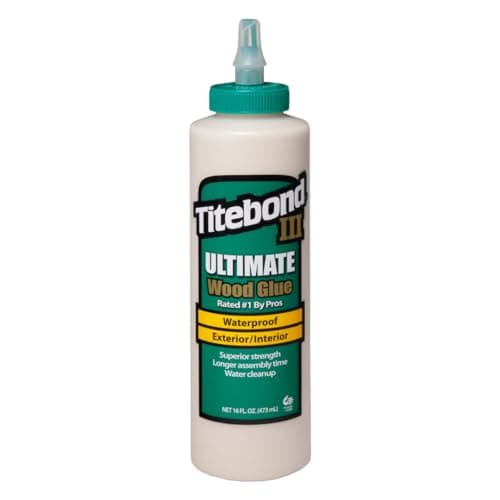
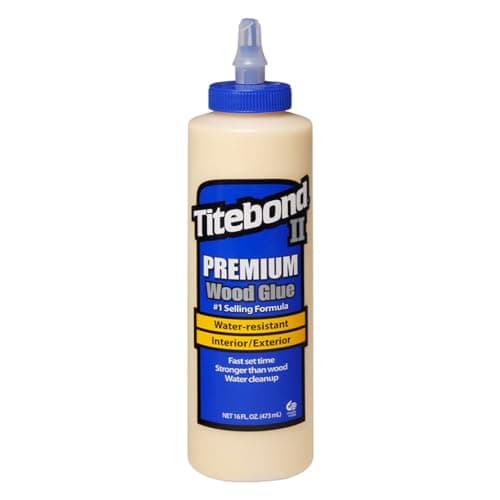
From the moment glue hits the wood until it has skinned enough that a fresh bond will not form. Franklin publishes 3–5 minutes for Titebond II and 8–10 minutesfor Titebond III, both at 70°F and 50% relative humidity. Total assembly time — spread, assemble and get clamps on — is published as 10–15 minutes and 20–25 minutes respectively.
This is the number that catches people out on a big glue-up. A fourteen-strip panel takes longer to spread than five minutes, and a joint closed after the glue has skinned is weak no matter how long you then leave the clamps on.
2. Clamp time — how long the clamps stay on
Long enough for the glue to hold the parts in place by itself. That is the thirty minutes to an hour for an unstressed joint, and the full 24 hours when the joint is under load while it cures — a bent lamination, a spring-loaded joint, anything the clamps are fighting.
3. Cure time — how long until full strength
Longer than either. Franklin's guidance is not to stress a new joint for at least 24 hours, and to allow 24 hours before machining a water-based glue line in high-moisture wood. Taking the clamps off at an hour is fine; putting the piece into service at an hour is not.
What actually changes these numbers in your shop
- Temperature.Cold slows everything, and below a glue's published minimum application temperature the bond itself is compromised — Franklin lists above 47°F for Titebond III and above 55°F for Titebond II. An unheated garage in winter is the most common cause of a mystery joint failure.
- Humidity. PVA cures largely by losing water into the wood and the air. A humid day lengthens everything; a dry, warm one shortens the open time most of all.
- Wood moisture content. Wet stock cannot absorb the water in the glue, so the joint stays soft for much longer.
- Joint type. End grain soaks glue away from the joint line and wants a sizing coat first; long grain to long grain is the easy case every published number assumes.
- Clamping pressure.Franklin publishes 100–150 psi for softwoods, 125–175 for medium woods and 175–250 psi for hardwoods. Firm and even, with a thin continuous bead of squeeze-out — not a flood, which means you have starved the joint.
A practical schedule
For a normal, well-fitted joint in a warm shop:
- Clamps on withinthe published total assembly time — 10–15 minutes for Titebond II, 20–25 for Titebond III.
- Scrape the squeeze-outat around 30–60 minutes, when it is rubbery. Wiping it wet pushes glue into the grain and ruins stain; chiselling it off dry risks tearing the surface.
- Clamps off at one hour if nothing is under load, and the assembly then sits undisturbed.
- Machine, sand or load after 24 hours.
The one exception worth building into your plan: if the next operation is a planer, a jointer or a sander, give it the full 24 hours regardless. A glue line that is not fully cured gums abrasive and loads cutters.
Signs you took the clamps off too early
A joint that creeps open a hair over the following days, a glue line that shows as a shiny ridge after sanding, a panel that goes out of flat on the bench overnight. All three are the same thing: the bond had not developed enough strength to hold against the wood's own movement.
If you are routinely short of clamps and tempted to cycle them early, the honest fix is more clamps rather than more patience — which is the one place in this hobby where buying the cheap version in quantity genuinely works.
What we rank for this
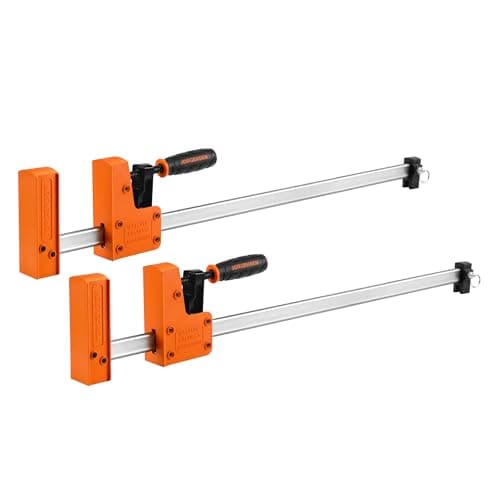
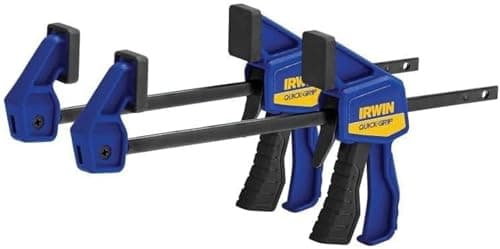
Two glues with published timings you can actually plan around, and two clamps — the parallel clamp that holds a carcase square for the hour, and the trigger clamp that holds everything else while you work.
Published timings side by side
Franklin International's own published figures for the two glues, and the published listing specifications for the two clamps.
| Product | Open assembly | Total assembly | Other published figures |
|---|
| Titebond II Premium (16 oz) | 3–5 min | 10–15 min | ANSI Type II, apply above 55°F |
| Titebond III Ultimate (16 oz) | 8–10 min | 20–25 min | ANSI/HPVA Type I, apply above 47°F |
| Jorgensen Cabinet Master | — | — | Parallel jaws, ~1,000 lb force, 90° self-squaring |
| Irwin Quick-Grip | — | — | One-handed trigger, resin jaws, quick-release |
Open and total assembly times are quoted at 70°F and 50% relative humidity, the conditions Franklin publishes them under.
Why a longer open time is worth paying for
On a single joint, three minutes is plenty. On anything with more than four glue surfaces — a carcase, a panel glue-up, a chair side — the extra five minutes Titebond III gives you is the difference between a calm assembly and a scramble. That is a better reason to buy it for indoor work than the waterproof rating most people buy it for.
The alternative is to work in stages: glue up sub-assemblies, let them cure, then join those. Free, and it beats any glue's open time.
Clamp pressure is about contact, not force
The purpose of a clamp is to hold two surfaces in intimate contact until the glue grabs. Beyond that, more force does nothing good: it squeezes glue out of a well-fitted joint and can rack an assembly out of square and lock it there. Franklin's published pressures — 100–250 psi depending on wood density — are far below what any parallel clamp can generate at full handle torque.
What matters much more is spacing and direction: clamps close enough that pressure overlaps along the joint, and alternated above and below a panel so it does not bow. That technique is in how to glue up a panel, and the clamp choice itself in best clamps for cabinet making.
Hide glue, polyurethane and CA are different animals
Everything above is PVA — the yellow and white glues that do almost all woodworking. Liquid hide glue has a much longer open time and is reversible with heat and moisture, which is why it is the repair and instrument glue. Polyurethane foams as it cures and needs moisture to do it. Cyanoacrylate grabs in seconds and is for small parts and jig-making, not for furniture joints.
If you are choosing between families rather than timings, our wood glue roundup covers them all, and best wood glue for outdoor furniture covers the water-resistance question on its own.
Where these numbers come from
Every timing, temperature and pressure on this page is Franklin International's own published technical data for Titebond II, Titebond III or its general wood-glue FAQ, all linked in Sources. We have not measured bond strength over time; we do not run a lab, and our methodology pagesays so plainly. The clamp specifications are the manufacturers' published listing specifications, and prices come from the live price feed with the date they were pulled.