Skip to content
Dovetail & Dust

HUB 02 · Power Tools

SawStop Alternatives

Nothing here has a blade brake, and we are not going to pretend otherwise. Here is what the alternatives do buy you, and when the honest answer is to save for the SawStop.

By Stephen V.Updated How we research
#ad

We earn a commission when you buy through our Amazon links, at no extra cost to you. It never changes our rankings, and we say so when the cheaper tool is the better buy. How this works.

If you want a SawStop because of the blade brake, no saw on this page is a substitute for it, and we are not going to tell you otherwise. If you want a SawStop because it is a well-built cabinet saw and the price or the footprint does not work in your shop, then the alternatives are real: the DeWalt DWE7491RS is the one to buy for cutting capability, the Bosch GTS15-10 if the saw has to be rolled out and folded away, the Delta 36-6023 if it lives in one spot, the SKIL TS6307 as the budget pick, and the Festool TS 55 if what you actually need is to stop pushing full sheets across a table saw at all.

Prices beside each pick come from our live price layer rather than from this article, last checked November 23, 2026. Table saws move on promotion, so treat the number as the current one and the ranking as the reasoning.

What SawStop is known for, stated plainly

SawStop built its reputation on one thing: a saw that stops when it touches you. The company calls it Active Injury Mitigation, and the way it describes the mechanism is that the saw monitors a small electrical signal carried on the blade. Skin is conductive, so contact changes that signal, and when it changes the system fires an aluminum brake into the blade and drops the blade below the table. SawStop publishes a figure of under 5 milliseconds for that sequence, and about 90 seconds to reset it — you inspect the blade, replace it if it is damaged, and fit a new brake cartridge.

Two things follow from that, and both are fair to SawStop. The first is that it works on a principle nothing else on this page uses, so there is no spec on a DeWalt or a Bosch that competes with it. The second is that the system is built into the saw — the cartridge sits against the blade inside the cabinet, wired to the motor contactor — so it is not something that can be added to a saw that was not designed around it. There is no retrofit. If the brake is the reason you are shopping, the cheapest route to it is SawStop's own smaller machines, the Compact and Jobsite saws, rather than a different brand.

SawStop is also, separately from the brake, a good saw company: cast-iron tops, fences that hold a setting, and dust collection that is better than most of the category. Some of that you can buy elsewhere for much less money. The brake you cannot.

Why people look for an alternative anyway

In our experience of the questions readers actually ask, there are three reasons, and they want different answers.

One: the price. A SawStop cabinet saw is a multiple of a good jobsite saw, and for a shop that cuts a few hundred board feet a year the difference is a jointer, a planer and a dust collector. That is a real trade-off and it deserves a straight answer rather than a lecture.

Two: the shop. Cabinet saws want floor space, a stand that never moves and frequently a 240 V circuit. A saw that has to come out of a corner, get used and go back is a different machine, and our workshop power requirements guide covers which of these run on a standard 15 A household circuit.

Three: safety, but by another route.This is the reader we most want to be useful to, because the honest answer is not "buy this instead". It is that the majority of table-saw injuries involve kickback and the loss of control that follows it, and kickback is addressed by a riving knife, a fence that stays parallel, and not fighting an unsupported sheet. Those are things the saws below either have or can be set up to do, and they cost nothing extra.

The criteria, in the order that matters

1. A riving knife, not a splitter. A riving knife rises, falls and tilts with the blade and sits just behind it, so the kerf cannot close on the back of the blade. That pinch is what launches a workpiece. A fixed splitter bolted to the table only works at one blade height and gets removed within a week. Every corded saw on this page ships with a riving knife; the thing that matters is whether you leave it in, which is mostly a question of whether it comes out and goes back without tools.

2. A fence that stays parallel. A fence that toes in towards the back of the blade traps the offcut between fence and blade, which is the second common path to kickback. Rack-and-pinion fences hold a setting better than single-point-clamp fences, which is most of why the DeWalt leads this page.

3. Rip capacity and support, together.A saw that rips 32 in. is not safer than one that rips 25 in. in itself. What makes it safer is that the cut you were about to make freehand now has a fence behind it. The same logic says an outfeed surface matters more than another inch of rip — see the best saw for cutting plywood for the full version of that argument, because a 60 lb sheet is the single most dangerous thing most home shops put on a table saw.

4. A guard you will actually use. Modular guards that come off for a non-through cut and go back on for a rip get used. Guards that need a wrench get left on the wall.

5. Dust, because fine dust is the injury you do not notice. A table saw throws most of its waste below the blade and a visible plume above it. Our table saw dust collection guide covers the two-port approach, and wood dust health risks sets out why it is worth doing, sourced to IARC, OSHA and NIOSH rather than to us.

The DeWalt DWE7491RS is the capability answer

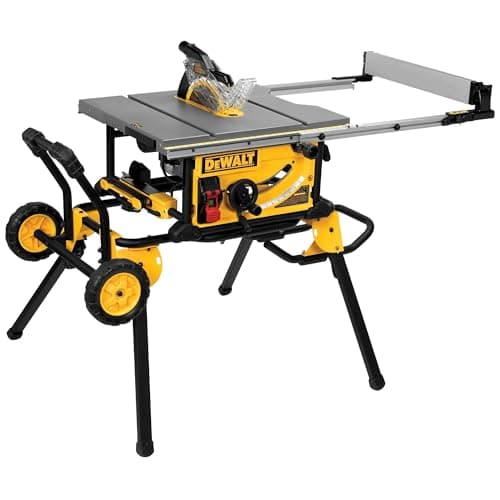
Of the saws we rank, the DWE7491RS gets closest to the feel of a stationary saw without being one. DeWalt publishes a 32-1/2 in. rip capacity on a 15 A motor, and the fence is rack-and-pinion, which in practice means you can set it, check it with a square and trust it for the next twenty cuts. The rolling stand matters more than it sounds: a saw that one person can move is a saw that gets positioned properly for a cut rather than used where it happens to sit.

What you give up against a cabinet saw is not capacity, it is mass and noise. A universal motor is loud and a 90 lb saw vibrates where a 400 lb one does not. For joinery that matters less than people think and for finish cuts it matters more — which is why our table saw roundup ranks this saw first for the same reason and says the same thing.

The Bosch GTS15-10 is the answer for a shared garage

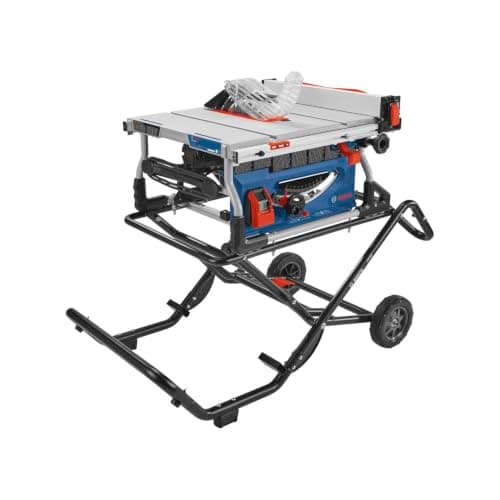
Bosch publishes a 32-1/8 in. rip capacity, a 15 A motor and the Gravity-Rise wheeled stand, and that stand is the entire argument for the saw. One lift deploys it; one lift folds it down and it rolls into a corner. If your shop is also where the car goes, the saw that sets up in one motion is the saw that gets used, and the one that needs ten minutes of clearing is the one that does not.

It costs more than the DeWalt for broadly similar cutting capacity, and once the stand is on it is heavy enough that you roll it rather than carry it. Both of those are real. Neither is a reason to buy the cheaper saw if the garage is shared.

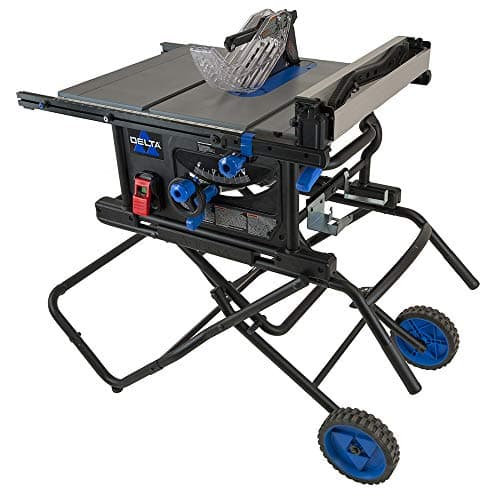
The Delta 36-6023 is the answer when the saw never moves

Delta publishes a 32-1/2 in. rip capacity on a 15 A motor with a stand in the box. The reason it is on this page rather than buried in the roundup is that it is the closest thing here to the contractor-saw layout a SawStop shopper is usually picturing: more mass than a folding jobsite saw, a fence that stays where you put it, and a footprint that assumes a fixed spot on the floor. Mass damps vibration, and vibration is what you feel as a rough cut in hardwood.

It is not designed to be broken down between sessions, and dust collection below the blade is basic. If you need the floor back on Sunday night, buy one of the folding saws instead.

The SKIL TS6307 is the budget pick, and it is an honest one

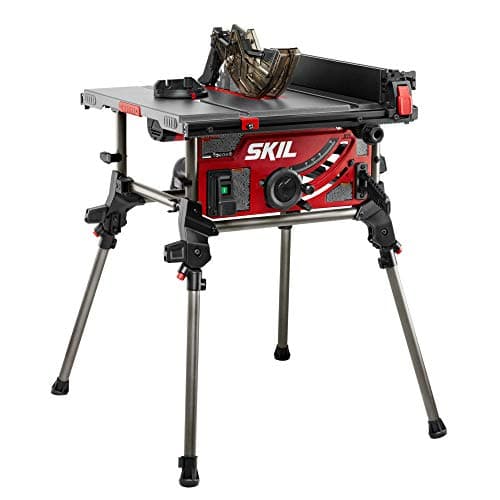
SKIL publishes a 25-1/2 in. rip capacity on a 15 A motor with a folding stand included, at a price that is a fraction of a cabinet saw. For furniture-scale work — case parts, drawer sides, anything you can crosscut to rough length first — 25-1/2 in. is enough, and the money you did not spend buys the dust collection and the sharpening setup that make the rest of the shop work.

The fence is not as refined as the DeWalt's and the rip capacity is the lowest of the corded saws here. If you regularly break down full sheets on your own, this is the wrong saw and the DeWalt earns its premium. Do not buy it as a cheaper SawStop; buy it as a first table saw.

The Festool TS 55 is the alternative that changes the question

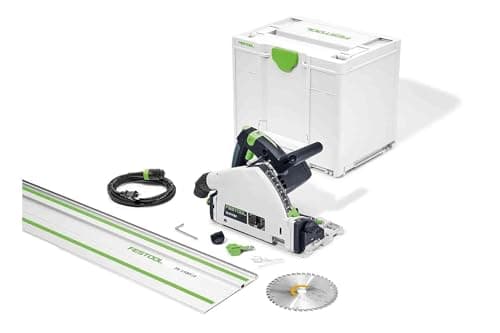
There is one more honest answer to "I want to be safer on a table saw", and it is to do fewer of the dangerous cuts on one. A plunge-cut track saw puts the blade in a housing that only opens when you push it into the cut, the workpiece stays flat on the bench or on foam, and the saw moves rather than the sheet. Festool ships the TS 55 FEQ-F with a 1,400 mm (55 in.) rail, a riving knife and a kickback stop, and the cut quality off the rail is genuinely finish-ready.

It is the most expensive thing on this page and it is not a table saw: there is no comfortable way to cut a 2 in. tenon cheek or a repeat batch of narrow rips with it. The honest configuration for a small shop is a track saw for sheet goods and a modest table saw for everything else, which is the point of table saw vs track saw. If the Festool price is the obstacle, our Festool track saw alternatives page ranks that field on its own.

Side by side, as published

SawPublished ripPublished motorBlade brakeBest for
DeWalt DWE7491RS32-1/2 in.15 ANoMost saw for the money
Bosch GTS15-1032-1/8 in.15 ANoA shared garage
Delta 36-602332-1/2 in.15 ANoA fixed shop spot
SKIL TS630725-1/2 in.15 ANoA first table saw
Festool TS 55 FEQ-FRail-guided, not applicableNot published in A by Festool for this modelNoSheet goods off the saw
SawStop (for reference)Varies by modelVaries by modelYes — Active Injury Mitigation, under 5 ms per SawStop, cartridge replaced after it firesThe brake

Every figure above is the manufacturer's own published number for the exact model we link, or SawStop's own description of its system. We did not measure a brake, time a stop or test a guard — there is no lab here, which the methodology page states plainly. The SawStop row is included so the comparison is complete, not to suggest any saw on this page matches it.

What we would actually do with the money

If the SawStop is affordable and the shop has room, buy the SawStop; nothing below replaces the brake. If it is not, the configuration we would build is the DeWalt DWE7491RS with the riving knife left in, a zero-clearance insert, a pair of push blocks, an outfeed table at table height, and the difference spent on extraction — our small-shop dust collector roundup is where that money goes. Add a track saw before you add a bigger table saw, because the cuts that frighten people are almost always sheet cuts. The push blocks, the insert and the safety gear all sit in the bracket covered by the best woodworking tools under $100.

One more thing worth saying on a page like this: the cheapest safety upgrade in any shop is a sharp, clean blade. A dull blade needs pushing, and pushing is how hands get where they should not be.
The short answer

Quick picks

#ProductBest forScorePrice
01
DeWalt DeWalt DWE7491RS 10-in Jobsite Table Saw
DeWalt DWE7491RS 10-in Jobsite Table Saw

The jobsite table saw home shops keep buying. A big rip capacity, a genuinely good fence and a rolling stand make it the do-everything portable saw.

Best overall table saw
8.4
$699.00Amazon
02
Bosch Bosch GTS15-10 10-in Jobsite Table Saw
Bosch GTS15-10 10-in Jobsite Table Saw

The saw you buy for the stand. The Gravity-Rise wheeled base sets up and folds down in one motion, which is the difference between using a saw in a shared garage and leaving it in the corner.

Best for a shared garage
8.2
$549.00Amazon
03
Delta Delta 36-6023 10-in Table Saw
Delta 36-6023 10-in Table Saw

A contractor-style saw at a jobsite price. More mass than the folding saws, a 32.5-inch published rip capacity, and a fence that stays where you put it.

Best for a fixed shop spot
7.6
$499.99Amazon
04
SKIL SKIL 10-in Jobsite Table Saw (TS6307)
SKIL 10-in Jobsite Table Saw (TS6307)

The value table saw. A surprisingly capable jobsite saw with a foldable stand at a price that makes it the easy budget pick.

Best value table saw
7.6
$279.00Amazon
05
Festool Festool TS 55 FEQ-F Plunge-Cut Track Saw (Plus-FS)
Festool TS 55 FEQ-F Plunge-Cut Track Saw (Plus-FS)

The saw the whole category is measured against. Splinter-free edges straight off the rail, the best dust capture in the class, and a 55-inch rail in the box rather than on the invoice.

Best overall
9.0
$818.00Amazon

#ad · Live prices from the Amazon Product API, as of November 23, 2026. Where we have no verified live price, we show none — we would rather leave a gap than print a number that has rotted.

In detail

The picks, in full

01
DeWalt DeWalt DWE7491RS 10-in Jobsite Table Saw

Best overall table saw

DeWalt DWE7491RS 10-in Jobsite Table Saw

10 in blade32.5 in ripRolling stand15 A
8.4/10

The jobsite table saw home shops keep buying. A big rip capacity, a genuinely good fence and a rolling stand make it the do-everything portable saw.

Rip capacity
9
Fence
9
Portability
8
Build
8
Value
8

Pros

  • Excellent rack-and-pinion fence for a portable saw
  • 32-1/2 inch rip handles most sheet-goods cuts
  • Rolling stand makes a heavy saw movable by one person

Cons

  • Loud universal motor, like all jobsite saws
  • Not the dead-flat cast-iron surface of a cabinet saw

Don't buy this if…

…you have a dedicated shop and want the quietest, most precise cut — a contractor or cabinet saw is the long-term answer.

$699.00View on Amazon

Price as of November 23, 2026. Prices change — Amazon's is the one that counts.

#ad · we may earn a commission from this link to DeWalt DWE7491RS 10-in Jobsite Table Saw

02
Bosch Bosch GTS15-10 10-in Jobsite Table Saw

Best for a shared garage

Bosch GTS15-10 10-in Jobsite Table Saw

10 in blade32-1/8 in rip15 AGravity-Rise stand
8.2/10

The saw you buy for the stand. The Gravity-Rise wheeled base sets up and folds down in one motion, which is the difference between using a saw in a shared garage and leaving it in the corner.

Rip capacity
9
Fence
8
Portability
9
Build
8
Value
7

Pros

  • Gravity-Rise stand is the fastest setup and teardown here — one lift, one roll
  • 32-1/8 inch published rip capacity handles a full sheet ripped to width
  • Well-supported top and a square fence for a portable saw

Cons

  • Heavy once the stand is attached — this is a roll-it-out saw, not a carry-it saw
  • Costs more than the DeWalt for broadly similar cutting capacity

Don't buy this if…

…the saw will live in one spot forever. You are paying a premium for a stand you would deploy once.

$549.00View on Amazon

$649.0015% off

Price as of November 23, 2026. Prices change — Amazon's is the one that counts.

#ad · we may earn a commission from this link to Bosch GTS15-10 10-in Jobsite Table Saw

03
Delta Delta 36-6023 10-in Table Saw

Best for a fixed shop spot

Delta 36-6023 10-in Table Saw

10 in blade32.5 in rip15 AStand included
7.6/10

A contractor-style saw at a jobsite price. More mass than the folding saws, a 32.5-inch published rip capacity, and a fence that stays where you put it.

Rip capacity
9
Fence
8
Portability
5
Build
8
Value
8

Pros

  • Mass damps vibration in a way the lightweight folding saws cannot
  • 32.5 inch published rip capacity matches the biggest jobsite saws
  • Priced below most contractor saws with a comparable footprint

Cons

  • Not designed to be broken down and moved between jobs
  • Dust collection below the blade is basic

Don't buy this if…

…you need to reclaim the floor space between sessions — a folding jobsite saw is the honest answer there.

$499.99View on Amazon

Price as of November 23, 2026. Prices change — Amazon's is the one that counts.

#ad · we may earn a commission from this link to Delta 36-6023 10-in Table Saw

04
SKIL SKIL 10-in Jobsite Table Saw (TS6307)

Best value table saw

SKIL 10-in Jobsite Table Saw (TS6307)

10 in blade25.5 in ripFoldable stand15 A
7.6/10

The value table saw. A surprisingly capable jobsite saw with a foldable stand at a price that makes it the easy budget pick.

Rip capacity
7
Fence
7
Portability
8
Build
7
Value
9

Pros

  • A lot of saw for the money, including a rolling/folding stand
  • Rip capacity is enough for most furniture-scale work
  • Good first table saw for a garage shop

Cons

  • Fence isn't as refined as the DeWalt's
  • Less rip capacity than the bigger jobsite saws

Don't buy this if…

…you regularly break down full sheets solo — the wider-ripping DeWalt earns its premium there.

$279.00View on Amazon

$329.9915% off

Price as of November 23, 2026. Prices change — Amazon's is the one that counts.

#ad · we may earn a commission from this link to SKIL 10-in Jobsite Table Saw (TS6307)

05
Festool Festool TS 55 FEQ-F Plunge-Cut Track Saw (Plus-FS)

Best overall

Festool TS 55 FEQ-F Plunge-Cut Track Saw (Plus-FS)

Plunge cut55 in (1400 mm) rail incl.Riving knifeSystainer case
9.0/10

The saw the whole category is measured against. Splinter-free edges straight off the rail, the best dust capture in the class, and a 55-inch rail in the box rather than on the invoice.

Cut quality
10
Dust handling
10
Build
10
Ecosystem
9
Value
6

Pros

  • Cut quality off the rail is genuinely finish-ready — a jointed edge without a jointer
  • Paired with an extractor it captures more at the shoe than anything else here
  • Riving knife and blade-brake safety kit are standard, not extras

Cons

  • The most expensive saw in the roundup by a wide margin
  • Blades and accessories carry the same premium as the saw

Don't buy this if…

…you break down two sheets a month. The cut-quality gap over a mid-price track saw is real but small; the price gap is not.

$818.00View on Amazon

Price as of November 23, 2026. Prices change — Amazon's is the one that counts.

#ad · we may earn a commission from this link to Festool TS 55 FEQ-F Plunge-Cut Track Saw (Plus-FS)

Set the saw up once, properly. Three checks take fifteen minutes and do more for cut quality and safety than any purchase on this page. Check that the blade is parallel to the miter slot, that the fence is parallel to the blade (or a few thousandths open at the back, never closed), and that the riving knife is in line with the blade rather than pushed to one side. A saw out of alignment burns, binds and throws work.

Buy the insert, not the upgrade.A zero-clearance insert supports the fibers either side of the kerf and keeps offcuts from dropping into the throat. It is the cheapest improvement to a table saw's cut there is, and on a jobsite saw it closes most of the quality gap people attribute to the saw itself.

Decide what the saw is not going to do.A small saw with a clear rule — full sheets get broken down with a track saw or a circular saw and a straightedge first — is safer than a big saw used as a sheet-goods machine. That rule is free.

How we picked

We do not run a testing lab

We researched published manufacturer specifications, manuals and spec sheets, ran the arithmetic those specs support, and read owner reviews at volume, then scored each tool against a published rubric. The scores are judgments from documented research — they are not measurements we took, because we do not have a lab and we are not going to pretend we do. Where a number came from a manufacturer's document, we name it and link it in Sources.

Questions

Frequently asked

Is there a cheaper saw with SawStop's blade brake?
Not from another brand. SawStop's system is integrated into the saw — the brake cartridge sits against the blade inside the cabinet and cuts power to the motor when it fires — so it is not a feature another maker can bolt on, and it is not a retrofit for a saw you already own. The cheapest route to the technology is SawStop's own smaller machines, its Compact and Jobsite models, rather than a different brand.
What should I buy instead of a SawStop?
For cutting capability, the DeWalt DWE7491RS: a published 32-1/2 in. rip on a 15 A motor with a rack-and-pinion fence. For a garage the car also lives in, the Bosch GTS15-10 and its Gravity-Rise stand. For a saw that never moves, the Delta 36-6023. On a budget, the SKIL TS6307. None of them has a blade brake.
What actually prevents table saw injuries if the saw has no brake?
Leaving the riving knife in, keeping the fence parallel to the blade, supporting the workpiece so you are never fighting it, using push blocks for narrow rips, and breaking full sheets down before they ever reach the saw. Most table-saw incidents begin as kickback or as a loss of control, and all five of those address that directly.
Can a track saw replace a table saw?
For sheet goods, largely yes, and it is safer and more accurate for them than a small table saw. For narrow repeat rips, tenon cheeks, dadoes and anything needing a fence and a miter slot, no. A track saw plus a modest table saw is a better small-shop configuration than one large table saw.
Does the SawStop brake fire on wet wood?
It can. SawStop says material that is conductive enough — very wet or green stock, and pressure-treated lumber in particular — may activate the brake, and the saw has a bypass mode for exactly that case, which switches the protection off while it is engaged. Firing the brake costs a cartridge and often the blade.
Is a jobsite saw accurate enough for furniture?
Yes, with two caveats: align it when it arrives rather than trusting the factory setting, and add a zero-clearance insert. The gap between a well-set-up jobsite saw and a cabinet saw shows up in vibration, noise and how it handles thick hardwood rips, not in whether a case side comes out square.

Keep reading

Receipts

Sources

We do not run a testing lab, and we do not pretend to. Our picks come from published manufacturer specifications and manuals, the arithmetic those specs support, and owner reviews read at volume. Where we could not verify something, we say so on the page rather than quietly leaving it out. Read our full method.