Skip to content
Dovetail & Dust

HUB 02 · Power Tools

The Best Table Saw for a Small Shop

Ranked on rip capacity and fence quality, because those two numbers decide what you can build — and everything else on the spec sheet is noise.

By Stephen V.Updated How we research
#ad

We earn a commission when you buy through our Amazon links, at no extra cost to you. It never changes our rankings, and we say so when the cheaper tool is the better buy. How this works.

Two specs decide a table saw for a home shop: how far the fence moves from the blade, and whether it lands parallel every time. Everything else — horsepower, blade size, the number in the model name — is a distant third. Rip capacity is what lets you cut a 24-inch cabinet side from a sheet. Fence quality is what decides whether that cut is a part or firewood.

Here is why rip capacity matters more than it looks. A saw with a 24-inch rip can cut a sheet of plywood into 24-inch pieces — but only if you can get the sheet onto the table safely in the first place. A saw with 32 inches of rip covers almost every cabinet dimension in one pass. That difference is the single biggest capability gap between the budget end of this list and the top of it, and it is the reason we rank the DeWalt DWE7491RS first: 32-1/2 inches of published rip with a rack-and-pinion fence that actually stays square.

The other decision is where the saw lives. A jobsite saw on a rolling stand — the DeWalt, the Bosch GTS15-10, the SKIL — folds up and gives the floor back, which is the difference between having a table saw and having a table saw and parking a car. A contractor-style saw like the Delta 36-6023 has more mass and cuts with less vibration, but it stays where you put it. Neither is better; they answer different questions about your garage.

A word about what is not here. Cabinet saws — the 3 HP, 600-pound, 240-volt machines — are genuinely better tools, and none of them belongs in this roundup. They need a circuit most garages do not have and a floor most shops cannot spare. If you have a dedicated shop and a 240 V outlet, buy one; you do not need this article. If you have a garage, one of these five is the honest answer.

If you mainly break down sheet goods rather than rip solid stock, read table saw vs track sawbefore you spend anything — a track saw may be the better first purchase. And if crosscutting trim is most of your work, table saw vs miter saw makes that call in a paragraph.

The short answer

Quick picks

#ProductBest forScorePrice
01
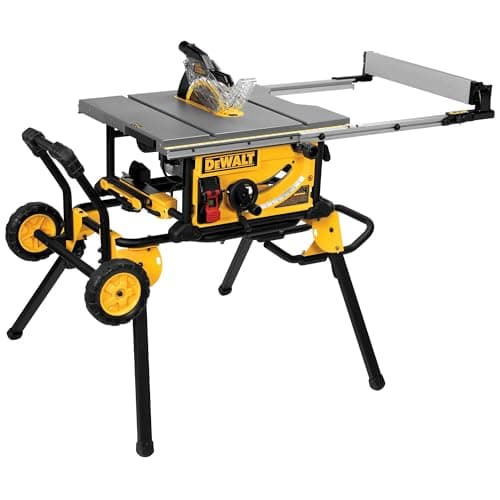
DeWalt DeWalt DWE7491RS 10-in Jobsite Table Saw
DeWalt DWE7491RS 10-in Jobsite Table Saw

The jobsite table saw home shops keep buying. A big rip capacity, a genuinely good fence and a rolling stand make it the do-everything portable saw.

Best overall table saw
8.4
$599.00Amazon
02
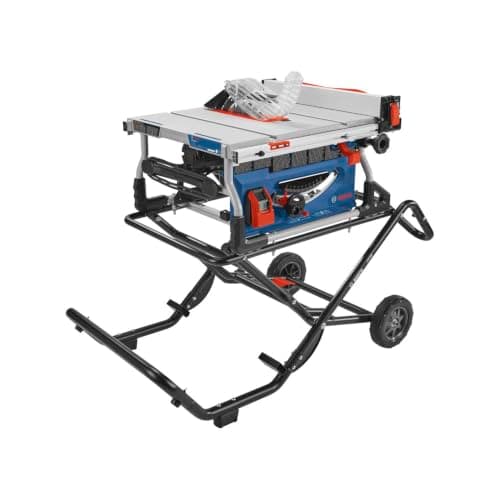
Bosch Bosch GTS15-10 10-in Jobsite Table Saw
Bosch GTS15-10 10-in Jobsite Table Saw

The saw you buy for the stand. The Gravity-Rise wheeled base sets up and folds down in one motion, which is the difference between using a saw in a shared garage and leaving it in the corner.

Best for a shared garage
8.2
$649.00Amazon
03
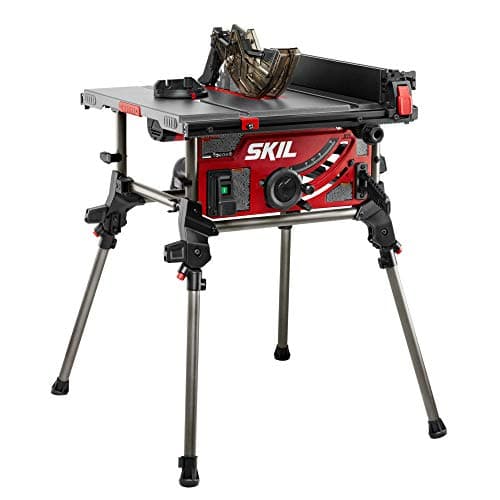
SKIL SKIL 10-in Jobsite Table Saw (TS6307)
SKIL 10-in Jobsite Table Saw (TS6307)

The value table saw. A surprisingly capable jobsite saw with a foldable stand at a price that makes it the easy budget pick.

Best value table saw
7.6
$302.68Amazon
04
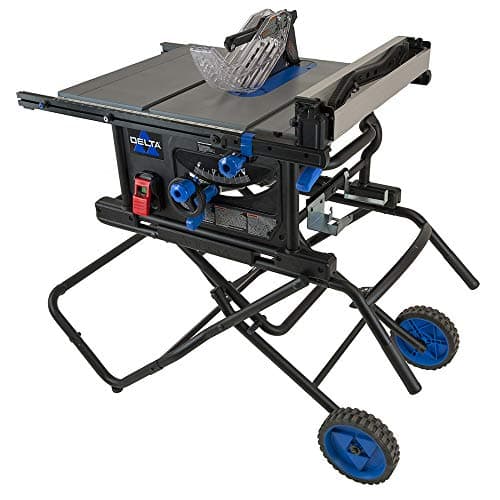
Delta Delta 36-6023 10-in Table Saw
Delta 36-6023 10-in Table Saw

A contractor-style saw at a jobsite price. More mass than the folding saws, a 32.5-inch published rip capacity, and a fence that stays where you put it.

Best for a fixed shop spot
7.6
$499.99Amazon
05
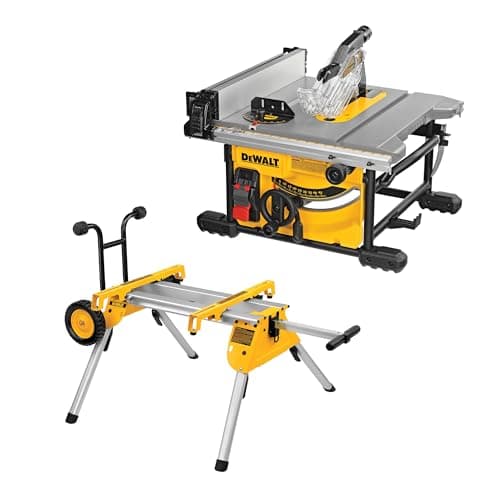
DeWalt DeWalt DWE7485 Compact Table Saw
DeWalt DWE7485 Compact Table Saw

The small-footprint table saw. An 8-1/4-inch compact that fits a tight garage and still rips real stock — a space-first choice.

Best compact table saw
7.8
$667.88Amazon

#ad · Live prices from the Amazon Product API, as of Sep 1, 2026. Where we have no verified live price, we show none — we would rather leave a gap than print a number that has rotted.

In detail

The picks, in full

01
DeWalt DeWalt DWE7491RS 10-in Jobsite Table Saw

Best overall table saw

DeWalt DWE7491RS 10-in Jobsite Table Saw

10 in blade32.5 in ripRolling stand15 A
8.4/10

The jobsite table saw home shops keep buying. A big rip capacity, a genuinely good fence and a rolling stand make it the do-everything portable saw.

Rip capacity
9
Fence
9
Portability
8
Build
8
Value
8

Pros

  • Excellent rack-and-pinion fence for a portable saw
  • 32-1/2 inch rip handles most sheet-goods cuts
  • Rolling stand makes a heavy saw movable by one person

Cons

  • Loud universal motor, like all jobsite saws
  • Not the dead-flat cast-iron surface of a cabinet saw

Don't buy this if…

you have a dedicated shop and want the quietest, most precise cut — a contractor or cabinet saw is the long-term answer.

$599.00View on Amazon

$649.008% off

Price as of Sep 1, 2026. Prices change — Amazon's is the one that counts.

#ad · we may earn a commission from this link to DeWalt DWE7491RS 10-in Jobsite Table Saw

02
Bosch Bosch GTS15-10 10-in Jobsite Table Saw

Best for a shared garage

Bosch GTS15-10 10-in Jobsite Table Saw

10 in blade32-1/8 in rip15 AGravity-Rise stand
8.2/10

The saw you buy for the stand. The Gravity-Rise wheeled base sets up and folds down in one motion, which is the difference between using a saw in a shared garage and leaving it in the corner.

Rip capacity
9
Fence
8
Portability
9
Build
8
Value
7

Pros

  • Gravity-Rise stand is the fastest setup and teardown here — one lift, one roll
  • 32-1/8 inch published rip capacity handles a full sheet ripped to width
  • Well-supported top and a square fence for a portable saw

Cons

  • Heavy once the stand is attached — this is a roll-it-out saw, not a carry-it saw
  • Costs more than the DeWalt for broadly similar cutting capacity

Don't buy this if…

the saw will live in one spot forever. You are paying a premium for a stand you would deploy once.

$649.00View on Amazon

Price as of Sep 1, 2026. Prices change — Amazon's is the one that counts.

#ad · we may earn a commission from this link to Bosch GTS15-10 10-in Jobsite Table Saw

03
SKIL SKIL 10-in Jobsite Table Saw (TS6307)

Best value table saw

SKIL 10-in Jobsite Table Saw (TS6307)

10 in blade25.5 in ripFoldable stand15 A
7.6/10

The value table saw. A surprisingly capable jobsite saw with a foldable stand at a price that makes it the easy budget pick.

Rip capacity
7
Fence
7
Portability
8
Build
7
Value
9

Pros

  • A lot of saw for the money, including a rolling/folding stand
  • Rip capacity is enough for most furniture-scale work
  • Good first table saw for a garage shop

Cons

  • Fence isn't as refined as the DeWalt's
  • Less rip capacity than the bigger jobsite saws

Don't buy this if…

you regularly break down full sheets solo — the wider-ripping DeWalt earns its premium there.

$302.68View on Amazon

$329.998% off

Price as of Sep 1, 2026. Prices change — Amazon's is the one that counts.

#ad · we may earn a commission from this link to SKIL 10-in Jobsite Table Saw (TS6307)

04
Delta Delta 36-6023 10-in Table Saw

Best for a fixed shop spot

Delta 36-6023 10-in Table Saw

10 in blade32.5 in rip15 AStand included
7.6/10

A contractor-style saw at a jobsite price. More mass than the folding saws, a 32.5-inch published rip capacity, and a fence that stays where you put it.

Rip capacity
9
Fence
8
Portability
5
Build
8
Value
8

Pros

  • Mass damps vibration in a way the lightweight folding saws cannot
  • 32.5 inch published rip capacity matches the biggest jobsite saws
  • Priced below most contractor saws with a comparable footprint

Cons

  • Not designed to be broken down and moved between jobs
  • Dust collection below the blade is basic

Don't buy this if…

you need to reclaim the floor space between sessions — a folding jobsite saw is the honest answer there.

$499.99View on Amazon

Price as of Sep 1, 2026. Prices change — Amazon's is the one that counts.

#ad · we may earn a commission from this link to Delta 36-6023 10-in Table Saw

05
DeWalt DeWalt DWE7485 Compact Table Saw

Best compact table saw

DeWalt DWE7485 Compact Table Saw

8-1/4 in blade24.5 in ripCompact15 A
7.8/10

The small-footprint table saw. An 8-1/4-inch compact that fits a tight garage and still rips real stock — a space-first choice.

Rip capacity
6
Fence
8
Portability
9
Build
8
Value
8

Pros

  • Small and light for a truly tight shop
  • Still rips 24-1/2 inches — enough for a lot of work
  • Same fence family as the bigger DeWalt saws

Cons

  • 8-1/4 inch blade limits max cut depth
  • Smaller table needs support for big panels

Don't buy this if…

you have the room — the 10-inch DWE7491RS cuts deeper and rips wider for not much more money or space.

$667.88View on Amazon

Price as of Sep 1, 2026. Prices change — Amazon's is the one that counts.

#ad · we may earn a commission from this link to DeWalt DWE7485 Compact Table Saw

How to choose a table saw, in the order that matters

Work down this list. Each step rules out saws, so by the end there is usually one answer left rather than five.

1. Rip capacity — start with your widest part

Measure the widest piece you expect to cut. Cabinet sides are commonly 24 inches; a bookcase side might be 12; a table apron is a few inches. Then add margin, because you will want to cut something bigger eventually. Published rip capacities in this group run from 24-1/2 inches (DeWalt DWE7485) through 25-1/2 (SKIL) to 32-1/8 (Bosch) and 32-1/2 (DeWalt DWE7491RS). If your widest part is 24 inches, the compact saws work but leave you nothing; the 32-inch saws leave headroom for the project after this one.

2. Fence — the spec nobody publishes

A fence has one job: land parallel to the blade, every time, without measuring at both ends. Rack-and-pinion fences (the DeWalt saws, the Bosch) move both ends together, which is why they repeat. Single-point-lock fences can be excellent or maddening depending on how well they were made. This is the one thing you cannot read off a box, and it is why fence behavior carries as much weight as rip capacity in our scores.

3. Where does it live?

Be honest about the floor. A folding jobsite saw takes about 2 × 2 feet stored; a contractor saw takes 3 × 4 feet permanently. If the shop is a shared garage, the folding stand is not a luxury — it decides whether the saw gets used or resented. If the shop is yours alone, the extra mass of a fixed saw is free accuracy.

4. Power and the circuit you actually have

Every saw here runs on a standard 15 A / 120 V circuit, which is deliberate. They all use universal motors: loud, powerful for their weight and unbothered by a garage outlet. If you find yourself wanting an induction-motor saw for the quiet and the smoothness, that is a cabinet or hybrid saw, a 240 V circuit and a different budget.

What to spend, by shop

Occasional builder, tight garage: the compact DeWalt DWE7485 or the SKIL TS6307. You give up rip capacity and get the floor back. Regular hobbyist building furniture and cabinets:the DeWalt DWE7491RS is the default and has been for years — buy it and stop researching. Shared garage where setup friction is the real enemy: the Bosch GTS15-10, for the Gravity-Rise stand alone. Dedicated shop corner: the Delta 36-6023, for mass and a lower price per inch of rip.

Budget for the things that are not the saw

A table saw is the start of a small shopping list. A decent 40- to 50-tooth combination blade transforms cut quality more than any saw upgrade at this level. A crosscut sled — which you build, not buy — is what makes a table saw accurate for crosscuts. Dust collection below the blade needs a shop vac at minimum; the blade guard port needs one too if you want to stay ahead of the fine dust. And a respirator is not optional equipment around a saw that throws this much dust.

What we could not verify

We have not cut test panels on these five saws side by side, and we do not claim to have. The rip capacities, amperages and blade sizes above are the manufacturers' published figures. The fence judgments come from reading owner reviews at volume and from the mechanism each saw uses, which is a documented design difference, not a measurement we took.
How we picked

We do not run a testing lab

We researched published manufacturer specifications, manuals and spec sheets, ran the arithmetic those specs support, and read owner reviews at volume, then scored each tool against a published rubric. The scores are judgments from documented research — they are not measurements we took, because we do not have a lab and we are not going to pretend we do. Where a number came from a manufacturer's document, we name it and link it in Sources.

Questions

Frequently asked

What size table saw do I need for a home shop?
A 10-inch blade with at least 24-1/2 inches of rip capacity handles most furniture work, and 32 inches covers virtually all cabinet dimensions in one pass. Blade diameter matters far less than rip capacity for a home shop — every saw here takes a 10-inch or 8-1/4-inch blade and cuts 3/4-inch stock without complaint.
Is a jobsite table saw good enough for woodworking?
Yes, for most home woodworking. Modern jobsite saws have genuinely good rack-and-pinion fences and enough power for hardwood at 3/4 inch. What you give up against a cabinet saw is noise, vibration and the ability to rip thick hardwood all day — not accuracy on furniture-scale parts.
Do I need a table saw if I own a track saw?
Not necessarily. A track saw breaks down sheet goods better than a table saw does. A table saw is better at repeat rips of narrow stock, at cutting joinery with a dado stack, and at anything where a fence beats a rail. If you build cabinets from sheet goods, buy the track saw first; if you build furniture from solid lumber, buy the table saw first.
How much should I spend on a table saw?
The useful bracket for a home shop starts around the price of a compact jobsite saw and tops out at a full-size jobsite saw with a rolling stand. Below that bracket you are buying a fence that will frustrate you; above it you are buying a cabinet saw, which needs 240 V power and dedicated floor space.
What blade should I put on a new table saw?
A 40- to 50-tooth carbide combination blade. Stock blades on saws at this price are adequate rather than good, and a decent combination blade improves cut quality more than any other change you can make for the money. Keep the stock blade for cutting anything you suspect might have a nail in it.

Keep reading

Receipts

Sources

We do not run a testing lab, and we do not pretend to. Our picks come from published manufacturer specifications and manuals, the arithmetic those specs support, and owner reviews read at volume. Where we could not verify something, we say so on the page rather than quietly leaving it out. Read our full method.