Skip to content
Dovetail & Dust

HUB 02 · Power Tools

Best Wood Lathe Under $1,000

A thousand dollars buys a very good midi lathe or a very large mini lathe. Which of those you want is settled by two published numbers, and almost nothing else on the spec sheet matters.

By Stephen V.Updated How we research
#ad

We earn a commission when you buy through our Amazon links, at no extra cost to you. It never changes our rankings, and we say so when the cheaper tool is the better buy. How this works.

Buy the JET JWL-1221VS. It is the only machine inside this cap with a published full horsepower, and it pairs that with 12 in. of swing and 21 in. between centers — the longest bed here — on electronic variable speed with a digital readout. The budget pick is the WEN 3421, a mini lathe that costs roughly a quarter of anything else on this page and will answer the question of whether you actually enjoy turning. The Delta 46-460 is the pick if bowls are the reason you want a lathe, the WEN 34035 if you want the biggest swing per dollar, and the JET JWL-1015VSif you want JET's build and parts network at the lowest price it is sold for.

Every price on this page comes from our live price layer rather than from this article, and all five lathes sat under the $1,000 cap at the last price check on November 21, 2026. Two of them sat within about $35 of it. Amazon moves prices daily, so if one has crossed the cap since, the number beside the pick will show that rather than hide it.

Two numbers gate the work. Everything else is comfort

Swing is roughly twice the distance from the spindle center to the bed, and it is the hard ceiling on bowl diameter. A 10 in. lathe cannot turn an 11 in. bowl at any speed, with any tool, by any technique. Distance between centersis the hard ceiling on spindle length — table legs, chair parts, tool handles, balusters.

Those two numbers are the only specifications on a lathe that decide whether the machine can do a job at all. Variable speed, reversing, indexing, banjo design and tailstock quill travel all change how pleasant the work is. Swing and bed length change what the work can be. Buy in that order and you will not regret the purchase; buy on features and you will find the ceiling in month two.

So the honest first question is not “which lathe” but “bowls or spindles”. If the answer is bowls, spend the cap on swing and mass. If it is spindles, spend it on bed length and power. If it is “I do not know yet”, that is a real answer too, and it points at the cheapest machine on this page rather than the best one.

What $1,000 does and does not buy

The cap lands across two of the three classes of lathe, which is why the field here looks so uneven.

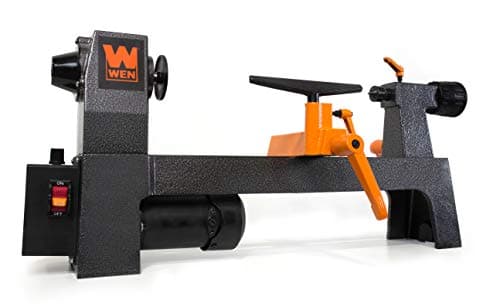
Mini lathes— the WEN 3421 here — are benchtop machines with small motors rated in amps rather than horsepower, swing in the 8 to 10 in. range and a bed around a foot. They are light enough to lift with one hand, which is also their weakness. They turn pens, handles, small boxes and spindles perfectly well.

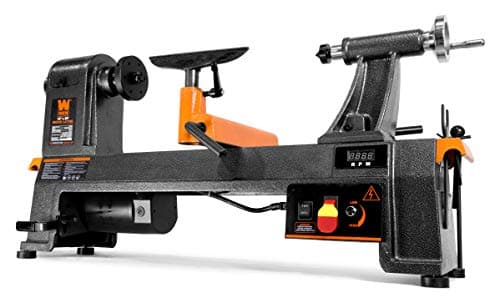
Midi lathes— the two JETs, the Delta and the WEN 34035 — are the class the cap was made for. Cast-iron beds, swing from 10 to 14 in., beds from 15 to 21 in., and electronic variable speed. This is the class most hobby turners buy and keep.

Full-size floor-standing lathesput 1-1/2 to 3 HP behind a 16 in. or larger swing on a cast-iron pedestal with several hundred pounds of mass. They are a different machine and they start well above this cap. If that is genuinely what you want, do not buy a $990 midi lathe as a stepping stone — save, and in the meantime read the full wood lathe roundup, which ranks the category without a price cap and reaches a different verdict because of it.

Mass is the third number, and the cap is exactly where you feel it

A lathe spins an unbalanced lump of wood. Nothing on the machine cancels that force; the machine's own weight simply absorbs it. A heavy lathe with a modest swing routinely turns better than a light lathe with a big one, because vibration that the frame does not absorb goes into the cut, and a chattering cut tears grain and dulls tools faster.

This is the real trade inside the cap. The WEN 34035 publishes the biggest swing on this page — 14 in., more than lathes costing twice as much — on a frame that is lighter than the premium midis. That is not a defect, it is the deal: you get the capacity and you supply the stability. Bolt it down to a solid bench or a sand-filled stand and it behaves; set it on rubber feet with a green, out-of-round blank mounted and it will walk.

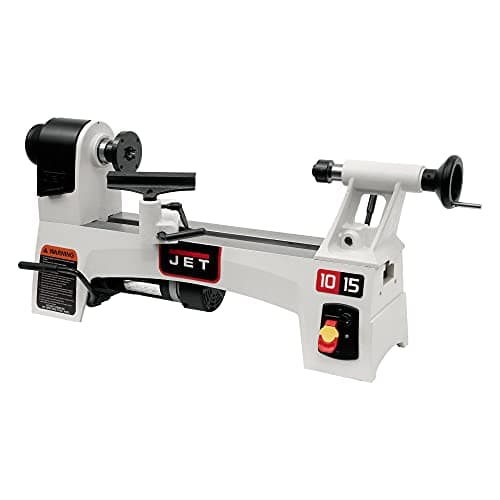
The JET JWL-1015VS is the clearest illustration of the opposite choice: the smallest swing here on 77 lb of cast iron. For bench tools, boxes and spindle work it is the most pleasant machine on the page. For a 12 in. bowl blank it is simply the wrong tool.

Variable speed, and what kind of variable speed

Every lathe on this page is described by its maker as variable speed, and that phrase covers two different arrangements.

Electronic variable speed within belt ranges— the JETs and the Delta — means a dial changes spindle speed continuously, and you move a belt between two or three pulley positions to shift the whole range up or down. JET publishes three ranges on the JWL-1015VS: 200–1050, 300–1750 and 600–3600 RPM. The dial is the control you reach for constantly; the belt change happens a few times a year.

Electronic variable speed across a single range— the two WEN machines — means no belt to move at all, at the cost of less torque at the bottom of the range. For most of what a hobby turner does this is the easier arrangement to live with.

Why it matters at all: speed has to come down as diameter goes up, because the rim speed of a 14 in. blank at 1,500 RPM is enormous. A machine where slowing down means stopping, loosening a cover and moving a belt is a machine on which you will be tempted not to. That is the real safety argument for variable speed, and it is why every lathe here has it.

The budget nobody quotes: the lathe is about half of it

This is the most useful paragraph on the page and it is not about lathes. A lathe is the only machine in a woodshop that cannot do anything at all on its own. The purchase is a system:

Turning tools.A spindle roughing gouge, a bowl gouge, a parting tool and a skew or scraper cover nearly all of the work. Four tools, and the good ones cost real money — the field is ranked on best wood turning tools, where handle length turns out to matter more than the piece count on the box.

A way to sharpen them.Turning tools are sharpened constantly — not occasionally, constantly, often several times within one bowl. A turner with dull gouges blames the lathe. A grinder or a wet sharpening system is not optional equipment here; see best sharpening systems and, if the price of those is the problem, Tormek alternatives, which costs the same question out in full.

A chuck, a faceplate and centers.Most machines ship with a drive center and a live center and nothing else. A four-jaw scroll chuck is what makes bowl work possible and it is a meaningful fraction of a lathe's price on its own.

Dust and chip handling. A lathe throws long shavings that no hood catches and fine dust during sanding that absolutely needs catching, which is a different problem from every other machine in the shop. We set out what actually works on lathe dust collection.

The practical consequence for this page: if your whole budget is $1,000, do not spend $990 of it on the lathe. A $240 mini lathe plus tools, a chuck and a grinder is a working setup. A $990 lathe with no tools is furniture.

Side by side

LathePublished swingBetween centersMotorSpeed control
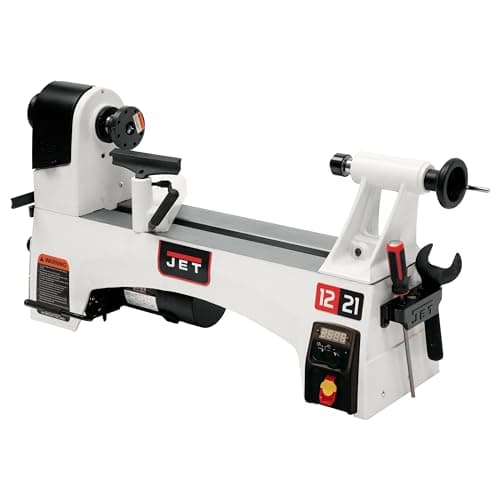
JET JWL-1221VS12 in.21 in.1 HPVariable, digital readout
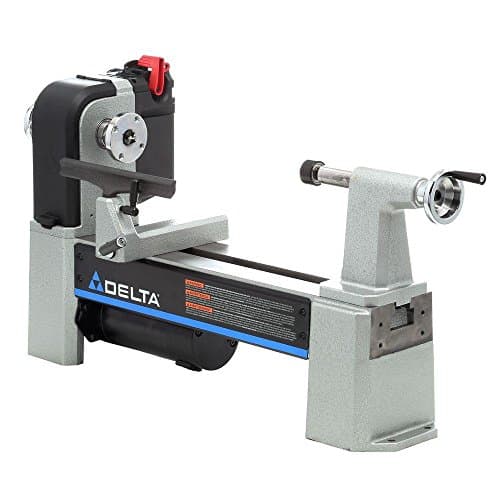
Delta 46-46012-1/2 in.16-1/2 in. (retailer listing)1 HPVariable, 3 belt ranges, reversing
WEN 3403514 in.20 in.6 AVariable
JET JWL-1015VS10 in.15-1/2 in.1/2 HP, 115V 4 AVariable, 3 ranges (200–3600 RPM)
WEN 34218 in.12 in.3.2 AVariable

Every figure is the manufacturer's published specification for the exact listing we link, with one exception we will not paper over. Delta does not publish a specification table for the 46-460 on its own product page, and the third-party sources disagree about its bed: a published owner's manual listing gives 16-1/2 in. between centers, while a Fine Woodworking comparison table gives 41-1/2 in. (which is the figure with the optional bed extension fitted, on the reading that makes both numbers true). The table above prints the shorter figure and labels it as a retailer listing rather than presenting either as Delta's own. Notice also that the two WEN machines are rated in amps because WEN publishes amps, not horsepower — those columns are not comparable and we have not converted one into the other. We did not measure a swing, time a cut or weigh a machine; there is no lab here, which the methodology page states plainly.

What to buy, in order

One lathe under $1,000 for a shop that turns furniture parts: the JET JWL-1221VS, and budget for tools separately. Bowls as the main interest, with reversing for sanding: the Delta 46-460. The largest blank you can mount for the least money, accepting that you must anchor it: the WEN 34035. JET build and JET parts at the lowest price JET sells them: the JWL-1015VS. Finding out whether turning is for you before spending real money: the WEN 3421, every time.

One last word on the cap. A lathe is the machine most often bought secondhand for good reason: they have no consumable wear parts beyond belts and bearings, and a 20-year-old cast-iron lathe is usually a better machine than a new one at the same money. If a used midi lathe with a chuck appears locally inside this budget, it is very likely the best buy on this page — and we have nothing to sell you there.
The short answer

Quick picks

#ProductBest forScorePrice
01
JET JET JWL-1221VS 12 x 21 Variable-Speed Wood Lathe
JET JWL-1221VS 12 x 21 Variable-Speed Wood Lathe

A full horsepower on a midi frame, with the longest bed here. If you turn spindles — table legs, chair parts, tool handles — the 21 inches between centers is the spec that decides it.

Best for spindle work
8.6
$989.99Amazon
02
Delta Delta Industrial 46-460 12-1/2-Inch Variable-Speed Midi Lathe
Delta Industrial 46-460 12-1/2-Inch Variable-Speed Midi Lathe

The lathe that defined the midi class. Electronic variable speed across three belt ranges means you can slow a heavy blank down without stopping to move a belt.

Best midi lathe
8.2
$946.58Amazon
03
WEN WEN 34035 14 x 20 Variable-Speed Benchtop Wood Lathe
WEN 34035 14 x 20 Variable-Speed Benchtop Wood Lathe

The biggest swing on this page for the least money. Fourteen inches takes a serious bowl, and six amps is enough motor to turn one — provided you accept a lighter machine than the premium brands.

Best swing per dollar
8.0
$779.30Amazon
04
JET JET JWL-1015VS 10 x 15 Variable-Speed Wood Lathe
JET JWL-1015VS 10 x 15 Variable-Speed Wood Lathe

Electronic variable speed on a cast-iron bed, in the smallest JET that is still a proper lathe. It costs more than the belt-change mini lathes, and the speed dial is what you are paying for — it is the control you reach for most while you are learning.

Best first lathe
7.4
$607.70Amazon
05
WEN WEN 3421 8 x 12 Variable-Speed Mini Benchtop Wood Lathe
WEN 3421 8 x 12 Variable-Speed Mini Benchtop Wood Lathe

The cheapest way to find out whether you like turning. 3.2 amps and eight inches of swing is genuinely limited, but pens, handles and small spindles do not care.

Best budget
6.2
Check price →

#ad · Live prices from the Amazon Product API, as of November 21, 2026. Where we have no verified live price, we show none — we would rather leave a gap than print a number that has rotted.

In detail

The picks, in full

01
JET JET JWL-1221VS 12 x 21 Variable-Speed Wood Lathe

Best for spindle work

JET JWL-1221VS 12 x 21 Variable-Speed Wood Lathe

12 in. swing21 in. between centers1 HPVariable speed
8.6/10

A full horsepower on a midi frame, with the longest bed here. If you turn spindles — table legs, chair parts, tool handles — the 21 inches between centers is the spec that decides it.

Capacity
9
Power
9
Speed control
9
Build
9
Value
7

Pros

  • 21 in. between centers covers most furniture-scale spindle work without an extension
  • A full horsepower means it does not stall in a heavy roughing cut
  • Variable speed with a digital readout takes the guesswork out of matching speed to diameter

Cons

  • The longest bed here also means the largest footprint
  • Priced against the Delta at a similar swing — the choice is bed length versus reversing

Don't buy this if…

…bowls are your interest. Swing matters for bowls; bed length does not.

$989.99View on Amazon

Price as of November 21, 2026. Prices change — Amazon's is the one that counts.

#ad · we may earn a commission from this link to JET JWL-1221VS 12 x 21 Variable-Speed Wood Lathe

02
Delta Delta Industrial 46-460 12-1/2-Inch Variable-Speed Midi Lathe

Best midi lathe

Delta Industrial 46-460 12-1/2-Inch Variable-Speed Midi Lathe

12-1/2 in. swingVariable speedThree belt rangesReversing
8.2/10

The lathe that defined the midi class. Electronic variable speed across three belt ranges means you can slow a heavy blank down without stopping to move a belt.

Capacity
8
Power
8
Speed control
9
Build
9
Value
7

Pros

  • Variable speed within each belt range covers everything from roughing to finishing
  • 12-1/2 in. swing takes a genuinely useful bowl size
  • Reversing is a real advantage for sanding a bowl without chasing tear-out

Cons

  • Costs roughly twice a capable mini lathe
  • Heavy — this is a machine you place once

Don't buy this if…

…you are not certain turning will stick. Buy a mini lathe, find out, and sell it for most of what you paid.

$946.58View on Amazon

Price as of November 21, 2026. Prices change — Amazon's is the one that counts.

#ad · we may earn a commission from this link to Delta Industrial 46-460 12-1/2-Inch Variable-Speed Midi Lathe

03
WEN WEN 34035 14 x 20 Variable-Speed Benchtop Wood Lathe

Best swing per dollar

WEN 34035 14 x 20 Variable-Speed Benchtop Wood Lathe

14 in. swing20 in. between centers6 A motorVariable speed
8.0/10

The biggest swing on this page for the least money. Fourteen inches takes a serious bowl, and six amps is enough motor to turn one — provided you accept a lighter machine than the premium brands.

Capacity
10
Power
7
Speed control
8
Build
6
Value
9

Pros

  • 14 in. swing beats every other machine here, including ones costing more
  • 20 in. between centers handles most spindle work as well
  • Variable speed across the range, not just belt steps

Cons

  • Less mass than the premium midi lathes, and mass is what damps a wobbling blank
  • A bigger swing on a lighter frame is only usable if the machine is properly anchored

Don't buy this if…

…you turn green or badly out-of-round blanks. That is exactly the case where machine mass earns its money.

$779.30View on Amazon

Price as of November 21, 2026. Prices change — Amazon's is the one that counts.

#ad · we may earn a commission from this link to WEN 34035 14 x 20 Variable-Speed Benchtop Wood Lathe

04
JET JET JWL-1015VS 10 x 15 Variable-Speed Wood Lathe

Best first lathe

JET JWL-1015VS 10 x 15 Variable-Speed Wood Lathe

10 in. swing15-1/2 in. between centers1/2 HP, 115V 4 AVariable speed, 3 ranges
7.4/10

Electronic variable speed on a cast-iron bed, in the smallest JET that is still a proper lathe. It costs more than the belt-change mini lathes, and the speed dial is what you are paying for — it is the control you reach for most while you are learning.

Capacity
7
Power
6
Speed control
9
Build
9
Value
6

Pros

  • Electronic variable speed across three published ranges — 200-1050, 300-1750 and 600-3600 RPM — instead of stopping to move a belt
  • Cast-iron bed and 77 lb of mass, which is what keeps a slightly out-of-round blank from walking the machine across the bench
  • 24-position indexing built in, so fluting and layout work do not need a separate jig
  • Runs on an ordinary 115V outlet at 4 A
  • It is a JET, so chucks, centers and spare parts are still easy to find years later

Cons

  • Costs considerably more than the mini lathes it sits alongside — that is the main reason to think twice
  • 1/2 HP will still bog in a heavy roughing cut on a large blank, so take lighter passes
  • 15-1/2 in. between centers is shorter than the 18 in. mini lathes offer, so long spindles need the optional bed extension
  • 10 in. of swing caps bowl diameter, and swing is the one spec you cannot work around

Don't buy this if…

…you are not yet sure turning will stick. The WEN 3421 at the bottom of this page is a fraction of the price and will answer that question for far less money.

$607.70View on Amazon

$714.9915% off

Price as of November 21, 2026. Prices change — Amazon's is the one that counts.

#ad · we may earn a commission from this link to JET JWL-1015VS 10 x 15 Variable-Speed Wood Lathe

05
WEN WEN 3421 8 x 12 Variable-Speed Mini Benchtop Wood Lathe

Best budget

WEN 3421 8 x 12 Variable-Speed Mini Benchtop Wood Lathe

8 in. swing12 in. between centers3.2 A motorVariable speed
6.2/10

The cheapest way to find out whether you like turning. 3.2 amps and eight inches of swing is genuinely limited, but pens, handles and small spindles do not care.

Capacity
4
Power
4
Speed control
8
Build
6
Value
9

Pros

  • Variable speed at this price is unusual and makes learning much safer
  • Light enough to lift onto a bench and put away again
  • Cheap enough that the turning tools and sharpening kit cost more than the lathe

Cons

  • Eight inches of swing rules out bowls of any size
  • Light frame transmits vibration — bolt it down or it will hop

Don't buy this if…

…bowls are the reason you want a lathe. This will disappoint you within a week.

Check price on Amazon →

No buyable offer at the last price check (November 21, 2026). We show nothing rather than a stale number.

#ad · we may earn a commission from this link to WEN 3421 8 x 12 Variable-Speed Mini Benchtop Wood Lathe

How we picked

We do not run a testing lab

We researched published manufacturer specifications, manuals and spec sheets, ran the arithmetic those specs support, and read owner reviews at volume, then scored each tool against a published rubric. The scores are judgments from documented research — they are not measurements we took, because we do not have a lab and we are not going to pretend we do. Where a number came from a manufacturer's document, we name it and link it in Sources.

Questions

Frequently asked

What is the best wood lathe under $1,000?
The JET JWL-1221VS. It is the only lathe inside the cap with a published full horsepower, and it has the longest bed here at 21 in. between centers with 12 in. of swing. If bowls rather than spindles are your interest, the Delta 46-460 is the better buy at a similar price for its 12-1/2 in. swing and its reversing switch.
Is a midi lathe enough for bowls?
Yes, up to the swing. A 12 in. machine turns a 12 in. bowl blank and no more, which covers most of what people actually make. What a midi lathe gives up against a floor-standing machine is mass, and mass is what keeps a heavy out-of-round blank from shaking the bench. Bolting the lathe down recovers much of that.
Swing or distance between centers — which should I prioritize?
Whichever matches the work. Swing caps bowl diameter and distance between centers caps spindle length, and neither can be worked around by technique. If you want both, the JWL-1221VS has the longest bed here and the WEN 34035 the biggest swing; nothing under $1,000 leads on both at once.
How much should I budget beyond the lathe itself?
Plan for the tools, a way to sharpen them and a chuck, and assume together they cost the same order of money as a mid-priced lathe. A roughing gouge, a bowl gouge, a parting tool and a scraper, plus a grinder or wet sharpener and a four-jaw chuck, is the working minimum — which is the argument for the WEN 3421 if $1,000 is the whole budget rather than just the lathe budget.
Do I need variable speed on a wood lathe?
Effectively yes, and every lathe on this page has it. Speed has to fall as blank diameter rises, and on a machine where slowing down means stopping and moving a belt, the temptation is to leave it fast. That is a safety argument more than a convenience one.
Is a used lathe a better buy than a new one at this price?
Often, yes. Lathes have no consumable cutting parts — belts and bearings are the wear items — so an older cast-iron machine is usually a sound machine. A used midi lathe that comes with a chuck and a set of tools inside this budget will beat anything new on this page, and we would tell you to buy it.

Keep reading

Receipts

Sources

We do not run a testing lab, and we do not pretend to. Our picks come from published manufacturer specifications and manuals, the arithmetic those specs support, and owner reviews read at volume. Where we could not verify something, we say so on the page rather than quietly leaving it out. Read our full method.