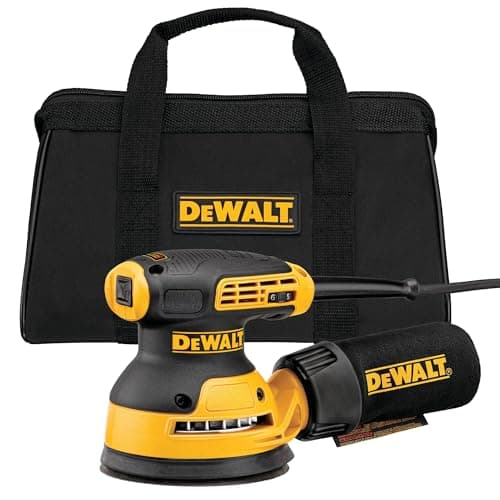
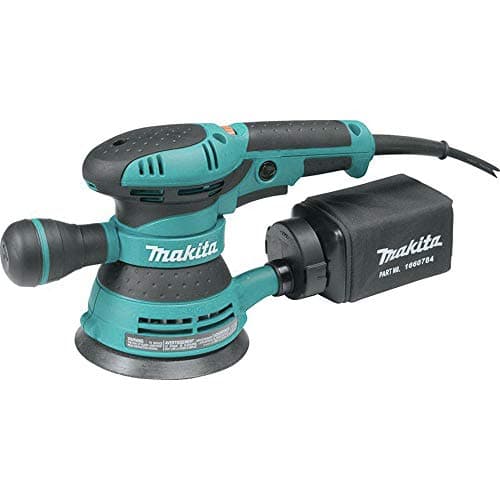
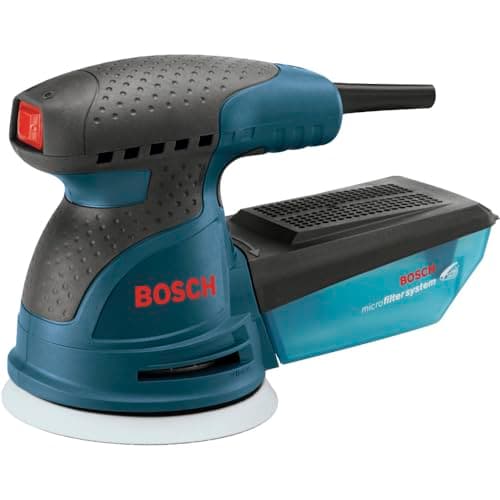
Buy a 5 in. random orbit sander with variable speed, and buy the Bosch ROS20VSC if you want the one that suits this job best. That is the answer for anyone refinishing a dresser, a table, a set of chairs or a cabinet door. The DeWalt DWE6423 is the pick if this is your first sander and the project is a single piece of furniture; the Makita BO5041 is the one to buy if you are refinishing something large enough that you will be holding the tool for an hour at a time.
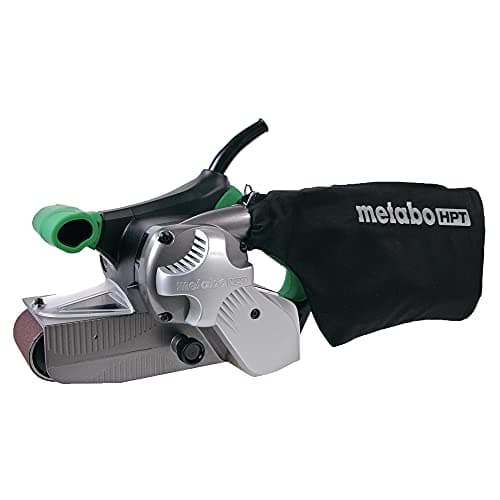
A belt sander is on this page too, in last place, for one specific job. If you are stripping heavy finish off a flat solid-wood slab and nothing else, it earns its keep. On anything with veneer, a moulding, a curve or a rail-and-stile door, it is the fastest way to ruin a piece of furniture you were trying to save.
Refinishing wants a different sander than building does
When you sand new stock you are removing wood — flattening a glue-up, cleaning mill marks, working a joint flush. When you refinish, you are removing a coating that might be a couple of thousandths of an inch thick, and under that coating is a surface somebody else already got flat. Every pass that cuts into the wood is a pass that undoes work.
That changes what good means in a sander. Aggression stops being a virtue. What you want instead is:
- A random orbit action, so the scratch pattern never repeats and never lines up into visible tracks along the grain.
- Variable speed, because the slow end of the dial is what lets you work up to an edge, over a veneer or along a moulding without burning through.
- Light weight and a low centre of gravity, because on a vertical surface like a cabinet side you are supporting the tool, not leaning on it.
- Dust capture that actually works, because old finish sands into a sticky powder that clogs abrasive almost instantly.
Note what is missing from that list: amps, orbit diameter, stroke length. Those are the numbers that matter when you are hogging material, which is the opposite of this job. If you want the general-purpose ranking rather than the refinishing one, our best random orbital sander roundup is the page to read. This page is specifically about taking a finish off something that already exists.
The lead and the veneer problem, before you switch anything on
Two facts decide a lot about how you approach an old piece. The first is that furniture finished before 1978 may carry lead paint, and the US Environmental Protection Agency's guidance on lead-safe work is explicit that power sanding without containment is one of the ways lead dust gets into a home. If you suspect lead, the honest answer is that a sander is not the right tool at all.
The second is veneer. A large share of mid-century and older case furniture is veneered, and veneer on older pieces can be thinner than a sheet of paper. A random orbit sander at low speed with 180 grit will take a finish off veneer. The same sander at full speed with 80 grit will take the veneer off the substrate, and there is no recovering from that. Check an inside edge or the underside of a top for a glue line first, so you know which situation you are in.
What each sander on this page is for
The six tools ranked below are not six versions of the same thing. They split by the job inside the job:
- The whole-project sander: the Bosch ROS20VSC. Variable speed, a dust canister for working away from a vacuum, and light enough for vertical surfaces.
- The first sander:the DeWalt DWE6423, which publishes an 8,000 to 12,000 OPM variable-speed range — the specification that matters most here — at the lowest price of anything on this page that has it.
- The long-session sander: the Makita BO5041, which exists for people sanding for an hour rather than for ten minutes.
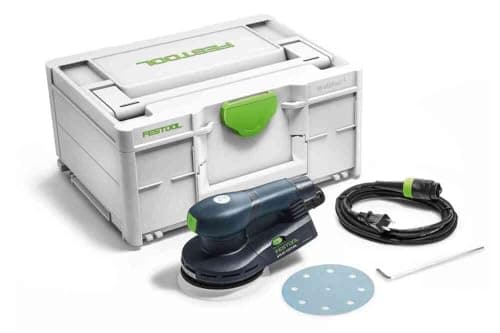
- The final-pass sander:the Festool ETS EC 125/3 EQ, whose published 3 mm stroke is deliberately small — a finishing stroke, not a stripping stroke.
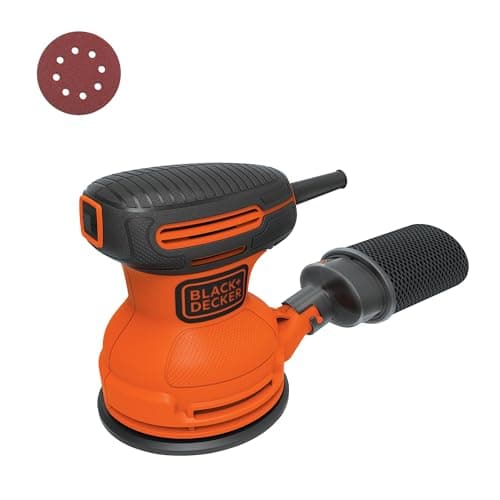
- The one-project sander: the Black+Decker BDERO100, if this is a single chair and you do not expect to own a sander afterwards.
- The stripping sander, with warnings: the Metabo HPT SB8V2 belt sander, for flat solid-wood slabs and nothing else.
Prices in the table below come from our live price feed and carry the date they were pulled, which matters in this category because sanders discount heavily and unpredictably.
The six side by side
Published listing specifications for the six sanders ranked above. Read the speed-control column first: for refinishing it is the most useful difference in the table, because it is what lets one tool do both the stripping passes and the delicate ones.
| Sander | Type | Pad or belt | Published specifications |
|---|
| Bosch ROS20VSC | Random orbit | 5 in. pad | 2.5 A, variable speed, dust canister |
| DeWalt DWE6423 | Random orbit | 5 in. pad | 8,000–12,000 OPM, variable speed, dust bag |
| Makita BO5041 | Random orbit | 5 in. pad | Variable speed, corded, dust bag |
| Festool ETS EC 125/3 EQ | Random orbit | 5 in. pad | 3 mm stroke, brushless motor, Plus package |
| Black+Decker BDERO100 | Random orbit | 5 in. pad | 2.0 A, 12,000 OPM, dust bag |
| Metabo HPT SB8V2 | Belt | 3 x 21 in. belt | 9 A, 820–1,475 ft/min, 9.5 lb |
The grit sequence for a refinish is not the sequence for new wood
On new stock you start coarse because you are removing material. On a refinish you start at the finest grit that will lift the coating, because every grit coarser than that is scratching wood you did not need to touch. In practice that means starting around 120 or 150 on a clear film finish, and dropping to 80 only when the finish is thick, painted or alligatored.
From there the progression is conventional, and the rule about not skipping more than one grit still applies. We lay the whole sequence out in sanding grit progression, including where to stop before a stain versus before a clear coat. Sanding too fine before a stain is the most common refinishing mistake there is, and it shows up as a blotchy, under-coloured surface that looks like the stain failed.
Why the belt sander is ranked last rather than left off
A belt sander removes material in a straight line, continuously, at a rate no random orbit sander approaches. On a solid-wood tabletop carrying four coats of polyurethane, that is exactly what you want for the first ten minutes. The Metabo HPT SB8V2 publishes a 820 to 1,475 ft/min variable belt speed, and the slow end of that range is the only thing that makes it usable near a finish at all.
What it cannot do is stay flat without you. The whole machine is a lever: tip it and the belt digs, dwell and it hollows, catch an edge and it is rounded over permanently. On a veneered surface it will be through the veneer before you have decided whether it is going well. Our belt sander roundup covers the family properly, including the larger machines we would reach for on a bench top rather than on furniture.
Hook the sander to something, and not to its own bag
The onboard bag or canister on all five random orbit sanders here is a convenience feature, not a dust solution. Old finish sands into a fine, sticky powder that loads abrasive in seconds, and abrasive that is loaded stops cutting and starts burnishing — which is how you end up sanding for forty minutes and achieving nothing.
Connecting the sander to a shop vacuum roughly doubles how long a disc lasts, and it is the cheapest improvement available to anyone refinishing indoors. A shop vac or dust extractor with a fine filter is the right partner; a dust bag is not. If the work is happening in a living space rather than a shop, read wood dust health risks before you start rather than after.
Where these numbers come from
The pad sizes, amperages, OPM ranges, stroke lengths, belt dimensions and weights above are the manufacturers' own published listing specifications, recorded when we researched each tool and cited per tool in Sources. We have not measured removal rate, surface finish or vibration in a lab — we do not have one, and our methodology pagesays so plainly. Prices come from the live price feed and carry the date they were pulled. The lead-paint guidance referenced above is the US EPA's and is linked in Sources.