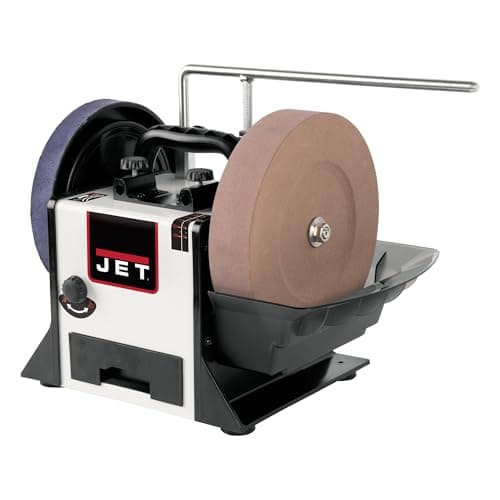
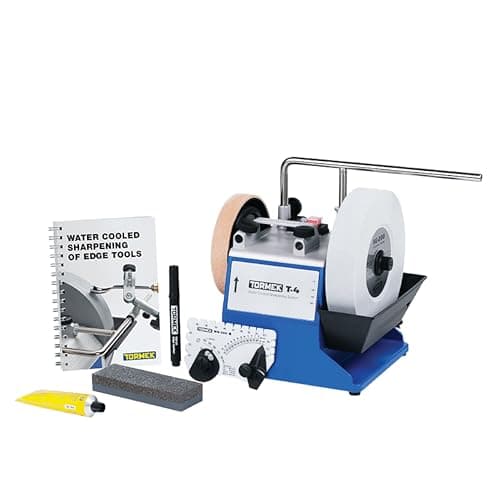
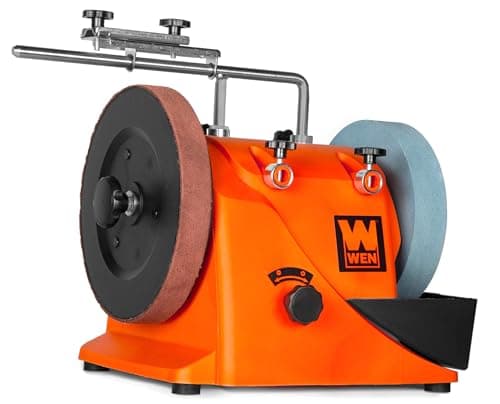
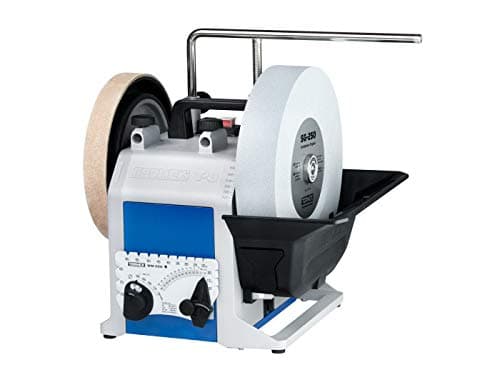
A sharpening system solves two problems that stones do not: it removes metal quickly without burning the edge, and it repeats an angle you set once. If neither of those is your problem, you do not need one — and we would rather say that on the way in than at the bottom of the page.
The burning problem is real and worth explaining. A dry bench grinder spins an abrasive wheel fast enough that the friction can heat a thin edge past the temperature at which its heat treatment holds. The steel turns blue, and that section will never hold an edge again — it has to be ground back past the damage. A water-cooled wheel runs slowly and carries away heat continuously, which is why every machine on this page is a wet system.
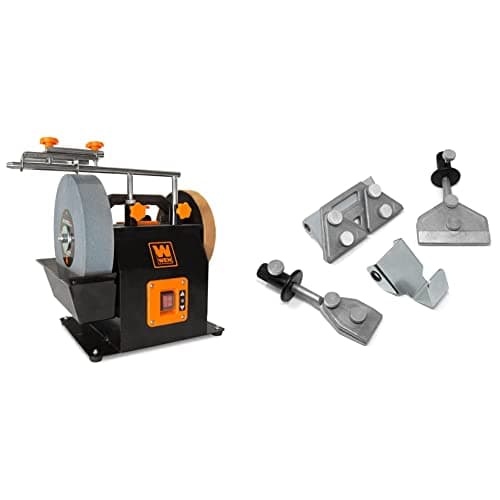
The repeatability problem is what jigs solve. Holding a chisel at 30 degrees by hand is a skill; holding it at exactly the same 30 degrees next month is a different skill. A jig clamps the tool at a set projection so the second sharpening lands on the bevel you already established, rather than creating a new one. That is where most of the time savings come from.
Read that back and you may notice the honest conclusion: for a shop with a handful of chisels and a plane, a stone and a honing guide do both of these jobs for a tenth of the money. The systems below earn their price in shops that sharpen a lot — turners, carvers, and anyone maintaining a full rack of edge tools.
What separates these machines
The jig range, not the wheel
Every machine here has a cooled wheel and every cooled wheel produces a good edge. What you are actually paying for at the top of the range is the accessory system — the jigs for a short chisel, a long plane iron, a bowl gouge, a skew, a knife, an axe. A machine with a narrow jig range will sharpen chisels beautifully and leave you improvising for everything else.
Before you buy, list the tools you actually want to sharpen and confirm a jig exists for each one. That single check is the most useful thing on this page.
Wheel diameter and the hollow grind
A wheel grinds a slightly concave bevel — a hollow grind. The smaller the wheel, the deeper that hollow. On a chisel a hollow grind is helpful: it leaves only the heel and the edge in contact with a stone, which makes freehand honing far easier. On a wide plane iron a deep hollow from a small wheel is less welcome. That is the practical difference between the eight- and ten-inch machines here.
Speed control
Slower is better for honing, faster for shaping. Machines with variable speed let you match the wheel to the job; fixed-speed machines pick one compromise. It is a genuine convenience, not a requirement.
What a system does not do
It does not flatten the back of a chisel. That is a one-time job on a flat abrasive, and it has to be done properly before any bevel work matters. Our guide on how to sharpen chisels covers the sequence.
It does not replace a strop. The final polish that takes an edge from sharp to frighteningly sharp still comes from a leather wheel or a bench strop with compound. Most of these machines include a honing wheel for exactly that reason.
It does not make you sharpen more often. That is a habit, not a machine. The shops with the sharpest tools are the ones that touch up an edge before it is obviously dull, whatever they use to do it.
System, stones, or both?
Most well-equipped shops end up with both, and use them for different jobs. The machine re-establishes a bevel, fixes a chip, and grinds a new angle — the heavy work. Stones do the two-minute touch-up between cuts, which is the work that actually keeps tools sharp. If you can only buy one and your tools are in reasonable shape, buy the stones.
What we could not verify
We have not compared edges from these machines under magnification or measured how long each holds. Wheel sizes, speeds and voltages come from the manufacturers' current listings; the reasoning about burning, hollow grinds and jig repeatability is standard sharpening practice rather than a test we ran.