The stiffness difference is much larger than the size difference suggests. Here is when it matters, when it does not, and why the adapter is the wrong answer.
We earn a commission when you buy through our Amazon links, at no extra cost to you. It never changes our rankings, and we say so when the cheaper tool is the better buy. How this works.
If your router accepts a 1/2-inch collet, buy 1/2-inch shank bits. The reason is not marketing: doubling a shaft's diameter increases its resistance to bending by roughly sixteen times, so the thicker shank deflects dramatically less under the same cutting load. Less deflection is less chatter, and less chatter is a surface you can finish straight off the router.
That is the whole physics of it, and it is worth stating precisely because “1/2-inch is twice as big” badly undersells the difference. Bending stiffness scales with the fourth power of diameter. Twice the diameter is not twice as stiff; it is about sixteen times as stiff.
When it genuinely matters
Large-diameter cutters. A raised panel bit, a big rail-and-stile cutter or a wide round-over is removing a lot of material per revolution, and all of that load is transmitted down the shank. These are 1/2-inch shank items and most are not sold any other way, for good reason.
Long bits. A long flush-trim or pattern bit is a lever. Length amplifies whatever deflection the shank allows, so a long bit on a thin shank is the worst combination available.
Table-mounted work. In a table you take heavier passes than you would handheld, because the machine is holding the cutter rather than you. Heavier passes are exactly the load case the thicker shank is for.
Hardwood, and figured hardwood especially. Denser stock and interlocked grain both raise cutting forces, and chatter marks show up more cruelly on the timber you least want to sand.
When 1/4-inch is genuinely fine
This is where a lot of writing on the subject overstates its case. A 1/4-inch shank is not a compromise for small bits — it is the correct choice for them.
Small straight bits, small round-overs and chamfers, V-groove bits, small cove bits: the cutting load is low, and the difference in finish is generally not visible.
Trim router work. A compact router has a 1/4-inch collet and nothing else, and the tool is not intended for the cutters that need a bigger shank anyway. That is a coherent design, not a limitation to work around. Which router has which collet is covered in which router should you buy.
Bits that only exist in 1/4-inch. Some specialist small-diameter profiles simply are not made with a bigger shank, because the cutter is narrower than the shank would be.
There is also a practical point in favor of small shanks in a trim router: a 1/4-inch bit spinning in a light one-handed tool is easier to control on delicate work than a heavier setup is.
Why we do not recommend shank adapters
A 1/4-to-1/2-inch adapter — a sleeve that lets a 1/4-inch bit run in a 1/2-inch collet — is a widely searched-for item and a poor idea for the cases people buy it for. Two reasons:
It does not add stiffness where the stiffness is missing. The bit is still a 1/4-inch shaft. The sleeve sits around it inside the collet; the unsupported length below the collet, which is the part that flexes, is unchanged.
It adds a concentricity error. A collet grips by squeezing a slotted sleeve onto the shank. Introducing a second sleeve adds another chance for the bit to sit slightly off-axis, and a bit spinning off-axis at 18,000 RPM is a vibration source.
The legitimate use is convenience, not performance: you own one 1/4-inch bit, your router is set up with the 1/2-inch collet, and you would rather not swap collets for one cut. That is fine. Buying an adapter so you can run a large 1/4-inch cutter is not.
The correct answer for a router with both collets is to keep both, and swap. It takes under a minute.
What this means for buying sets
If your router takes 1/2-inch shanks, buy 1/2-inch sets and do not hedge. A mixed-shank set is occasionally useful in a shop that runs both a trim router and a mid-size machine, but for a single-router shop it is mostly a way of owning bits you cannot use in the machine you are holding.
The strategy we argue for in the router bit roundup holds regardless of shank: buy an affordable set, use it for a year, notice which three or four bits are worn and which are still shiny, then replace the worn ones with genuinely good bits. Shank size determines which set to buy; it does not change that sequence.
One more spec worth knowing before you buy anything large: big cutters have published maximum speeds well below what your router can spin, and they are not advisory. Our router bit speed chart has the manufacturer figures.
What we could not verify
We have not measured deflection, run-out or surface finish on any bit. The stiffness relationship quoted is standard beam mechanics — bending stiffness scales with the fourth power of diameter — not a measurement we took. Shank sizes, set contents and cutter diameters are as published by the manufacturers and the live listings.
The sensible way to find out which profiles you actually use. Fifteen carbide-tipped bits for less than three good ones, and genuinely usable while you learn.
The single bit that most improves a shop's mortises. A solid-carbide upcut spiral shears the fibers and lifts chips clear instead of packing them in the slot.
#ad · Live prices from the Amazon Product API, as of Sep 19, 2026. Where we have no verified live price, we show none — we would rather leave a gap than print a number that has rotted.
In detail
The picks, in full
01
Best value set
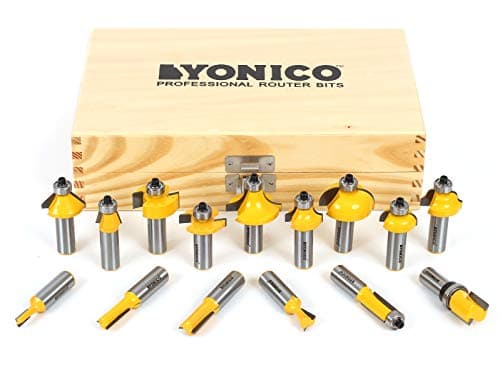
Yonico 17150 Router Bit Set (15 pc, 1/2 in shank)
15 pieces1/2 in shankCarbide tippedRound-over, cove, chamfer, dovetail, flush trim
7.6/10
The sensible way to find out which profiles you actually use. Fifteen carbide-tipped bits for less than three good ones, and genuinely usable while you learn.
Cut quality
7
Carbide
6
Set contents
9
Balance
7
Value
9
Pros
+Covers the whole profile spread at once, so you can discover your habits before spending properly
+1/2-inch shanks, which is unusual at this price and makes the bits noticeably steadier
+Wooden case keeps them located and identifiable
Cons
−Thinner carbide than a premium bit — expect a shorter working life and limited resharpening
−Finish off the bit is good rather than glassy; a light sanding pass is often wanted
Don't buy this if…
…you already know the three profiles you run constantly. Buy those three properly instead of fifteen adequately.
Price as of Sep 19, 2026. Prices change — Amazon's is the one that counts.
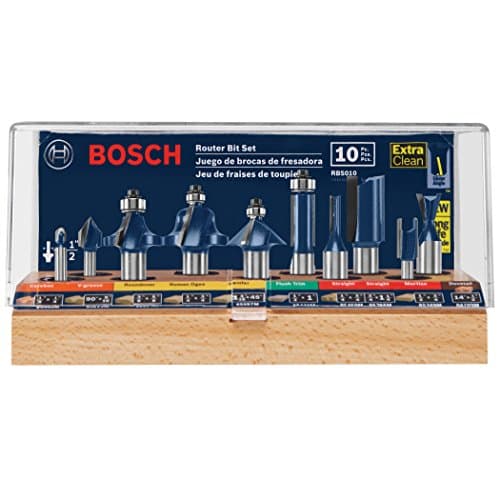
#ad · we may earn a commission from this link to Bosch RBS010 Router Bit Set (10 pc, 1/4 + 1/2 in shanks)
04
Best spiral bit
Whiteside RU5150 Spiral Upcut Bit (1/2 in, 1/2 in shank)
1/2 in cutting diameter1/2 in shank1-1/2 in cutting lengthSolid carbide, upcut
8.6/10
The single bit that most improves a shop's mortises. A solid-carbide upcut spiral shears the fibers and lifts chips clear instead of packing them in the slot.
Cut quality
9
Carbide
10
Chip clearing
10
Versatility
7
Value
7
Pros
+Clears chips upward, which is exactly what a deep mortise needs to stay cutting cleanly
+Shearing helix leaves far less tear-out than a straight bit in figured stock
+Solid carbide rather than a brazed tip, so the whole edge is the hard material
Cons
−Upcut geometry can lift and fray fibers at the top surface of a visible cut
−Costs as much as several straight bits for one profile
Don't buy this if…
…your cuts are shallow grooves in plywood with a visible top face — a down-cut or compression bit is the better choice there.
Price as of Sep 19, 2026. Prices change — Amazon's is the one that counts.
#ad · we may earn a commission from this link to Whiteside RU5150 Spiral Upcut Bit (1/2 in, 1/2 in shank)
How we picked
We do not run a testing lab
We researched published manufacturer specifications, manuals and spec sheets, ran the arithmetic those specs support, and read owner reviews at volume, then scored each tool against a published rubric. The scores are judgments from documented research — they are not measurements we took, because we do not have a lab and we are not going to pretend we do. Where a number came from a manufacturer's document, we name it and link it in Sources.
Questions
Frequently asked
Are 1/2-inch router bits better than 1/4-inch?+
For large or long cutters, meaningfully yes — bending stiffness scales with the fourth power of shank diameter, so a 1/2-inch shank resists deflection roughly sixteen times better than a 1/4-inch one. For small round-overs, chamfers and V-groove bits the difference is usually not visible in the finish.
Can I use 1/4-inch bits in a 1/2-inch router?+
Yes — most mid-size routers ship with both collets, and swapping takes under a minute. That is the right way to do it. Running a 1/4-inch bit through a sleeve adapter in the 1/2-inch collet works for convenience but adds a concentricity error and no stiffness.
Are router bit shank adapters any good?+
For convenience on a small bit, they are acceptable. As a way to run a large 1/4-inch cutter more safely, no — the sleeve does not stiffen the part of the shank that flexes, and it introduces another opportunity for the bit to sit off-axis.
What shank does a trim router take?+
1/4-inch, and only 1/4-inch. That is not a defect: a compact router is not intended for the large cutters that need a bigger shank, so the collet matches the tool's job.
Should I buy a mixed-shank router bit set?+
Only if you genuinely run two routers with different collets. In a single-router shop a mixed set means owning bits you cannot fit to the machine in your hands. Buy the set that matches your collet.
We do not run a testing lab, and we do not pretend to. Our picks come from published manufacturer specifications and manuals, the arithmetic those specs support, and owner reviews read at volume. Where we could not verify something, we say so on the page rather than quietly leaving it out. Read our full method.