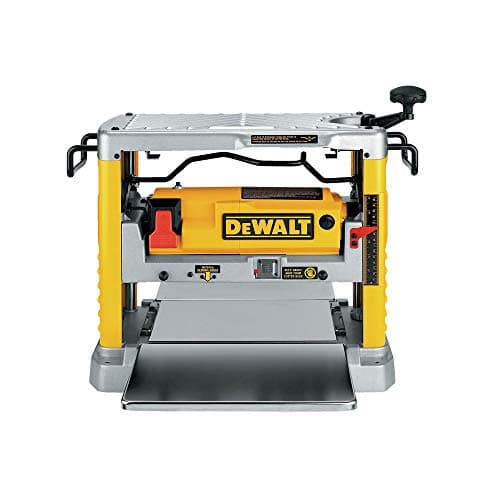
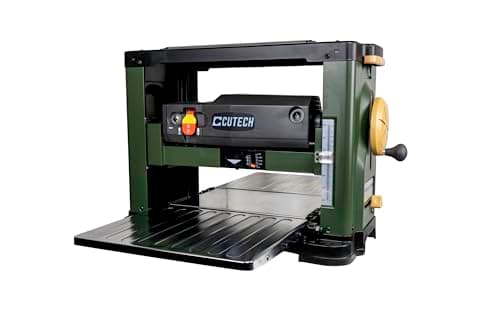
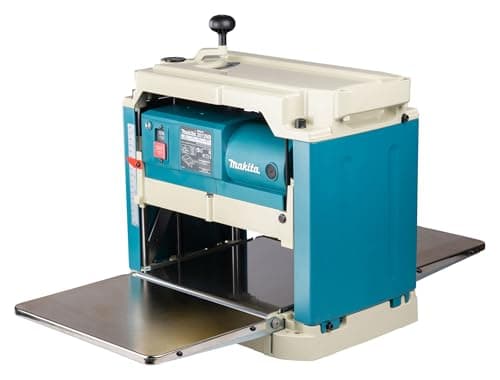
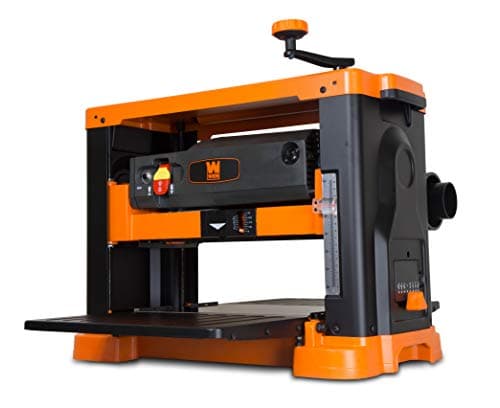
For most shops the answer is the WEN PL1326. It is a 13 in. planer with a spiral insert cutterhead — the thing the DW735X does not have at any price — and at our last price check it was the cheapest planer in this comparison. If what you want is DeWalt's cut and DeWalt's parts network for less money, buy the DW734: the same three-knife head, 12-1/2 in. wide, one feed speed instead of two. If your shop is attached to a house and noise is the reason you are reading this, the Makita 2012NB publishes 83 dB and 61.9 lb and is the quietest, lightest machine here. And if figured wood is your whole reason for owning a planer, the Cutech 13 in. spiral is the dedicated insert-head machine.
Prices beside each pick come from our live price layer rather than from this article, last checked November 21, 2026. Planer prices move a long way in both directions, so treat the number beside the pick as the current one and this ranking as the reasoning.
What the DW735X is known for
Three things, and no alternative on this page has all three. That is the honest shape of this decision, so it is worth setting out what you are giving up before anyone recommends anything.
A three-knife cutterhead on a two-speed gearbox. DeWalt publishes 96 cuts per inch in dimensioning mode and 179 cuts per inch in finishing mode, from a 15 A, 20,000 RPM motor turning the cutterhead at 10,000 RPM. Cuts per inch is simply how many times a knife passes over a given inch of board as it feeds through: more cuts per inch means a shorter, shallower scallop and a surface closer to finish-ready. Dropping to the slower feed for the last pass is the single most useful feature on the machine.
Fan-assisted chip ejection. The DW735 has a powered impeller that throws chips out of the housing instead of relying on your dust collector to pull them. In a shop with a shop vac rather than a collector, that is the difference between planing and unclogging. Nothing else in this class has it.
A 13 in. capacity on a cast aluminum base, which DeWalt gives as 19-3/4 in., with the X package adding infeed and outfeed tables and a spare set of knives.
So the three reasons people go looking for an alternative map neatly onto what the machine does notdo. It is expensive. It is loud. And its straight knives tear out figured grain, which is a limitation of the cutterhead design rather than of DeWalt's engineering. Pick the route that matches your reason and the shortlist collapses to one machine.
Route one: the same cut for less money
The DeWalt DW734is the closest thing to a cheaper DW735 that exists, because it is the same company's smaller machine. DeWalt publishes the same 15 A, 20,000 RPM motor and the same 10,000 RPM three-knife cutterhead, at 12-1/2 in. of width and a single 96 cuts-per-inch feed rate, with 33-1/2 in. of infeed and outfeed table support.
What you lose is specific and short: the second feed speed, the chip-ejection fan, and half an inch of width. The first is a genuine loss on highly figured stock, where the slow pass is what saves the surface. The second matters most if you plan to run the planer on a shop vac. The third matters only if you dimension wide panels, and if you do, note that no benchtop planer takes a 13 in. board comfortably — you glue up after planing, not before.
Buy this one if the DW735X was always the machine you wanted and the price was the only objection. It is the lowest-risk purchase on the page: the knives are on the shelf at every tool retailer and every third woodworker you ask has run one.
Route two: a spiral cutterhead, which the DeWalt does not offer
This is the route most people searching for a DW735 alternative have not considered, and it is the one we rank first.
A straight-knife planer carries two or three full-width blades. Every knife meets the whole width of the board at once, square to the grain, and where the grain reverses — curl, crotch, knots, quartersawn ribbon — it lifts fibers ahead of the cut instead of severing them. That is tearout, and the DW735 is as prone to it as any straight-knife machine because physics does not care how good the rest of the machine is.
A spiral or helical head carries rows of small square inserts set in a spiral around the drum. Each insert takes a narrow shaving at a slight skew, so the cutting action shears the fibers rather than chopping them, and the cut is quieter because there is no full-width impact on every revolution. When an insert nicks, you rotate it to a fresh edge instead of replacing a whole knife set. The trade is that inserts leave a very slightly scalloped surface and that a full set of replacements is a real expense when the day comes.
Two machines here take that route. The WEN PL1326 is a 13 in. spiral planer at the lowest price of any planer in this comparison, which is the reason it leads the page: it is the only machine that gives you a feature the DW735 does not have and costs less than it. The Cutech 13 in. spiralis the specialist — its listing publishes 26 tungsten carbide inserts, a single-speed feed, a snipe minimizer and board return rollers — for the shop where figured wood is not an occasional board but the whole point.
Neither is as refined as the DeWalt and neither has its support network. If a part fails on a DW735 you order it on a Tuesday; on the smaller brands you email. That is the cost of the cutterhead, stated plainly. Our helical vs straight cutterhead guide works through the trade in more detail, including what insert replacement actually costs over a decade.
Route three: quiet, and light enough to put away
Benchtop planers are the loudest tools most woodworkers own, and a planer in an attached garage is a negotiation with the rest of the household. The Makita 2012NBis the machine that takes that seriously: Makita publishes 83 dB and a net weight of 61.9 lb, against the 80 lb DeWalt publishes for the DW734 and the heavier DW735. It takes a 12 in. board up to 6-3/32 in. thick, cuts up to 1/8 in. deep, and uses Makita's Interna-Lok automated head clamp, which the company says eliminates snipe.
Snipe is worth a sentence because it is the complaint every planer owner has. It is the slightly deeper cut at the leading and trailing few inches of a board, and it happens when the board is supported by only one feed roller and the cutterhead can flex up against the pressure. Every maker addresses it differently — locks, longer tables, four-post designs — and no machine eliminates it in every condition. The practical fix on any of these planers is to feed boards a few inches longer than you need and cut the ends off.
The 2012NB carries two knives rather than three, so it needs more passes to reach the same surface on difficult grain, and it is the most expensive machine on this page. You are buying noise and weight, not capacity or cut quality, and it is worth being clear-eyed that this is the one route where the alternative costs more than the DW735X rather than less.
Route four: not a planer at all
Two honest answers that sell you nothing on this page.
If your boards are rough-sawn and cupped,a planer alone will not fix them. A thickness planer references the face sitting on its bed, so it makes two faces parallel — it does not make either one flat. A cupped board goes in cupped and comes out thinner and still cupped. The first flat face comes from a jointer, a hand plane or a sled, which is the whole subject of jointer vs planer and of flattening a board without a jointer. If you have no way to flatten a face, that is the machine to buy before any planer here.
If what you want is a finished surface on wild figure, a drum sander does something no planer does: it abrades rather than cuts, so grain direction stops mattering entirely. It is slower, it cannot hog material, and it costs more, which is why drum sander vs planer exists as its own page. For bookmatched curl, highly figured veneer-thin stock and end-grain panels, it is the right tool and no planer substitutes for it.
Side by side, as published
| Planer | Width | Cutterhead | Feed / CPI | Published noise and weight |
|---|
| DeWalt DW735X (the original) | 13 in. | 3 straight knives, 10,000 RPM | Two speeds: 96 / 179 CPI | Not published |
| WEN PL1326 | 13 in. | Spiral insert head | Not published | Not published |
| DeWalt DW734 | 12-1/2 in. | 3 straight knives, 10,000 RPM | One speed: 96 CPI | 80 lb (image caption) |
| Cutech 13 in. spiral | 13 in. | Spiral head, 26 carbide inserts | Single speed (CPI not published) | Not published |
| Makita 2012NB | 12 in. | 2 double-edge knives | Not published | 83 dB, 61.9 lb |
Every figure above is the manufacturer's own published number for the exact model we link, and the blanks are blanks for a reason. DeWalt publishes cuts per inch and cutterhead speed for both its machines but no noise figure for either. Makita publishes 83 dB without stating the A-weighting, so we print it as the company does. The two spiral machines are described from their live listings for the exact SKUs we link — the WEN as a 15 A 13 in. spiral planer, the Cutech as a 13 in. spiral head with 26 tungsten carbide inserts and a single-speed feed — and neither maker publishes a noise figure or a cuts-per-inch rating. We are not going to estimate one: a spiral head's surface quality does not reduce to a CPI number in the first place, because the inserts are not full-width knives. We did not measure a decibel, weigh a machine or time a feed rate — there is no lab here, which the methodology page states plainly.
What to buy, in order
One machine for a shop that planes a mix of straight and figured stock and wants the most capability per dollar: the WEN PL1326. The DW735X's cut, support and resale value for meaningfully less money, accepting one feed speed and no fan: the DeWalt DW734. A garage attached to a bedroom wall: the Makita 2012NB, every time. Curly maple, crotch walnut and quartersawn white oak as the regular diet: the Cutech spiral.
And the answer we should not talk you out of: if you want the three-knife, two-speed, fan-ejecting machine that the whole category is measured against, buy the DW735X. It leads our benchtop planer roundupfor good reason, and buying a cheaper machine to avoid a feature you actually wanted is how tools get resold at a loss twelve months later. The point of this page is that most people who go looking for an alternative want one specific thing — a lower price, a quieter shop, or a cutterhead that handles figure — and each of those has a better answer than the famous machine.
Whichever you buy, budget for dust before you budget for knives. A 13 in. planer produces more chip volume per minute than any other tool in a small shop, and a planer on an undersized extractor packs its own housing solid. Our small-shop dust collector roundup covers what that actually needs, and dust extractor alternatives covers the vacuum end of it if a full collector is not happening this year.