A dovetail jig is only "the best" relative to the joint you want. If you need quick half-blind drawers, a cheap fixed-template jig is the right answer and the pricey adjustable one is a waste. If you want variable-spaced through dovetails that don't look machine-cut, you need the adjustable jig and the budget one will frustrate you. So we ranked these by capability, and flagged which shop each one is for.
There are two questions that decide everything. First, which joint — half-blind (the classic drawer-front joint, hidden from the front) or through (visible on both faces, the one people admire). Second, fixed or variable spacing — a fixed template repeats one layout quickly and looks uniform; a variable jig lets you place each pin and tail where you want, which is what makes a dovetail look hand-cut. Price tracks capability closely here, so the honest move is to buy the least jig that cuts the joint you actually care about.
Every jig here is router-based (you supply the router and a dovetail bit), and every one has a real learning curve — budget an afternoon of test cuts in scrap before you touch your project stock. If you have never cut the joint at all, start with our how to cut dovetails guide first; it explains what each tool does before you spend on any of them.
The short answer
#ad · Live prices from the Amazon Product API, as of Sep 19, 2026. Where we have no verified live price, we show none — we would rather leave a gap than print a number that has rotted.
In detail
Best overall
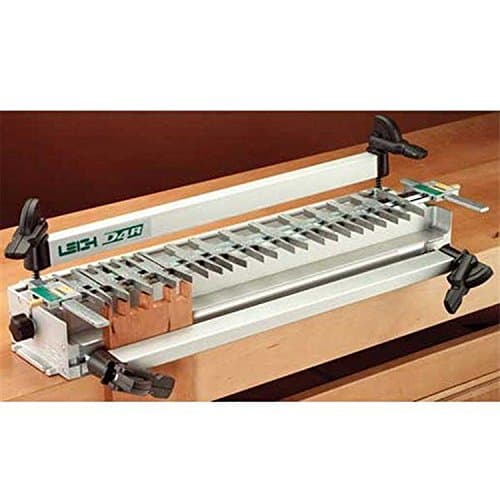
Leigh D4R Pro Dovetail Jig
24 in widthThrough + half-blindVariable spacingRouter-based
The dovetail jig for people who are serious about dovetails. Fully variable spacing cuts through, half-blind and sliding joints — the most capable jig here.
- Joint quality
- 10
- Versatility
- 10
- Ease of setup
- 6
- Build
- 9
- Value
- 7
Pros
- +Variable spacing means your dovetails don't look machine-made
- +Cuts through, half-blind, and more from one jig
- +Excellent manual and support — a jig you grow into, not out of
Cons
- −Expensive, and there is a real learning curve to setup
- −Overkill if you only ever need one drawer spacing
Don't buy this if…
…you want to cut a few half-blind drawers and be done — a fixed-template jig does that faster and for a fraction of the price.
Best value
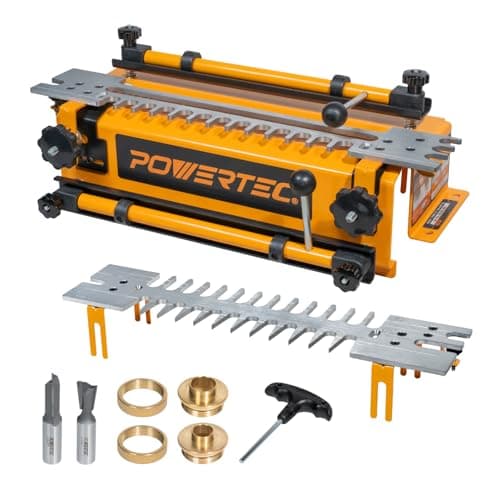
POWERTEC 72069 12-in Dovetail Jig
12 in widthHalf-blind + throughBox joints + dadosSteel base
The value all-rounder. A template-based jig that cuts half-blind and through dovetails plus box joints and dados — the sensible first dovetail jig for most shops.
- Joint quality
- 8
- Versatility
- 8
- Ease of setup
- 7
- Build
- 8
- Value
- 9
Pros
- +Two templates cover half-blind, rabbeted half-blind, sliding and through dovetails, plus box joints
- +Router bits and guide bushing are in the box, so there is nothing else to buy first
- +Takes stock from 1/4 to 1-1/8 in thick and up to 12 in wide
Cons
- −Fixed template spacing looks more uniform than variable-spaced joints
- −Template swaps take time compared with a single adjustable jig
Don't buy this if…
…you want hand-cut-looking, variable-spaced dovetails — that is what the pricier adjustable jigs are for.
Best for router-table shops
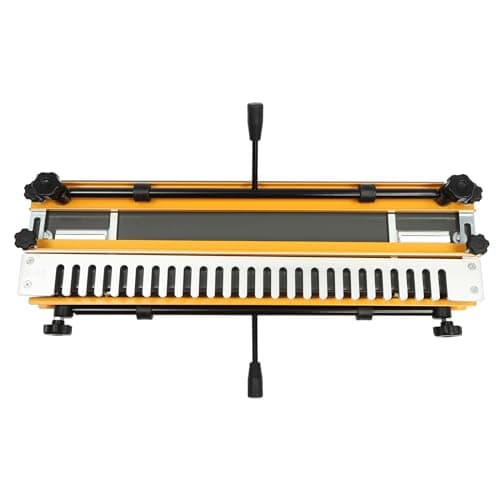
Woodhaven 7660 Half-Blind Router-Table Dovetail Jig
Router-table basedHalf-blind only1/2-3/4 in. stock, to 11-3/4 in. wideCarbide bit included
The dovetail jig for router-table shops. It bolts nothing to your bench and balances no router on a template — you bring the drawer part to the bit on the table you already own.
- Joint quality
- 8
- Versatility
- 5
- Ease of setup
- 8
- Build
- 9
- Value
- 7
Pros
- +Runs on the router table, which most people find steadier than balancing a router on a clamped jig
- +A 1/2-inch CNC-machined phenolic template is tough and cheap to replace if you cut into it
- +Ships with the matching 14-degree carbide dovetail bit and a bit-height setup gauge, so setup is not a shopping trip
Cons
- −Half-blind dovetails only — it will not cut the through dovetails a Leigh-style jig does
- −Requires a router table; it is not a standalone solution
- −Fixed 7/8-inch on-center spacing, so every joint it cuts looks the same
Don't buy this if…
…you want visible through dovetails or variable pin spacing. This is a drawer-production jig, not a showpiece-joint jig.
Best budget
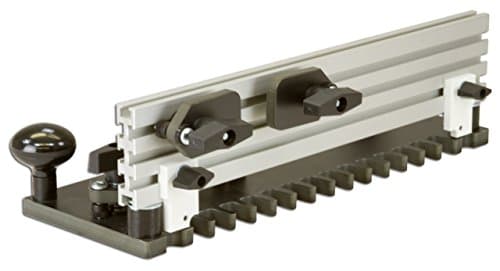
Aluminum Half-Blind Dovetail Jig
Fixed 1/2 in templateHalf-blindAluminumClamp-on
The budget way to try dovetails. A simple fixed-template aluminum jig that cuts half-blind drawer joints for very little money.
- Joint quality
- 6
- Versatility
- 5
- Ease of setup
- 6
- Build
- 6
- Value
- 8
Pros
- +Cheapest way to find out whether jig-cut dovetails are for you
- +Simple, few parts to fuss with
- +Fine for basic half-blind drawer boxes
Cons
- −One fixed spacing and joint type — limited as you improve
- −Basic build; setup can be finicky to dial in
Don't buy this if…
…you already know you'll want through dovetails or variable spacing — buy a more capable jig once and skip the upgrade.
How to choose a dovetail jig
Work backward from the project. A chest of drawers with hidden joints only needs half-blind dovetails, and a fixed-template jig like the Porter-Cable cuts those all day for a fraction of the price of an adjustable system. A blanket chest or a piece where the joinery is the feature wants through dovetails with variable spacing, which is the Leigh D4R's home turf.
Fixed template vs variable spacing
A fixed template has the pin-and-tail spacing built in, so every joint comes out identical and setup is fast — but a trained eye can tell it was jig-cut because the spacing is perfectly even. A variable jig lets you slide the guide fingers to any spacing, so you can vary the pins the way a hand-cut joint does. That flexibility is the whole reason the adjustable jigs cost several times more.
Router-table vs handheld
Most jigs clamp the workpiece and you run a handheld router over it. The Woodhaven 7660 flips that: the jig mounts to a router table and you bring the work to the bit, which many people find steadier. The trade is that it cuts half-blind dovetails only. If a router table is already the center of your shop and drawers are what you build, that approach is worth a look; if not, a clamp-on handheld jig is the more flexible first buy.
Whatever you buy, pair it with sharp chisels for cleaning up the corners — see our best woodworking chisels roundup — and cut every joint in scrap first.
How we picked
We do not run a testing lab
We researched published manufacturer specifications, manuals and spec sheets, ran the arithmetic those specs support, and read owner reviews at volume, then scored each tool against a published rubric. The scores are judgments from documented research — they are not measurements we took, because we do not have a lab and we are not going to pretend we do. Where a number came from a manufacturer's document, we name it and link it in Sources.
Questions
What is the best dovetail jig for a beginner?+
For a first jig, a fixed-template half-blind jig like the POWERTEC 72069 is the easiest to get a clean joint from, because the spacing is set for you and there are fewer variables to dial in. A fully variable jig is more capable but has a steeper setup curve.
Do I need a special router bit for a dovetail jig?+
Yes — a dovetail jig uses a dovetail router bit (and, for some joints, a straight bit), usually with a guide bushing in the router base. Most jigs specify the exact bit and bushing they need; buy the ones the jig calls for rather than guessing.
Can I cut dovetails without a jig?+
Absolutely — hand-cut dovetails need only a dovetail saw, a marking gauge and sharp chisels, and many woodworkers prefer them. A jig trades that skill-building for speed and repeatability. Our
how to cut dovetails guide covers the hand-tool route.
What's the difference between half-blind and through dovetails?+
A half-blind dovetail is hidden from the front of the joint — the classic drawer-front joint, where you see the tails only from the side. A through dovetail is visible on both faces and is the decorative joint most people picture. Some jigs cut only half-blind; others cut both.
Receipts
We do not run a testing lab, and we do not pretend to. Our picks come from published manufacturer specifications and manuals, the arithmetic those specs support, and owner reviews read at volume. Where we could not verify something, we say so on the page rather than quietly leaving it out. Read our full method.