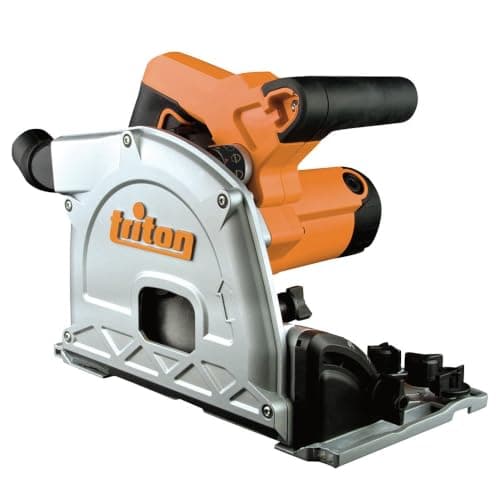
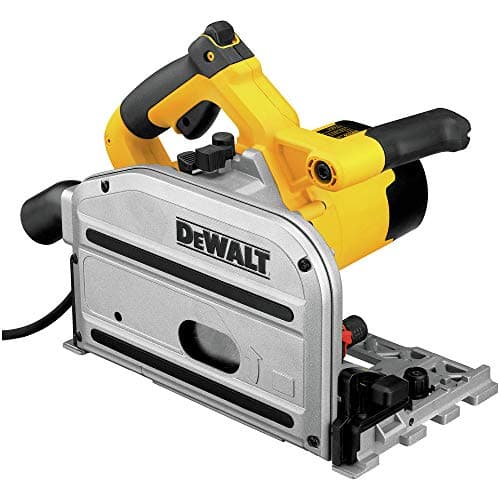
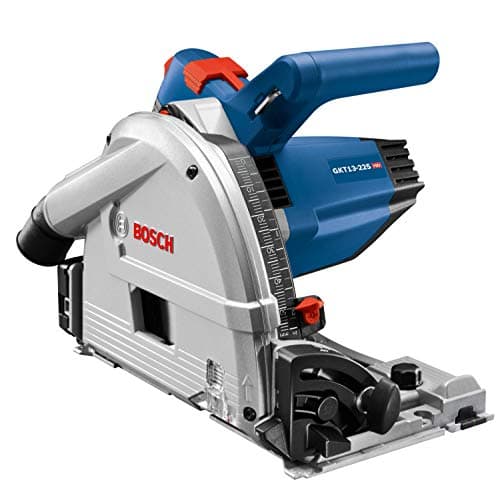
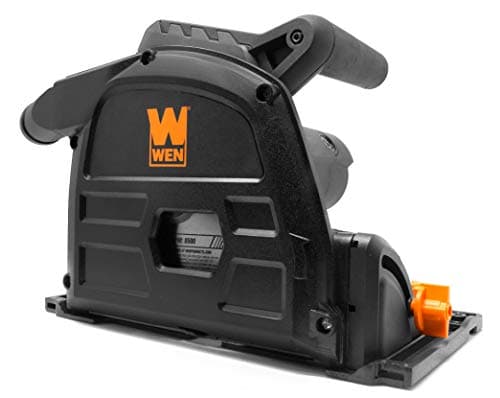
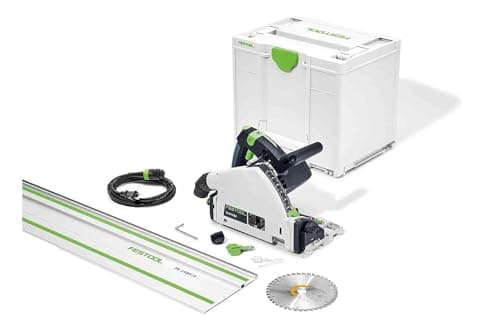
A track saw is not a better circular saw. It is a portable substitute for a panel saw — it brings the cut line to the sheet instead of wrestling an 8-foot sheet across a table saw — and the edge it leaves is good enough to glue. That last part is what people underestimate. A properly set-up track saw produces an edge square and clean enough that you skip the jointer entirely on plywood.
Here is the cost nobody puts on the box: the rails. Only one saw here — the Festool TS 55 in its Plus-FS configuration — ships with a 55-inch guide rail. Every other saw is a saw. Budget for at least one 55-inch rail (for crosscutting a sheet) and ideally a second, joined, to rip the full 8-foot length. On the mid-price saws, rails can add half the saw's price again. That is the single most common budgeting mistake in this category and the reason we call it out before the ranking rather than after.
What separates these saws is narrower than the prices suggest. All of them plunge, all of them ride a rail with a splinter strip, and all of them cut about 2 inches deep at 90 degrees. The differences that matter are: how clean the edge is on the offcut side, how much dust the shoe actually captures when connected to an extractor, and how stiff the rail-to-saw connection is — because a saw that rocks on the rail wanders, and no amount of technique fixes that.
One saw here is not a track saw at all, and we have kept it deliberately. The WEN CT1065 is a plunge-cut sidewinder circular saw — it plunges and it can run on a track, but it does not have the rail geometry or the dust shroud of the true track saws. It is in the ranking as the honest answer to "what if I only have a hundred dollars", with its limitations stated rather than glossed.
If you have not decided between this and a table saw yet, start at table saw vs track saw. And whatever you buy, pair it with real extraction — a track saw without a vacuum on the port blows fine dust straight along the cut line, which is both a health problem and a can't-see-the-line problem.
What actually separates a value track saw from a premium one
Three things, in descending order of how much you will notice them.
Dust extraction at the shoe
This is the biggest practical difference and the least discussed. A well-shrouded saw connected to an extractor captures the great majority of the dust at the cut. A poorly shrouded one throws a plume along the rail, which coats the splinter strip and hides your line. Festool built its reputation on this and it is still the clearest gap in the group. If you work in an attached garage, weigh it heavily.
Rail stiffness and the saw-to-rail fit
Every track saw rides in a groove on the rail, and every one has adjustable cams to take the slop out of that fit. On the premium saws the adjustment is fine and it holds. On cheaper saws it is coarser and drifts. A loose fit shows up as a cut that is square at the start and a hair off at the end — the classic symptom, and the reason to check and re-set the cams periodically on any saw here.
Blade quality and kerf consistency
The splinter strip on a rail is cut to the exact kerf of the blade fitted at the time. Swap to a blade with a different kerf and the strip no longer marks the true cut line. Premium saws ship with a good blade; cheaper saws often do not, so plan on a blade upgrade and trimming a fresh splinter strip afterwards.
How much rail do you actually need?
Work it out from your cuts, not from the catalog. A single 55-inch rail crosscuts a 4-foot-wide sheet with room to start and stop the plunge outside the material. Two 55-inch rails joined, or one 106-inch rail, rips the 8-foot length in one pass. If you never rip a full sheet lengthwise — and many cabinet cutting lists do not — one 55-inch rail is genuinely enough. Joining rails works well but every joint is a place a rail can go slightly out of line, so a single long rail is better if you can store it.
By shop size and budget
Occasional sheet work, tight budget: the WEN, understanding exactly what it is not. Regular cabinet builder: the Triton TTS1400 plus a 55-inch rail is the value sweet spot in this whole category. Already invested in one brand:the DeWalt if you own DeWalt, the Bosch if you own Bosch — rails and accessories compound. Building a cutting station, not just making cuts: the Kreg Adaptive Cutting System, because the table is the product. Attached garage, dust matters, budget is not the constraint: the Festool.
What we could not verify
We have not run identical sheets through all six saws. The wattages, blade sizes and rail lengths above are the manufacturers' published specifications. Cut-quality and dust-capture judgments come from documented design differences (shroud geometry, rail systems, included blades) and from owner reviews read at volume — not from instrumented tests, because we do not run a lab.
Still deciding against a circular saw?
The honest dividing line is whether the cut you make is the finished edge. A rail-guided plunge cut comes off the saw clean enough to glue; a circular saw leaves an edge something later has to clean up. We work that comparison through properly, with both families ranked side by side, in track saw vs circular saw— including the part most price comparisons miss, which is that a track saw without a rail is not yet a track saw.