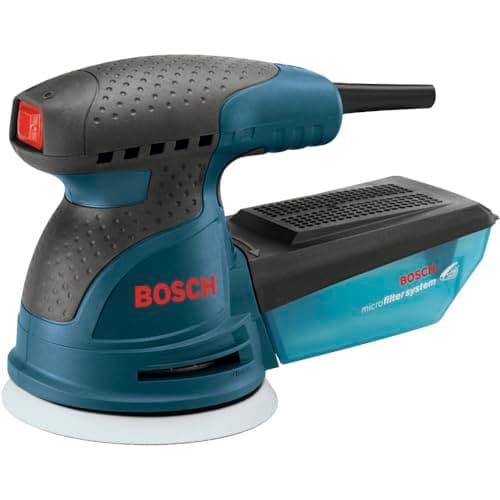
If you buy one sander for woodworking, buy a 5 in. random-orbit sander, and the one to buy is the Bosch ROS20VSC. It is for anyone sanding flat surfaces before a finish — which is nearly everyone — and it handles the overwhelming majority of sanding a furniture shop does. The budget pick is the Black+Decker BDERO100: one speed, a token dust bag, a published 12,000 OPM, and the cheapest honest way to stop sanding by hand. The other three machines on this page are not upgrades to that sander. They are different tools for jobs it genuinely cannot do: a belt sander for fast stock removal, an oscillating spindle sander for inside curves, and a drum sander for glued-up panels.
Prices beside each pick come from our live price layer rather than from this article, last checked November 23, 2026. Sanders are discounted hard and often, so treat the number beside the pick as the current one and the ranking as the reasoning.
The four sanding jobs, and which machine owns each
Almost every article on this subject ranks five random-orbit sanders against each other and calls that the category. It is not the category. Sanding in a woodworking shop is four separate problems, and the reason people end up with a drawer full of disappointing sanders is that they kept buying the same machine and asking it to do all four.
One: flattening and finishing a flat face. This is a random-orbit sander, and it is the job that fills most of the sanding hours in a furniture shop. The pad spins and orbits at the same time, so no abrasive grain travels the same path twice. That is what stops the swirl marks a disc sander leaves, and it is the whole reason the random-orbit layout exists.
Two: removing material fast.This is a belt sander. A random-orbit sander removes stock at a rate that makes you question your life choices if the surface is a quarter-inch out. A 3 x 21 in. belt at 1,000-plus feet per minute does the same work in a tenth of the time, and will also ruin a workpiece in a tenth of the time — which is why it is the second machine you buy, not the first.
Three: sanding an inside curve. No flat-pad sander reaches into a concave edge. An oscillating spindle sander has a drum that spins and simultaneously moves up and down, which both reaches the curve and spreads the wear over the whole abrasive sleeve instead of burning a band into the middle of it. If you cut curves on a bandsaw or a jigsaw, this is the machine that makes them look intentional.
Four: flattening and thicknessing a glued-up panel.This is a drum sander, and it is a machine, not a tool. It abrades rather than cuts, so grain direction stops mattering entirely — which is why it handles bookmatched curl and end-grain panels that no planer will touch without tearout. It is also the most expensive thing on this page by an order of magnitude, and it is the last sander any shop should buy.
Start with the random-orbit sander, and connect it to something
The Bosch ROS20VSC is the pick because of two specifications and one thing that is not a specification. The specifications are variable speed, which lets you drop the pad speed for a finish coat or an edge where a fast pad will roll the corner over, and a microfilter dust canister that does enough on its own that the shop air stays readable when you have not got a hose attached. The thing that is not a specification is that it is comfortable enough to hold through an hour of sanding, which decides whether a surface gets the pass it needed.
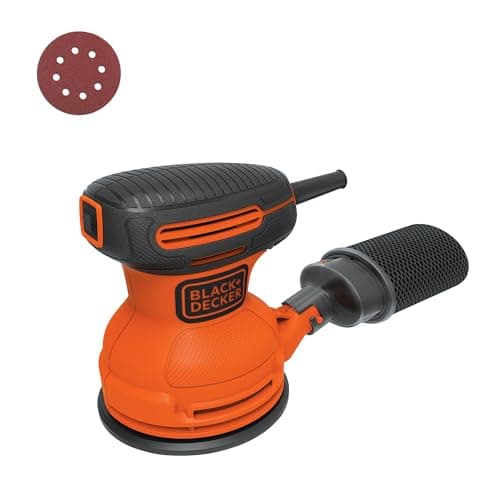
The Black+Decker BDERO100 is the budget pick and it is an honest one: a single speed, a published 12,000 OPM, a 2.0 A motor and the same ubiquitous 5 in. hook-and-loop discs. It will make a first project look finished. What you give up is the ability to slow the pad down, which matters on thin veneer and on a final pass before finish.
Whichever you buy, the sander is not the thing that decides how clean your shop is. Sanding dust is the finest dust a woodworking shop produces and the most worth capturing — our wood dust health risks page sets out why, sourced to IARC, OSHA and NIOSH rather than to us. A 5 in. sander on a shop vac with a decent filter is a different experience from the same sander on its onboard bag. The shop vac roundup covers that end of it, and a cyclone separator is what stops you buying a bag a week.
The belt sander is a stock-removal tool, not a finishing tool
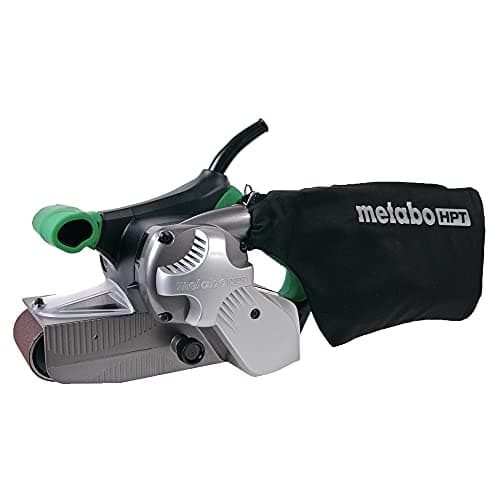
The Metabo HPT SB8V2 is the handheld to buy, and the reason is the speed dial. Metabo HPT publishes 820 to 1,475 ft/min on a 9 A motor: at the bottom of that range you can ease an edge on plywood without going through the face veneer, and at the top you can take a glue line off a hardwood edge in seconds. The company publishes 87 dB and a 9.5 lb weight, and backs it with a five-year limited warranty. A belt sander with one speed is a tool you use carefully; one with a dial is a tool you use.
The thing to understand about belt width is that a 3 in. belt follows the shape of whatever is under it, while a 4 in. belt bridges across high spots. If your reason for wanting a belt sander is flattening glued-up tabletops, the wider belt is the one that does that job, and our belt sander roundupranks that field in full. If your reason is edges, doors and small parts — which is most shops — the 3 x 21 in. class is lighter, cheaper and easier to control, and belt sanders under $200 is where that part of the field sits.
Curves need a spindle sander, and the combo machine is the sensible compromise
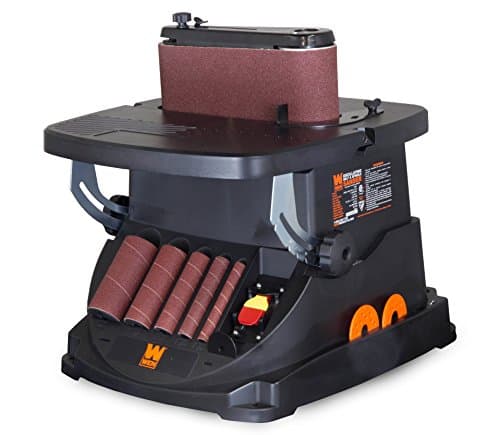
The WEN 6524 is here because it is an oscillating spindle sander and an oscillating belt sander in one benchtop footprint, with the range of spindle sizes in the box rather than sold separately. For a shop with one spare bench slot that is the right answer: the spindle mode does inside curves, the belt mode does straight edges and end grain, and you batch the work rather than swapping the machine mid-task.
If curves are a serious part of what you build, the dedicated machines in our spindle sander roundup have flatter, heavier cast-iron tables and quieter running under load, and that difference shows on parts you care about. The combo machine is the compromise, and it is a good one.
The drum sander is the last machine, and it is a machine
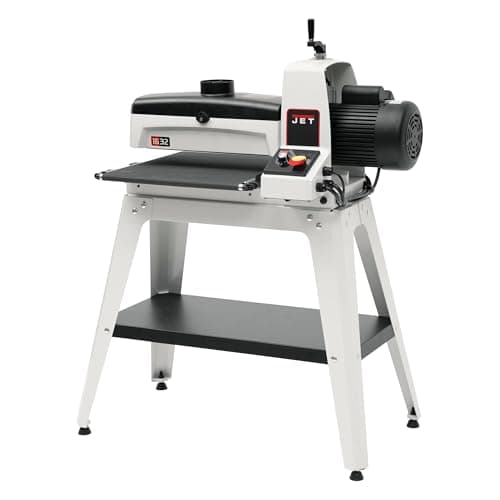
The JET JWDS-1632 is on this page for completeness and for one specific reader: the person gluing up panels that a planer tears out. JET publishes a 16 in. drum on a 1-1/2 HP, 115 V single-phase motor on an open stand, and open-ended means a 32 in. panel goes through in two passes. A drum sander abrades, so a bookmatched curly maple top that would chip out under any cutterhead comes off the drum clean.
It is also a chip factory that needs real floor space and real extraction, and it costs more than the other four machines on this page put together. Buy it fifth. Our drum sander roundup ranks that field properly, and drum sander vs planer is the page to read before you spend the money, because for most shops a planer and a hand plane is the cheaper answer to the same problem.
Side by side, as published
| Machine | Job it owns | Published motor / speed | Published abrasive | Buy it |
|---|
| Bosch ROS20VSC | Flat faces, pre-finish | 2.5 A, variable speed | 5 in. hook-and-loop discs | First |
| Black+Decker BDERO100 | Flat faces, occasional | 2.0 A, 12,000 OPM single speed | 5 in. hook-and-loop discs | First, on a budget |
| Metabo HPT SB8V2 | Fast stock removal | 9 A, 820-1,475 ft/min | 3 x 21 in. belts | Second |
| WEN 6524 | Inside curves and end grain | Not published by WEN | Spindle sleeves + belt | Third |
| JET JWDS-1632 | Glued-up panels | 1-1/2 HP, 115 V 1-phase | 16 in. drum wrap | Last |
Every figure above is the manufacturer's own published number for the exact model we link, and the blanks are blanks for a reason: WEN publishes no motor amperage, belt speed or oscillation rate for the 6524, so we print none. We did not measure an orbit, time a pass or weigh a machine — there is no lab here, which the methodology page states plainly.
What to buy, in order
A first shop buys the Bosch ROS20VSC, a box of 80, 120 and 180 grit discs, and a hose to put it on. That is the whole sanding department for a year, and our grit progression guide covers how to use it without wasting half the discs. The belt sander comes when you find yourself sanding for twenty minutes to remove an eighth of an inch. The spindle sander comes the first time you cut a curve you are not proud of. The drum sander comes when panels are the bottleneck, and for most shops that day never arrives.
If your sanding leaves swirls rather than a surface, the machine is rarely the problem. Sander swirl marks works through the real causes, and how to use a random orbital sander covers the technique that makes the biggest difference of anything on this page.