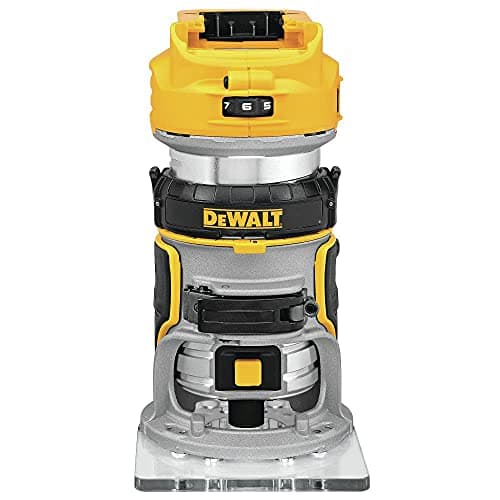
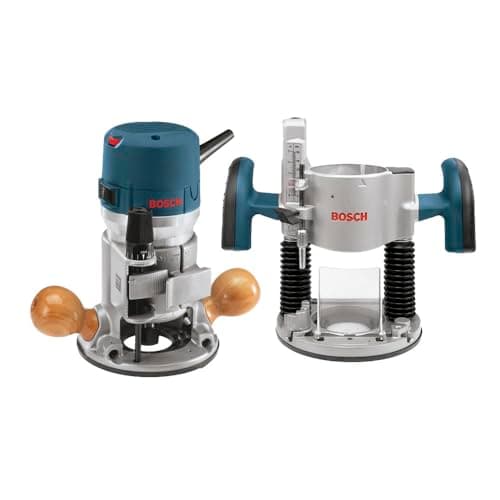
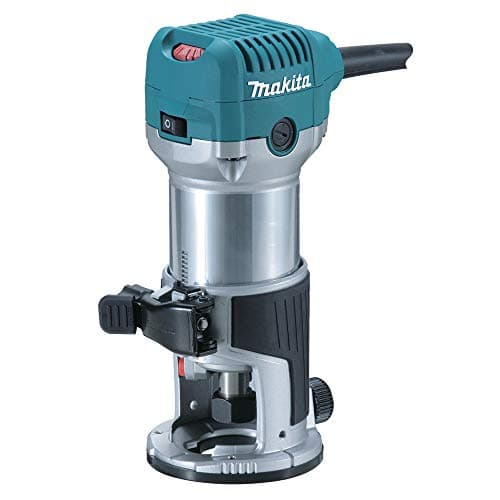
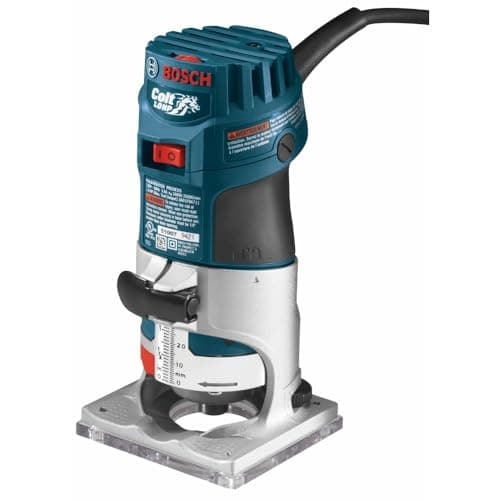
Buy the Bosch Colt PR20EVS. A 1.0 HP palm router with variable speed from 16,000 to 35,000 RPM is the right first router because it is light enough to control with one hand, small enough to see the bit and the line, and powerful enough for every job a beginner actually has: rounding over edges, trimming laminate and veneer, cutting small dados, following a template. It is also the cheapest router on this page with a live price, so there is no separate budget pick to name — the right answer and the cheap answer are the same tool. Buy the DeWalt DCW600B instead if you already own 20V MAX batteries, the Bosch 1617EVSPK if you would rather buy once and never upgrade, and the Makita RT0701C if you want a compact router with a reputation for lasting.
Why small is the right first router
A router is a motor spinning a cutter at tens of thousands of RPM, held in your hands, against the grain of the wood. Everything about learning to use one safely is about control, and control is mostly about mass and sightlines.
A compact router you can hold in one hand lets you keep the other hand on the work, see the bit meeting the line, and feel immediately when the cut loads up. If it catches, your wrist stops it. A 2 to 3 HP two-handed plunge router is a very different object: it is heavy, the body hides the cut, and if it grabs, it moves. Both of those are fine once you know what the tool does. Neither is where to start.
There is a second reason, which nobody mentions in reviews: bit cost. A compact router takes 1/4 in. shank bits, and 1/4 in. bits are substantially cheaper than their 1/2 in. equivalents. Your first year with a router is a year of discovering which profiles you actually use, and discovering that on cheap bits is much less painful. The shank question in full is on router bit shank size.
Fixed base or plunge, for a first router
A fixed base sets the bit at one depth and holds it there. That covers edge profiles, rabbets, dados against a straightedge, and anything run in a router table — which is most of what a beginner does.
A plunge base lets you lower a spinning bit into the middle of a surface and lift it out again. You need it for stopped dados, mortises, inlay, and template work that starts inside the panel rather than at an edge.
The honest recommendation is to start with a fixed base, because the jobs that require plunging are not usually the first jobs anyone does, and because a plunge base adds height, weight and a second set of things to adjust. The Bosch 1617EVSPK here is on the page precisely for people who want to skip that step: it is a combo kit with both bases and a single motor that swaps between them, with 1/4 and 1/2 in. collets and a published 8,000 to 25,000 RPM range. The full argument is on plunge vs fixed base router.
Variable speed is not optional
This is the one specification a beginner should refuse to compromise on, and it is the reason every router on this page has it.
Bit speed should fall as bit diameter rises, because what matters is the speed at the cutting edge, not at the shaft. A small round-over bit is happy at the top of the range. A large panel-raising bit at the same RPM is dangerous and will burn the wood. Running a big bit too fast is the most common way a beginner scares themselves, and a single-speed router makes it unavoidable. The published figures per diameter are tabulated on router bit speed chart.
Note the ranges here differ meaningfully. The Bosch Colt publishes 16,000 to 35,000 RPM — a high range suited to small-diameter bits, which is what a palm router takes. The Bosch 1617EVSPK publishes 8,000 to 25,000 RPM, a lower range because it will be swinging large 1/2 in. shank bits. Neither range is better; they match the bits each tool is for.
The first four jobs, and what you need for them
Round over an edge. A bearing-guided round-over bit, a fixed base, and no other equipment at all. This is the job that makes people buy a router and it is genuinely as easy as it looks.
Cut a dado or a groove. A straight bit and a clamped straightedge. Measure the offset from the edge of the base to the edge of the bit once, write it on the base, and the job becomes arithmetic.
Flush-trim a template. A bearing-guided flush-trim bit, a template, and double-sided tape. This is the technique that unlocks repeatable parts and it is worth learning early.
Rabbet for a back panel. A rabbeting bit with a bearing, or a straight bit against a fence. Either works; the bearing version needs no setup.
Three rules cover the safety of all four. Feed against the rotation — left to right on an outside edge — so the bit pushes back at you rather than running away. Take shallow passes; two light cuts are faster than one heavy one plus the repair. Let the router reach full speed before it touches the wood, and wait for it to stop before you set it down.
Side by side
| Router | Published power | Published speed | Collet | Base |
|---|
| Bosch Colt PR20EVS | 1.0 HP, 5.6 A | 16,000-35,000 RPM | 1/4 in. | Palm, fixed |
| DeWalt DCW600B | Brushless, 20V MAX | 16,000-25,500 RPM | 1/4 in. | Fixed (bare tool) |
| Bosch 1617EVSPK | 2.25 HP | 8,000-25,000 RPM | 1/4 and 1/2 in. | Fixed + plunge |
| Makita RT0701C | 1.25 HP | 10,000-30,000 RPM | 1/4 in. | Compact, fixed |
Every figure is the manufacturer's published specification for the listing we link. We did not measure horsepower or RPM — we do not run a lab, as the methodology page says in those words.
What to buy with it
Budget for bits. A router with no bits does nothing, and a starter set of 1/4 in. shank bits — a couple of round-overs, a straight bit, a flush-trim and a rabbeting bit — covers the first year. The sets are ranked on best router bits, and what each profile actually does is on router bit types explained.
Do not budget for a router table yet. A table is the right second step, not the first, and buying one on day one usually means buying the wrong one. When the time comes, that is best router table.
What to buy, in order
First router, no battery platform: the Bosch Colt. First router, already on DEWALT 20V MAX: the DCW600B. First and last router, if you would rather buy the big one now and grow into it: the Bosch 1617EVSPK combo. A compact alternative with a long reputation: the Makita RT0701C.
The category ranked without the beginner lens is on best woodworking router, and if you are not yet sure what a router is for, start at the router buying guide.