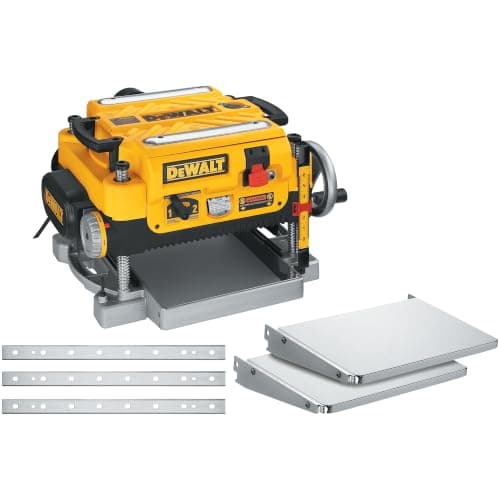
The DeWalt DW735X is the benchtop planer most shops should buy: a three-knife head, two feed speeds and a powered fan that actually clears chips make it the cleanest, best- supported machine in the class. But if figured or curly wood is your staple, a spiral cutterhead like the WEN PL1326 or the Cutech tears out far less on wild grain — and that, not the badge on the front, is the decision that should drive your choice. So we ranked these by cutterhead and by how they handle the grain you actually cut.
The cutterhead is the whole decision. A three-knife straight head, like the ones in the DW735 and the DW734, shears cleanly on straight-grained stock and leaves a glassy surface — but on curly, wavy or interlocked grain it lifts and tears the fibers. A spiral or helical head replaces the long knives with rows of small square inserts that each take a tiny shearing bite, which slices figured grain instead of ripping it and runs noticeably quieter. The WEN PL1326 and the Cutech both use that insert design, which is why they are the picks for anyone who mills a lot of figured wood.
Two things bother every benchtop planer. The first is snipe — a slightly deeper cut in the last few inches at each end of a board, caused by the board rocking as it leaves one feed roller. Support the ends with infeed and outfeed tables or a helper, feed boards nose-to-tail, and snipe mostly disappears. The second is noise: these are loud, universal-motor machines, and the Makita 2012NB stands out precisely because it runs much quieter than the rest — a real consideration in a shared garage. Whichever you pick, plan for chips, because a planer makes them by the bin — see our small-shop dust collector guide.
The short answer
#ad · Live prices from the Amazon Product API, as of Sep 19, 2026. Where we have no verified live price, we show none — we would rather leave a gap than print a number that has rotted.
In detail
Best overall
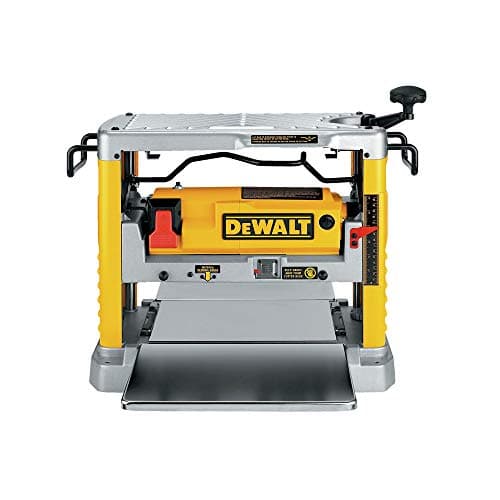
DeWalt DW735X 13-in Thickness Planer
13 in width2 speeds (96/179 CPI)3-knife headFan chip ejection
The benchtop planer standard. A three-knife head, two feed speeds and a real chip-ejection fan make it the cleanest-cutting unit in the class.
- Cut quality
- 9
- Snipe control
- 8
- Dust handling
- 9
- Noise
- 5
- Value
- 8
Pros
- +Two feed speeds let you trade speed for a finer finish on the last pass
- +Powered fan actually blows chips out — pairs beautifully with dust collection
- +The X kit adds infeed/outfeed tables and spare knives
Cons
- −Heavy and loud, like all benchtop planers
- −Straight knives cost more to replace than carbide inserts over time
Don't buy this if…
…figured or curly wood is your staple — a spiral/helical insert head tears out less on wild grain than any straight-knife planer.
Best value (spiral)
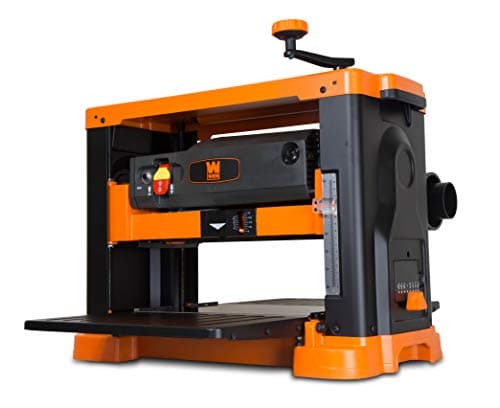
WEN PL1326 13-in Spiral Planer
13 in widthSpiral headHSS inserts15 A
A spiral-cutterhead planer at a straight-knife price. Insert cutters mean quieter cuts and far less tearout on figured stock, for the money.
- Cut quality
- 8
- Snipe control
- 7
- Dust handling
- 7
- Noise
- 7
- Value
- 9
Pros
- +Insert cutterhead handles figured grain with much less tearout than straight knives
- +Rotate an insert when it nicks instead of replacing a whole knife set
- +Costs less than the straight-knife category leader
Cons
- −Not as refined or as well-supported as the DeWalt
- −Snipe control needs attention with support on long boards
Don't buy this if…
…you want the most proven, best-supported machine and cut mostly straight-grained stock — the DW735 is the safer long-term buy there.
Best DeWalt value
DeWalt DW734 12-1/2-in Planer
12-1/2 in width3-knife head10k RPM head96 CPI
The DW735's smaller, cheaper sibling. One feed speed, three knives, and the same clean DeWalt cut for less money.
- Cut quality
- 8
- Snipe control
- 7
- Dust handling
- 6
- Noise
- 5
- Value
- 8
Pros
- +Excellent finish for a single-speed planer
- +Cheaper than the DW735 while keeping the three-knife head
- +Well supported, easy to find knives
Cons
- −No second feed speed and no powered chip fan
- −Narrower capacity than the 13-inch machines
Don't buy this if…
…you want the powered chip ejection and finish-pass speed — that is what the extra money on the DW735 buys.
Best for a quiet/small shop
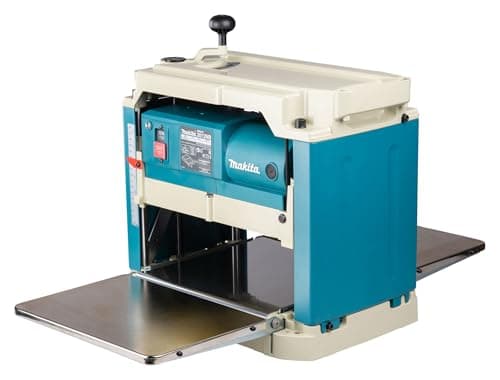
Makita 2012NB 12-in Planer
12 in widthQuiet (~83 dB)Interna-Lok head~62 lb
The quiet, light one. Notably lower noise and weight than its rivals, with a clever anti-snipe head lock — a good fit for a shared or small shop.
- Cut quality
- 7
- Snipe control
- 8
- Dust handling
- 6
- Noise
- 9
- Value
- 6
Pros
- +Much quieter than typical benchtop planers — real relief in a garage
- +Light enough to move and store easily
- +Head-lock design helps keep snipe down
Cons
- −Two-knife head, so more passes on figured wood
- −Premium price for the capacity
Don't buy this if…
…you want maximum cut quality per pass or a spiral head — the three-knife DeWalt and the spiral WEN both out-finish it on tough grain.
Best spiral alternative
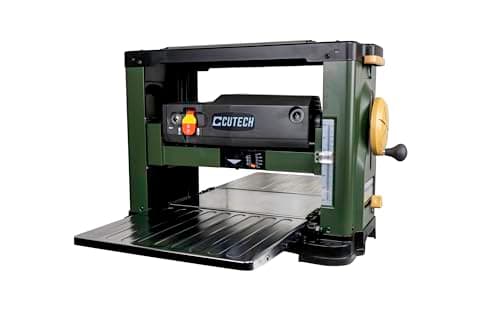
Cutech 13-in Spiral Planer
13 in widthSpiral headHSS insertsBenchtop
A dedicated spiral-head benchtop planer for the figured-wood crowd. Rows of carbide-style inserts give a clean, quiet cut on difficult grain.
- Cut quality
- 8
- Snipe control
- 7
- Dust handling
- 6
- Noise
- 7
- Value
- 8
Pros
- +Insert cutterhead excels on curly and figured stock
- +Quieter than a straight-knife planer
- +Rotate a nicked insert rather than replacing a knife set
Cons
- −Smaller support network than DeWalt or WEN
- −Fit and finish is functional, not premium
Don't buy this if…
…you want the best-supported, most widely serviced machine — the DeWalt line is easier to get parts and help for.
How to choose a benchtop planer
Start with the wood you actually cut. If you mostly run construction lumber and straight- grained hardwood, a three-knife machine gives you the cleanest cut for the money, and the DW735 is the class benchmark. If figured, curly or reclaimed wood is a regular part of your work, a spiral cutterhead pays for itself in avoided tearout and sanding, and it is quieter on every pass. That single choice — knife type — matters more than brand or capacity.
Three-knife vs spiral heads
A three-knife head spins two or three long straight blades and takes a clean, wide shaving — excellent on cooperative grain, but it can chip out on figure. A spiral (or helical) head carries dozens of small inserts arranged in a shearing spiral, so it slices difficult grain with much less tearout and less noise. Maintenance differs too: nick a straight knife and you replace or re-set the whole set; nick a spiral insert and you simply rotate that one square insert to a fresh edge.
Snipe, feed speed, and finish
Nearly every benchtop planer snipes a little; good board support is the fix, not a spec. The DW735's two feed speeds help here — drop to the slower speed for a fine finish pass, so the last cut is as clean as possible. Take light passes as you approach final thickness, keep the board flat on the bed, and you will need little more than a light sanding to finish.
Noise, chips, and dust
These machines are loud and throw an enormous volume of chips. The Makita 2012NB is the quiet option if a shared or attached garage makes noise a real problem; the DW735's powered fan is the standout for chip ejection and pairs well with a collector. Either way, connect real dust collection — a planer will bury a shop vac fast, as our small-shop dust collector guide explains.
How we picked
We do not run a testing lab
We researched published manufacturer specifications, manuals and spec sheets, ran the arithmetic those specs support, and read owner reviews at volume, then scored each tool against a published rubric. The scores are judgments from documented research — they are not measurements we took, because we do not have a lab and we are not going to pretend we do. Where a number came from a manufacturer's document, we name it and link it in Sources.
Questions
Do I need a spiral cutterhead planer?+
Only if you regularly plane figured, curly or interlocked grain. A spiral or helical head takes small shearing bites that slice wild grain with far less tearout than straight knives, and it runs quieter. For mostly straight-grained stock, a good three-knife planer like the DW735 gives an excellent finish for less money.
What causes snipe, and how do I stop it?+
Snipe is a slightly deeper cut in the first and last few inches of a board, caused by the board tipping when only one feed roller is holding it. Support long boards with infeed and outfeed tables or a helper, keep the board flat against the bed, and feed pieces end-to-end so the trailing board backs up the one ahead. Most benchtop planers snipe a little; good support reduces it to a light sanding pass.
Can a planer flatten a warped board?+
No — a planer references the bottom face and cuts the top parallel to it, so a cupped or twisted board comes out thinner but still cupped or twisted. To flatten a face you need a jointer, a planer sled, or a hand plane first, then the planer makes the opposite face parallel. Our
jointer vs planer comparison explains the workflow.
Are benchtop planers loud?+
Yes, most are — they use high-speed universal motors and cut a lot of wood at once. The Makita 2012NB is the notable exception, running quieter than typical benchtop planers, which matters in a shared or attached garage. Hearing protection is sensible with any of them.
Receipts
We do not run a testing lab, and we do not pretend to. Our picks come from published manufacturer specifications and manuals, the arithmetic those specs support, and owner reviews read at volume. Where we could not verify something, we say so on the page rather than quietly leaving it out. Read our full method.