Skip to content
Dovetail & Dust

HUB 05 · Shop Setup

Best Air Compressor for Woodworking

Nearly every compressor sold will run a brad nailer. Almost none of them will do it without making a noise you can hear through the house, and that is the specification woodworkers get wrong.

By Stephen V.Updated How we research
#ad

We earn a commission when you buy through our Amazon links, at no extra cost to you. It never changes our rankings, and we say so when the cheaper tool is the better buy. How this works.

Buy the California Air Tools 8010A. Eight gallons, a published 60 dBA, and enough air for any nailer a woodworker owns. Noise is the specification you live with every single time you use the tool, and it is the one the category competes on least. The DEWALT DWFP55130is the pick if the compressor has to be carried — 3.0 SCFM at 90 PSI out of a 36 lb box — the Metabo HPT EC28M is the pick if you own exactly one brad nailer, and the Makita MAC2400 is the pick if you want a compressor you will never replace.

What woodworking actually asks of a compressor

Air tools fall into two groups and the gap between them is enormous. Nailers and staplers are intermittent: each shot uses a tiny, fixed volume of air and then the tool sits idle while you reposition. Sanders, die grinders, spray guns and blowguns are continuous: they consume air the entire time the trigger is down. A compressor that feeds a brad nailer all day cannot feed an air sander for two minutes, and no tank size fixes it — the pump has to make air as fast as the tool uses it.

Almost all woodworking air use is in the first group. A brad nailer, a 16-gauge finish nailer, a crown stapler, the occasional burst from a blowgun. That is why this page ranks quiet, modest compressors above big ones: for the tools woodworkers own, a 60 dBA 8-gallon unit is a better machine than a 79 dBA twin-stack that delivers twice the air you will never use. If spray finishing is in your plans, that changes the answer, and it changes it toward the Makita and away from everything else here.

SCFM at 90 PSI is the only output number worth reading

Compressors are marketed on horsepower and tank gallons, and neither tells you what the machine delivers. Horsepower is a motor rating, not an air rating, and the peak figures used in marketing are not sustainable. Tank gallons tell you how much air is stored, which only buys you time before the pump has to catch up.

The number that matters is SCFM at 90 PSI: how much air the machine can supply continuously at the pressure tools actually run at. Every published figure on this page is at 90 PSI so the six are comparable — 0.8 CFM for the 1-gallon Metabo HPT, 2.6 SCFM for both 6-gallon pancakes, 3.0 SCFM for the DEWALT trim unit, 4.2 CFM for the Makita. Note that the DEWALT delivers more air than either 6-gallon pancake from a 2.5 gallon tank, because it stores at 200 PSI instead of 150. Gallons are not air.

How much air a nailer really uses

Published per-shot figures make this concrete. Metabo HPT lists the NT65MA4 15-gauge finish nailer at 0.045 cu. ft. per cycle at 100 psi. An 18-gauge brad nailer uses materially less, though Metabo HPT publishes no per-cycle figure for the one we rank. At those numbers, a compressor delivering 2.6 SCFM can supply a finish nailer firing continuously faster than anybody nails by hand, and the 0.8 CFM of the 1-gallon unit is enough for a brad nailer at a working pace and not enough for a 15-gauge tool.

So the sizing question for a woodworker is not “how big” but “which nailer”. One brad nailer: a gallon will do. A brad nailer and a finish nailer: 2.5 to 6 gallons and 2.5 SCFM or better. Anything that consumes air continuously: a different class of machine entirely, and look at the published duty cycle before you buy it. Our brad nailer roundup covers the tools on the other end of the hose, and brad nailer vs finish nailer settles which one you need first.

Noise is the specification you live with

A pancake compressor at 78.5 dBA in a closed garage is loud enough to want hearing protection for, and loud enough to notice through a wall. The quiet units on this page publish 59 and 60 dBA. The decibel scale is logarithmic, so that gap is far larger than the numbers look: an 18-point difference is roughly the difference between a conversation and a food blender.

Quiet compressors get there by turning a larger pump slowly rather than a small pump fast. The trade is weight and cost per unit of air — the California Air Tools unit is heavier and pricier than a pancake delivering similar output. If the shop is attached to a house with people in it, or shares a wall with a neighbor, that is money well spent. Note also what quiet does not buy: oil-free pumps of any kind are shorter-lived than oil-lubricated ones, and the quiet rating comes from motor speed, not from the pump type.

And one figure to watch for by its absence: CRAFTSMAN publishes no dBA for its pancake unit. On a tool where noise is the daily experience, an unpublished noise figure is a real gap, and we have said so in that pick rather than guessing a number.

Oil-free or oil-lubricated

Five of the six here are oil-free: nothing to check, nothing to change, nothing to spill, and a pump that wears out rather than one you maintain. The Makita is oil-lubricated with a cast iron cylinder, which is the construction that makes a compressor a twenty-year tool. It asks for an oil level check, periodic changes and a reasonably level floor in exchange.

For a woodworker firing a few hundred brads a month, oil-free is the right answer and the maintenance you avoid is worth more than the service life you give up. For a shop running air continuously, the opposite is true. There is no version of this trade where the oil-free pancake is the tool for spraying.

Two things to do the week it arrives

Open the tank drain. Compressed air condenses water, the water collects at the bottom of the tank, and a steel tank rusts from the inside where you cannot see it. Drain it after every session you can remember to, and at minimum every few weeks — this is the single maintenance item that decides whether a cheap compressor lasts.

Then check your circuit. A 120V compressor drawing 10 to 15 A on startup shares badly with a dust collector or a table saw on the same circuit, and a breaker trip mid-glue-up is its own kind of disaster. Our workshop power requirements guide covers what a garage shop can actually run at once. Prices below come from our live price feed and carry the date they were pulled.

The short answer

Quick picks

#ProductBest forScorePrice
01
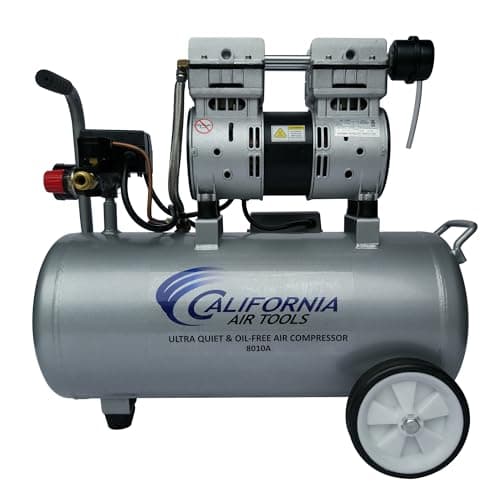
California Air Tools California Air Tools 8010A Ultra Quiet 8-Gallon Air Compressor
California Air Tools 8010A Ultra Quiet 8-Gallon Air Compressor

Sixty decibels and eight gallons. The compressor that can live in a one-car shop and still feed a nailer all afternoon, which is the whole brief for woodworking.

Best overall
7.8
$249.99Amazon
02
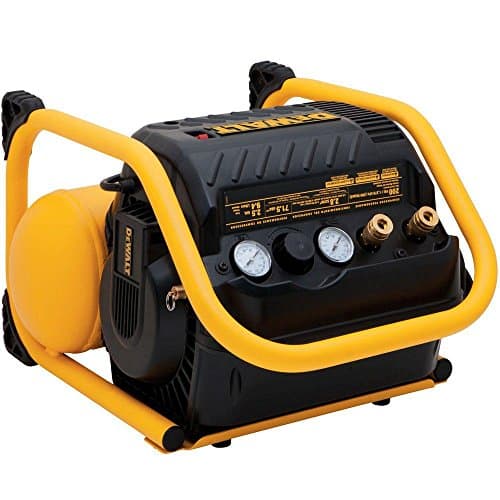
DEWALT DEWALT DWFP55130 Quiet Trim Compressor (2.5 gal., 200 PSI)
DEWALT DWFP55130 Quiet Trim Compressor (2.5 gal., 200 PSI)

Three SCFM at 90 PSI out of a 2.5 gallon tank, because DEWALT stores it at 200 PSI instead of 150. The most usable air per pound of compressor on this page.

Best air-to-size ratio
7.6
$278.00Amazon
03
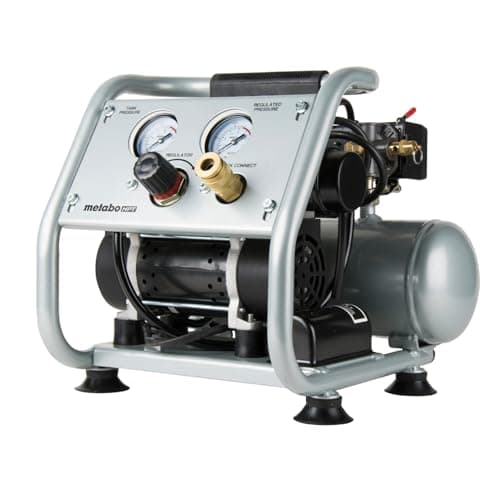
Metabo HPT Metabo HPT EC28M Quiet Air Compressor (1 gal.)
Metabo HPT EC28M Quiet Air Compressor (1 gal.)

Twenty-five pounds, 59 dB and a gallon of air. The compressor for someone who owns one brad nailer and does not want a machine in the shop.

Best small and quiet
6.8
$189.00Amazon
04
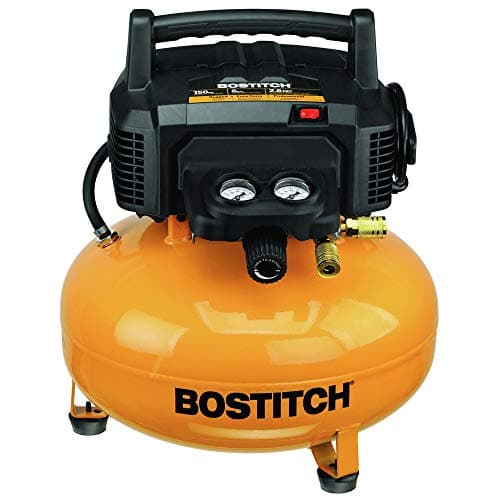
BOSTITCH BOSTITCH BTFP02012 Pancake Air Compressor (6 gal., 150 PSI)
BOSTITCH BTFP02012 Pancake Air Compressor (6 gal., 150 PSI)

The pancake compressor the category is measured against: 6 gallons, 150 PSI, 2.6 SCFM at 90 PSI and two couplers so a second tool stays connected.

Best conventional pancake
7.2
$219.98Amazon
05
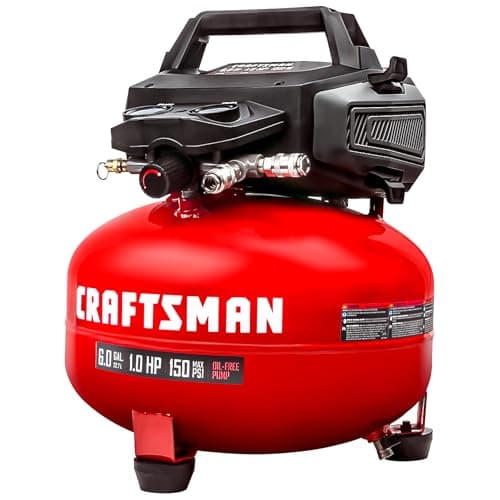
CRAFTSMAN CRAFTSMAN CMXECXA02106410 Pancake Air Compressor (6 gal.)
CRAFTSMAN CMXECXA02106410 Pancake Air Compressor (6 gal.)

The same 6 gallons, 150 PSI and 2.6 SCFM at 90 PSI as the BOSTITCH, for noticeably less. The budget pick that is not a compromise on air.

Best value
7.2
$159.99Amazon
06
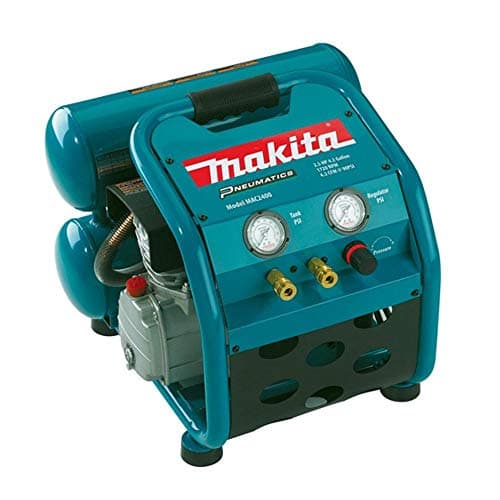
Makita Makita MAC2400 Big Bore Air Compressor (2.5 HP, 4.2 gal.)
Makita MAC2400 Big Bore Air Compressor (2.5 HP, 4.2 gal.)

A cast-iron, oil-lubricated pump delivering 4.2 CFM at 90 PSI. The buy-once compressor, and the only machine here that will feed a tool consuming air continuously.

Best buy-once compressor
6.2
$434.00Amazon

#ad · Live prices from the Amazon Product API, as of October 18, 2026. Where we have no verified live price, we show none — we would rather leave a gap than print a number that has rotted.

In detail

The picks, in full

01
California Air Tools California Air Tools 8010A Ultra Quiet 8-Gallon Air Compressor

Best overall

California Air Tools 8010A Ultra Quiet 8-Gallon Air Compressor

8 gal. aluminum tank1.0 HP60 dBA publishedOil-free
7.8/10

Sixty decibels and eight gallons. The compressor that can live in a one-car shop and still feed a nailer all afternoon, which is the whole brief for woodworking.

Noise
10
Air delivery
7
Tank capacity
8
Portability
6
Value
8

Pros

  • A published 60 dBA is quiet enough to run in a garage shop without ear protection and without a conversation with the neighbors
  • Eight gallons is enough stored air that a finish nailer never waits for the pump, unlike the 1 and 2 gallon quiet units
  • An aluminum tank will not rust from the inside out the way a steel tank does when the drain valve goes unopened for a year

Cons

  • Oil-free pumps are shorter-lived than oil-lubricated ones; the quiet here comes from a low-RPM motor, not from the pump type
  • 1.0 HP means slow recovery compared with a 2.5 HP machine — fine for nailers, thin for continuous spraying
  • Eight gallons on wheels is still a compressor you have to find permanent floor space for

Don't buy this if…

…you need air for a sander, a die grinder or continuous spray work. Those are continuous-consumption tools and they want a far bigger pump than this.

$249.99View on Amazon

$265.006% off

Price as of October 18, 2026. Prices change — Amazon's is the one that counts.

#ad · we may earn a commission from this link to California Air Tools 8010A Ultra Quiet 8-Gallon Air Compressor

02
DEWALT DEWALT DWFP55130 Quiet Trim Compressor (2.5 gal., 200 PSI)

Best air-to-size ratio

DEWALT DWFP55130 Quiet Trim Compressor (2.5 gal., 200 PSI)

2.5 gal.200 max PSI3.0 SCFM at 90 PSI71.5 dBA, 36 lb
7.6/10

Three SCFM at 90 PSI out of a 2.5 gallon tank, because DEWALT stores it at 200 PSI instead of 150. The most usable air per pound of compressor on this page.

Noise
7
Air delivery
9
Tank capacity
6
Portability
9
Value
7

Pros

  • A published 3.0 SCFM at 90 PSI beats every 6-gallon pancake here, from a tank less than half the size
  • 200 PSI storage means the small tank holds far more usable air than its gallon figure suggests
  • 36 lb published with a roll cage — genuinely carryable to a job, which an 8-gallon quiet unit is not

Cons

  • 71.5 dBA is quiet for a compressor and still well above the 60 dBA California Air Tools unit
  • 2.5 gallons cycles the pump more often than 8 gallons does, so you hear it more often even though each burst is shorter
  • 200 PSI hoses and fittings are not what a big-box store stocks by default — check the rating on anything you already own

Don't buy this if…

…the compressor will live in one place forever. Portability is a large part of what you are paying for, and an 8-gallon quiet unit gives you more air for the money if it never moves.

$278.00View on Amazon

Price as of October 18, 2026. Prices change — Amazon's is the one that counts.

#ad · we may earn a commission from this link to DEWALT DWFP55130 Quiet Trim Compressor (2.5 gal., 200 PSI)

03
Metabo HPT Metabo HPT EC28M Quiet Air Compressor (1 gal.)

Best small and quiet

Metabo HPT EC28M Quiet Air Compressor (1 gal.)

1 gal.125 max PSI0.8 CFM at 90 PSI59 dB, 25.2 lb
6.8/10

Twenty-five pounds, 59 dB and a gallon of air. The compressor for someone who owns one brad nailer and does not want a machine in the shop.

Noise
10
Air delivery
4
Tank capacity
3
Portability
10
Value
7

Pros

  • A published 59 dB and 25.2 lb make this the only compressor here you would carry into a finished room without apologizing
  • 0.8 CFM at 90 PSI is enough for an 18-gauge brad nailer firing at a trim-work pace, which is what most woodworkers actually need
  • Oil-free and hot-dog-shaped, so it stores on a shelf rather than owning a corner of the floor

Cons

  • 0.8 CFM at 90 PSI is below the published air requirement of several finish nailers and of every framing nailer — this is a brad-nailer compressor
  • One gallon means the pump runs almost continuously under any real load, and continuous running is how small compressors die
  • Nothing bigger than a nailer will work on it: no blowgun marathons, no spraying, no air sanders

Don't buy this if…

…you own or want a 15 or 16-gauge finish nailer as well. You will be waiting on the tank, and the DEWALT trim unit is barely larger and delivers nearly four times the air.

$189.00View on Amazon

Price as of October 18, 2026. Prices change — Amazon's is the one that counts.

#ad · we may earn a commission from this link to Metabo HPT EC28M Quiet Air Compressor (1 gal.)

04
BOSTITCH BOSTITCH BTFP02012 Pancake Air Compressor (6 gal., 150 PSI)

Best conventional pancake

BOSTITCH BTFP02012 Pancake Air Compressor (6 gal., 150 PSI)

6 gal.150 max PSI2.6 SCFM at 90 PSI78.5 dBA, 29 lb
7.2/10

The pancake compressor the category is measured against: 6 gallons, 150 PSI, 2.6 SCFM at 90 PSI and two couplers so a second tool stays connected.

Noise
4
Air delivery
8
Tank capacity
8
Portability
8
Value
8

Pros

  • 6 gallons at 150 PSI runs a 15-gauge finish nailer without the pump cutting in on every third nail
  • Two universal couplers, so a second nailer or a blowgun stays connected instead of being swapped onto the hose
  • 29 lb and oil-free: no break-in, no oil changes, nothing to tip over and spill on a panel

Cons

  • A published 78.5 dBA is loud enough to want hearing protection in a closed garage, which is the single biggest difference between this and the quiet units
  • Pancake tanks are steel and the drain sits underneath, so it is the compressor most likely to be corroding internally while you forget about it
  • An 0.8 HP oil-free pump keeps up with nailers and will not feed anything that consumes air continuously

Don't buy this if…

…the shop is attached to a house with people in it. Noise is the specification you live with every day, and the quiet units cost roughly the same money.

$219.98View on Amazon

Price as of October 18, 2026. Prices change — Amazon's is the one that counts.

#ad · we may earn a commission from this link to BOSTITCH BTFP02012 Pancake Air Compressor (6 gal., 150 PSI)

05
CRAFTSMAN CRAFTSMAN CMXECXA02106410 Pancake Air Compressor (6 gal.)

Best value

CRAFTSMAN CMXECXA02106410 Pancake Air Compressor (6 gal.)

6 gal.150 max PSI2.6 SCFM at 90 PSIDual couplers
7.2/10

The same 6 gallons, 150 PSI and 2.6 SCFM at 90 PSI as the BOSTITCH, for noticeably less. The budget pick that is not a compromise on air.

Noise
4
Air delivery
8
Tank capacity
8
Portability
7
Value
9

Pros

  • Matches the BOSTITCH on the two specifications that decide whether a nailer works — tank volume and SCFM at 90 PSI — at a lower price
  • Dual couplers as standard, so the second tool does not need a splitter
  • Oil-free pancake format: nothing to maintain, and it stacks under a bench

Cons

  • CRAFTSMAN does not publish a noise figure for this model, and pancake compressors of this type are universally loud
  • No published weight either, which matters on a tool whose main advantage over a stationary unit is that you can pick it up
  • A newer listing than the BOSTITCH, with a shorter owner-review record behind it

Don't buy this if…

…you want to know how loud it is before you buy. On a tool where noise is the thing you notice daily, an unpublished dBA figure is a real gap.

$159.99View on Amazon

Price as of October 18, 2026. Prices change — Amazon's is the one that counts.

#ad · we may earn a commission from this link to CRAFTSMAN CMXECXA02106410 Pancake Air Compressor (6 gal.)

06
Makita Makita MAC2400 Big Bore Air Compressor (2.5 HP, 4.2 gal.)

Best buy-once compressor

Makita MAC2400 Big Bore Air Compressor (2.5 HP, 4.2 gal.)

2.5 HP, oil-lubricated2 x 2.1 gal. twin-stack4.2 CFM at 90 PSI130 max PSI, 79 dBA
6.2/10

A cast-iron, oil-lubricated pump delivering 4.2 CFM at 90 PSI. The buy-once compressor, and the only machine here that will feed a tool consuming air continuously.

Noise
4
Air delivery
10
Tank capacity
7
Portability
3
Value
7

Pros

  • 4.2 CFM at 90 PSI is half again what the best pancake here delivers, which is the difference between running a nailer and running a tool
  • A cast-iron cylinder and an oil-lubricated pump: the construction that makes a compressor a twenty-year purchase rather than a five-year one
  • A big-bore pump reaching 130 PSI on a low-RPM motor runs cooler per unit of air than a high-RPM oil-free pump

Cons

  • A published 77 lb and a twin-stack tank: this is a roll-it-once machine, not a carry-it-to-the-job one
  • Oil-lubricated means checking and changing oil and keeping it level — real maintenance an oil-free unit does not ask for
  • 79 dBA published, so quiet it is not; you are buying air delivery and service life, not silence

Don't buy this if…

…the only air tool you own is a brad nailer. Everything this compressor does better than the quiet units is something a brad nailer never asks for, and it costs twice as much.

$434.00View on Amazon

Price as of October 18, 2026. Prices change — Amazon's is the one that counts.

#ad · we may earn a commission from this link to Makita MAC2400 Big Bore Air Compressor (2.5 HP, 4.2 gal.)

The six side by side

Published manufacturer specifications for the six compressors ranked above. Read the SCFM column against the dBA column: those two together are the whole decision for a woodworking shop.

CompressorTankAir at 90 PSINoise / weight
California Air Tools 8010A8 gal. aluminumNot published60 dBA
DEWALT DWFP551302.5 gal., 200 PSI3.0 SCFM71.5 dBA / 36 lb
Metabo HPT EC28M1 gal., 125 PSI0.8 CFM59 dB / 25.2 lb
BOSTITCH BTFP020126 gal., 150 PSI2.6 SCFM78.5 dBA / 29 lb
CRAFTSMAN CMXECXA021064106 gal., 150 PSI2.6 SCFMNot published
Makita MAC24002 x 2.1 gal., 130 PSI4.2 CFM79 dBA / 77 lb

California Air Tools publishes 1.0 HP and 60 dBA for the 8010A but no SCFM-at-90-PSI figure we could verify on its own listing, so the cell says so rather than carrying a number from a different model in the same family. Treat it as comfortably above the 1-gallon unit and below the Makita — which is all the sizing decision needs.

What each one will and will not run

Tool1 gal.2.5–6 gal.Makita class
18-gauge brad nailerYesYesYes
16-gauge finish nailerMarginalYesYes
15-gauge finish nailerNoYesYes
Blowgun, short burstsMarginalYesYes
HVLP spray gun, air sanderNoNoCheck the tool's published SCFM first

Do not blow sawdust off with it

A blowgun is the most tempting accessory a compressor comes with and the worst thing you can do with it in a wood shop. Blasting a bench clear does not remove fine dust, it puts the respirable fraction into the air you are standing in, where it stays for hours. The particles that matter are the ones you cannot see, and compressed air is extremely good at suspending them.

Collect at the tool and vacuum the rest. Our wood dust health risks guide covers why the invisible fraction is the one to care about, and best shop vac ranks the tool that should be doing this job.

The hose and fittings are part of the purchase

A compressor with a 25 ft hose coiled on the floor is a trip hazard and a drag on the tool in your hand. Two things make this better for very little money: a hose reel or a ceiling-mounted retractor, and a short whip hose at the tool end so the weight is not hanging off the nailer.

Check coupler compatibility before you buy anything else. Industrial, automotive and ARO couplers all exist and they do not interchange, so pick one standard and convert everything to it. And if you bought the DEWALT, check the pressure rating stamped on any hose you already own — a 200 PSI compressor outruns hoses rated for the 150 PSI norm.

Where these numbers come from

Every figure in the tables above is a manufacturer's published specification, taken this week from the maker's own product page where it publishes one — dewalt.com for the DWFP55130, metabo-hpt.com for the EC28M, Makita's published catalog figures for the MAC2400 — and from the live retail listing otherwise, cited per product in Sources. Where a maker publishes nothing, the table says “Not published” rather than filling the gap. We have not measured air delivery, recovery time or noise — we do not run a lab, and our methodology page says so plainly. Prices come from the live price feed and carry the date they were pulled.
How we picked

We do not run a testing lab

We researched published manufacturer specifications, manuals and spec sheets, ran the arithmetic those specs support, and read owner reviews at volume, then scored each tool against a published rubric. The scores are judgments from documented research — they are not measurements we took, because we do not have a lab and we are not going to pretend we do. Where a number came from a manufacturer's document, we name it and link it in Sources.

Questions

Frequently asked

What size air compressor do I need for woodworking?
If you are firing nailers, almost anything: one gallon is enough for an 18-gauge brad nailer, and 2.5 to 6 gallons with 2.5 SCFM or better covers every finish nailer too. Size becomes a real constraint only when a tool consumes air continuously — a spray gun or an air sander — and then you are shopping for published SCFM, not for gallons.
Is a pancake compressor good enough for a brad nailer?
Yes, comfortably. A 6-gallon pancake at 2.6 SCFM delivers several times what a brad nailer consumes. The reason to choose something else is noise: pancake units run near 78 dBA where the quiet units publish 59 to 60 dBA.
How quiet is a quiet air compressor, really?
The two quiet units here publish 59 dB and 60 dBA against 78.5 dBA for a conventional pancake. Because decibels are logarithmic that is a large difference in practice — roughly conversation volume against a kitchen blender. It is the main reason to spend more.
Do I need an oil-lubricated compressor?
Not for nailers. Oil-free pumps need no maintenance and will outlast the job if the only load is intermittent. An oil-lubricated cast-iron pump like the Makita's is the right buy when air runs continuously or when you want one compressor for twenty years.
Can I spray finish with a small compressor?
Not with the small units on this page. Spray guns consume air continuously and their published SCFM requirement is usually well above what a 1 to 6 gallon oil-free compressor delivers. Read the gun's published figure first; it decides the compressor, not the other way round.
Where should the compressor live in a small shop?
Somewhere you can reach the tank drain and somewhere the noise is not next to your head — under a bench at the far end, or outside the shop with a hose run in, which is the cheapest sound treatment there is. Check that its startup current is not sharing a circuit with a dust collector.

Keep reading

Receipts

Sources

We do not run a testing lab, and we do not pretend to. Our picks come from published manufacturer specifications and manuals, the arithmetic those specs support, and owner reviews read at volume. Where we could not verify something, we say so on the page rather than quietly leaving it out. Read our full method.