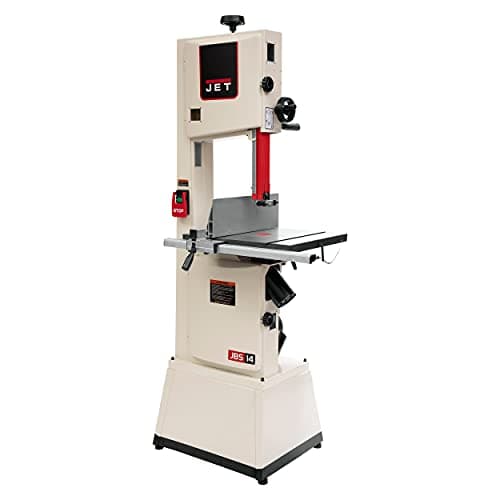
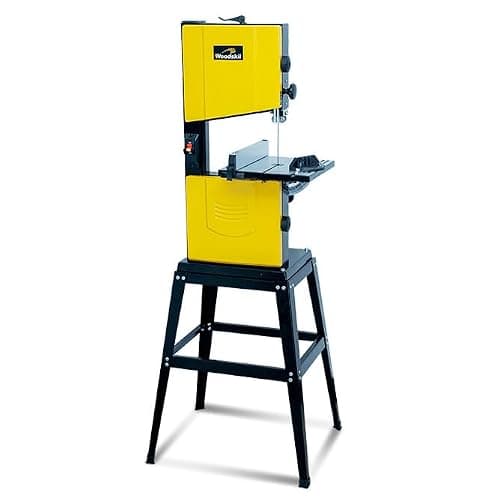
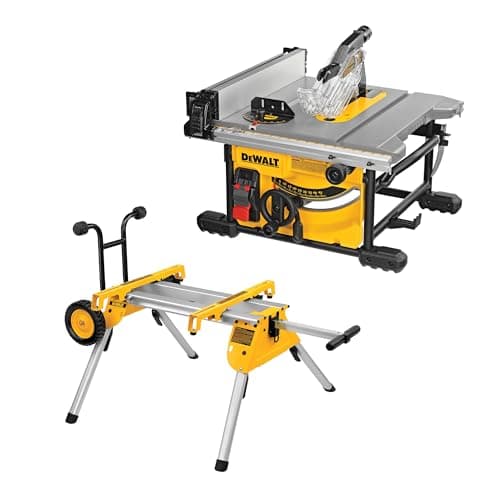
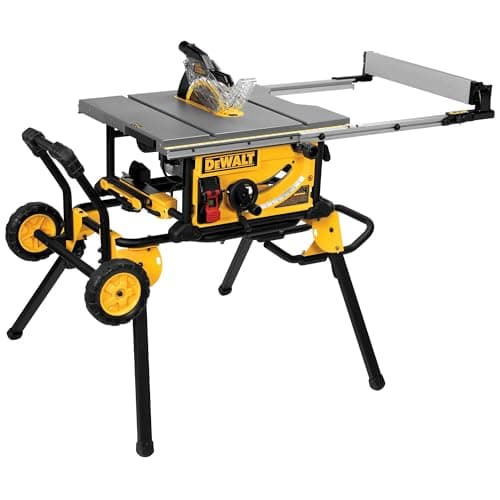
These two machines are rivals only in the sense that they compete for the same floor space. A table saw cuts straight lines accurately and fast. A bandsaw cuts curves, resaws boards into thinner boards, and does neither of the first two things as well.
The physical difference is the blade. A table saw spins a rigid circular blade at high speed, which is why it cuts fast, cuts straight, and throws material back at you if the cut pinches. A bandsaw runs a thin continuous loop supported above and below the table, which is why it cuts curves, has almost no kickback, and leaves a rougher edge.
There is one capability neither shares. Resawing — slicing a thick board into two thinner ones along its width — is a bandsaw job and only a bandsaw job. A table saw can nibble at it from both edges on stock narrower than twice the blade height, badly and dangerously. If you want book-matched panels or your own thin stock for drawer sides, that is a bandsaw and nothing else.
The decision in one paragraph: if you build casework and need repeatable straight parts, the table saw is the higher priority. If you work with rough or figured lumber, cut curves, or want to resaw, the bandsaw is — and it is by some distance the safer of the two to learn on.
Head to head
Straight, repeatable cuts
Table saw, decisively. A rigid blade against a parallel fence produces a cut straight enough to glue without further work. A bandsaw blade drifts — it has a natural tracking angle that is rarely parallel to the fence — so bandsaw rips need cleaning up on a jointer or with a plane.
Curves
Bandsaw, exclusively. A table saw cannot cut a curve at all. A bandsaw with a 1/4 in. blade will follow a tight radius through 2 in. hardwood all day. If your work has shaped aprons, cabriole legs or templates, the bandsaw is not optional.
Resawing
Bandsaw, exclusively. This is the operation that makes a bandsaw pay for itself. Resawing an 8 in. board into two 3/8 in. leaves is routine on a 14-inch bandsaw with a resaw blade, and it turns one expensive board into two — plus book-matched grain you cannot buy.
Safety
Bandsaw, clearly. The bandsaw blade pushes down into the table, so a pinch stalls the blade rather than launching the workpiece. Kickback is essentially a table saw phenomenon. A bandsaw can still injure you badly, but it does so slowly and in one place. For a shop where a beginner is learning, that difference is worth weighing.
Dust
Table saw, marginally. Both are heavy dust producers, but a table saw throws chips predictably below the table where a shroud can catch them. A bandsaw sprays fine dust from the lower wheel housing and is notoriously hard to collect from. Either way, read our table saw dust collection guide before you plumb anything in.
Footprint
Bandsaw, clearly. A bandsaw is tall and narrow and needs clearance only in front. A table saw needs board-length clearance in front and behind plus rip capacity to the side. In a one-car garage that difference is decisive, and it is why many small shops run a bandsaw and a track saw instead of a table saw at all.
The shop that owns both
Most established shops do, and they divide the work cleanly. The bandsaw breaks down rough lumber, resaws, and cuts every curve. The table saw sizes parts to final dimension and cuts joinery. Neither machine is asked to do the other's job, which is exactly why they coexist so comfortably.
Which to buy first, by what you build
Cabinets, boxes, shop furniture, anything from sheet goods: table saw. Your work is straight lines and repeatable widths.
Chairs, curved furniture, small boxes, anything from rough or figured lumber: bandsaw. Your work is curves and resawing, and a circular saw with a straightedge covers the straight cuts in the meantime.
What we could not verify
We have not measured cut quality or resaw capacity on these machines against each other. Motor ratings, resaw heights and rip capacities are the manufacturers' published figures; the comparison above rests on how a rigid circular blade and a supported band behave in a cut.