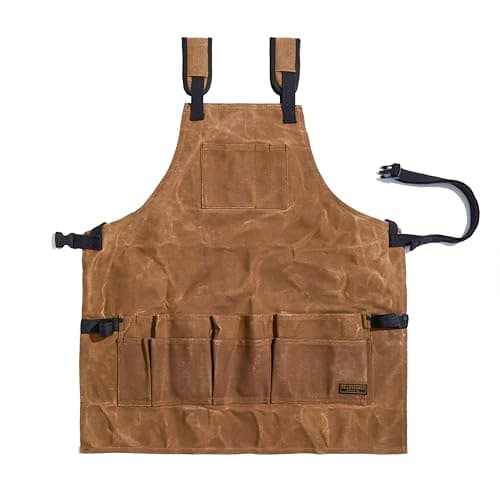
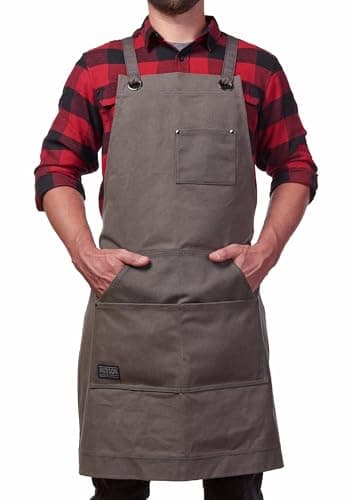
The best woodworking apron for most people is a waxed-canvas bib with cross-back straps, because the two things that decide whether you actually wear an apron are the material and the straps — not the pocket count on the listing. Our top pick is the Hudson Durable Goods waxed-canvas apron: coated canvas that shrugs off sawdust and glue drips, on cross-back straps that put the weight on your shoulders instead of your neck. But the honest truth is that the "best" apron depends on what your shop throws at you. We ranked these by material, straps, coverage and pockets, and told you where each one earns its place.
Aprons split by material first. Waxed canvasis the default for a reason: it is water- and stain-resistant, so finish and squeeze-out wipe off instead of soaking in, and it wears in rather than out — the trade is that it runs warm and wants an occasional re-wax. Cotton duck is untreated canvas: lighter, cooler and cheaper, and it breathes on a long session, but it soaks up a spill instead of shrugging it off. Leatheris the specialist — heat- and spark-resistant and nearly indestructible, but heavy, hot and overkill for a shop that only makes dust.
The second decision is the straps, and it matters more than most buyers expect. A traditional apron loops over your neck, so a loaded bib hangs its whole weight there and aches by the end of an afternoon. Cross-back strapscriss-cross your shoulders and carry the load like a backpack, which is the single biggest comfort upgrade an apron can have. After that come coverage and pockets — how much of your lap and thighs the bib protects, and whether the pockets suit the tools you actually keep on you.
So the honest first buy is a comfortable, durable apron in the right material for your work, not the one with the most pockets in the photo. If you are still assembling a first shop, our essential woodworking tools checklist shows where shop wear fits alongside the tools, and once the apron is keeping the dust off you, the chisels and clamps in its pockets are the buys that decide how your joints come out.
How to choose a woodworking apron
Start from your shop, not the pocket count. Decide the material first, the straps second, and the coverage and pockets last — in that order, because a burly apron with twenty pockets is useless if it is so hot or neck-heavy that it stays on the hook. A comfortable apron you wear on every project protects you far better than a "better" one you keep taking off.
Waxed canvas vs cotton duck vs leather
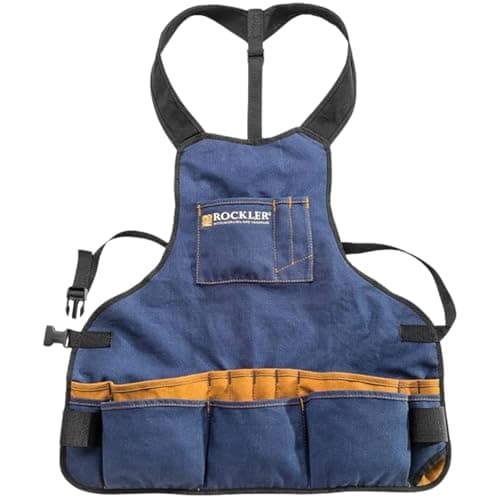
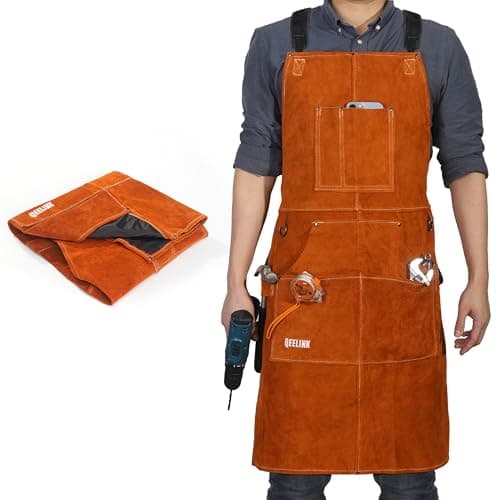
Waxed canvasis the all-rounder and the right default for most woodworkers. The wax makes it water- and stain-resistant, so glue squeeze-out, oil and finish bead up and wipe off instead of soaking through to your clothes, and the fabric breaks in and softens with use. The cost is that it runs warm, feels stiff at first, and wants a re-wax every so often to keep its water resistance — the Hudson and the premium Readywares both live here. Cotton duckis the same canvas without the wax: lighter, more breathable and cheaper, which makes it comfortable on a warm day or a long session, but it absorbs a spill rather than repelling it — the 14-oz Rockler is the pick if breathability and pockets matter more to you than water resistance. Leatheris the specialist: the QeeLink is heat- and flame-resistant cowhide that laughs off sparks and hot chips, which is exactly what you want if you also weld, turn or do torch work — and exactly the wrong, sweaty choice for a shop that only makes dust.
Cross-back vs traditional straps
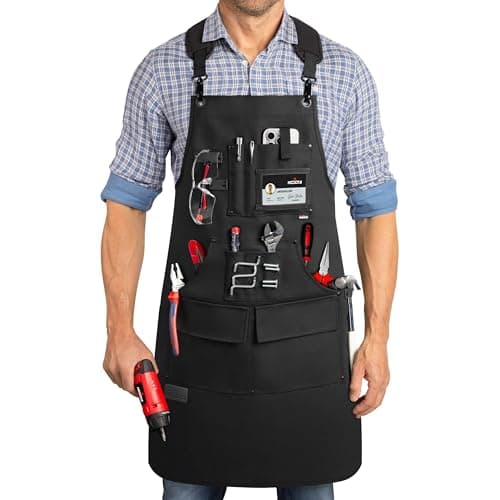
This is the comfort decision, and it is worth more than any spec on the tag. A traditional apronhangs from a loop around your neck, so every tool you load into it pulls down on the same few vertebrae — fine for an hour, tiring by the end of a build. Cross-back strapscross between your shoulder blades and spread the load across both shoulders like a rucksack, so a fully loaded apron stops being a literal pain in the neck. If you expect to wear the apron for real stretches, or to carry a lot in it, cross-back straps — on the Hudson and the NoCry here — are the feature to prioritize. A quick-release buckle is a smaller but real nicety: it lets you drop the apron in one pull instead of ducking out of it over your head.
Coverage, fit and pockets
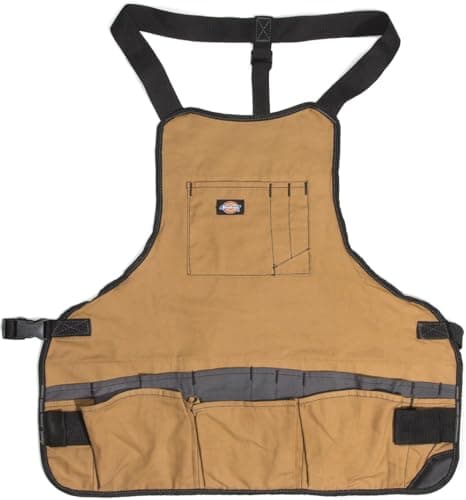
Coverage is how much of you the bib actually protects — chest down to at least mid-thigh is what keeps sawdust out of your lap and finish off your jeans. Check the size range too: a good apron adjusts across a wide span of body sizes and waist measurements, so "fits up to XXL" or a long waist strap matters if you are at either end of the range. Pockets come last on purpose. More is not better — the right pockets are the ones that fit the handful of things you actually keep on you: a pencil, a rule or tape, a marking knife, maybe a chisel and your phone. A hammer loop and a dedicated pencil slot earn their keep; a wall of tiny pockets you never fill is just weight. The Rockler's seventeen and the Dickies' sixteen suit someone who likes everything on their body; a cleaner four-or-five-pocket bib suits someone who works off the bench.
Practical tip: match the apron to the work, then look after it
Buy the material your shop calls for — waxed canvas for general woodworking and any wet finishing, cotton duck if you run hot and want to breathe, leather only if you also throw sparks. Then keep it working: brush the sawdust off rather than letting it grind into the weave, spot-clean instead of machine-washing (a hot wash strips the wax straight out of waxed canvas), and re-wax a canvas apron once its water resistance fades — a bar of fabric wax and twenty minutes brings it back. Treated like that, a good apron outlasts several cheap ones. If you are outfitting a shop from scratch, our beginner woodworking tool list puts the apron in order alongside the tools it carries, and the shop-setup hub covers the bench, storage and dust side of a comfortable place to work.