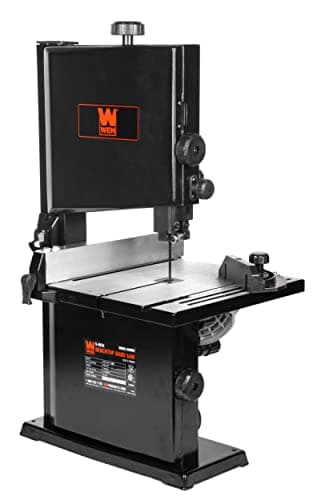
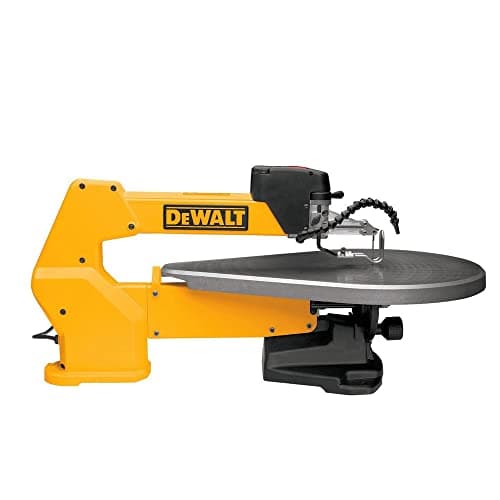
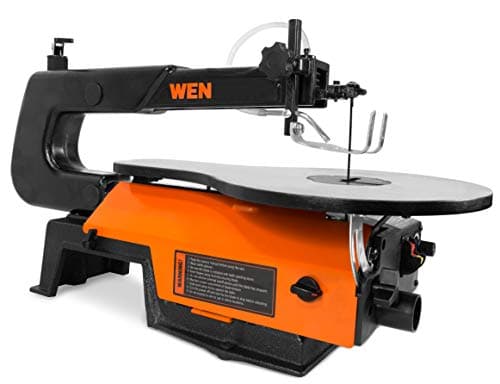
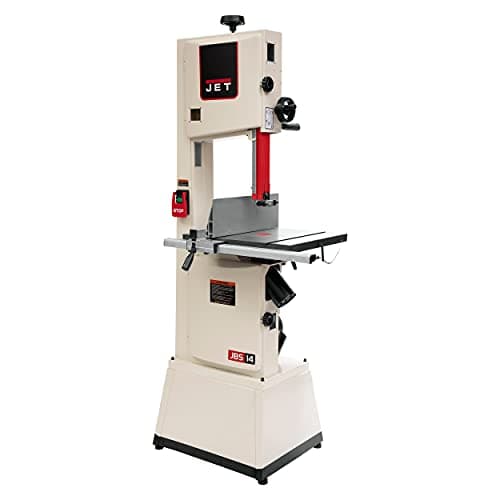
Buy a bandsaw if the saw has to make the board smaller — resawing, ripping curves, cutting tenon cheeks, breaking down thick stock. Buy a scroll saw if the saw has to cut a shape out of the inside of a board without cutting through the edge. The JET JWBS-14SFX is the bandsaw a furniture shop keeps, and the DEWALT DW788 is the scroll saw for anyone who intends to cut fretwork seriously.
If you came here expecting these two machines to compete, they barely do. Most shops that own both bought them years apart for unrelated reasons, and the sentence above is why.
The blade decides everything
A bandsaw blade is a continuous welded loop running over two or three wheels. It cannot be taken apart and re-threaded without being unwelded, which means every bandsaw cut must start at an edge of the workpiece and travel inward. There is no way to begin a bandsaw cut in the middle of an uncut panel.
A scroll saw blade is a short straight blade, clamped at both ends, moving up and down. Release the top clamp, pass the blade up through a hole you drilled in the panel, re-clamp, and you can cut a closed shape — the inside of a letter, the window in a fretwork panel, a pierced inlay — with the outer edge of the board completely untouched. That single capability is the entire reason scroll saws exist, and no bandsaw at any price can do it.
Everything else follows from that. A loop blade under tension running continuously in one direction can be made wide and thick, so it can be pushed hard through 6 in. of oak. A short reciprocating blade clamped at both ends has to be thin and narrow to turn tightly, which caps how thick and how fast it cuts.
What a bandsaw does that a scroll saw cannot
- Resaw.Slicing a thick board into two thinner ones along its width. This is the bandsaw's signature job and the reason to buy frame rather than motor — see the best bandsaw for why 14 in. of frame is the usual dividing line.
- Cut thick stock. Depth of cut on a 14 in. bandsaw is measured in inches; on a scroll saw it is 2 in. at best, and in practice far less if you want the cut to stay square.
- Rough out curves fast. Chair legs, cabriole shapes, curved rails.
- Cut joinery. Tenon cheeks and shoulders, dovetail waste, lap joints.
What a scroll saw does that a bandsaw cannot
- Interior cuts. The one that matters. Drill a hole, thread the blade, cut an enclosed shape.
- Very tight radii. A narrow scroll blade turns inside its own width. The narrowest practical bandsaw blade has a minimum radius measured in fractions of an inch, and it is much larger.
- Cuts that need almost no cleanup. A fine scroll blade in thin stock leaves an edge you can sand with a few strokes, where a bandsaw leaves tooth marks.
- Stack cutting. Tape two or three thin pieces together and cut identical parts in one pass.
If you can only buy one
Buy the bandsaw.It is the more generally useful machine by a wide margin, because resawing, thick curves and joinery come up in almost every kind of woodworking, and enclosed decorative cuts come up in one kind. A bandsaw also covers a usable share of scroll saw work — any curve that starts from an edge — whereas a scroll saw covers essentially none of the bandsaw's.
The exception is specific and real: if what you want to make is fretwork, intarsia, puzzles or pierced decorative work, buy the scroll saw and do not pretend a bandsaw will get you there. It will not.
And if the honest answer is “occasional curves, no resawing, no fretwork”, the right machine may be neither. A jigsawcuts interior shapes too — drill a hole, drop the blade in — for a fraction of either saw's price, and it goes to the work instead of the work coming to it.
And if you are weighing the bandsaw against the machine that actually competes with it for floor space and for ripping duty, that comparison is table saw vs band saw rather than anything on this page.
The four saws, side by side
Published listing specifications for the saws ranked above. Note that “throat” means two different things across the two families: on a bandsaw it is the distance from blade to frame, which caps how wide a panel you can cut; on a scroll saw it is the arm reach, which caps how far from the edge you can place an interior cut.
| Saw | Family | Throat | Published specifications |
|---|
| JET JWBS-14SFX | Bandsaw | 14 in. | 1-3/4 HP, 115/230 V, steel frame |
| WEN BA3959 | Bandsaw | 9 in. | 2.8 A, benchtop, corded |
| DEWALT DW788 | Scroll saw | 20 in. | 400–1,750 SPM, 2 in. depth of cut, bevels 45° left and right |
| WEN 3922 | Scroll saw | 16 in. | 550–1,600 SPM, cuts up to 2 in. thick, 16 × 10 in. table, bevels 45° |
Depth of cut is the number that ends the argument
Both scroll saws above publish a 2 in. maximum. That is a hard ceiling, and in practice you want to be well inside it, because a thin blade in thick stock flexes and the cut comes out bevelled even when the table is dead square. Scroll saws live in material from 1/8 in. to 3/4 in.
A 14 in. bandsaw cuts several times that depth, which is what makes resawing possible at all. If you have ever wanted to turn one 8/4 board into two 4/4 boards, that is a bandsaw operation and nothing on the scroll saw side of this table participates.
Variable speed means different things on each
On a scroll saw, strokes per minute is a control you use constantly: slow for hardwood and tight turns so the blade does not burn or wander, fast for thin softwood where a slow blade just rubs. Both scroll saws above publish a usable range, the DEWALT from 400 and the WEN from 550 — and the low end is the end that matters.
On a bandsaw, blade speed is mostly fixed and the variable you actually change is the blade itself. Blade width sets minimum radius, tooth pitch sets finish and feed rate, and tension sets whether the cut stays straight. A 14 in. saw with the wrong blade will cut worse than a 9 in. saw with the right one.
Vibration, and why it costs more than it sounds like
A scroll saw moves a blade up and down thousands of times a minute, and every one of those strokes is a reversal of direction. Cheap saws transmit that into the table, the stand and the workpiece, and a vibrating workpiece cannot be steered accurately along a pencil line. This is the single thing that separates a scroll saw you will enjoy from one you will fight.
The mechanism matters more than the mass. A parallel-link arm keeps the blade vertical through the stroke instead of arcing it, which is both the reason the DEWALT holds a line in 3/4 in. hardwood and the reason it costs what it costs. For a few ornaments a year, the WEN's trade is a sane one.
Blade changes, in the one place it decides the purchase
Pinned blades have small cross-pins at each end and drop into a hook. Pinless blades are plain-ended and clamp in a holder. Pinned blades are quicker to change and much thicker, which means they cannot pass through a small drilled hole — and a small hole is exactly what fine interior work needs.
So “takes pinless blades properly” is not a convenience feature on a scroll saw. It is the difference between being able to do delicate pierced work and not. Both saws above take them; many of the cheapest saws on the market do not.
Dust, briefly
Neither of these is a serious dust producer by volume, and both produce dust in the fine fraction that stays airborne, because thin blades make fine chips. A ceiling air filtration unit does more for a shop that runs a scroll saw than a collector hooked to the saw ever will. A bandsaw, by contrast, genuinely benefits from a hose on the lower port — our CFM chart lists the published airflow figure for a 14 in. saw.
Where these numbers come from
Throat capacities, horsepower and amperage, stroke rates, depths of cut, table dimensions and bevel ranges above are the manufacturers' own published listing specifications, cited per saw in Sources. We have not measured cut quality, vibration or blade deflection — we do not run a lab, and our methodology page says so. Prices come from the live price feed and carry the date they were pulled.