Skip to content
Dovetail & Dust

HUB 02 · Power Tools

The Best Wood Shapers

Ranked on the three things that decide a shaper: the power your shop can actually supply, spindle speeds matched to cutter diameter, and whether the machine fits. Plus the answer most readers need — you probably want a router table.

By Stephen V.Updated How we research
#ad

We earn a commission when you buy through our Amazon links, at no extra cost to you. It never changes our rankings, and we say so when the cheaper tool is the better buy. How this works.

Most people searching for a shaper should buy a router table instead. If you genuinely need a shaper, the Laguna Compact 4-Speed is the one we would buy for a small shop — and if your shop has no 220V circuit, the JET JWS-20CS is not a compromise, it is the only machine on this page you can plug in. Everything below follows from those two sentences.

A shaper is the heavy-industrial ancestor of the router table. A vertical spindle rises through a cast-iron table, a large three-wing cutter bolts to it, and a fence and hold-downs guide the stock past. It runs cutters that are bigger, thicker and better supported than any router bit, at speeds the cutter's diameter dictates, powered by a motor measured in horsepower rather than amps. On the work it is built for — doors, rail-and-stile, raised panels, long runs of molding — nothing else in a wood shop touches it.

It is also the most expensive machine on this site, one of the two or three most dangerous, and for a large share of the people who search for one it is the wrong purchase. So this page starts with a gate rather than a ranking.

First, the honest gate: do you need a shaper at all?

Our own router table roundup opens by saying a router table turns a handheld router into a small shaper, and that is exactly the point. For most home shops a router table is the right answer, because:

  • The cost difference is enormous. A capable benchtop router table plus a mid-size router costs a small fraction of the cheapest machine on this page, and you very likely own the router already.
  • Router bits cover the common profiles. Rail-and-stile sets and raised-panel bits exist in 1/2 in. shank form and they work. They are slower and they want more passes, but the door comes out.
  • Power and space. A router table runs on a standard outlet and can live on a bench. Four of the five shapers here need a 220V or 230V circuit, and the Powermatic alone weighs 664 lb.

A shaper starts to make sense when one of these is true:

  • Volume.You are cutting doors in batches rather than in ones and twos, and a power feeder — which a shaper accepts and a router table generally does not — would change your day.
  • Cutter size. You want profiles wider or deeper than a router bit can take safely in one pass, on a spindle that supports the cutter from both sides.
  • Duty cycle. A router motor is a universal motor asked to run at 20,000 RPM. A shaper is an induction motor turning a heavy spindle at a quarter of that. One of those is built for an eight-hour day.

If none of those is true for you, close this page and read the router table roundup or which router should you buy instead. We would rather lose the click than sell you a $3,600 machine you will use twice a year.

One quick disambiguation, because the words collide: a spindle shaper is this machine. A spindle sander is a completely different tool that sands curved edges, and it is covered in our spindle sander roundup.

What actually separates these machines

We ranked on five criteria, in the order that decides a real purchase rather than the order a spec sheet lists them.

1. The power you can actually supply

This is first because it is the one criterion that can make a machine impossible rather than merely inferior. Of the five here, exactly one — the JET JWS-20CS — arrives prewired for 115V and runs on an ordinary 15 A circuit. Every other machine needs 220V or 230V single phase, and the Powermatic publishes a recommended 30 A circuit on top of that.

If your shop does not already have that supply, the true price of the machine includes an electrician. Our workshop power guide walks through reading an amp rating and deciding whether a 240V circuit is worth running. Do that arithmetic before you shortlist, not after.

We also rejected one machine outright on this criterion. The 5 HP Powermatic PM2700 listed on Amazon is the three-phase version. Three-phase power does not exist in a residential shop without a converter, so it is not on this page at any price.

2. Spindle size and what it lets you mount

Shaper cutters are sold by bore — commonly 1/2 in., 3/4 in. and 1-1/4 in. The spindle you have decides which catalog is open to you. A 1-1/4 in. spindle takes the heaviest industrial cutters; a 3/4 in. spindle covers the great majority of what a furniture shop actually runs; a 1/2 in. spindle is limited.

Two machines here ship with both a 3/4 in. and a 1-1/4 in. spindle in the box. The JETs ship with one spindle and sell the others separately, and spindle assemblies are not cheap. That is a real cost difference hiding behind two similar sticker prices, and it is why the Laguna outranks the JET 3 HP despite costing a few dollars more.

Watch for router collets too. The Laguna and the JWS-20CS both include 1/4 in. and 1/2 in. collets, which means the machine will hold the router bits you already own. That is a genuinely useful fallback on the jobs that do not justify buying a shaper cutter.

3. Speed range, because cutter diameter sets the speed

This is the criterion buyers most often skip, and it is the one that bites. The bigger the cutter, the faster its rim travels at any given RPM, and tip speed is what burns the cut, dulls the carbide and over-stresses the tooling. We laid the arithmetic out in full on our router bit speed chart: tip speed is π × diameter × RPM, and it rises fast.

Apply that here. A 4 in. cutter at 4,000 RPM is moving its rim about 4,190 ft/min. The same cutter at 10,000 RPM is moving it about 10,470 ft/min. That is why the four-speed machines exist and why their slowest step — 4,000 RPM — matters more than their fastest.

Three of the five machines here offer 4,000, 6,000, 8,000 and 10,000 RPM. The Powermatic offers two speeds and neither is below 7,500 RPM. The JWS-20CS offers two speeds and neither is below 8,000 RPM. Those are small-cutter machines whatever else their spec sheets say, and we scored them accordingly.

4. Table, fence and spindle travel

Table area is outfeed support you do not have to build. The Powermatic's 30 x 40 in. table is in a different class from the JWS-20CS's 18 x 20 in., and on a long rail that difference is the whole job. Spindle travel — how far the spindle rises — sets how much of a tall cutter you can use and how easily you can make a cut in two passes. Four of these machines give 4 in.; the JWS-20CS gives 2 in.

On fences, every machine here has independently adjustable infeed and outfeed halves with micro-adjustment, which is the arrangement that lets a shaper joint an edge as it profiles it. That is table stakes at these prices, so it did not separate them much.

5. Value, honestly assessed

Value here means what the machine does per dollar for a small shop, not the lowest number. The JWS-20CS scores well on value and poorly overall, which is exactly the situation its buyer is in. The Powermatic scores poorly on value and is still the best-made machine on the page. Both statements are true at the same time and the ranking reflects the whole rubric, which is published on our methodology page.

A word on availability, because it shaped this list

Shapers are a thin market online and we are not going to pretend otherwise. When we checked live on 15 September 2026, Grizzly's G1026 and G1035 both came back currently unavailable, the G5912Z was quoted at nine to ten days, and the SHOP FOX W1702 was down to two units. Those machines are not on this page, not because they are bad — the Grizzlys in particular are long-standing favorites — but because we will not rank a machine you cannot buy today.

Every one of the five below returned “In Stock” and single-phase power on that same check. Prices shown are pulled live from Amazon and stamped with the date they were fetched; when that data goes stale the number disappears rather than misleading you.

The short answer

Quick picks

#ProductBest forScorePrice
01
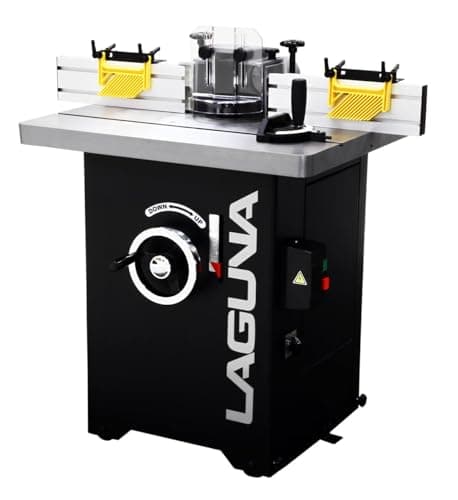
Laguna Tools Laguna Compact Shaper, 4-Speed 3 HP (MSHAP4SPD-3-0130)
Laguna Compact Shaper, 4-Speed 3 HP (MSHAP4SPD-3-0130)

The most useful shaper here for a small shop, because it is the one that arrives ready for every job. Four speeds down to 4,000 RPM for large cutters, both spindle sizes in the box, and router collets as well — so it doubles as a very large router table on the days that do not justify a shaper cutter.

Best overall
8.2
$3,649.00Amazon
02
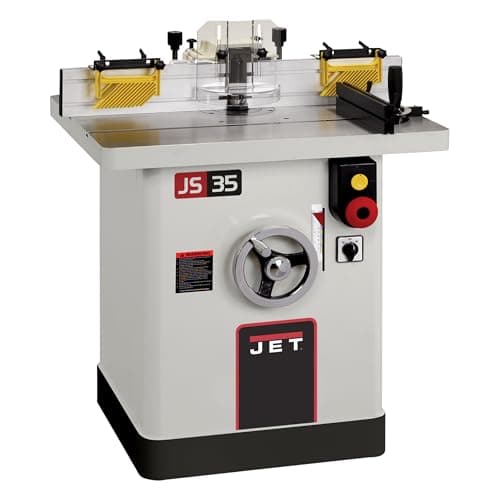
JET JET JWS-35X3-1 3 HP Spindle Shaper
JET JWS-35X3-1 3 HP Spindle Shaper

The full-size 3 HP machine at close to the Laguna's price, trading the included spindles and collets for a bigger cast-iron table and a frame already drilled for a power feeder. If you can see production work in your future, this is the one that grows into it.

Best full-size value
8.0
$3,629.74Amazon
03
JET JET JWS-35X5-1 5 HP Spindle Shaper
JET JWS-35X5-1 5 HP Spindle Shaper

The same frame, table and four-speed drive as the 3 HP JET with a 5 HP motor behind it. Worth the step only if you are cutting large panel profiles in hardwood in a single pass, which is a smaller group of people than the spec sheet suggests.

Best for big cutters and long runs
7.6
$4,278.00Amazon
04
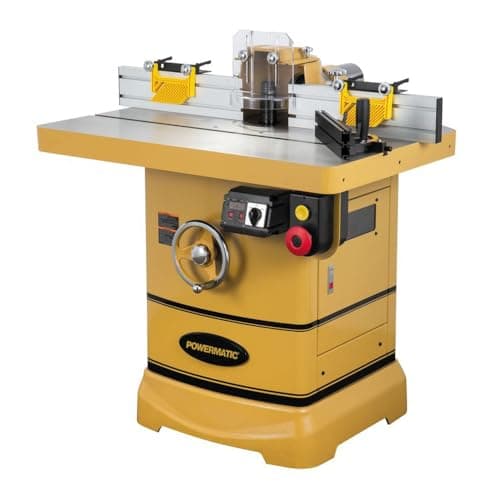
Powermatic Powermatic PM2700 3 HP Shaper (30 x 40 in. table)
Powermatic PM2700 3 HP Shaper (30 x 40 in. table)

The best-made machine on this page and the one with the biggest table by a wide margin. The digital spindle-height readout and the retractable casters are the two features you notice every single session. You pay a large premium for them, and it still only has two speeds.

Best fit and finish
6.8
$5,499.00Amazon
05
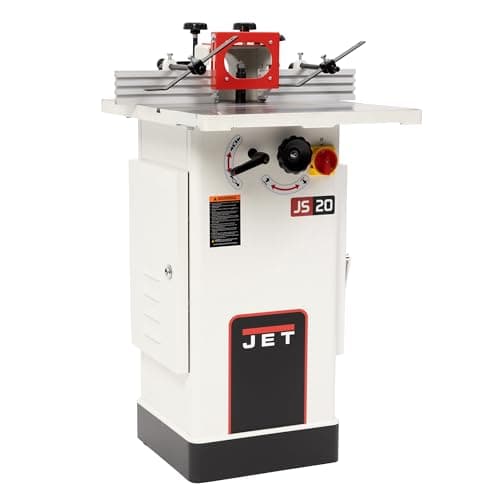
JET JET JWS-20CS 1-1/2 HP Spindle Shaper
JET JWS-20CS 1-1/2 HP Spindle Shaper

The lowest-scoring machine here and the only one most home shops can actually plug in. It arrives prewired for 115V, weighs 201 lb, and costs roughly half of anything else on this page. If your shop has no 220V circuit, this is not the compromise pick — it is the only pick.

Best on a standard 115V circuit
6.4
$2,048.48Amazon

#ad · Live prices from the Amazon Product API, as of Sep 19, 2026. Where we have no verified live price, we show none — we would rather leave a gap than print a number that has rotted.

In detail

The picks, in full

01
Laguna Tools Laguna Compact Shaper, 4-Speed 3 HP (MSHAP4SPD-3-0130)

Best overall

Laguna Compact Shaper, 4-Speed 3 HP (MSHAP4SPD-3-0130)

3 HP, 220V 1Ph4,000-10,000 RPM, 4 speeds3/4 + 1-1/4 in. spindles450 lb net
8.2/10

The most useful shaper here for a small shop, because it is the one that arrives ready for every job. Four speeds down to 4,000 RPM for large cutters, both spindle sizes in the box, and router collets as well — so it doubles as a very large router table on the days that do not justify a shaper cutter.

Power you can supply
6
Spindle and cutter range
10
Speed range
9
Table and fence
8
Value
8

Pros

  • Four published speeds — 4,000, 6,000, 8,000 and 10,000 RPM — and the 4,000 RPM step is the one large-diameter cutters need
  • Both the 3/4 in. and 1-1/4 in. spindles are included, so the cutter catalog is open from day one rather than after a parts order
  • 1/4 in. and 1/2 in. router collets are included too, which makes it a very capable router table when the job does not justify a shaper cutter
  • 450 lb net is heavy enough to damp a big cutter and light enough that two people and a pallet jack can place it
  • 4 in. of spindle travel and a 4 in. dust port, both matching the full-size machines

Cons

  • 220V single phase only — if your shop has no 220V circuit, this machine is a wiring job before it is a tool
  • Laguna does not publish an amperage figure, so you cannot size the circuit from the spec sheet alone
  • The 32 x 26-1/2 in. table is genuinely compact, which is the point, but long rail stock still wants outfeed support you provide
  • Priced within a few dollars of JET's full-size 3 HP machine, so you are choosing feature set over table size rather than saving money

Don't buy this if…

your shop is on 115V only. Nothing about this machine is adjustable on that point, and the JET JWS-20CS exists precisely for that case.

$3,649.00View on Amazon

Price as of Sep 19, 2026. Prices change — Amazon's is the one that counts.

#ad · we may earn a commission from this link to Laguna Compact Shaper, 4-Speed 3 HP (MSHAP4SPD-3-0130)

02
JET JET JWS-35X3-1 3 HP Spindle Shaper

Best full-size value

JET JWS-35X3-1 3 HP Spindle Shaper

3 HP, 230V 1Ph4,000-10,000 RPM, 4 speeds1-1/4 in. spindle26-3/4 x 32-1/4 in. table
8.0/10

The full-size 3 HP machine at close to the Laguna's price, trading the included spindles and collets for a bigger cast-iron table and a frame already drilled for a power feeder. If you can see production work in your future, this is the one that grows into it.

Power you can supply
6
Spindle and cutter range
8
Speed range
9
Table and fence
9
Value
8

Pros

  • Four-speed step pulley with a quick-release lever — the same 4,000 to 10,000 RPM range as the Laguna
  • The 26-3/4 x 32-1/4 in. cast-iron table is the largest of the three mid-priced machines here
  • Predrilled for a power feeder, which is the upgrade that makes a shaper both safer and genuinely repeatable
  • Magnetic controls and a reversible spindle, so a cutter can be run from either face of the stock
  • JET publishes a minimum of 400 CFM at the 4 in. port, which lets you size dust collection honestly before you buy

Cons

  • Ships with the 1-1/4 in. spindle; smaller spindles and any router collet are separate purchases, and JET's spindle assemblies are not cheap
  • 230V single phase only
  • JET does not publish a net weight on the product page, so plan the delivery before you plan the position
  • A full-size cabinet footprint in exchange for a table only marginally bigger than the compact Laguna's

Don't buy this if…

you want one machine that also covers router-bit work. The Laguna includes the collets; here they are an extra.

$3,629.74View on Amazon

Price as of Sep 19, 2026. Prices change — Amazon's is the one that counts.

#ad · we may earn a commission from this link to JET JWS-35X3-1 3 HP Spindle Shaper

03
JET JET JWS-35X5-1 5 HP Spindle Shaper

Best for big cutters and long runs

JET JWS-35X5-1 5 HP Spindle Shaper

5 HP, 230V 1Ph4,000-10,000 RPM, 4 speedsReversible spindlePower-feeder predrilled
7.6/10

The same frame, table and four-speed drive as the 3 HP JET with a 5 HP motor behind it. Worth the step only if you are cutting large panel profiles in hardwood in a single pass, which is a smaller group of people than the spec sheet suggests.

Power you can supply
4
Spindle and cutter range
9
Speed range
9
Table and fence
9
Value
7

Pros

  • 5 HP does not bog in a full-depth pass with a large panel cutter, which is exactly where a 3 HP machine starts asking for two passes
  • Identical 26-3/4 x 32-1/4 in. table and four-speed drive as the 3 HP version, so nothing else is compromised
  • Extruded aluminum fence with T-slots and two featherboard hold-downs included — hold-downs are a safety item, not an accessory
  • Magnetic controls and a reversible spindle

Cons

  • A 5 HP single-phase motor is a serious electrical draw and JET does not publish the amperage on the listing — budget for an electrician's opinion before you budget for the machine
  • Several hundred dollars more than the 3 HP version for power most home shops will never reach
  • Same spindle-and-collet caveat as the 3 HP machine: anything beyond the supplied spindle is an extra purchase
  • No more compact than the 3 HP machine, with the same full-size footprint and a heavier motor

Don't buy this if…

you are a one-person shop cutting doors in batches of six. The 3 HP machine does that work; this one is sized for a production run.

$4,278.00View on Amazon

Price as of Sep 19, 2026. Prices change — Amazon's is the one that counts.

#ad · we may earn a commission from this link to JET JWS-35X5-1 5 HP Spindle Shaper

04
Powermatic Powermatic PM2700 3 HP Shaper (30 x 40 in. table)

Best fit and finish

Powermatic PM2700 3 HP Shaper (30 x 40 in. table)

3 HP, 230V 1Ph, 14 A30 x 40 in. table3/4 + 1-1/4 in. spindles664 lb
6.8/10

The best-made machine on this page and the one with the biggest table by a wide margin. The digital spindle-height readout and the retractable casters are the two features you notice every single session. You pay a large premium for them, and it still only has two speeds.

Power you can supply
4
Spindle and cutter range
9
Speed range
6
Table and fence
10
Value
5

Pros

  • A 30 x 40 in. precision-ground cast-iron table — far more surface than anything else here, which is what supports a long rail without a helper
  • Digital readout on the spindle height, so returning to a previous setup is a number rather than a test cut
  • Retractable omni-directional casters built into the base: a 664 lb machine that still moves out of the way
  • Both the 3/4 in. and 1-1/4 in. spindles are included, and spindle travel is a full 4 in.
  • Powermatic publishes 14 A and a recommended 30 A circuit — more electrical detail than anyone else here gives you

Cons

  • Two speeds only, published as 7,500 and 10,000 RPM. Neither is slow, and on a machine at this price that is a real limitation with large-diameter panel cutters
  • Substantially more money than the JET 3 HP for the same horsepower
  • 664 lb and a 30 A circuit: this is a permanent installation, whatever the casters suggest
  • Powermatic specifies a minimum of 600 CFM at the dual 4 in. ports, which is more dust collection than most home shops own

Don't buy this if…

large raised-panel cutters are the reason you are buying a shaper. The four-speed machines here drop to 4,000 RPM; this one does not.

$5,499.00View on Amazon

Price as of Sep 19, 2026. Prices change — Amazon's is the one that counts.

#ad · we may earn a commission from this link to Powermatic PM2700 3 HP Shaper (30 x 40 in. table)

05
JET JET JWS-20CS 1-1/2 HP Spindle Shaper

Best on a standard 115V circuit

JET JWS-20CS 1-1/2 HP Spindle Shaper

1-1/2 HP, 115/230V 1Ph8,000 / 10,000 RPM1/2 + 3/4 in. spindles201 lb
6.4/10

The lowest-scoring machine here and the only one most home shops can actually plug in. It arrives prewired for 115V, weighs 201 lb, and costs roughly half of anything else on this page. If your shop has no 220V circuit, this is not the compromise pick — it is the only pick.

Power you can supply
10
Spindle and cutter range
4
Speed range
4
Table and fence
5
Value
9

Pros

  • Prewired for 115V at 15 A — no electrician, no new circuit, no three-week wait before you can cut anything
  • 1/2 in. and 3/4 in. interchangeable spindles plus 1/4 in. and 1/2 in. router collets, so it takes router bits you already own
  • 201 lb is the only weight on this page that two people and a hand truck can handle
  • Independent left and right fences with micro-adjustment, and JET publishes a modest 300 CFM minimum for the 4 in. port
  • Roughly half the price of every other machine here

Cons

  • Two speeds, 8,000 and 10,000 RPM, and neither is slow — this is a small-cutter machine and the spec sheet says so
  • No 1-1/4 in. spindle, which closes off the heaviest industrial cutters entirely
  • 2 in. of spindle travel against 4 in. on every other machine here
  • The 18 x 20 in. table is small; anything longer than a cabinet door needs outfeed support you rig yourself
  • 1-1/2 HP will ask for two passes where a 3 HP machine takes one

Don't buy this if…

you have 220V in the shop and any intention of running large panel cutters. Spend the extra on speed range and spindle capacity you will not outgrow in a year.

$2,048.48View on Amazon

Price as of Sep 19, 2026. Prices change — Amazon's is the one that counts.

#ad · we may earn a commission from this link to JET JWS-20CS 1-1/2 HP Spindle Shaper

The costs that are not the machine

Cutters are a second budget, and it is not small

This is the single most under-estimated part of buying a shaper. A shaper cutter is a solid carbide-tipped steel body, and a good one costs a meaningful fraction of a decent power tool. A rail-and-stile set, a panel raiser and a couple of straight and profile cutters is a real outlay on top of the machine.

The practical strategy is the same one we argue for on the router bit page: buy the two or three profiles the current project needs, not a catalog. Shaper cutters do not go out of date and they can be resharpened, so there is no rush and no bargain in buying ahead.

If the machine you buy includes router collets, you have a useful bridge: run the router bits you already own until a specific job justifies a specific cutter.

A power feeder is the upgrade that changes the machine

A power feeder is a motorized set of rubber wheels that pushes stock past the cutter at a constant rate. It costs real money and it is the best safety and quality upgrade a shaper can have: it holds the work down and against the fence with a consistency no human hand achieves, it keeps your hands away from the cutter entirely, and it eliminates the feed-rate variation that causes burning and chatter.

Two of the machines here arrive predrilled for one. If there is any chance you will add a feeder, that detail is worth more than a spec-sheet difference of half a horsepower.

Dust collection is not optional on this machine

A shaper removes a startling volume of material, and the manufacturers publish what they need at the port: 300 CFM for the JWS-20CS, 400 CFM for the JET 3 HP, and 600 CFM at the Powermatic's dual ports. Those are not suggestions — they are the figures the hood was designed around.

Put them next to our CFM and duct chartand the problem is immediate: a 4 in. duct carries about 349 CFM at the velocity chips need. The JWS-20CS is comfortable on a 4 in. line. The JET 3 HP is marginal. The Powermatic's 600 CFM is simply not available through a single 4 in. pipe, which means 6 in. duct or a dedicated machine. Budget for that before the machine arrives, not after.

Safety, stated plainly

A shaper carries a large, heavy cutter with no guard over most of the cut, turning fast enough that it will not slow down for anything. It is generally regarded as the least forgiving machine in a woodworking shop, and it deserves that reputation.

  • Use the hold-downs and the guard that came with it. They are not accessories. The JET 5 HP ships with two featherboard hold-downs for a reason.
  • Bury as much of the cutter in the fence as the profile allows. The exposed part of the cutter is the part that can reach you.
  • Never freehand against a bearing without a starting pin and a guard. The starting pin is what stops the work being snatched as it contacts the cutter.
  • Match the speed to the cutter diameter, every time. Changing the cutter and not changing the speed is the classic mistake, and on a 4 in. cutter it is not a small one.
  • Feed against the rotation. Climb cutting on a shaper pulls the work out of your hands. A power feeder is the only sane way to climb cut.

What we could not verify

We have not run any of these machines. We do not have a lab, we say so on our methodology page, and nothing on this page is presented as a measurement we took.

Horsepower, voltage, amperage, spindle sizes, spindle speeds, spindle travel, table dimensions, dust-port sizes, minimum CFM figures and weights are the manufacturers' published numbers. Two figures came from a retailer's reproduction of the spec sheet rather than the manufacturer's own product page and we flag them rather than hide them: the JET JWS-20CS net weight of 201 lb, and the Powermatic PM2700's published speeds of 7,500 and 10,000 RPM. JET publishes no net weight for either 35X machine, so we have not guessed one. Laguna publishes no amperage figure, so we have not guessed that either.

The tip-speed figures in the speed section are arithmetic — π × diameter × RPM — and the formula is shown so you can check them. Availability was checked live on 15 September 2026 and it changes; the live price on each row is the current truth, and where a price is missing the button falls back to a plain price check rather than a remembered number.
How we picked

We do not run a testing lab

We researched published manufacturer specifications, manuals and spec sheets, ran the arithmetic those specs support, and read owner reviews at volume, then scored each tool against a published rubric. The scores are judgments from documented research — they are not measurements we took, because we do not have a lab and we are not going to pretend we do. Where a number came from a manufacturer's document, we name it and link it in Sources.

Questions

Frequently asked

Do I need a wood shaper or is a router table enough?
For most home shops a router table is enough, and it costs a fraction as much. A shaper earns its keep on volume (cutting doors in batches, ideally with a power feeder), on cutter sizes a router bit cannot take safely, and on duty cycle — an induction motor turning a heavy spindle is built for an eight-hour day in a way a router motor is not. If none of those describes your work, buy the router table.
What size shaper do I need for a home shop?
Power supply decides it before horsepower does. If you have a 220V circuit, a 3 HP machine with a 3/4 in. and 1-1/4 in. spindle covers essentially all furniture and cabinet-door work. If you only have 115V, your choice narrows to one machine on this page — the JET JWS-20CS — and you should plan around smaller cutters.
Why do bigger shaper cutters have to run slower?
Because tip speed scales with diameter. Tip speed = π × diameter × RPM, so a 4 in. cutter at 10,000 RPM moves its rim roughly 10,470 ft/min against about 4,190 ft/min at 4,000 RPM. Too much tip speed burns the cut, dulls the carbide and over-stresses the tooling. The same arithmetic is worked through on our router bit speed chart.
Can a shaper use router bits?
Some can. The Laguna and the JET JWS-20CS both include 1/4 in. and 1/2 in. router collets, so they will hold standard router bits. The full-size JETs ship with a shaper spindle and sell collets separately. It is a genuinely useful bridge while you build up a cutter set, though remember a shaper's top speed is well below a router's, so small bits will cut more slowly than you are used to.
How much dust collection does a shaper need?
More than most home shops have. JET publishes 300 CFM for the JWS-20CS and 400 CFM for the 3 HP machine; Powermatic specifies 600 CFM at the PM2700's dual ports. A 4 in. duct carries only about 349 CFM at the velocity chips need, so anything above roughly 400 CFM means 6 in. duct. The figures and the arithmetic are in our CFM chart.
Why are there no Grizzly shapers on this list?
Availability, not quality. When we checked live on 15 September 2026, the G1026 and G1035 both returned “currently unavailable” and the G5912Z was quoted at nine to ten days. We do not rank machines you cannot buy. If that changes, the list changes.

Keep reading

Receipts

Sources

We do not run a testing lab, and we do not pretend to. Our picks come from published manufacturer specifications and manuals, the arithmetic those specs support, and owner reviews read at volume. Where we could not verify something, we say so on the page rather than quietly leaving it out. Read our full method.