Skip to content
Dovetail & Dust

HUB 01 · Hand Tools

Best Chisels for Dovetails

Cutting dovetails asks two things of a chisel that general bench work does not: it has to reach into an acute corner without bruising the neighbouring wall, and its back has to be flat enough to pare to a line.

By Stephen V.Updated How we research
#ad

We earn a commission when you buy through our Amazon links, at no extra cost to you. It never changes our rankings, and we say so when the cheaper tool is the better buy. How this works.

For dovetails, buy the Narex Richter bevel-edge set — and if the budget says otherwise, buy the four-piece Narex Woodline set and spend the difference on a sharpening stone. Those are the two answers worth having. The WoodRiver bench chisel set is the pick if your dovetails are small and the paring is fine; the Irwin Marples M444 set is the one to buy if the same chisels also have to chop mortises and open hinge gains on a Saturday.

This is deliberately not our general chisel ranking. If you want the chisel set to live on a bench and do everything, that page is best woodworking chisels, and if you are buying your first set at all, start with chisels for beginners. This page answers a narrower question: which of those sets is best at the specific geometry a dovetail puts in front of a chisel.

What a dovetail actually asks of a chisel

A dovetail socket is an acute corner. The tail wall leans, the baseline is square to it, and the waste you are removing sits in the sharp angle where the two meet. Three properties decide whether a chisel can get in there cleanly.

Thin side lands.A bevel-edge chisel has its sides ground back so the blade narrows towards the back face, leaving a flat strip — the land — running along each side. The thinner that land, the further into an acute corner the edge can reach before the body of the chisel bottoms out against the leaning wall. A firmer or square-edge chisel has no clearance at all and will crush the corner rather than cut it. Every set on this page is a bevel-edge pattern for this reason.

A flat back.Paring to a baseline is a registration job: the back of the chisel sits on the wood and the edge follows wherever that face points. If the back is convex, the edge dives; if it is hollow at the tip, the chisel skates and the cut wanders. The first few inches behind the edge are what matter, and flattening that area is the first thing to do with any new chisel — our chisel sharpening guide covers the sequence, including how little of the back actually needs attention.

An edge that survives paring end grain. Dovetail work is mostly end grain and cross grain, and both are hard on an edge. Harder steel holds longer and chips more readily; softer steel dulls faster and is easier to bring back. That trade-off is the main difference between the sets below, and the published hardness figures in the comparison table are the clearest expression of it.

Buy sizes, not set counts

The useful dovetail chisels are the narrow ones. A 1/4 in. does most of the work in drawer stock; a 1/8 in. or 3/16 in. earns its place in fine pins; a 1/2 in. cleans a baseline quickly; a 3/4 in. or 1 in. is for paring broad shoulders and is barely used inside the joint. A ten-piece set is not ten times more useful than a four-piece set, and a set whose sizes stop at 1/4 in. will leave you working a narrow socket with a chisel that does not fit it.

We have written the sizing question out in full in what size chisels do I need, which is the page to read before you choose between a four-piece and a six-piece set here. The short version for dovetails: 1/4 in. and 1/2 in. do the overwhelming majority of the work, and a 1/8 in. is the first addition worth making.

What we are not claiming

We have not measured land thickness with a micrometer, tested edge retention on a fixed number of cuts, or hardness-tested a single blade. The hardness figures below are what each maker publishes, and where a maker only claims a figure rather than specifying it, the table says “claimed”. Our methodology page explains how we score and what the scores are and are not.

The short answer

Quick picks

#ProductBest forScorePrice
01
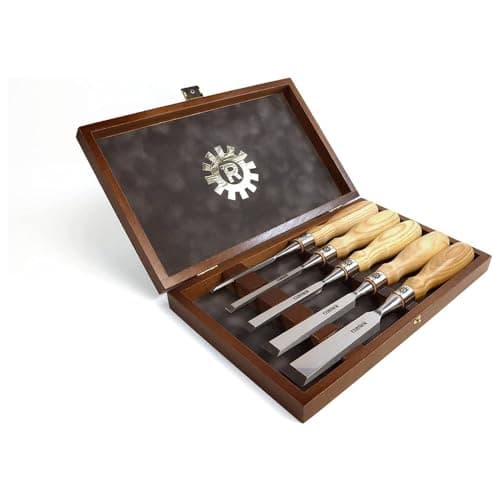
Narex Narex Richter Bevel-Edge Chisel Set (5)
Narex Richter Bevel-Edge Chisel Set (5)

The most edge you can buy at this price. Cryo-treated Cr-V hardened to a claimed 62 HRC holds a keen edge far longer than the mid-price field.

Best overall
8.4
$228.53Amazon
02
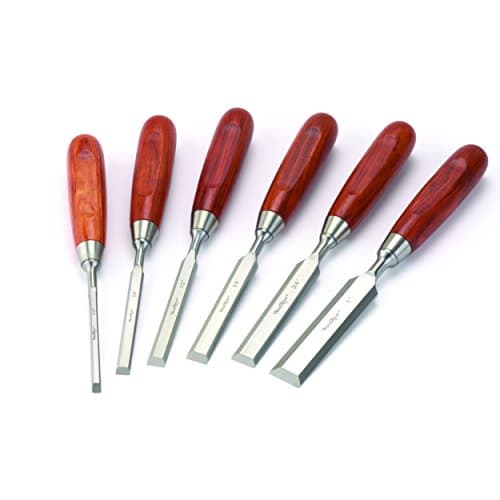
WoodRiver WoodRiver Bench Chisel Set (6)
WoodRiver Bench Chisel Set (6)

Six sizes of Cr-V hardened to a published RC 59-63, in bubinga handles with steel ferrules. The set to buy when the Narex is spoken for and an import set is not enough.

Best for fine work
7.8
$138.98Amazon
03
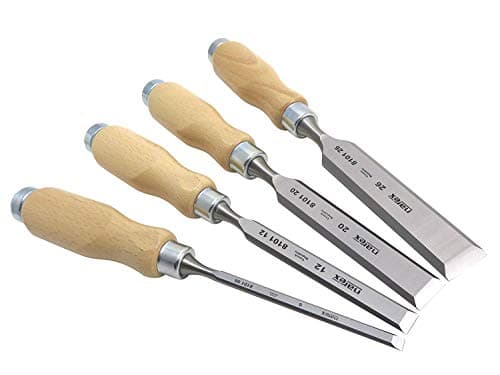
Narex Narex Bevel-Edge Chisel Set (4)
Narex Bevel-Edge Chisel Set (4)

The value pick nobody regrets. Genuinely good Cr-Mn steel and comfortable beech handles for roughly the price of a fast-food week.

Best value
8.0
$48.90Amazon
04
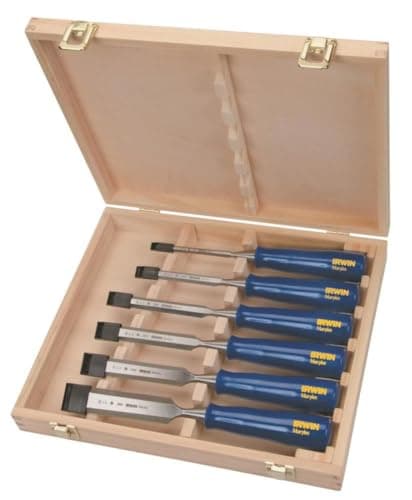
Irwin Irwin Marples M444 Bevel-Edge Chisels (6)
Irwin Marples M444 Bevel-Edge Chisels (6)

The tough, do-anything set. Six bevel-edge sizes in a wooden box, hardened to a published 58-61 HRC, at a price that makes owning the whole range easy.

Best all-rounder
7.0
$60.99Amazon

#ad · Live prices from the Amazon Product API, as of October 10, 2026. Where we have no verified live price, we show none — we would rather leave a gap than print a number that has rotted.

In detail

The picks, in full

01
Narex Narex Richter Bevel-Edge Chisel Set (5)

Best overall

Narex Richter Bevel-Edge Chisel Set (5)

Cr-V steelClaimed 62 HRCSet of 5Ash handles
8.4/10

The most edge you can buy at this price. Cryo-treated Cr-V hardened to a claimed 62 HRC holds a keen edge far longer than the mid-price field.

Edge retention
9
Steel quality
9
Ergonomics
8
Out-of-box
8
Value
8

Pros

  • Manufacturer rates the steel at HRC 62 — high for a bench chisel, and it shows in edge retention
  • Backs and bevels arrive flatter and closer to ready than most sets in the range
  • Fine bevel-edge sides get into dovetail corners cleanly

Cons

  • Costs meaningfully more than a serviceable beginner set
  • Harder steel is a little more work to bring back on a stone once it does dull

Don't buy this if…

…you are cutting your first joint and not sure the hobby will stick — a cheaper set will teach you everything, and you can graduate to these later without regret.

$228.53View on Amazon

Price as of October 10, 2026. Prices change — Amazon's is the one that counts.

#ad · we may earn a commission from this link to Narex Richter Bevel-Edge Chisel Set (5)

02
WoodRiver WoodRiver Bench Chisel Set (6)

Best for fine work

WoodRiver Bench Chisel Set (6)

Cr-V steelRC 59-63 (published)Set of 6, 1/4-1 in.Bubinga handles
7.8/10

Six sizes of Cr-V hardened to a published RC 59-63, in bubinga handles with steel ferrules. The set to buy when the Narex is spoken for and an import set is not enough.

Edge retention
8
Steel quality
8
Ergonomics
9
Out-of-box
7
Value
7

Pros

  • A published RC 59-63 puts it in the same hardness conversation as the Narex, not the import sets
  • Steel ferrules and hardwood handles are built to be struck, and the balance suits paring
  • Six sizes plus a wooden storage box, so the whole range arrives at once

Cons

  • Costs several times a serviceable beginner set for a difference you only feel once you can sharpen
  • Backs still want flattening out of the box — that is true of every chisel at this price

Don't buy this if…

…you are cutting your first joint and not sure the hobby will stick. A cheaper set teaches you everything, and you can graduate later without regret.

$138.98View on Amazon

Price as of October 10, 2026. Prices change — Amazon's is the one that counts.

#ad · we may earn a commission from this link to WoodRiver Bench Chisel Set (6)

03
Narex Narex Bevel-Edge Chisel Set (4)

Best value

Narex Bevel-Edge Chisel Set (4)

Cr-Mn steel~59 HRCSet of 4Beech handles
8.0/10

The value pick nobody regrets. Genuinely good Cr-Mn steel and comfortable beech handles for roughly the price of a fast-food week.

Edge retention
7
Steel quality
8
Ergonomics
8
Out-of-box
7
Value
10

Pros

  • Punches far above its price — the steel takes and holds a real edge
  • Four sizes cover the great majority of joinery a first shop does
  • A great first set that you will keep using even after you upgrade

Cons

  • Backs need a proper flattening session before first use
  • Softer than the Richter line, so it dulls a little sooner

Don't buy this if…

…you already sharpen well and want maximum edge life — the Richter set holds longer and is worth the jump for someone chopping mortises daily.

$48.90View on Amazon

Price as of October 10, 2026. Prices change — Amazon's is the one that counts.

#ad · we may earn a commission from this link to Narex Bevel-Edge Chisel Set (4)

04
Irwin Irwin Marples M444 Bevel-Edge Chisels (6)

Best all-rounder

Irwin Marples M444 Bevel-Edge Chisels (6)

High-carbon steel58-61 HRC (published)Set of 6, 1/4-1 in.Wooden box
7.0/10

The tough, do-anything set. Six bevel-edge sizes in a wooden box, hardened to a published 58-61 HRC, at a price that makes owning the whole range easy.

Edge retention
6
Steel quality
6
Ergonomics
8
Out-of-box
7
Value
8

Pros

  • Six sizes from 1/4 to 1 in. out of one box, so there are fewer gaps to fill later
  • Contoured polypropylene handles take a mallet and shrug off shop abuse
  • Widely stocked, so replacements and singles are easy to find

Cons

  • A published 58-61 HRC is a step below the harder Czech steel above it, and the edge shows it
  • Bevel sides are a touch thick for the tightest dovetail corners

Don't buy this if…

…your work is fine dovetails and delicate paring — a thinner-sided, harder chisel will serve that better than this general-purpose set.

$60.99View on Amazon

Price as of October 10, 2026. Prices change — Amazon's is the one that counts.

#ad · we may earn a commission from this link to Irwin Marples M444 Bevel-Edge Chisels (6)

The four sets side by side

Published listing specifications for the four sets ranked above. The hardness column is the one to read for dovetail work: it is the trade-off between how long an edge lasts in end grain and how easily it chips when you lever waste out of a socket.

SetSteelPublished hardnessPieces and handles
Narex Richter bevel-edge (5)Cr-V62 HRC (claimed)Set of 5, ash handles
WoodRiver bench chisels (6)Cr-VRC 59–63 (published)Set of 6, 1/4–1 in., bubinga handles
Narex bevel-edge Woodline (4)Cr-MnAbout 59 HRCSet of 4, beech handles
Irwin Marples M444 (6)High-carbon58–61 HRC (published)Set of 6, 1/4–1 in., wooden box

Why the Richter set leads for this job

Two reasons, and neither is the brand. The first is the published 62 HRC claim, which is at the top of this group and is the right end of the trade-off for paring end grain: the edge stays keen through a drawer's worth of sockets rather than needing a touch-up halfway through. The second is that the Richter pattern is ground with notably fine side lands, which is exactly the geometry that lets a chisel work into the acute corner of a tail socket without bruising the wall next door.

The cost of that hardness is honest and worth stating: harder steel is less forgiving if you use a chisel as a lever or hit it into a knot. If your chisels do double duty as site tools, the softer Irwin Marples set is the better buy, and you will spend less time worrying about the edge.

None of them is sharp enough out of the box

Every set here arrives ground, not honed, and a factory grind will not pare end grain cleanly. Budget for a stone before you budget for a wider set. A 1000/6000 combination waterstone and a honing guide will take any of these four to a paring edge, and our sharpening stone roundup and honing guide roundup rank the options. If you are deciding between stone types in the first place, waterstones versus diamond plates settles it on how often you want to flatten the stone.

One dovetail-specific note on sharpening: resist the temptation to put a steeper secondary bevel on your narrow chisels to protect the edge. A 25 degree bevel pares; a 35 degree bevel pushes fibres over rather than slicing them, and in end grain you will see the difference immediately on the baseline.

The chisel is half the joint

The other half is the saw and the marking. A chisel cannot rescue a sawcut that wandered past the baseline, and it cannot find a line that was never scribed properly in the first place. If you are assembling a dovetail kit rather than replacing one tool, the three purchases that matter are a backed saw, a marking gauge and these chisels — see best dovetail saw and best marking gauge, and then how to cut dovetails for the order the work happens in.

If you would rather not cut them by hand at all, that is a legitimate answer and we have priced it: a dovetail jig and a router will produce a repeatable joint in a fraction of the time, and jig versus hand-cut is the page that compares the two honestly.

Where these numbers come from

The steel types, hardness figures, set counts and handle materials above are the manufacturers' own published listing specifications, recorded when we researched each set and cited per set in Sources. We have not hardness-tested or edge-tested anything, and the scores are judgments from documented research rather than measurements. Prices come from the live price feed and carry the date they were pulled.
How we picked

We do not run a testing lab

We researched published manufacturer specifications, manuals and spec sheets, ran the arithmetic those specs support, and read owner reviews at volume, then scored each tool against a published rubric. The scores are judgments from documented research — they are not measurements we took, because we do not have a lab and we are not going to pretend we do. Where a number came from a manufacturer's document, we name it and link it in Sources.

Questions

Frequently asked

What size chisels do I need for dovetails?
A 1/4 in. and a 1/2 in. will cut the great majority of dovetails in drawer-thickness stock, and a 1/8 in. is the first worthwhile addition for fine pins. Width matters more than count: a set that stops at 1/4 in. leaves you nothing that fits a narrow socket. The full reasoning is in what size chisels do I need.
Do I need special dovetail chisels?
No. You need bevel-edge chisels with thin side lands, which is what all four sets here are. Dedicated dovetail chisels exist, with the sides ground almost to a knife edge and triangular in section, and they do reach a little further into an acute corner — but they are a refinement, not a requirement, and none of the registry sets we rank is one.
Are harder chisels better for dovetails?
Up to a point. Harder steel holds a paring edge longer in end grain, which is most of dovetail work, and that is why the 62 HRC Richter set leads this page. Past that the edge becomes chip-prone, and if a chisel is also going to be levered or chopped into construction lumber, a softer high-carbon blade is the more sensible tool.
Can I chop dovetail waste with a mallet, or should I only pare?
Both, in that order. Most people chop the bulk of the waste from both faces with a mallet, leaving a little above the baseline, then pare the last shaving by hand to the scribed line. Chopping all the way to the line risks blowing out the far face; paring everything takes much longer than it needs to.
Is a chisel set or individual chisels better value?
A small set, usually. Four-piece and six-piece sets price out well below the same widths bought singly, and the widths you want for dovetails are the ones every set includes. Buy individually only when you are adding a size a set does not carry, such as a 1/8 in.

Keep reading

Receipts

Sources

We do not run a testing lab, and we do not pretend to. Our picks come from published manufacturer specifications and manuals, the arithmetic those specs support, and owner reviews read at volume. Where we could not verify something, we say so on the page rather than quietly leaving it out. Read our full method.