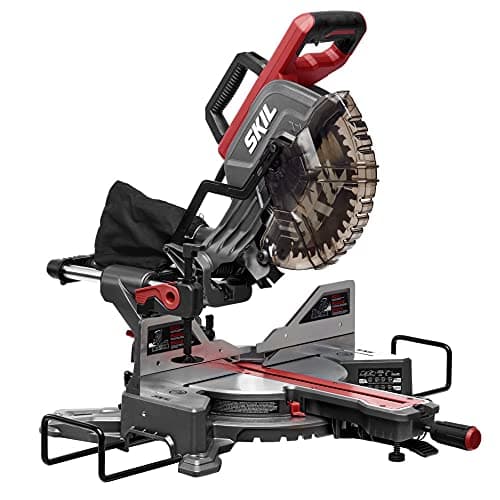
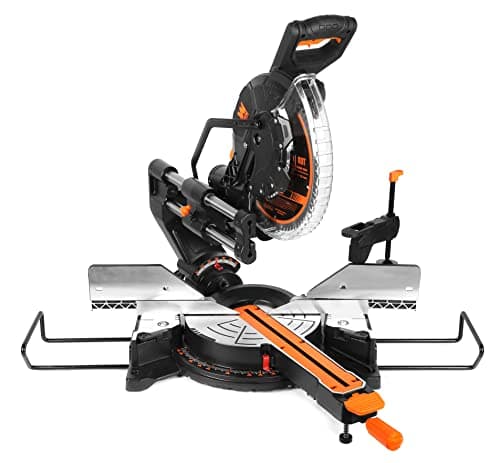
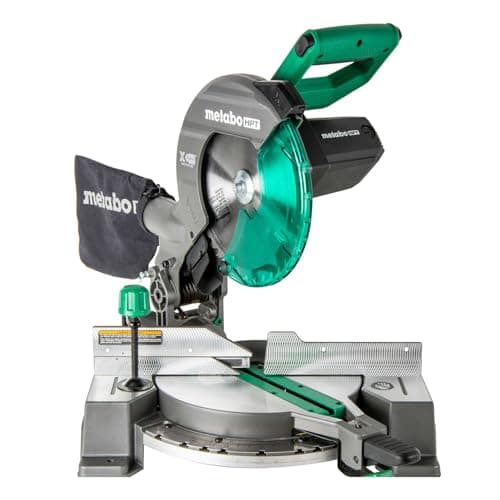
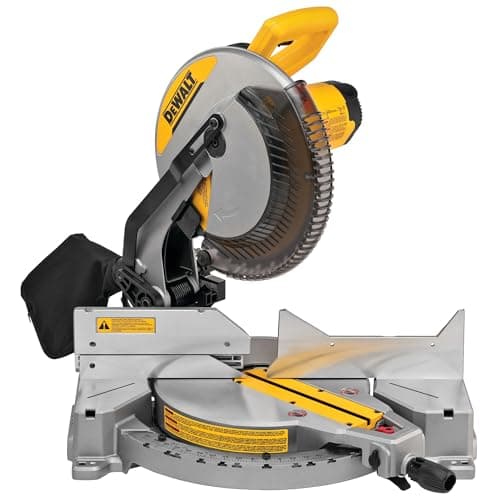
Buy the DEWALT DWS715. A 12 in. blade on a 15 A motor crosscuts wider stock than any 10 in. saw in this bracket, the detents are positive, and the single bevel is a limitation you will meet about twice a year. The budget pick is the Metabo HPT C10FCG2 — the cheapest saw here, a 10 in. single-bevel compound with a 40-tooth blade already in the box, and genuinely enough saw for a hobby shop. Buy the SKIL MS6305 if you need a slider and a dual bevel at the lowest price they exist for, and the WEN MM1215 if the deciding number is crosscut width: it publishes 13-1/4 in.
Prices here come from our live price layer, not from this page, and all four saws sat under the $500 cap at the last price check on November 21, 2026. If one has crossed the cap since, the table will show the current number rather than the one we wish were true.
The real decision: blade size or slide
A miter saw only has one job — crosscutting a board to length and to an angle — and under $500 there are exactly two ways to buy more of that capability.
A bigger blade. A 12 in. saw swings a longer arc than a 10 in. saw, so it reaches further across a board before the blade runs out of radius. It is the simpler, stiffer, cheaper route to capacity, and a non-sliding 12 in. saw has no rails to deflect. The cost is a bigger, heavier, more expensive blade every time you replace it, and a saw that takes more bench space.
A sliding head. Rails let the head travel forward and back, so a 10 in. sliding saw can crosscut as wide as a 12 in. fixed saw or wider. The cost is rails: they add deflection, they add cost, and they add roughly a foot of clearance behind the saw, because the rails have to go somewhere when the head is pulled back. That last point kills a lot of sliders in small shops — a saw against a wall cannot slide.
Under $500, the honest ranking is: a good 12 in. fixed saw beats a cheap slider for furniture work, and a slider wins only if you genuinely need to crosscut wide panels or shelves and have the wall clearance. The WEN MM1215 answers the clearance problem specifically with a dual-rail compact slide design.
Single bevel or dual bevel
Bevel is the head tilting sideways, which is what cuts a crown molding or an angled leg. A single-bevel saw tilts one way only, so cutting a matched pair of bevels means flipping the workpiece end for end. A dual-bevel saw tilts both ways and you never flip anything.
For furniture work this matters less than the marketing suggests. Flipping a 30 in. board is trivial; flipping a 12 ft piece of installed crown is not, which is why trim carpenters care and cabinet makers mostly do not. If you are choosing between a single-bevel 12 in. saw and a dual-bevel 10 in. saw at the same money, take the 12 in. saw unless you cut crown.
What none of these saws do well
Dust. A miter saw throws a fan of chips in an arc behind it, and the bag supplied with every saw in this bracket catches a small part of it. This is physics, not a defect: the blade is exposed and spinning away from the user. A shop vac on the port helps, a plywood hood behind the saw helps far more, and the arrangement that actually works is laid out on miter saw dust collection.
Supporting long stock.A miter saw with no outfeed support is a saw that cuts a taper, because the board tips as the cut finishes. Two sawhorses and a flat board either side of the saw, at exactly the saw's table height, fixes it for nothing.
Fine joinery. A miter saw is a crosscut tool, not a joinery tool. Tenon shoulders, dados and repeatable small parts belong on a table saw with a miter gauge or a sled. If that is the work you are doing, read table saw vs miter saw before spending here.
Side by side
| Saw | Blade | Slide | Bevel | Published note |
|---|
| DEWALT DWS715 | 12 in. | No | Single | 15 A compound miter |
| SKIL MS6305-00 | 10 in. | Yes | Dual | Sliding compound miter |
| WEN MM1215 | 12 in. | Yes (dual-rail compact) | Dual | 13-1/4 in. crosscut |
| Metabo HPT C10FCG2 | 10 in. | No | Single | 15 A, 40T blade included |
Every figure is the manufacturer's published specification for the listing we link. We did not cut a test board on any of them — we do not run a lab, which the methodology page says in exactly those words.
The blade matters more than the saw
The blade supplied with a miter saw is usually a 24- to 40-tooth general blade, and swapping it for a high-tooth-count crosscut blade is the single biggest improvement available. A 60-tooth blade on a 10 in. saw, or 80 on a 12 in., turns a rough crosscut into one that needs no cleanup. The Metabo C10FCG2 is the exception worth noting: it publishes a 40-tooth blade in the box, which is better than most at this price.
What to buy, in order
Furniture and general shop work: the DWS715, and a 12 in. 80-tooth blade with it. Tightest budget: the Metabo HPT C10FCG2, which arrives usable. Wide shelves and panels, with the wall clearance to slide: the WEN MM1215. Crown molding on a budget, where dual bevel earns its place: the SKIL MS6305.
If none of these is quite it, the category without a cap is on best miter saw.