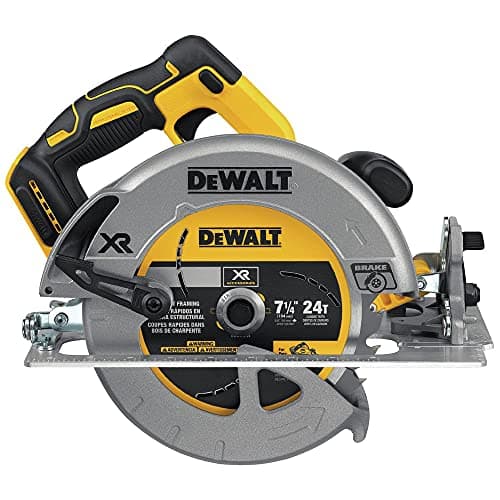
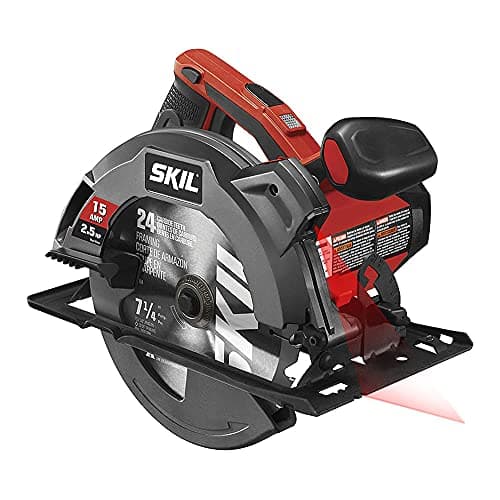
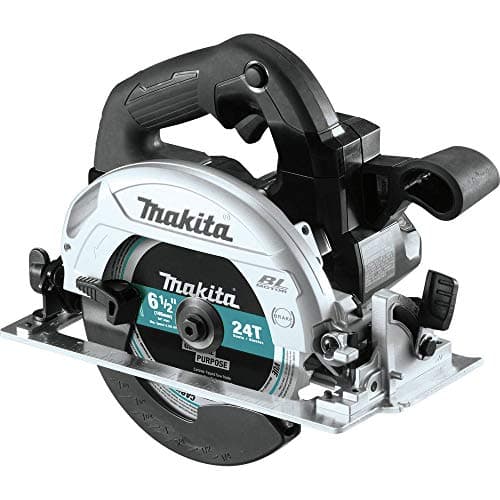
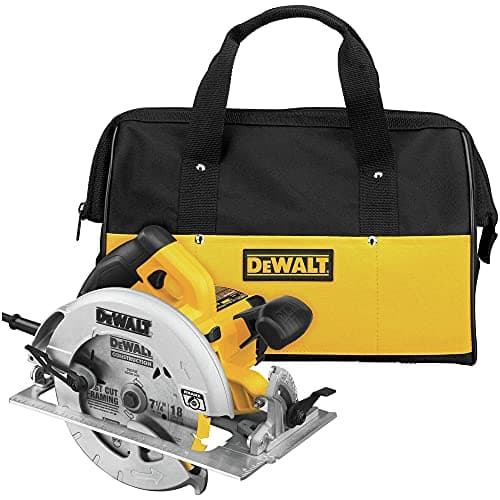
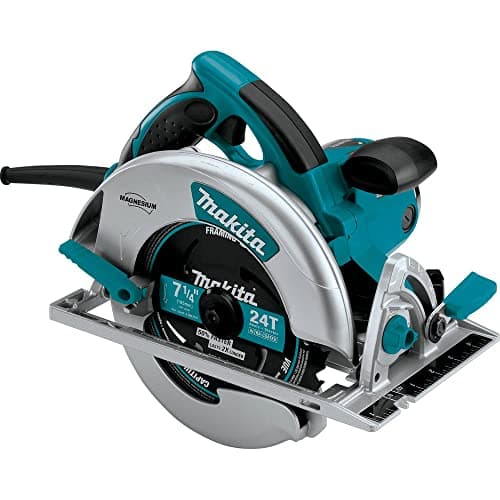
Buy the Makita 5007MG, fit a 40-tooth blade, and clamp a straightedge to the sheet. That is the whole answer for most shops. A magnesium shoe that does not rock on the cut line is worth more than any other feature on a circular saw, and the 5007MG has one at a weight you can still control at the far end of a full sheet. The DEWALT DCS570B is the same cut without a cord, the SKIL 5280-01 is the honest choice if you cut plywood four times a year, and the Makita XSH04ZBis the one you can hold out at arm's length.
What a circular saw is actually for
It is the tool that makes a sheet of plywood small enough to handle. Nobody should be pushing a full 4x8 sheet across a contractor table saw on their own: it outweighs the saw, it overhangs the table in both directions, and the moment it tips the blade is doing something you did not ask it to. The sequence that works is to break the sheet into oversize parts on the floor or on sawhorses with a circular saw, then take those parts to the table saw for the cuts that have to be exact.
That is a different job from the one a table saw does, and it is why the two are not alternatives. Our table saw vs circular saw comparison covers which machine should own which cut; this page is about buying the handheld one.
The honest gate first. If you already own a track saw, you probably do not need a circular saw. A track saw is a circular saw with the straightedge built in and the dust collected, and the overlap is nearly total — track saw vs circular saw sets the two against each other properly. The argument for the circular saw is money and indifference: it costs a quarter as much, and you can cut a rotten deck board or a nail-ridden pallet with it without flinching. Most shops want both eventually, and almost everybody should buy the circular saw first.
The shoe is the specification that matters
A circular saw has no fence, no table and no riving knife. Every bit of accuracy it has comes from a flat plate sliding on the workpiece, which means the plate is the tool. There are three grades of it, and they correspond almost exactly to the three price tiers.
Stamped steel is pressed from sheet, which is why it is cheap and why it flexes. Lean on the saw at the end of a cut and the shoe twists; the blade follows the twist and the cut wanders away from your line in the last six inches. Cast aluminum is stiffer and stays flatter. Magnesiumis the one worth paying for: about a third lighter than aluminum at similar stiffness, which is how the Makita 5007MG manages to be rigid and light at the same time. On a saw you are holding out over a sheet at arm's length, those two properties are usually in conflict, and magnesium is the material that resolves them.
Put your hand on the shoe of a saw before you buy it, if you can. If you can flex it with thumb pressure, so can the cut.
Depth of cut, and why 6-1/2 in. is usually enough
A 7-1/4 in. blade is the standard size and gives roughly 2-3/8 to 2-9/16 in. of depth at 90 degrees, depending on the saw. A 6-1/2 in. blade gives about 2-1/4 in. Both of those clear a nominal 2x, which is 1-1/2 in. thick, with room to spare. Both of them cut 3/4 in. plywood without noticing.
So the depth difference almost never decides anything. Where 7-1/4 in. earns its keep is at 45 degrees, because bevelling the saw reduces the depth of cut substantially — the DEWALT DCS570B drops from 2-9/16 in. at 90 degrees to 2 in. at 45. If you bevel through 2x stock, buy the bigger blade. If you cut sheet goods, the smaller blade on a lighter saw is the better tool, and the Makita XSH04ZB is on this page for exactly that reason.
The other consideration is blades. A 7-1/4 in. blade is the most common woodworking blade size in the world and every hardware store has a wall of them. A 6-1/2 in. blade is a cordless-tool size, and the choice is thinner and often no cheaper.
Sidewinder or worm drive
A sidewinder puts the motor beside the blade, driving it directly. It is lighter, cheaper, shorter front-to-back and spins faster. Almost every saw sold is one.
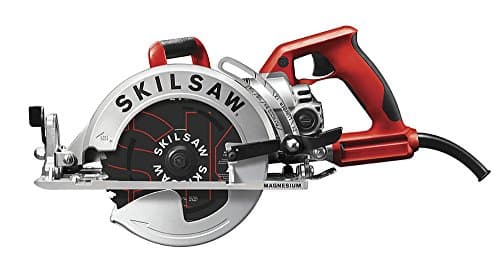
A worm drive puts the motor behind the blade and gears the drive down through a worm and wheel. That trades blade speed for torque, which is why framers use them in wet and knotty timber where a sidewinder bogs. The layout also makes the tool longer and heavier, and the gearbox needs an occasional oil change. The SKILSAW SPT77WML is here because it is the version of that argument that a woodworker might actually accept: magnesium throughout, which keeps a worm drive down to a weight you can hold up.
For sheet goods and furniture stock, a sidewinder is the right answer. Buy a worm drive if you regularly cut pressure-treated lumber or 4x material; do not buy one because it sounds more serious.
Blade-left, blade-right, and which line you can see
This is the detail that surprises people, and it is worth getting right because you cannot change it later. On a blade-rightsaw — the usual sidewinder layout — a right-handed user has the motor between their eye and the cut line, so you follow the line through a notch in the shoe. On a blade-left saw, which includes every worm drive and a few sidewinders, a right-handed user looks straight down at the blade and the line.
Blade-left gives a better view of the cut. It also means the offcut falls away on the far side of the blade from your body, and the weight of the saw sits over the supported side of the work rather than over the piece that is about to drop. Many experienced users will not go back. The counter-argument is that the guard and the sight notch on a good blade-right saw work fine once you have cut a hundred feet with it, and that blade-right saws are cheaper and far more numerous. Try one of each if you get the chance; it matters more than the spec sheet does.
Corded or cordless
A 15 A corded saw delivers about 1,800 watts all day and never needs charging. A 20V cordless saw with a 7-1/4 in. blade will cut a sheet of plywood on a driveway with no extension lead and no tripping hazard, and that convenience is genuinely worth something — sheet breakdown happens where the sheet is, which is rarely next to an outlet.
What cordless costs you is runtime and money. A full-size blade in hardwood is one of the hardest things you can ask a battery to do, and a 2.0 Ah pack will not get you through a sheet of 3/4 in. ply. Budget for a 5.0 Ah battery or larger and treat the saw price as the start of the number, not the end of it. If the saw will live in a shop with outlets within reach, buy corded and spend the difference on blades.
The blade it comes with is the first thing to replace
Every saw here ships with a 24-tooth framing blade, which is designed to cut construction lumber fast and leaves a torn, splintery edge in plywood. Fit a 40-tooth or 60-tooth thin-kerf blade and the same saw becomes a different tool: a clean enough edge in veneered plywood that you can glue to it. The logic is identical to the one on our table saw bladepage — more teeth, smaller gullets, a finer finish and a slower feed.
The one trick worth knowing for sheet goods: score the cut line first with a utility knife through the face veneer, or put the good face down and let the teeth exit through the face you do not care about. A circular saw blade cuts upward on the exit side, so the splintering happens on the face pointing at you.
Prices below come from our live price feed and carry the date they were pulled.
The six side by side
Manufacturers' and retailers' published listing specifications for the six saws ranked above. Read the shoe column first and the depth column second.
| Saw | Blade / power | Depth at 90 deg | Bevel |
|---|
| Makita 5007MG | 7-1/4 in., corded | Full 2x capacity | To 45 deg |
| DEWALT DCS570B | 7-1/4 in., 20V MAX | 2-9/16 in. | 57 deg, stops at 22.5 and 45 |
| SKIL 5280-01 | 7-1/4 in., 15 A | 2-7/16 in. | 51 deg, stop at 45 |
| SKILSAW SPT77WML | 7-1/4 in., 15 A worm drive | Full 2x capacity | To 53 deg |
| Makita XSH04ZB | 6-1/2 in., 18V LXT | 2-1/4 in. | 0 to 50 deg |
| DEWALT DWE575SB | 7-1/4 in., corded | Full 2x capacity | 57 deg |
Which saw for which shop
| If this is your situation | Buy | Because |
|---|
| First saw, mostly sheet goods and furniture stock | Makita 5007MG | A magnesium shoe that stays flat is the accuracy, and it is light enough to steer |
| Cutting sheets in a driveway or on site | DEWALT DCS570B | Full 7-1/4 in. depth with no lead to trip over or run out of |
| Four sheets of plywood a year | SKIL 5280-01 | The same 15 A motor and a blade in the box, at a quarter of the price |
| Wet, treated or 4x timber | SKILSAW SPT77WML | Gear reduction means torque, and it does not slow in heavy stock |
| One-handed trimming, overhead and awkward cuts | Makita XSH04ZB | Makita publishes 6.4 lb with a 2.0 Ah pack and it still clears a nominal 2x |
| Repetitive cuts where the blade must stop fast | DEWALT DWE575SB | Light, and the electric brake shortens every coast-down |
A clamped straightedge beats a laser, every time
No freehand circular-saw cut is straight, and no laser makes one straight either. The fix is mechanical: clamp a straight edge to the sheet and run the shoe along it. A factory edge of plywood works, an 8 ft level works, and a dedicated aluminum saw guide costs very little.
The one measurement to take once and write on the guide: the distance from the edge of the shoe to the near face of the blade. That offset is what you set the guide back from your cut line, and it is different for every saw. Measure it by making a cut along the guide on a piece of scrap, then measuring from the guide to the kerf.
You can go one step further and build a sacrificial guide — a strip of 1/4 in. hardboard with a fence glued to it, cut once with the saw itself, so the edge of the hardboard IS the cut line. That turns a circular saw into a crude track saw for the price of an offcut, and it is the single most useful jig a new shop can make. If you find yourself making one every week, buy the track saw.
Set the depth, and support the sheet underneath
Two habits do most of the safety work with this tool.
Set the depth so the blade projects about 1/4 in. below the work. Less blade in the cut means less blade available to bind, a smaller exposed arc under the sheet, and teeth entering the wood at a steeper angle, which actually improves the cut. A saw set to full depth for a 3/4 in. sheet is both more dangerous and less accurate.
Support the whole sheet, not its two ends. Resting a sheet between two sawhorses and cutting down the middle makes the two halves sag inward, close on the blade and kick the saw back at you. A circular saw has no riving knife to hold the kerf open. Lay the sheet on a full sheet of rigid foam insulation on the floor, or on four or five joists across sawhorses, and cut through it with the blade set 1/4 in. deep. Nothing can pinch if nothing can move.
Also: let the blade reach speed before it touches the wood, never retract the lower guard with your hand to start a cut, and keep the cord behind the saw. If a cut binds, release the trigger and let the blade stop before you move anything.
Dust, and why there is no good answer here
A circular saw throws fine dust sideways out of a slot in the upper guard, and most of them have no port at all. The saws that do have one are mostly cordless models with a plastic chute that fits a shop-vac hose badly. This is the one category where our dust collection advice does not have much purchase: the practical answer is to make the cut outdoors or in the garage doorway, and to wear a respirator while you do it. It is also the strongest practical argument for a track saw, which captures most of its dust at the blade.
Where these numbers come from
Depths of cut, bevel ranges, amperage, no-load speeds, blade sizes and weights above are the manufacturers' published figures where the manufacturer publishes one — Makita's own product page for the XSH04ZB (5,000 RPM, 2-1/4 in. at 90 degrees, 1-5/8 in. at 45, 0 to 50 degree bevel, 6.4 lb with a 2.0 Ah battery) — and the retailer's reproduction of the maker's specification sheet elsewhere, cited per saw in Sources.
Two figures are flagged rather than quoted. DEWALT's own copy on the DCS570B conflicts with itself: it is published as 5,200 RPM under load in one place and 5,500 RPM in another, so we give neither as fact. And no reliable weight exists for the SKIL 5280-01— retailer listings for the same saw give 5.0 lb, 8.7 lb and 10.1 lb, and SKIL's own product page for it is no longer online, so we do not quote a number. We have not tested any of these saws in a lab; we do not have one, and our methodology page says so plainly. Prices come from the live price feed and carry the date they were pulled.