Buy the planer first. Buy the drum sander when the planer starts ruining your work. Those are not competing machines at the same job — they are two different methods of making a board a chosen thickness, and the method that is fast is also the method that tears out figured grain. The DeWalt DW735X is the planer most shops should own, and the JET JWDS-1632 is the drum sander to add when curly maple, thin stock or a glued-up panel defeats it.
Two different ways to remove wood
A thickness planer carries knives on a rotating cutterhead that take a shaving off the top face while rollers feed the board through. It is a cutting tool. It removes a measurable fraction of an inch per pass, works in seconds, and leaves a surface ready for light sanding.
A drum sander carries abrasive wrapped around a cylinder, and a conveyor belt feeds the board underneath it. It is an abrading tool. It removes thousandths of an inch per pass, takes several passes to do what a planer does in one, and leaves a surface that is already sanded to whatever grit is on the drum.
Every practical difference between the machines comes out of that one distinction.
What the planer is better at, and it is not close
- Speed. A planer takes 1/16 in. off a board in one pass. A drum sander takes that long to remove a few thousandths.
- Cost per inch of width. A 13 in. benchtop planer is a fraction of the price of a 16 in. drum sander.
- Volume. Dimensioning a stack of rough boards is planer work. Trying to do it on a drum sander wastes abrasive and hours.
- Flattening a twisted board— with the caveat below, because neither machine does this unaided.
What the drum sander is better at, and why people buy one anyway
- Figured and reversing grain. Curly maple, birdseye, crotch walnut, any board where the grain direction changes mid-board. A knife lifts and tears those fibres; an abrasive cannot, because it is not levering anything up.
- Thin stock. Planers have a minimum thickness and snipe or shatter thin boards. A drum sander will take stock down to a few millimetres against a conveyor.
- Glued-up panels. A panel with alternating grain direction is the exact case a planer handles worst, and a drum sander handles perfectly.
- Short and narrow pieces. A planer needs enough length to span its feed rollers. A conveyor does not care.
- Finished thickness with no tear-out to fix. The surface leaves the machine sanded.
The thing neither machine does
Neither one flattens a board. Both reference the bottomface — the planer with its feed rollers and bed, the drum sander with its conveyor — and both will happily make a curved board into a thinner curved board of even thickness. To get one genuinely flat face you need a jointer, a hand plane, or a sled that holds the board immobile while the machine cuts.
This is the single most common misunderstanding in machine buying, and we have written it up twice: jointer vs planer explains why the two machines are not interchangeable, and how to flatten a board without a jointer covers the three ways to get a flat reference face when you do not own one.
Helical heads change the maths, partly
A straight-knife planer head takes the full width of the cut with a blade edge parallel to the board. A helical or spiral head carries dozens of small square carbide inserts arranged in a spiral, each shearing a small slice at an angle. The result is quieter, lasts far longer between changes, and tears out noticeably less on difficult grain.
“Noticeably less” is not “not at all”. A helical head narrows the gap between planer and drum sander on figured stock; it does not close it. If your work is routinely curly or quilted, the sander is still the machine that cannot tear out. We cover the head trade-off in full in helical vs straight cutterhead.
The order to buy in
- Planer. It is the machine that makes rough lumber usable, and rough lumber is where the money is saved.
- Jointer, or a planer sled, or a hand plane. Because the planer needs a flat reference face to work from.
- Drum sander.When you are regularly working figured wood, thin stock or wide glued-up panels — and not before.
A drum sander as a first thicknessing machine is a defensible choice in exactly one case: you make instruments, boxes or anything else that lives in thin figured stock. Then it is the right first machine and the planer is the one you may never need.
The four machines, side by side
Published listing specifications for the machines ranked above. Width is the number to compare across families, and note that drum sander widths are usually smaller for the money — a 16 in. sander and a 13 in. planer are not far apart on price.
| Machine | Family | Width | Published specifications |
|---|
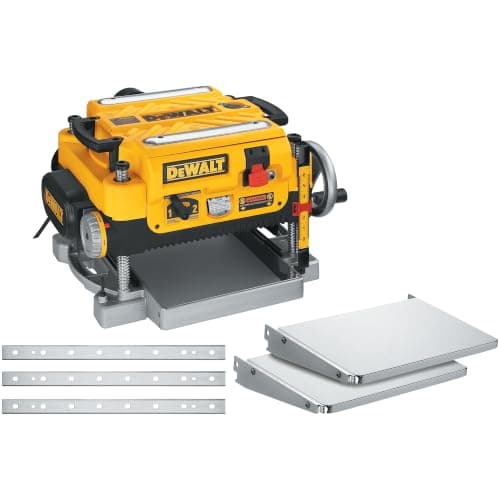
| DeWalt DW735X | Thickness planer | 13 in. | Two speeds (96/179 CPI), 3-knife head, fan chip ejection |
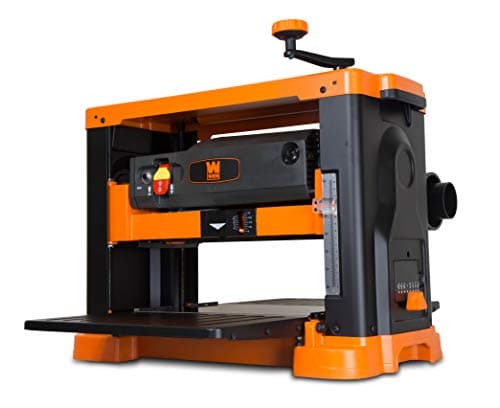
| WEN PL1326 | Thickness planer | 13 in. | Spiral head, HSS inserts, 15 A |
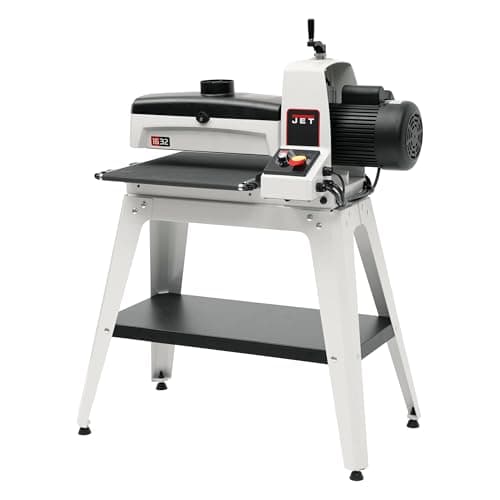
| JET JWDS-1632 | Drum sander | 16 in. drum | 1-1/2 HP, 115 V single phase, open stand |
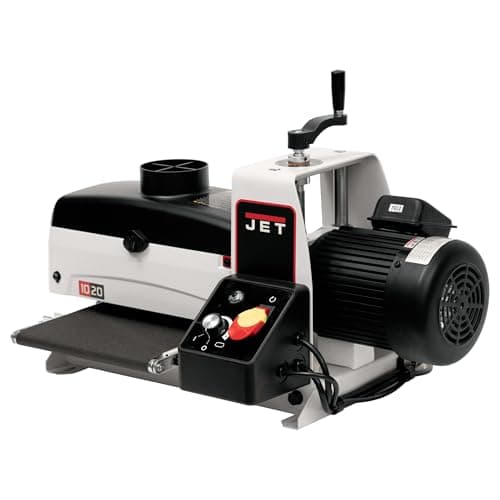
| JET JWDS-1020 | Drum sander | 10 in. drum | 1 HP, 115 V single phase, benchtop |
Cuts per inch, and why the planer has two speeds
The DW735X publishes 96 and 179 cuts per inch. That figure is knives multiplied by head speed divided by feed rate, and it decides surface quality: more cuts per inch means each knife removes a shorter arc, so the scallops it leaves are shallower and closer together.
The practical use of two speeds is sequencing. Run the fast speed to get boards close to thickness, then switch to the slow speed for a final light pass. You get the removal rate of one setting and the finish of the other, which is most of what a planer with a single speed makes you choose between.
Snipe, and the honest way to deal with it
Snipe is the slightly deeper cut a planer takes at the start and end of a board, and it happens when only one feed roller has pressure on the board. Every planer with two rollers does it to some degree. The fixes are mechanical and unglamorous: support the board level going in and coming out, lock the head if the machine has a lock, and plane stock longer than you need so you can cut the ends off.
A drum sander does not snipe. A conveyor holds the board against the belt along its whole length, so there is no transition where support changes. On short parts that is a genuine advantage and not a small one.
Load control is the drum sander specification to read
The failure mode of a drum sander is burning: too deep a pass loads the abrasive with compacted dust, the drum heats, and the board gets a scorched streak you then have to sand out. The machines that manage this slow the conveyor automatically when the drum starts to bog, rather than leaving you to notice the smell.
If you are comparing drum sanders, that feature and the drum width are the two things worth paying for. Everything else is refinement. See the best drum sander for the full field, including the wider two-pass machines this page leaves out.
Dust is not optional on either machine
A planer produces the highest volume of chips of any machine in a small shop, and a 13 in. benchtop planer running without collection will bury itself in minutes. A drum sander produces less volume but far finer dust, which is the fraction that stays airborne and matters most for your lungs.
Published airflow requirements for both machine classes are listed in our dust collector CFM chart, and the sizing logic is in the CFM guide. A shop vac is not enough for a planer; it is borderline on a benchtop sander.
Where these numbers come from
Widths, cuts-per-inch figures, head types, horsepower, voltage and stand configurations above are the manufacturers' own published listing specifications, cited per machine in Sources. We have not measured removal rates, surface finish or tear-out in a lab — we do not have one, and our methodology page says so in those words. Prices come from the live price feed.