There is no single "best router," because the word covers three different tools. If you mostly break edges and round over corners, a compact palm router is the best buy and a big table router is a waste. If you want one router to do handheld joinery now and drop into a router table later, a mid-size combo like the Bosch 1617 is the honest default. And if you are building a router table, a big fixed unit with above-table adjustment is the one to get. So we ranked these by the job, not by raw horsepower.
Start with three questions. The first is whether you need a trim router — a light, one-handed tool for chamfers, round-overs, hinge mortises and laminate, where the Bosch Colt is the specialist. The second is whether you want a do-everything mid-size combo: around 2.25 HP, a fixed and a plunge base in the kit, and both collet sizes, which is where the Bosch 1617 and the DeWalt DW618 live. The third is whether the router will spend its life bolted under a table, where the 3-1/4 HP Trend T8 and its above-table height adjustment earn their keep.
The compacts — the DeWalt DCW600B and the Makita RT0701C — sit between the palm router and the mid-size machines, and they are what most people should actually own first. They handle edge work and light joinery, both take an optional plunge base, and they are far easier to control one-handed than a full 2 HP router. If you are still building out a first shop, our essential woodworking tools guide shows where a router fits in the buying order.
The short answer
#ad · Live prices from the Amazon Product API, as of Sep 19, 2026. Where we have no verified live price, we show none — we would rather leave a gap than print a number that has rotted.
In detail
Best overall
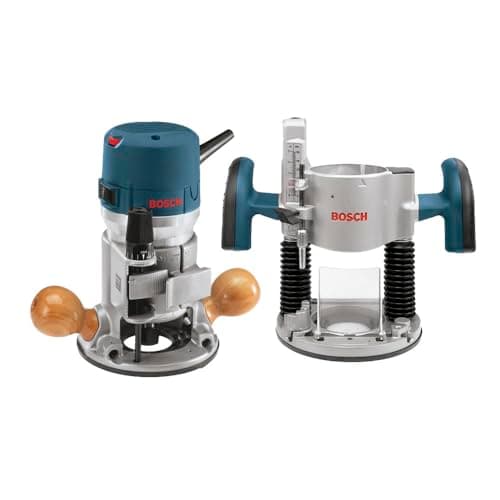
Bosch 1617EVSPK Router Combo
2.25 HP8k–25k RPMFixed + plunge bases1/4 & 1/2 in collets
The default recommendation for a first serious router. Fixed and plunge bases in one kit, 2.25 HP, and a reputation for lasting decades.
- Power
- 8
- Control
- 8
- Versatility
- 9
- Build
- 9
- Value
- 8
Pros
- +Two bases cover handheld work and, with the fixed base, a router table
- +Accepts both collet sizes, so it runs the full range of bits
- +Long track record — a genuinely durable machine
Cons
- −Above-table height changes mean going under the table without a lift
- −No onboard LED work light
Don't buy this if…
…you only ever do light edge work and hate weight — a compact trim router is lighter and easier for one-handed rounding-over.
Best cordless compact
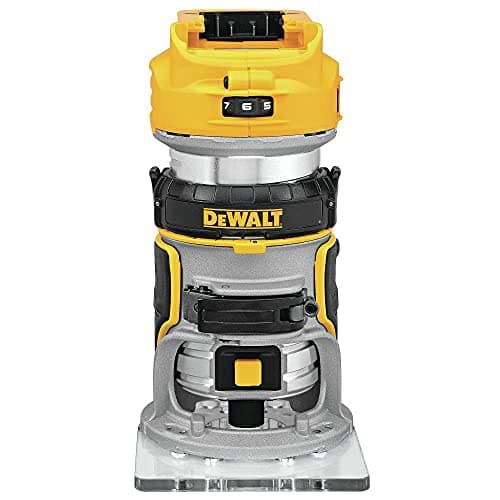
DeWalt DCW600B 20V MAX XR Compact Router (Tool Only)
16,000-25,500 RPM1/4 in. colletBrushless, 20V MAXFixed base, tool only
DeWalt's current compact router, and the one that removes the cord from edge work. Dual LEDs, a depth-adjustment ring and a brushless motor — but it arrives as a bare tool on a fixed base.
- Power
- 6
- Control
- 9
- Versatility
- 7
- Build
- 8
- Value
- 7
Pros
- +No cord to drag across a workpiece, which is exactly where a trailing lead does the most damage
- +Dual LEDs light the bit and the depth-adjustment ring sets height without tools
- +Electronic brake stops the bit quickly when you release it
Cons
- −Bare tool — a 20V MAX battery and charger are extra unless you already run the platform
- −Fixed base only; DeWalt's plunge base for this router is a separate purchase
- −1/4-inch collet only, so the big rail-and-stile and panel-raising bits are out
Don't buy this if…
…you have no DeWalt batteries and want the cheapest capable compact. A corded compact does the same work for less once the battery is priced in.
Best value compact
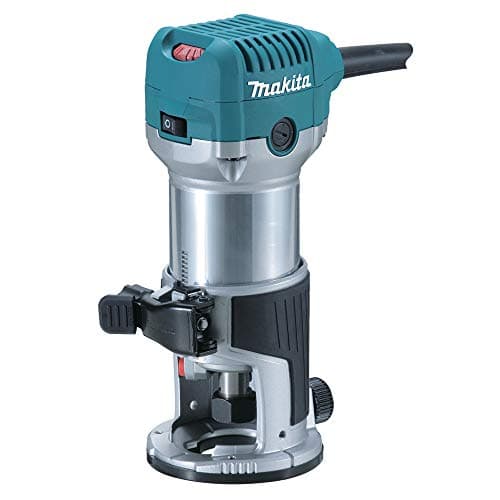
Makita RT0701C Compact Router
1.25 HP10k–30k RPM1/4 in colletVariable speed
The compact router's value champion. Smooth variable speed and a wide accessory ecosystem, usually a little cheaper than the DeWalt.
- Power
- 6
- Control
- 8
- Versatility
- 8
- Build
- 8
- Value
- 9
Pros
- +Very smooth speed control and a quiet, refined motor
- +Huge range of aftermarket bases and plates fit it
- +Often the cheapest way into a quality compact router
Cons
- −No onboard light
- −1/4-inch collet only, like all compacts
Don't buy this if…
…you want the lit cut and the finest height micro-adjust out of the box — the DeWalt edges it on both.
Best for trim work
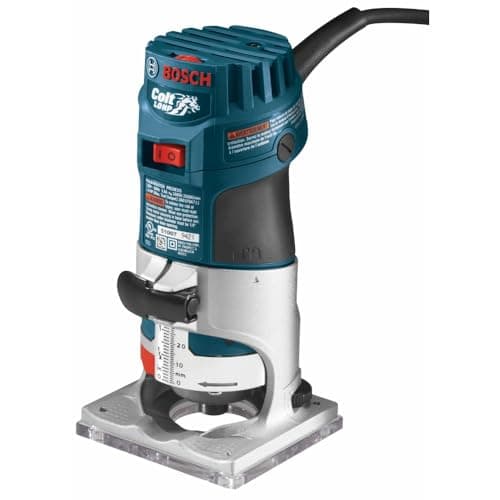
Bosch Colt PR20EVS Palm Router
1.0 HP16k–35k RPMPalm grip5.6 A
A true one-hand palm router for trim and rounding-over. The smallest, lightest way to break edges and run laminate.
- Power
- 5
- Control
- 8
- Versatility
- 6
- Build
- 8
- Value
- 8
Pros
- +Small and light — comfortable for long sessions of edge work
- +Fine depth adjustment for a palm router
- +Great for laminate trimming and small round-overs
Cons
- −Least powerful of the routers here — light cuts only
- −1/4-inch collet, small bits
Don't buy this if…
…you want one router to do everything — a slightly larger compact like the DCW600B or the RT0701C does trim work and more.
Best for a router table
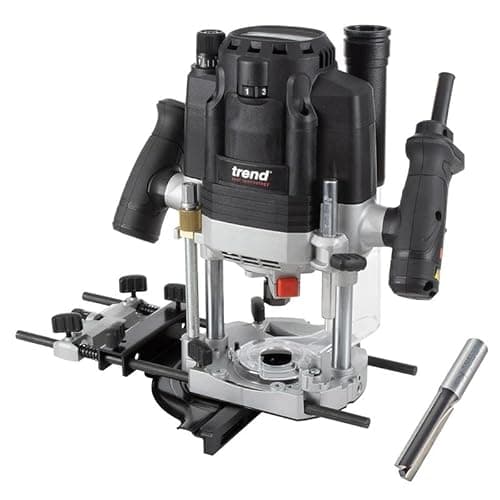
Trend T8 Dual-Mode Plunge Router (3-1/4 HP)
3-1/4 HP / 15 A10k–20k RPMAbove-table height1/2 in collet
The router-table router. Above-table height adjustment is the feature that makes table work painless, and this one is built around it rather than bolting it on.
- Power
- 9
- Control
- 8
- Versatility
- 7
- Build
- 8
- Value
- 7
Pros
- +Above-table height adjustment means depth tuning and bit changes without crawling under the table
- +3-1/4 HP, 15-amp motor swings large panel-raising bits
- +Eleven-step speed dial lets you slow a big cutter down, which is what stops burning
Cons
- −Heavy and large for handheld use
- −The most expensive router in this roundup
Don't buy this if…
…you want a handheld router first — this is happiest bolted under a table, and it is a lot to swing by hand.
Best mid-size alternative
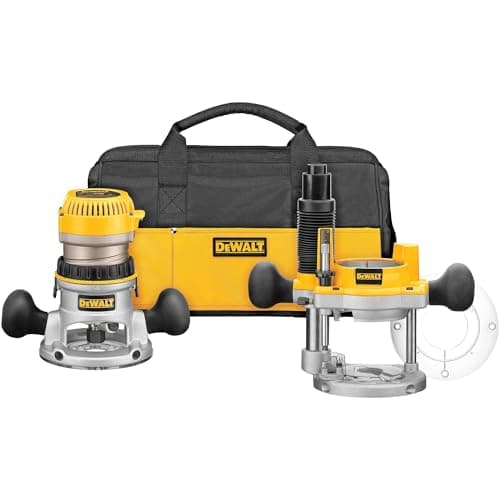
DeWalt DW618PK Router Combo
2.25 HP8k–24k RPMFixed + plungeSoft start
A solid mid-size alternative to the Bosch. 2.25 HP, soft start and both bases — a dependable do-most-things router.
- Power
- 8
- Control
- 8
- Versatility
- 8
- Build
- 8
- Value
- 8
Pros
- +Soft start keeps it from jumping on power-up
- +Both bases and both collets, like the Bosch
- +Well-built DeWalt motor with a good service network
Cons
- −Below-table height adjustment without a lift
- −Nothing it does clearly beats the Bosch — often comes down to price
Don't buy this if…
…the Bosch 1617 is cheaper the day you buy — the two are close enough that price should decide.
How to choose a woodworking router
Two things decide most of it: collet size and base type. The collet is the sleeve that grips the bit, and the 1/2-inch versus 1/4-inch choice matters more than horsepower on paper. A 1/2-inch collet accepts big rail-and-stile and panel-raising bits and runs them with less vibration; a router that only takes 1/4-inch bits is fine for edge work and light joinery but shut out of the large bits. Every compact here — the DCW600B, the RT0701C and the Colt — is 1/4-inch only, while the mid-size Bosch 1617 and DeWalt DW618 take both. The table-focused Trend T8 is listed with a 1/2-inch collet, which is the one that matters under a table.
Trim router, mid-size combo, or table router?
A trim router (also called a palm or compact router) is a light, often one-handed tool for chamfers, round-overs, hinge mortises and laminate. The Bosch Colt is the dedicated version; the DCW600B and RT0701C are slightly larger compacts with finer height control and an optional plunge base sold separately. A mid-size combo runs about 2.25 HP with both a fixed and a plunge base, and is the one router that can do handheld joinery today and drop under a table later. A dedicated table router like the Trend T8 is meant to live bolted upside-down, where its size stops mattering and its above-table height adjustment starts to.
Fixed base, plunge base, or both?
A fixed base holds the bit at one set depth — simplest and steadiest for edge work and table use. A plunge base lets you lower a spinning bit into the middle of a board for stopped grooves, mortises and inlay. The combo kits give you both bases on one motor, which is why they are the sensible default for a first serious router: you swap the motor between bases in seconds and cover nearly every job. Buy a single fixed-base router only when you know a table is its one and only home.
What a router table changes
Once a router lives under a table, the pain point becomes changing bits and setting height from below. A router with above-table height adjustment, like the Trend T8, lets you set depth from the top — no reaching underneath, no separate lift to buy. If a table is on your plan, it is worth reading where the table itself belongs in the buying order in our essential woodworking tools guide before you spend on the router.
How we picked
We do not run a testing lab
We researched published manufacturer specifications, manuals and spec sheets, ran the arithmetic those specs support, and read owner reviews at volume, then scored each tool against a published rubric. The scores are judgments from documented research — they are not measurements we took, because we do not have a lab and we are not going to pretend we do. Where a number came from a manufacturer's document, we name it and link it in Sources.
Questions
What HP router do I need for a router table?+
For a router table you generally want a 2 HP or larger router with a 1/2-inch collet, so it can swing big rail-and-stile and panel-raising bits without bogging down. The mid-size combos here are around 2.25 HP, which handles most table work; a dedicated table router like the Trend T8 runs 3-1/4 HP for the largest bits. Just as important is above-table height adjustment, which saves you reaching under the table on every setup.
Do I need both a fixed and a plunge base?+
Not strictly, but the combo kits give you both on one motor, which covers far more work than either alone. A fixed base is steadier for edge profiling and table use; a plunge base is what you need for stopped grooves, mortises and inlay. For a first router, buying the combo is the cheapest way to have both.
Is a compact router enough for a beginner?+
For most beginners, yes — a compact like the DCW600B or RT0701C handles round-overs, chamfers, dadoes and light joinery, and it is far easier to control one-handed than a big 2 HP machine. Its limit is the 1/4-inch collet, so if you know you will run large bits in a table, start with a mid-size combo instead.
What's the difference between a trim router and a full-size router?+
A trim router (or palm router) is small, light and usually 1/4-inch collet only, made for edges, laminate and small profiles. A full-size router has more power and a 1/2-inch collet for big bits and heavier cuts, at the cost of size and weight. Many shops end up owning one of each.
Receipts
We do not run a testing lab, and we do not pretend to. Our picks come from published manufacturer specifications and manuals, the arithmetic those specs support, and owner reviews read at volume. Where we could not verify something, we say so on the page rather than quietly leaving it out. Read our full method.