Skip to content
Dovetail & Dust

HUB 03 · Dust Collection

Router Table Dust Collection

The fence port catches the chips. The cabinet catches what falls. Collect at only one and the table still coats the shop — here is how to do both without buying two collectors.

By Stephen V.Updated How we research
#ad

We earn a commission when you buy through our Amazon links, at no extra cost to you. It never changes our rankings, and we say so when the cheaper tool is the better buy. How this works.

A router table is two dust sources bolted together. The fence catches the chips thrown sideways off the cutter; the enclosure under the table catches everything that falls and everything the fence missed. Connect only one and you will keep sweeping.

This surprises people because a handheld router has one obvious problem — chips everywhere — and a table seems like it should be tidier. It is tidier, but only if both halves are collected, and the two halves want different things from the machine on the other end of the hose.

The fence port: high pressure, small hose

The fence port sits within an inch or two of the cutter, in a small enclosure, with a small opening. That is textbook shop-vac territory: high static pressure through a 2-1/2 in. hose, pulling hard on a small volume. A dust collector connected here does surprisingly little, because a collector's strength is moving a lot of air at low pressure and there is no volume for it to move through that opening. Our shop vac versus dust collector piece works through why.

Two things determine how well the fence port performs, and neither is the vac:

  • How closely the fence faces close around the bit. Most router-table fences have sliding sub-fences precisely so you can bring them in until they nearly touch the cutter. Every inch of gap you leave is an inch of air that gets pulled in instead of chips.
  • Whether the port is behind the cutter or above it. Chips leave the bit roughly tangentially. A port directly behind the cutting zone catches them; a port high on the fence catches the fine stuff and lets the chips bounce.

Under the table: high volume, big hose

The space below the table is the opposite problem. It is a large box with a large volume of air in it, and what you want is to move that whole volume steadily so falling material is carried out rather than settling on the router motor. That is a dust collector's job, through a 4-inch port, not a vac's.

If your table is an open stand with no enclosure at all, the single highest-value improvement is to box it in. A plywood or MDF cabinet with a 4-inch port in the back turns an open frame into a collection chamber, and it also drops the noise noticeably. It does not need to be airtight — in fact it should not be, because the collector needs make-up air from somewhere — but it needs to be enclosed enough that the airflow has a direction.

Watch the reducer trap here. A 4-inch cabinet port stepped down to 2-1/2 in. to reach a vac throttles the whole thing to the small pipe's capacity: about 136 CFM at the velocity chips need, against 349 CFM for the 4-inch line. Those figures and the arithmetic behind them are in our CFM and duct chart.

Running both without buying two machines

The honest ideal is a vac on the fence and a collector on the cabinet, running together. Plenty of shops do not have both, so in descending order of how well they work:

  1. Vac on the fence, collector on the cabinet. Each machine does what it is good at. This is as good as a home router table gets.
  2. Collector on both, via a wye.Works, but the collector will preferentially pull from whichever branch offers less resistance — nearly always the big cabinet port — so fence capture suffers. A blast gate on the cabinet branch, closed part way, helps more than it sounds like it should.
  3. Vac on the fence only. Better than it sounds, because the fence is where most of the volume is generated on edge work. The cabinet fills up and you vacuum it out periodically.
  4. Vac on the cabinet only. The weakest of the four. A vac cannot move enough air through a large box, and you have left the chips at the cutter uncollected.

Whichever you run, put a separator in front of the vac. Router work produces a genuinely startling volume of chips for the size of the tool, and a vac filter on router duty without a separator will load in one session.

The cut where none of this works

When the bit is buried in the fence — a rebate cut with most of the cutter shrouded — collection is excellent. When the bit stands proud above the fence, as it does on large panel-raising cutters, the fence port is capturing only part of what is thrown, and there is nothing above the cut. Those are also the cuts that generate the most material.

The mitigation is a fence with an over-cutter guard that has its own port, which some aftermarket fences include. Failing that, this is the cut where a respirator stops being optional, and a good argument for running an air filtration unit during and after the session.

Large panel bits are also the ones with the strictest speed limits — a 3-1/4 in. cutter is not safe at trim-router RPM. The published figures are in our router bit speed chart.

If you are still choosing the table

Dust collection provision varies a lot between router tables and is worth weighing when you buy: whether the fence has a port at all, what size it is, whether the fence faces slide, and whether the stand is enclosed or open. Our router table roundup covers the field, and which router to buy covers whether the motor you own can even be mounted under one.

What we could not verify

We have not measured capture rates at any fence or in any cabinet, and we found no published CFM specification for a router table from a source we were willing to cite — which is why there is no row for one in our CFM chart. The duct-diameter figures quoted above are arithmetic from published transport velocities and are shown as such on that page. Everything else here is a description of how the airflow and the machine behave.
The short answer

Quick picks

#ProductBest forScorePrice
01
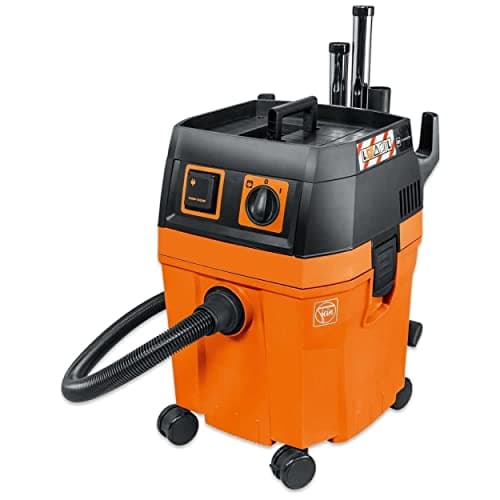
Fein Fein Turbo II HEPA Wet/Dry Dust Extractor
Fein Turbo II HEPA Wet/Dry Dust Extractor

A dust extractor, not a shop vac — and the difference is the filter and the noise. HEPA filtration and a published 66 dB running noise turn all-day sanding from a chore into background work.

Best overall
7.8
$649.95Amazon
02
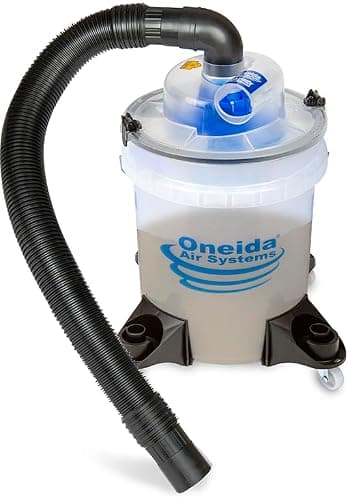
Oneida Oneida Dust Deputy Deluxe Cyclone Separator
Oneida Dust Deputy Deluxe Cyclone Separator

Not a collector — the upgrade that makes your shop vac one. A cyclone that drops nearly all the debris into a bin before it ever reaches the filter.

Best shop-vac upgrade
8.2
$156.95Amazon
03
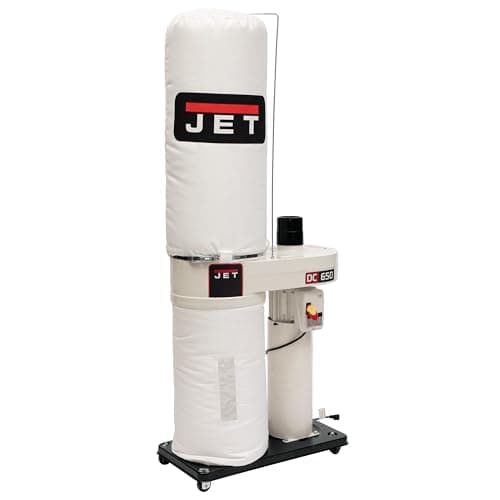
JET JET DC-650 1 HP Dust Collector (30-micron bag)
JET DC-650 1 HP Dust Collector (30-micron bag)

The one to buy if you want a real collector that plugs into an ordinary outlet and still has a documented upgrade path. JET publishes 650 CFM at the 4-inch inlet and 6-1/2 in. WC of static pressure, which is the number that actually survives a hose run.

Best overall (small shop)
6.8
$499.99Amazon
04
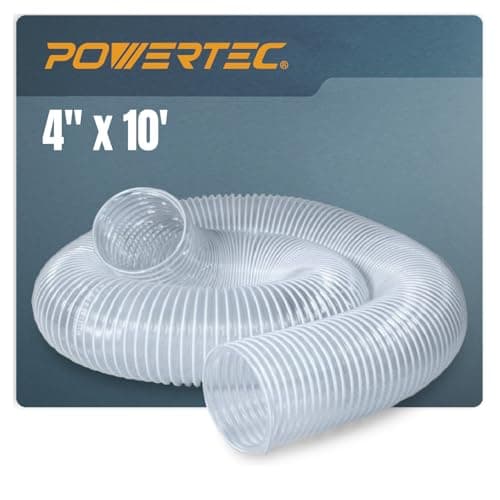
POWERTEC POWERTEC 4-in × 10-ft Dust Collection Hose
POWERTEC 4-in × 10-ft Dust Collection Hose

The standard 4-inch flexible tail. Ten feet is the right length for a machine drop — long enough to reach, short enough not to waste airflow.

Best 4-in hose
8.4
$31.19Amazon
05
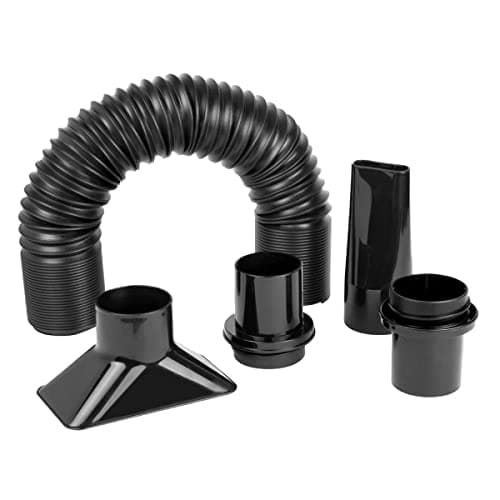
POWERTEC POWERTEC 70208V 2-1/4-in Hose Kit (shop vac)
POWERTEC 70208V 2-1/4-in Hose Kit (shop vac)

The small-port side of the system. A 2-1/4-inch hose kit that connects a shop vac to the sanders, routers and track saws a 4-inch line is wasted on.

Best for hand tools
8.4
$24.99Amazon

#ad · Live prices from the Amazon Product API, as of Sep 19, 2026. Where we have no verified live price, we show none — we would rather leave a gap than print a number that has rotted.

In detail

The picks, in full

01
Fein Fein Turbo II HEPA Wet/Dry Dust Extractor

Best overall

Fein Turbo II HEPA Wet/Dry Dust Extractor

8.5 gal151 CFMHEPA filter66 dB
7.8/10

A dust extractor, not a shop vac — and the difference is the filter and the noise. HEPA filtration and a published 66 dB running noise turn all-day sanding from a chore into background work.

Filtration
10
Suction
8
Noise
9
Capacity
6
Value
6

Pros

  • HEPA filtration captures the fine dust that a standard vac blows straight back at you
  • 66 dB published noise level is quiet enough to hold a conversation next to
  • Anti-static system stops the hose shocking you every time you touch it

Cons

  • Costs three to four times a comparable-capacity shop vac
  • 8.5 gallons is modest capacity for the money

Don't buy this if…

the vac's main job is sucking up floor sweepings and the odd spill. That is not worth HEPA money.

$649.95View on Amazon

Price as of Sep 19, 2026. Prices change — Amazon's is the one that counts.

#ad · we may earn a commission from this link to Fein Turbo II HEPA Wet/Dry Dust Extractor

02
Oneida Oneida Dust Deputy Deluxe Cyclone Separator

Best shop-vac upgrade

Oneida Dust Deputy Deluxe Cyclone Separator

Cyclone separatorFits most shop vacsMolded bodyPre-separator
8.2/10

Not a collector — the upgrade that makes your shop vac one. A cyclone that drops nearly all the debris into a bin before it ever reaches the filter.

Airflow
7
Filtration
9
Footprint
8
Noise
8
Value
9

Pros

  • Captures the vast majority of dust and chips before the vac filter
  • Keeps vac suction high and the filter clean for far longer
  • Cheapest big improvement you can make to a vac-based setup

Cons

  • Adds a second bin to find room for
  • You still need a shop vac — this only separates, it doesn't suck

Don't buy this if…

you have already moved to a dedicated collector — a bigger single- or two-stage collector is the next step, not a vac cyclone.

$156.95View on Amazon

Price as of Sep 19, 2026. Prices change — Amazon's is the one that counts.

#ad · we may earn a commission from this link to Oneida Dust Deputy Deluxe Cyclone Separator

03
JET JET DC-650 1 HP Dust Collector (30-micron bag)

Best overall (small shop)

JET DC-650 1 HP Dust Collector (30-micron bag)

1 HP650 CFM at 4 in.115/230V, 11/5.5 A6-1/2 in. WC static pressure
6.8/10

The one to buy if you want a real collector that plugs into an ordinary outlet and still has a documented upgrade path. JET publishes 650 CFM at the 4-inch inlet and 6-1/2 in. WC of static pressure, which is the number that actually survives a hose run.

Airflow
7
Filtration
5
Footprint
8
Noise
7
Value
7

Pros

  • Runs on a standard 115V circuit at 11 A, or converts to 230V — no electrician needed to get started
  • JET publishes static pressure (6-1/2 in. WC) as well as airflow, so you can size ducting against a real number instead of a free-air headline
  • Four casters and a compact base: it rolls to the machine, which beats ducting a whole shop on a small budget
  • Published at 65-70 dB — quiet enough to leave running through a session
  • JET sells a 2-micron canister kit for this frame, so filtration is an upgrade rather than a new machine

Cons

  • This listing is the 30-micron bag version, and a 30-micron bag passes exactly the fine fraction that matters for your lungs — budget for the canister or a finer bag from day one
  • 650 CFM is the same airflow class as the cheaper Rikon 60-100 further down this page; you are paying for the published numbers, the upgrade path and parts support, not for more air
  • Single-stage, so the filter loads with fine dust — a separator in front of it pays for itself quickly
  • One 4-inch inlet, which caps how much you can duct permanently

Don't buy this if…

price is the deciding factor. The Rikon 60-100 lower down moves a similar 650 CFM for less money, and on a tight budget the difference is better spent on a separator and a finer bag.

$499.99View on Amazon

Price as of Sep 19, 2026. Prices change — Amazon's is the one that counts.

#ad · we may earn a commission from this link to JET DC-650 1 HP Dust Collector (30-micron bag)

04
POWERTEC POWERTEC 4-in × 10-ft Dust Collection Hose

Best 4-in hose

POWERTEC 4-in × 10-ft Dust Collection Hose

4 in diameter10 ft lengthFlexible PVCClear wall
8.4/10

The standard 4-inch flexible tail. Ten feet is the right length for a machine drop — long enough to reach, short enough not to waste airflow.

Airflow
8
Durability
8
Flexibility
9
Fit
8
Value
9

Pros

  • Full 4-inch bore is what a planer, jointer or table saw actually needs to clear chips
  • Clear wall lets you see a blockage instead of guessing where it is
  • Ten-foot length discourages the twenty-foot flex runs that strangle collectors

Cons

  • Ribbed flex has far more internal drag than smooth rigid pipe — keep the run short
  • Needs clamps and fittings, which are not included

Don't buy this if…

you are ducting a whole shop. Use rigid pipe for the mains and keep flex for the last few feet.

$31.19View on Amazon

Price as of Sep 19, 2026. Prices change — Amazon's is the one that counts.

#ad · we may earn a commission from this link to POWERTEC 4-in × 10-ft Dust Collection Hose

05
POWERTEC POWERTEC 70208V 2-1/4-in Hose Kit (shop vac)

Best for hand tools

POWERTEC 70208V 2-1/4-in Hose Kit (shop vac)

2-1/4 in diameterFlexible hoseAdapters includedShop-vac fit
8.4/10

The small-port side of the system. A 2-1/4-inch hose kit that connects a shop vac to the sanders, routers and track saws a 4-inch line is wasted on.

Airflow
7
Durability
8
Flexibility
9
Fit
9
Value
9

Pros

  • The right diameter for hand-tool ports, where a big hose kills the vac's suction
  • Adapters cover the mismatched port sizes tool makers insist on using
  • Light and manageable, which matters on a hose you drag around a bench

Cons

  • Far too small for a planer, jointer or table saw — do not use it as a collector line
  • Small hoses clog on shavings rather than dust

Don't buy this if…

your machines are chip producers. This diameter is for hand tools on a vac, nothing more.

$24.99View on Amazon

Price as of Sep 19, 2026. Prices change — Amazon's is the one that counts.

#ad · we may earn a commission from this link to POWERTEC 70208V 2-1/4-in Hose Kit (shop vac)

How we picked

We do not run a testing lab

We researched published manufacturer specifications, manuals and spec sheets, ran the arithmetic those specs support, and read owner reviews at volume, then scored each tool against a published rubric. The scores are judgments from documented research — they are not measurements we took, because we do not have a lab and we are not going to pretend we do. Where a number came from a manufacturer's document, we name it and link it in Sources.

Questions

Frequently asked

Should I connect a shop vac or a dust collector to a router table?
Both, ideally, in different places. The fence port is small and close to the cutter, which suits a vac's high pressure and small hose. The enclosure under the table is a large volume with a 4-inch port, which suits a collector. If you can only run one, put the vac on the fence.
Do I need to enclose the bottom of my router table?
It is the single biggest improvement you can make to an open stand. A boxed-in cabinet with a 4-inch port gives the airflow somewhere to go, so falling material is carried out instead of settling on the motor. It also cuts the noise. It should not be airtight — the collector needs make-up air.
Why does my router table fence port collect so little?
Usually because the sliding fence faces are left too far apart. Bring them in until they nearly touch the cutter, so the air being pulled through the port has to travel past the cutting zone rather than through an open gap either side of it.
Can I run the fence and the cabinet off one dust collector?
Yes, through a wye, but the collector will pull most of its air from the cabinet branch because it offers less resistance, and fence capture will suffer. Partly closing a blast gate on the cabinet branch rebalances it more effectively than you would expect.

Keep reading

Receipts

Sources

We do not run a testing lab, and we do not pretend to. Our picks come from published manufacturer specifications and manuals, the arithmetic those specs support, and owner reviews read at volume. Where we could not verify something, we say so on the page rather than quietly leaving it out. Read our full method.