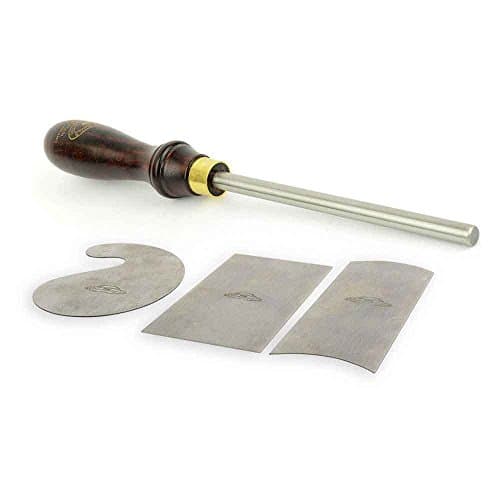
If you have never used one, buy the Crown three-piece set: two scrapers and the burnisher, in one box, for the price of a mid-range router bit. If you already own a burnisher, buy the Bahco 474 and be done. The truth about this tool is that the steel is almost irrelevant and almost free; what you are really buying is a twenty-minute skill, and the single commonest reason a first card scraper ends up in a drawer is that it arrived without the rod needed to make it cut.
What a card scraper actually does
It is a rectangle of hardened steel, about as thick as a credit card. You file and stone its long edge square, then roll a tiny hook of steel over along that edge with a hard rod. That hook — the burr — is a cutting edge with a very high effective cutting angle, and it takes a shaving a few thousandths of an inch thick.
That matters for two reasons that nothing else in the shop provides.
It cuts instead of abrading. Sandpaper tears fibers and leaves a field of scratches; the finer the paper, the finer the scratches, but they are still scratches and a gloss finish in raking light will find them. A scraper severs fibers cleanly and leaves a burnished surface with no scratch pattern at all. On a surface going under a film finish, that is a visibly different result.
It has no grain direction.A plane iron cuts at a low angle and lifts fibers ahead of the edge, which is why reversing grain and figured wood tear out. A scraper's burr meets the surface at a steep angle and scrapes the fiber off rather than lifting it, so curly maple, crotch walnut and figured cherry — the exact boards a smoothing plane destroys — are what a scraper is best at. Our tearout guide names a scraper as the tool that survives when nothing else does; this is the page behind that.
Two more jobs it quietly owns: taking dried glue squeeze-out off a panel without sanding through the surrounding surface, and leveling a finish between coats where paper would cut through.
The burr is the tool, and that changes what you buy
Here is the thing that makes this category different from every other tool page on this site. A chisel arrives sharp or nearly so. A plane needs tuning but it still cuts out of the box. A card scraper, out of the box, is a flat piece of steel that does nothing at all. It has no edge. You make the edge, and then you remake it every twenty minutes of use, because a burr that fine wears off fast.
So the purchase is not really "a scraper". It is a small kit:
- The scraper — hardened steel, ideally 0.6 to 0.8 mm thick. Thinner flexes more, which lets you bow it between your thumbs and take a narrow shaving from the middle of the edge rather than digging in with the corners.
- A burnisher — a polished rod, harder than the scraper. This is the one non-negotiable extra, and the one most first buyers do not know about.
- A mill file — to joint the edge dead square and flat before anything else. This is the step people skip, and skipping it is why a burr appears along three inches of a five-inch edge.
- A stone — any medium and fine stone you already own for chisels works. You are polishing the file marks off, not grinding a bevel.
That is why the Crown three-piece set is ranked where it is despite costing several times what a single scraper does. It is the only listing here that puts the scrapers and the burnisher in one box, and solving "I bought a scraper and it does nothing" is worth more than saving thirty dollars.
The four-step edge, in order
Every sequence you will read is a variation on these four steps. The order is not optional.
1. Joint the edge square. Clamp the scraper in a vise, or hold the file in a wooden block, and file along the long edge with a single-cut mill file until the edge is flat and at 90 degrees to both faces. You are aiming for a square corner along the full length, because the burr you are about to roll is made out of that corner. If the edge is rounded or wavy, the burr will be too.
2. Stone the faces and the edge. Lay the scraper flat on a medium then fine stone and take the file marks off both faces near the edge, then stand it up and do the same to the edge itself. Two minutes. A polished corner makes a clean burr; a rough corner makes a ragged one that leaves tracks in the wood.
3. Consolidate. Lay the scraper flat on the bench, hold the burnisher flat against the face, and run it along the edge with firm pressure two or three times. Then do the other face. This work-hardens and draws out the steel at the corner, and it is the step that makes the burr in step four durable rather than crumbly.
4. Turn the hook. Hold the scraper upright, place the burnisher across the edge at about 90 degrees, and make one firm pass. Then tilt the burnisher about 5 degrees off square and make one more. That is it. You are rolling a few thousandths of an inch of steel over into a hook — you should feel it with a fingernail and barely see it.
The commonest mistake is force. People expect a sharpening operation and lean on the burnisher, which rolls the burr right over past useful into a flap that will not cut. One pass at 90 degrees and one at 5 degrees, firm and light. If it is not cutting, it is far more likely that the edge was never filed square than that you did not push hard enough.
In use: hold the scraper in both hands, tilt it 15 to 20 degrees forward from vertical, push, and flex it slightly with your thumbs so the middle of the edge does the work. Shavings mean the burr is right. Dust means the burr is gone — re-burnish, which takes thirty seconds and does not need the file again until you have re-burnished three or four times.
Shapes, and when a rectangle is not enough
A rectangle handles every flat and convex surface, which is most work. Its four corners are also its weakness: dig one in and you leave a track. The standard trick is to round the corners slightly with the file so they cannot catch.
Concave shapes — a chair seat, a cove molding, the inside of a curve — need a gooseneck or French-curve profile, which carries a range of radii along its edge so some part of it always matches the hollow you are in. That is what the multi-shape sets are for, and it is the one genuine reason to own more than one scraper shape.
Thickness is the other variable worth knowing. A thin scraper (around 0.6 mm) flexes easily, which is good for taking a controlled narrow shaving out of the middle of a surface. A thicker one (0.8 mm and up) is stiffer, holds a burr slightly longer, and is better for aggressive stock removal and for scraping flat. Most makers do not publish the thickness; Bahco's part number encodes it, which is unusually helpful.
Why a scraper, when you own a sander and a plane
Because the three tools fail in different places, and the scraper fails where the other two are strongest.
A random orbital sander is fast and tireless and leaves swirls you will discover after the first coat of finish. A smoothing plane leaves the best surface in woodworking, right up until the grain reverses and it tears a chunk out of a board you cannot replace. The scraper is slow and makes your thumbs ache, and it does not care about grain direction at all.
The practical answer in a furniture shop is all three: machine or plane to flatten, scraper for the figured patches and the glue lines, paper only for the final uniform surface if you want one. And if the surface is going under a film, scrape rather than sand the last pass — our wood finish page explains why that choice shows up in gloss.
Prices below come from our live price feed and carry the date they were pulled.
The six side by side
Published listing specifications for the six items ranked above. The last two are not scrapers — they are the tools that make a scraper work, and this page ranks them because no scraper set sold includes both.
| Item | What is in the box | Size | Burnisher included |
|---|
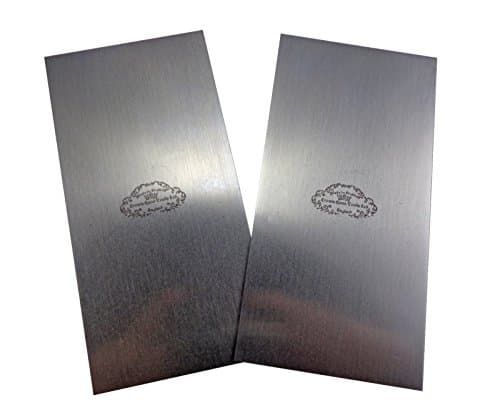
| Crown 377 & 376 set | Two scrapers plus a burnisher | Not published | Yes |
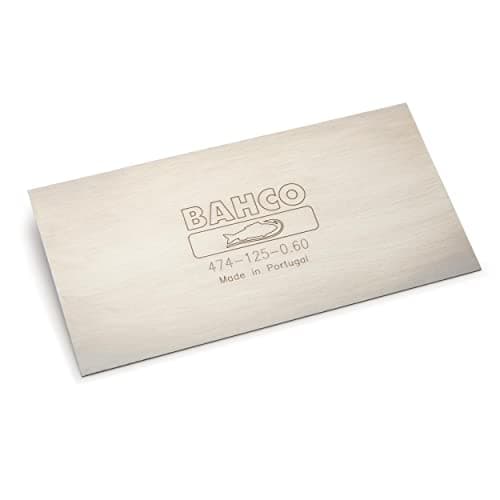
| Bahco 474 | One rectangular scraper | 5 in. (part code reads 125 mm x 0.60 mm) | No |
| Crown 375 set | Two rectangular scrapers | 2-1/2 x 5 in. | No |
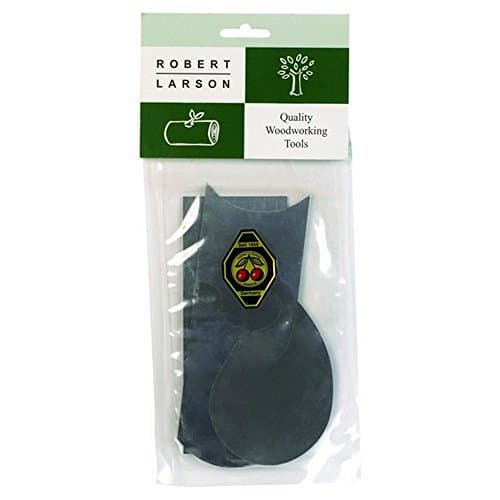
| Two Cherries 3-piece set | Three scrapers | 5 in. wide; profiles not published | No |
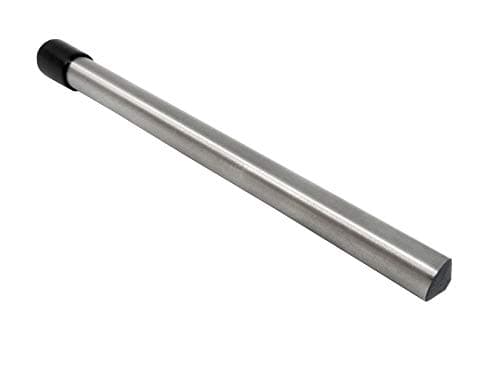
| Taytools 773673 burnisher | One unhandled rod | 3/8 in. dia. x 5 in., HRC 62-64 | It is the burnisher |
| Nicholson 08497NN mill file | One file | 8 in., single cut, bastard | No |
Where these numbers come from
Every figure above is from the live retail listing, because card-scraper makers publish remarkably little. Taytools is the exception and publishes the one specification that actually matters for a burnisher: HRC 62-64, at 3/8 in. diameter by 5 in. long. A burnisher must be harder than the scraper it works on, or it polishes the edge instead of moving steel, and almost no competing listing publishes a hardness at all.
What is notpublished is worth stating plainly. Bahco publishes no hardness figure we could confirm for the 474; the digits in its part code (474-125-0.60) read as a 125 mm scraper 0.60 mm thick, which is consistent with Bahco's range, but that is us reading a part number rather than Bahco publishing a specification. Crown publishes the model numbers and, for the 375, the Sheffield UK steel and the 2-1/2 by 5 in. size, but no thickness or hardness for either set. The Two Cherries listing does not publish which three profiles are in its three-piece set, which is a real gap when the whole reason to buy a multi-piece set is to get a curved profile. We have put that in the product's cons rather than guessing at the shapes.
We have not tested any of these and do not run a lab. For a tool whose performance is entirely a function of how well you file and burnish it, that limitation is unusually honest: the steel differences between a Bahco, a Crown and a Two Cherries scraper are far smaller than the difference between a well-turned burr and a badly turned one.
What to buy, in order
Never used one: the Crown three-piece set. Two scrapers and a burnisher, and you need a file you very likely already own. If you do not, add the Nicholson.
Own a burnisher already — or own a hardened round rod, the back of a gouge, or a drill bit shank you are willing to use as one: the Bahco 474, which is the cheapest useful tool on this entire site.
Using one regularly: the Crown 375 pair, because the real workflow is one scraper working while the other waits for a fresh burr, and swapping beats stopping.
Working on curves: the Two Cherries three-piece set, accepting that the listing will not tell you the profiles in advance.
Everyone, eventually: a dedicated burnisher with a published hardness, and a single-cut mill file kept somewhere it will not get chipped. Those two items are the difference between owning a card scraper and using one.
One thing to make rather than buy
A handle for the burnisher. The Taytools rod is sold unhandled, which is normal in this category, and a bare polished rod is awkward to hold with the firm, controlled pressure that turning a burr wants. Drill a hole in a scrap of hardwood, epoxy the rod in, and you have the tool properly. It is a fifteen-minute job and it is the kind of small shop-made fixture that makes a hand-tool skill click.
The other shop-made fixture worth the time is a filing block: a square-ended piece of hardwood with a kerf cut in it to hold the file square to the scraper edge. Freehand filing rounds the edge over, and a rounded edge cannot hold a burr. Both of these are on the same list as flattening your own bench — see how to flatten a workbench top for the other end of that argument.