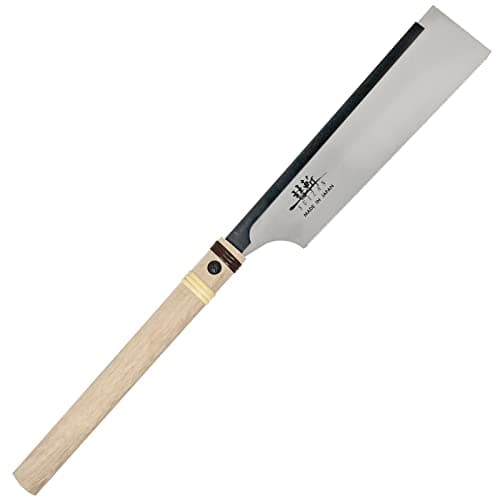
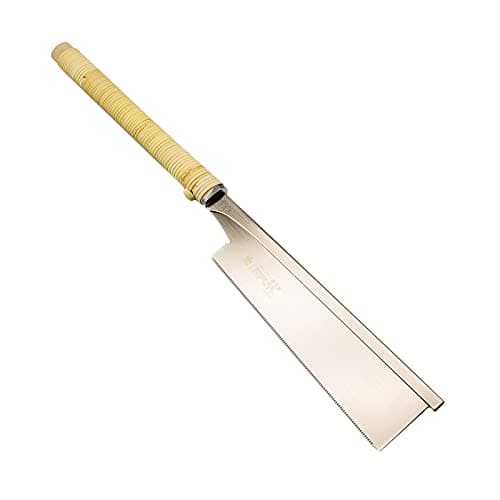
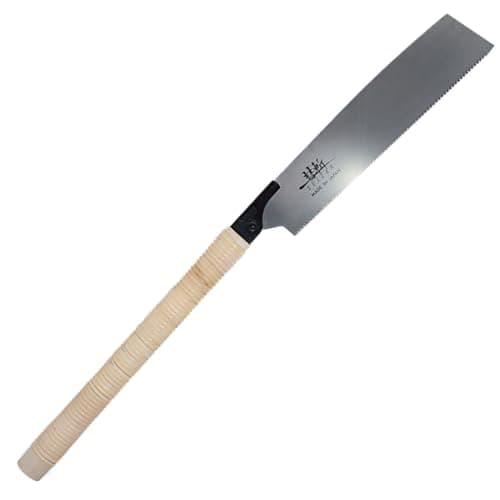
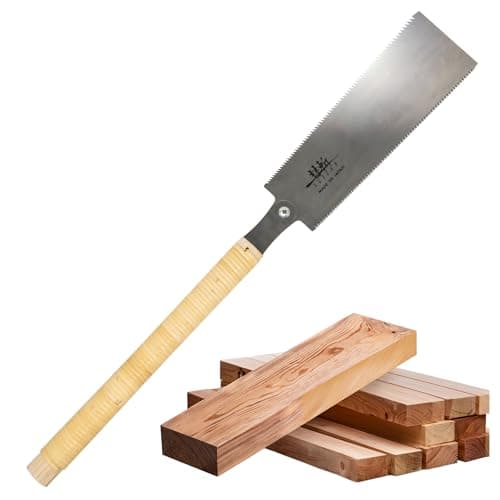
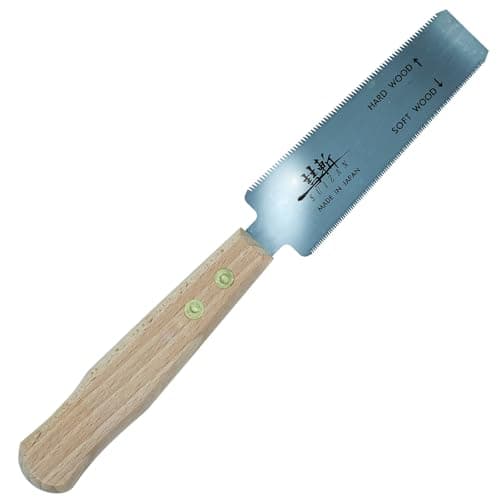
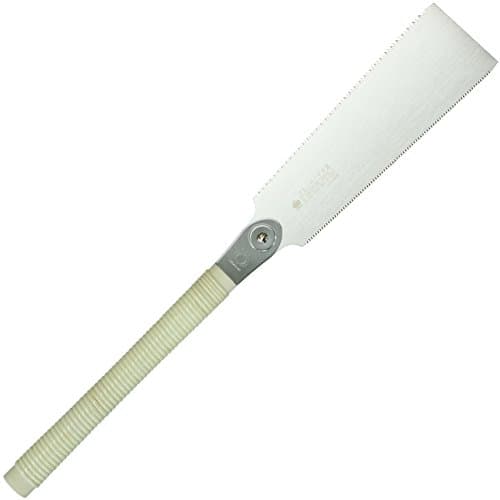
Buy the Gyokucho Razorsaw 651 ryoba. One saw, two edges — 9 tpi rip along one side and 22 tpi crosscut along the other — on a 0.018 in. plate, which means it will break down stock, cut a tenon shoulder and trim a joint without you ever changing tools. If you are cutting dovetails and want a back on the saw, buy the Suizan Dozuki; if you want that same saw with a blade you can replace rather than resharpen, buy the Gyokucho Dozuki 240 mm. The budget pick is the Suizan Flush-Cut — the cheapest Japanese saw here, and the one that does a job no other saw in your rack can do at all.
Why the pull stroke changes the tool
A Western saw cuts as you push it. Pushing puts the blade in compression, and a thin plate in compression buckles, so a push saw's plate has to be thick enough to stay straight under load. That thickness is the kerf, and the kerf is wood you are turning into dust.
A Japanese saw cuts as you pull. Pulling puts the plate in tension, and a plate in tension cannot buckle, so it can be made far thinner. The 651 ryoba on this page publishes a 0.018 in. plate; a typical Western backsaw plate is roughly double that. Three things follow, and all three are the reason people switch and do not switch back.
The cut is easier. You are removing half the wood, so it takes roughly half the effort, and the saw starts in a knife line instead of skating out of it.
The cut is more accurate. A thin kerf leaves less room for the saw to wander, and the pull stroke lets you guide with a light hand rather than fight the tool.
The teeth are harder, and that is a trade. Most modern Japanese saws use impulse-hardened teeth. They stay sharp for a very long time and then cannot be sharpened at all — the hardened zone is far harder than a file. That is why the replaceable-blade saws exist, and why we rank one.
The four shapes, and which one you need
Ryoba — double edge, no back. Rip teeth on one side, crosscut on the other, and no spine, so depth of cut is unlimited. This is the one general-purpose Japanese saw. If you are buying one, buy this.
Dozuki — single edge with a rigid steel back. The back keeps the thinnest plates dead straight, which is what you want for joinery, and it limits how deep you can cut, which almost never matters on a dovetail or a tenon shoulder. If you cut joints by hand, this is the second saw.
Kataba— single edge, no back. A dozuki's accuracy without the depth limit, at the cost of a slightly thicker plate to stay rigid on its own. The Suizan Kataba here publishes 14 TPI crosscut on a 0.03 in. kerf: this is the saw for deep crosscuts in wide stock.
Flush-cut— a short, extremely flexible blade with no set on the teeth at all. It does exactly one job: trimming a dowel, a plug or a through-tenon flush to a surface without scratching the surface. No other saw can do this, because every other saw's teeth are set wider than the plate and will score the wood beside the cut. It is also the cheapest saw on this page, which is why it is the honest first purchase for anyone unsure about the whole category.
Replaceable blade or not
Because impulse-hardened teeth cannot be refiled, a Japanese saw is a consumable with a long life, and the makers split into two camps about it.
Replaceable-blade saws — the Gyokucho Dozuki 240 mm here is the example — let you unclip a dull plate and clip a new one onto the same handle. The handle is the part you paid for and the part that lasts; the blade is a spare part you buy every few years. Over a decade this is the cheaper way to own a saw, and it is why these dominate working shops in Japan.
Fixed-blade saws — most of the Suizan range — cost less up front and feel marginally more solid, because there is no clip in the load path. When the teeth go, the saw goes. The Suizan Flush-Cut on this page publishes a non-replaceable blade, and for a saw at that price it does not matter.
Neither is a mistake. Buy replaceable if you expect to cut joints every week; buy fixed if this is a tool you will pick up a few times a month.
Looking after one
Three rules keep a pull saw alive. Never force the cut — if it is not cutting, the plate is twisted or you are pushing, and pushing is how a thin plate kinks. Never saw into anything harder than wood: a staple, a nail or a screw will take out several teeth in one stroke, and those teeth are not coming back. Store it where the plate cannot bend. A hanging hook through the handle, or the original card sleeve, is enough; a drawer full of other tools is how most of them die.
If you are going to cut dovetails with one, the layout matters more than the saw does. Marking gauge technique and a knife line are what a thin-kerf saw gives you the ability to follow; without them the extra accuracy has nothing to follow.
Side by side
| Saw | Shape | Published blade | Teeth | Blade replaceable |
|---|
| Gyokucho Razorsaw 651 | Ryoba (double edge) | 9.5 in., 0.018 in. plate | 22 tpi cross / 9 tpi rip | Not published |
| Suizan Dozuki | Dozuki (backed) | 9.5 in. | Crosscut | Not published |
| Gyokucho Dozuki 240 mm (No. 370) | Dozuki (backed) | 240 mm | Crosscut | Yes |
| Suizan Kataba | Kataba (single edge, no back) | 10.5 in., 0.03 in. kerf | 14 TPI crosscut | Not published |
| Suizan Ryoba | Ryoba (double edge) | 9.5 in. | Rip and crosscut edges | Not published |
| Suizan Flush-Cut | Flush-cut | 5 in. | No set | No |
Every figure above is the maker's published specification for the exact listing we link, and where a maker publishes nothing we have written "not published" rather than filling the cell. We did not measure a single plate: we do not run a lab, and the methodology page says so.
What to buy, in order
One saw: the Gyokucho 651 ryoba. Two saws: add the Suizan Dozuki, or the Gyokucho dozuki if you would rather buy blades than sharpen. Three saws: add the flush-cut, which costs almost nothing and is the only tool that trims a plug without marking the surface around it.
If you want the Western field instead — or a saw you can refile forever — that is the best hand saw roundup, and the dedicated joinery saws, Western and Japanese together, are ranked on best dovetail saw.