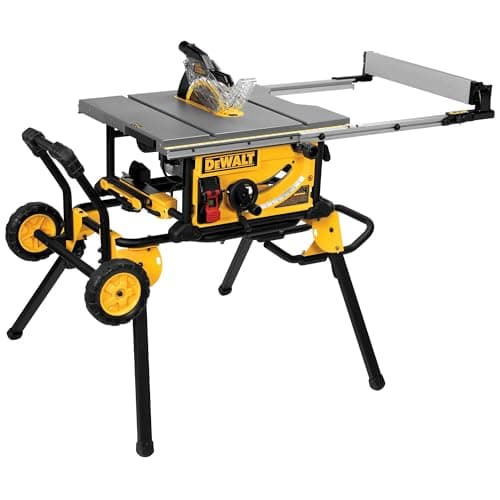
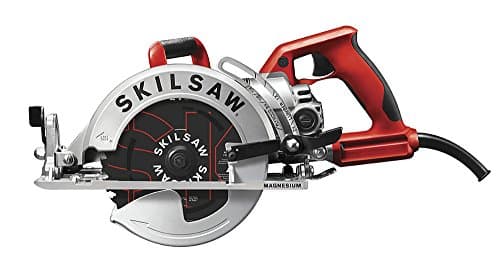
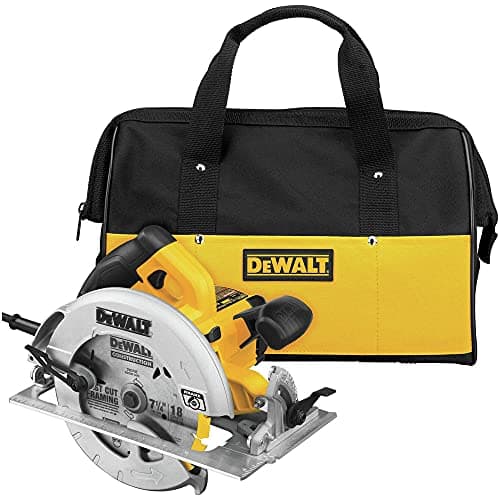
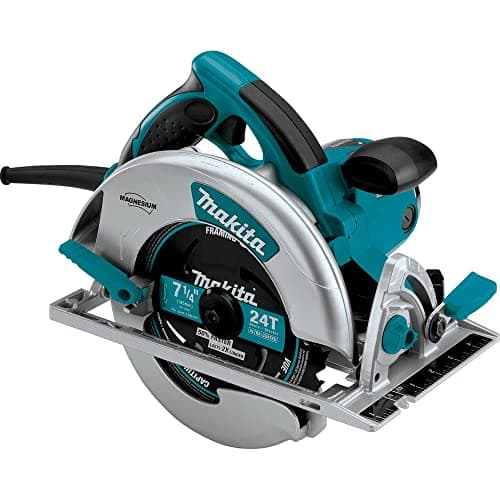
A table saw holds the blade still and you move the wood past it. A circular saw holds the wood still and you move the blade along it. Everything that follows — accuracy, capacity, safety, footprint — comes out of that one difference.
Because a table saw's blade is fixed relative to a fence, it produces repeatable cuts. Set the fence at 3-1/2 in. and every part you push through is 3-1/2 in., all day, without measuring again. That repeatability is the reason furniture gets built on a table saw and not on anything else.
Because a circular saw is carried to the work, it has no capacity limit. A table saw cannot rip a 4 x 8 sheet without a big outfeed setup and real floor space; a circular saw cuts that sheet on the ground with two lengths of foam under it. It goes where the work is, including the driveway.
The decision in one paragraph: if you build furniture from solid lumber in a dedicated space, buy the table saw, because repeatable rips are the operation you will do most. If you build from sheet goods, work in a shared garage, or need to pack the shop away, buy the circular saw — and with a straightedge it will do more of the table saw's work than most people expect.
Head to head
Repeatability
Table saw, decisively. A fence is a reference surface you set once. Every subsequent cut is identical without measuring, which is the entire basis of making six drawer sides that match. A circular saw repeats only as well as you can re-clamp a straightedge, which is to say: not well enough for joinery.
Sheet goods
Circular saw, decisively. Wrestling a full sheet of 3/4 in. plywood across a table saw is awkward, and in a small shop it is genuinely unsafe — a sheet that tips mid-cut is how kickback happens. Cutting it on the floor with a circular saw and a straightedge is safer, easier and needs no outfeed space at all.
Cut quality
Table saw, but closer than you think. A table saw with a good blade leaves a glue-ready edge. A circular saw against a clamped straightedge, with a sharp fine-tooth blade and a slow feed, gets remarkably close — and a track saw closes the gap entirely, which is precisely what track saws exist for.
Space and portability
Circular saw, by an enormous margin. A table saw needs its blade width plus the length of the longest board in front and behind, and its rip capacity to the right. In practice a contractor saw occupies a 10 x 10 ft footprint while in use. A circular saw lives in a case on a shelf.
Safety
Different risks, not a clear winner.A table saw's characteristic hazard is kickback — the workpiece pinching between blade and fence and being thrown back at you. It is preventable with a riving knife and correct technique, and it injures a lot of people anyway. A circular saw's hazard is the saw kicking back at your hands and the cut line being obscured. Both demand respect; neither is casually safe.
Cost of entry
Circular saw, by roughly five to one. A very good circular saw costs less than an entry-level jobsite table saw. If money is the constraint, the circular saw plus a straightedge is not a compromise — it is how a great many shops start.
The setup that changes the answer
A circular saw with a shop-made straightedge guide — a strip of plywood with a fence glued to it, trimmed to the exact blade offset on first use — gives you repeatable straight cuts in sheet goods at essentially no cost. It is slower to set up per cut than a table saw fence, but it is accurate, and it is the single highest-value shop jig a beginner can build in an afternoon.
Add that jig and the question changes from “which saw” to “do I have room for a table saw yet?” For a lot of garage shops the honest answer is not yet, and the circular saw carries the whole load in the meantime.
What each one cannot do
A circular saw cannot rip narrow strips safely. Once the offcut is narrower than the shoe, there is nothing to support the saw. This is the job a table saw does effortlessly and the reason most shops eventually buy one.
A table saw cannot leave the shop. If you also do site work, trim carpentry or deck building, a circular saw is not optional — a table saw simply is not the tool for those jobs.
What we could not verify
We have not measured cut squareness or edge quality from these saws against one another. Blade sizes, motor ratings and bevel capacities are the manufacturers' published figures; the comparison above rests on how each machine constrains the cut, which is geometry rather than a test result.
The third option this page leaves out
If a circular saw is winning on price and portability but losing on cut quality, the tool that resolves that is a track saw rather than a table saw. It keeps the saw going to the work and adds the straight, splinter-free edge a clamped straight edge cannot quite give you. Track saw vs circular saw sets the two against each other on edge quality, depth of cut and what the rail actually costs.