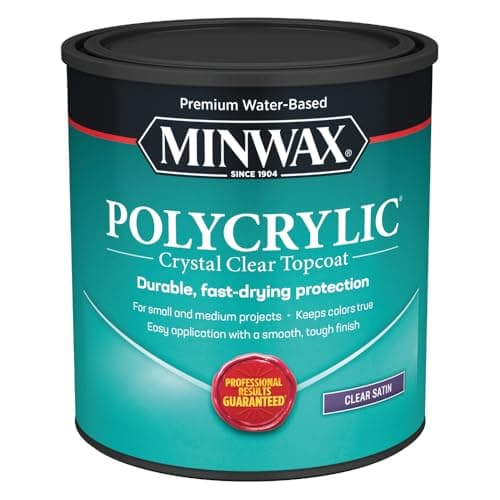
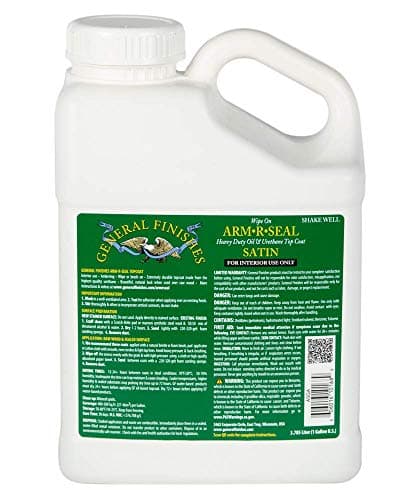
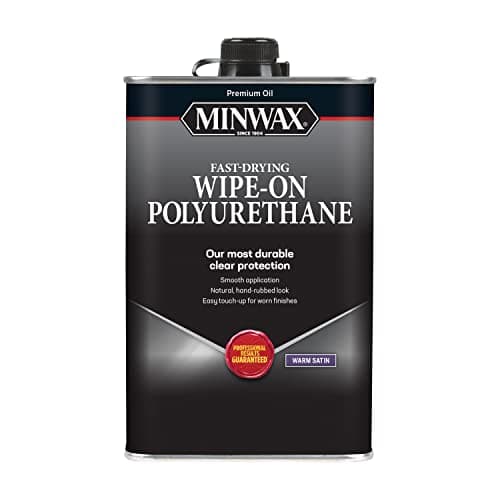
Buy Minwax Fast-Drying Polyurethane if the surface has to survive plates and glasses, and Minwax Polycrylic if the wood is pale and has to stay that way. Those two cover most of what a home shop builds. If you want the furniture-maker's answer and do not want to learn to brush, General Finishes Arm-R-Seal is wiped on with a cloth and is close to foolproof. If the thing you built is a cutting board, none of the above applies and Walrus Oil is the whole answer.
Every finish is one of two things
There is a genuine fork at the start of this decision, and almost every finishing disappointment comes from taking the wrong branch of it.
A film finish cures into a continuous layer that sits on top of the wood. Polyurethane, varnish, lacquer, shellac and water-based acrylics all do this. The film is what stops a wet glass reaching the wood, and it is the only kind of finish that genuinely resists water, alcohol and heat. The cost is that a film can fail as a film: it chips at an edge, clouds where water sat too long, and when it wears through in the middle of a tabletop the repair is not a touch-up, it is stripping the whole surface so the new coat has somewhere continuous to key into.
A penetrating finish soaks into the wood and hardens inside it. Oils, Danish oils and hardwax oils do this. There is no layer, so there is nothing to chip, peel or cloud, and a worn patch is repaired by wiping more oil onto the worn patch. What you give up is protection: an oiled surface will take a water ring, and spilled wine on an oiled table is a stain rather than a wipe.
So the first question is not "which polyurethane". It is what does this surface meet? Dining tables, desks, kitchen cabinets, window sills and anything a child will own meet liquid, and want a film. Bookcases, picture frames, boxes, chair legs, carved work and anything whose appeal is the texture of the wood do not, and are better oiled.
The amber question, which is the one people regret
Every oil-based finish is slightly yellow in the can and gets yellower in the film over years. On walnut, cherry and oak that is almost always welcome — it is the warmth people mean when they say an old piece of furniture looks right.
On maple, ash, birch and poplar it is a problem, and it is a problem you cannot undo. A white oak kitchen finished in oil-based poly is a yellow-brown kitchen in five years. Minwax says this plainly in its own product literature: Polycrylic is published as non-yellowing and non-ambering, and Minwax names maple, ash and birch as the woods it is for. If you have just spent four weekends getting a hard maple top flat, do not put an amber finish on it because the can was cheaper.
The same applies over paint and over white or gray stains, where ambering reads as a surface that has been left dirty.
How you apply it matters more than what is in it
This is the part nobody says out loud: among film finishes of the same general type, the application method predicts the result more reliably than the chemistry does. Brushing is a learned skill. A brushed finish can sag, show brush marks, hold dust nibs and trap bubbles, and all four of those failures live in the last coat, where they are most visible and most annoying to fix.
Wiping removes all four. A thinned finish on a cloth cannot sag because there is not enough of it on the surface to run; it cannot show brush marks because there is no brush; it does not trap bubbles because you are not agitating it. The price is build: each wiped coat leaves perhaps a third of what a brushed coat leaves, so you do three or four or five instead of two. For most people most of the time that is a trade worth taking, and it is why both General Finishes Arm-R-Seal and Minwax Wipe-On Poly are on this page.
Spraying is a third route and a genuinely better one at volume, but it is a compressor or a turbine, a respirator, somewhere to spray and a day of learning to tune a gun. That is a different purchase from a can of finish, and if you are going there the air compressor page is the place to start costing it.
Sheen is not a product
Gloss, semi-gloss, satin and matte are the same finish with increasing amounts of flatting agent stirred in. The flatting agent is a fine solid suspended in the resin, and it scatters light — which is also why a very flat finish can look faintly cloudy in thick coats over dark wood.
Two consequences. First, a gloss finish is marginally clearer and marginally tougher than the matte version of the same product, because it is the same resin without a solid mixed in. Second, the flatting agent settles, so a can of satin that has not been stirred from the bottom will spray or wipe glossy and then go progressively flatter as you work down the can. Stir it — never shake it, because shaking puts air in — and stir it again halfway through.
The professional trick is to build with gloss and switch to satin for the final coat only. You get the clarity of gloss in the body of the film and the sheen you wanted on the surface.
Sealers, and the blotch you can prevent
Pine, cherry, maple and birch blotch under stain, and the reason is that the wood absorbs unevenly — some areas drink pigment, some refuse it, and the result looks like a cloud rather than a color. The fix is to even out absorption before the color goes on, with a thinned sealing coat.
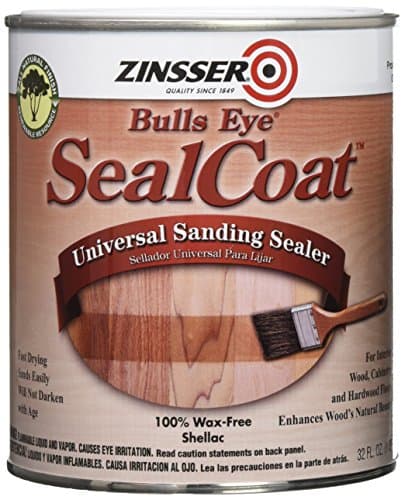
De-waxed shellac is the standard choice for this, because it is the one coating that is compatible in both directions: it grips raw wood, old finish, knots and oily exotic timbers, and oil-based or water-based topcoats grip it. Zinsser's own technical sheet gives SealCoat's resin as de-waxed shellac with denatured alcohol and water as the solvents, which is exactly what you want under something else. It is the cheapest insurance on this page and the only product here that is not a finish at all.
Food contact, and why a board is not a table
A cutting board is the one place where the whole film-versus-oil argument inverts. A board gets cut with a knife hundreds of times and washed hundreds of times. Any film you put on it will be scored through, and then water gets under the film through the score, and then the film lifts in flakes you do not want in your food.
So boards, butcher block and utensils get a penetrating oil, sold and labeled for food contact, and they get it again every few weeks forever. That is maintenance rather than finishing, and it is the correct answer rather than a compromise. Our tools needed to make a cutting board page covers the build; this is the last step of it.
The surface under the finish decides the finish
No finish hides a bad surface — several of them magnify one, because a film is glossy and glossy raking light finds every scratch you left. Two things are worth getting right before a can is opened.
Grit. Sand to 180 before stain and 220 before a clear film. Going finer than that before stain burnishes the surface so it can no longer hold pigment, and the stain goes on pale and patchy — the reasoning is set out in full on our sanding grit progression guide.
Scratch direction. Random-orbit swirl marks are invisible on bare wood and obvious under finish, which is why they get discovered at the worst possible moment. If a surface has figure in it, or if you have been fighting swirls, a card scraper leaves a surface with no scratch pattern at all, because it cuts a shaving rather than abrading.
Prices below come from our live price feed and carry the date they were pulled.
The seven side by side
Manufacturers' published figures for the seven products ranked above. Read the "type" column first: it decides more than any other column on the table.
| Finish | Type | Applied with | Published recoat |
|---|
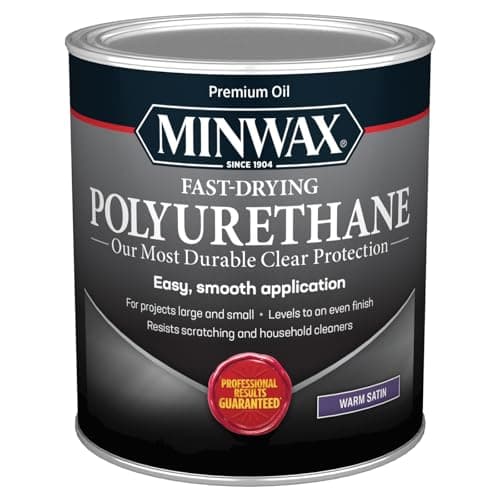
| Minwax Fast-Drying Polyurethane | Oil-based film | Natural bristle or foam brush | 3-4 hours (directions say 4-6) |
| Minwax Polycrylic | Water-based film | Brush or pad | 2 hours |
| General Finishes Arm-R-Seal | Oil-based urethane film | Cloth or foam brush | 12-24 hours on raw wood |
| Minwax Wipe-On Poly | Oil-based film, pre-thinned | Cloth | Not published for this product |
| Zinsser Bulls Eye SealCoat | De-waxed shellac sealer | Brush, pad or spray | Not published by Zinsser |
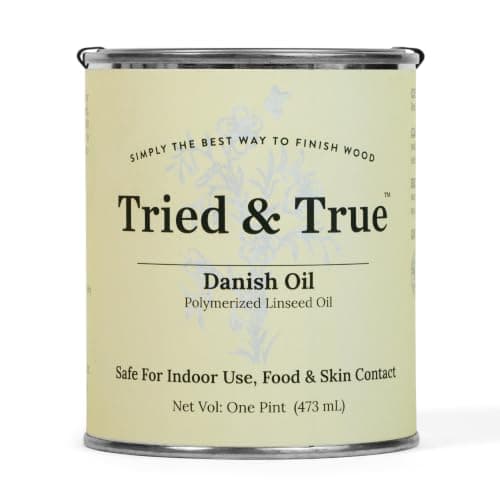
| Tried & True Danish Oil | Penetrating polymerized oil | Lint-free cloth only | Minimum 8-hour cure per coat |
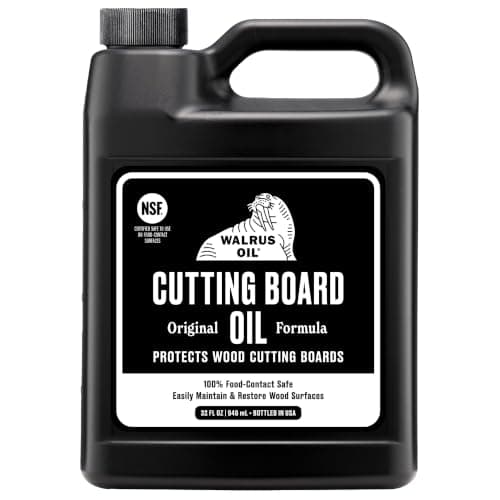
| Walrus Oil Cutting Board Oil | Penetrating food-contact oil | Cloth | Re-oil as needed, indefinitely |
Where these numbers come from
Every figure above is published by the maker, and we have said so where a maker publishes nothing. Minwax publishes 125 sq ft per quart and a 3-4 hour recoat for Fast-Drying Polyurethane on its product page, with light sanding at 220 grit between coats and 24 hours before normal use; its separate application directions give 4-6 hours for recoat, and because Minwax disagrees with itself we have printed both rather than picking one. Minwax publishes 125 sq ft per quart, a two-hour recoat, three recommended coats and a non-yellowing, non-ambering claim for Polycrylic, together with two explicit exclusions: not for floors, and not over red mahogany stains.
General Finishes' current technical sheet was not reachable from our build machine, so the Arm-R-Seal figures above come from retailer reproductions of General Finishes' own sheet, which give a minimum of three coats wiped on with a cloth or foam brush and 12-24 hours to recoat raw wood at 70 degrees and 50% relative humidity. Those sources disagree above that interval, with other reprints giving 24-plus hours, so the page says 12-24 and no more. Zinsser's technical data sheet gives SealCoat's resin as de-waxed shellac and its solvents as denatured alcohol and water; we could not confirm a dry-time table from Zinsser itself and so quote none. Tried & True publishes its own application sequence and an 8-hour minimum cure, and describes the product as a polymerized linseed oil suitable for salad bowls, utensils and butcher blocks.
Nothing on this page was tested by us. We do not run a lab, and a finish is one of the few products where that admission matters most — durability claims are the hardest thing in woodworking to measure honestly, which is exactly why we have ranked on published chemistry, published application method and published exclusions instead.
What to buy, in order
If you are buying one can and you build boxes, shelves and small furniture: the wipe-on poly. It is a pint, it costs almost nothing, and it will teach you how a finish behaves without punishing you for a bad brush.
If you are buying one can and you build tables: the Fast-Drying Polyurethane, in satin, with a decent natural-bristle brush and a room you have vacuumed.
If you are buying two: add SealCoat. It costs less than a router bit and it is the difference between a cherry panel that takes stain evenly and one that looks like camouflage.
If the piece is maple, ash, birch or painted: swap the oil-based poly for Polycrylic and do not think about it again.
If the piece is a board, a bowl or a spoon: the board oil, and nothing else.
The honest alternatives we did not rank
Three families are deliberately absent from the ranking rather than overlooked. Hardwax oils — Osmo Polyx-Oil and Rubio Monocoat are the names — sit between the two branches of this page: they penetrate like an oil but leave a thin hard surface, and they are genuinely excellent on floors and tabletops. They are also three to five times the price per project and the smallest sensible container is large, so they belong in a shop that has already decided finishing is something it cares about. Tung-oil sealers such as Waterlox build a slow, beautiful, highly water-resistant finish over many coats and many days, and are the traditional answer for a kitchen table. General Finishes High Performance is the premium water-based topcoat and the one a professional shop would reach for over Polycrylic — we have left it out of the ranking only because the reliably stocked listing is a gallon, which is far more than a home shop should buy to find out whether it likes a finish.
If any of those three descriptions is you, buy them without hesitation. They are not on the list because of price and container size, not because of quality.