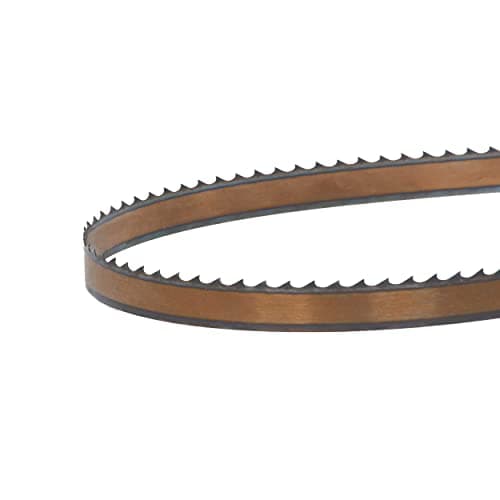
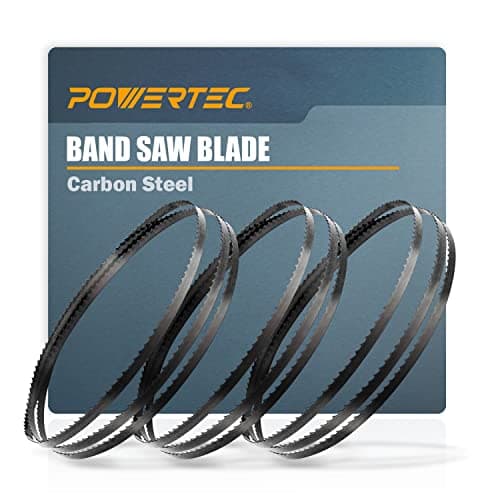
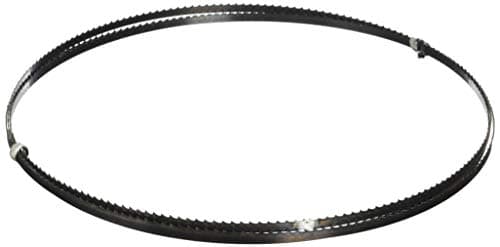
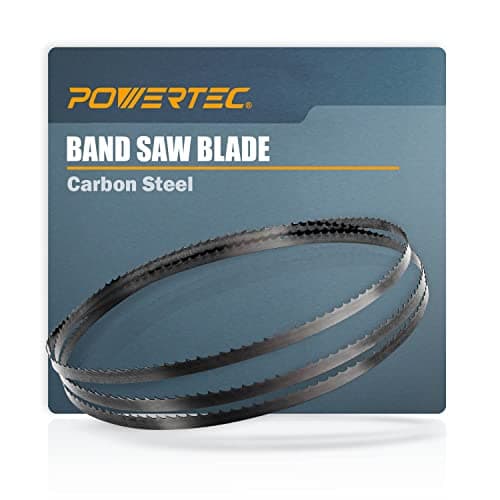
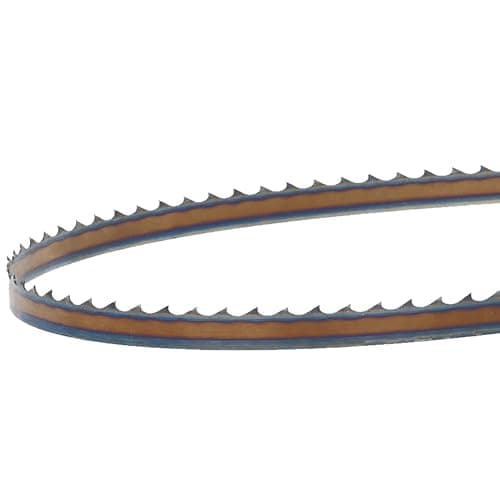
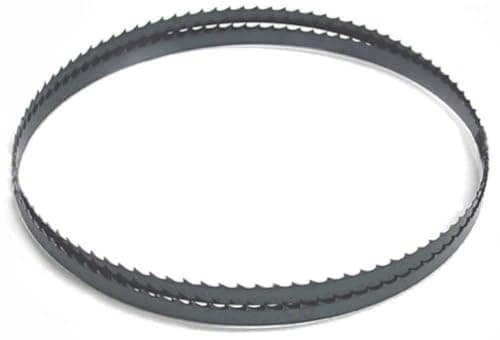
Check your saw's blade length first, then buy a 1/2 in. 3 TPI blade and leave it on the machine. The Olson APG72693 All Pro is the one to buy. That single blade resaws a 6 in. board, rips stock to width and still steers a gentle curve, which is most of what a 14 in. bandsaw is asked to do. The Timber Wolf 3/4 in. is the upgrade when resawing is the job, the Olson 1/4 in. skip-tooth is the one that follows a template line, and the POWERTEC 3-pack is the cheapest way to own all three widths while you work out which you reach for.
Length is a fit specification, not a preference
Every blade on this page is 93-1/2 in. long. That is the loop a 14 in. Delta/Rockwell-pattern saw takes, along with the Grizzly, Jet, Rikon, Shop Fox and Craftsman machines built on the same geometry — by far the most common bandsaw in a home shop. If your saw takes a different length, none of these blades will fit it, and no amount of tension adjustment changes that. The number is in your manual, it is often cast or printed on the saw itself, and if both have gone missing you can measure the old blade: lay it flat as a circle, measure the inside diameter, multiply by pi and add the blade width.
The one wrinkle worth knowing: a 14 in. saw with a riser block fitted takes a longer blade than the same saw without one, usually 105 in. If someone has added a riser to raise the resaw capacity, the length on the sticker is no longer the length you need. Each pick below carries a tagged Amazon search as well as a direct listing link, which is how you reach the same blade family in a length we have not linked.
Width decides the curve, and the curve decides the width
A bandsaw blade cuts a radius no tighter than its width allows, because the back of the band has to travel through the kerf the teeth cut. Blade makers publish the limit per blade. Olson's own figures, as carried by Lee Valley, put the 1/4 in. 6 TPI blade at a 5/8 in. minimum radius in stock 1/2 in. to 4 in. thick, and the 3/8 in. 4 TPI blade at a 1-1/2 in. minimum radius in stock 3/4 in. to 5 in. thick. Woodcraft's selection guide puts a 1/8 in. blade at a 3/16 in. radius.
Above 3/8 in. the published tables stop agreeing with each other — charts compiled from several makers put a 3/4 in. blade anywhere from 5 in. to 5-1/2 in. of minimum radius — which is a polite way of saying that a 3/4 in. blade is a straight-line blade. Treat the narrow end of the range as real and the wide end as a reminder that you cannot steer a resaw blade.
Width does something else too, and it is the reason resawing wants the widest blade your saw will tension: a wide band is a stiffer beam. Deflection sideways under feed pressure is what makes a resaw cut barrel in the middle of a board, and stiffness is the only thing that resists it. So the rule runs in both directions. Go as wide as the saw will tension for straight cuts; go as narrow as the radius demands for curves; own both rather than compromising with one blade in the middle.
What your saw can actually tension
There is a ceiling on width and it is set by the machine, not by you. A stock 14 in. cast-iron saw with a 3/4 or 1 HP motor is usually rated to 3/4 in. and genuinely happy at 1/2 in.; the frame flexes before a wide band is properly tight, and an under-tensioned wide blade wanders worse than a correctly tensioned narrow one. Check the maximum blade width in your manual and believe it. If you have ever cranked the tension handle to its stop and still had a blade drift, that is the flex, and it is also the argument for the Timber Wolf blades, which are sold specifically to run at lower tension.
Pitch: coarse clears, fine finishes
Teeth per inch is the other half of the specification and it is decided by thickness, not by the finish you want. Each tooth carries its chip in the gullet ahead of it until the tooth exits the cut. In a 6 in. resaw the tooth is buried for a long time, so the gullet has to be large — which means few teeth per inch. Run a 14 TPI blade through 6 in. of oak and the gullets fill in the first inch, the teeth stop cutting, and the blade starts burning and smoking instead. Run a 3 TPI blade through 1/4 in. plywood and you get a rippled edge and a blade that grabs, because only one or two teeth are in the work at a time.
That is the whole mechanism, and it is why this page ranks three pitches rather than crowning one. Coarse pitch for deep cuts, fine pitch for thin stock, and the middle of the range for the 3/4 in. and 4/4 in. boards most furniture is made from.
Tooth form, in one paragraph
Three forms cover everything on this page. Regular(or raker) teeth are evenly spaced with a shallow rake — the finest finish, the slowest cut, best in thin material. Skip teeth leave every other gullet empty, which doubles chip clearance at the same pitch and is why the 1/4 in. skip blade works in 3/4 in. hardwood where a regular-tooth blade of the same pitch clogs. Hook teeth add a positive rake angle, so the tooth pulls itself into the wood: the fastest, most aggressive cut and the right form for resawing. The feed effort you notice in a deep rip is mostly rake angle.
Beyond those, blade makers sell carbide-tipped resaw bands — the Laguna Resaw King and Lenox Tri-Master are the names you will see. They stay sharp many times longer than carbon steel and cost roughly what a cheap bandsaw costs, and on a light 14 in. saw that cannot tension a wide band properly, they are money spent on a property the machine cannot use. We have not ranked one here for that reason, and the honest advice is to buy three carbon blades and a sharp sense of when they are done.
If the saw itself is the weak link rather than the blade, our bandsaw roundup ranks the machines, and table saw vs band saw covers which machine should own which cut. Prices below come from our live price feed and carry the date they were pulled.
The six side by side
Published listing specifications for the six blades ranked above. Every one is the 93-1/2 in. length. Read the width column first and the pitch column second — in that order, they tell you what each blade can and cannot cut.
| Blade | Width | Pitch / form | What it is for |
|---|
| Olson APG72693 All Pro | 1/2 in. | 3 TPI hook | Leave-it-on blade: resaw, rip, gentle curves |
| Timber Wolf 3/4 in. | 3/4 in. | 3 TPI | Resawing only, on a saw that can tension it |
| POWERTEC 13603 (3 pk) | 1/8, 1/4, 1/2 in. | 14, 6 and 6 TPI | Learning which width you need |
| Olson FB14593DB | 1/4 in. | 6 TPI skip | Curves in 3/4 in. stock, roughly 1 in. radius |
| POWERTEC 13118 | 1/8 in. | 14 TPI | Tight curves, bandsaw boxes, scrollwork |
| Timber Wolf 1/2 in. | 1/2 in. | 3 TPI positive claw | The leave-it-on spec on a saw that will not tension hard |
Which pitch for which thickness
Match the pitch to how thick the material is, not to how smooth you want the cut. A coarse blade in thin stock chatters; a fine blade in thick stock burns.
| Material thickness | Pitch that works | Why |
|---|
| Under 1/2 in. | 10–14 TPI | Enough teeth engaged to stop the blade grabbing the work |
| 1/2 in. to 1-1/2 in. | 6 TPI | The furniture range: cuts cleanly and still clears chips |
| Over 1-1/2 in. (resaw) | 3–4 TPI | Gullets big enough to carry the chip all the way out of a deep kerf |
A blade is the cheapest upgrade a bandsaw gets
Most complaints about bandsaws are complaints about blades. A cut that wanders off a line, a resaw that bows in the middle, burn marks on both faces, a blade that will not follow a curve — all four of those have a blade cause before they have a machine cause, and all four are cheaper to fix than to live with. The blade that came in the box with a new 14 in. saw is usually a 3/8 in. general-purpose band chosen because it offends nobody, and replacing it is the single biggest change you can make to how the saw behaves.
That is also the case for keeping more than one. Blades are consumable and cheap relative to everything else in the shop; the slow part is the changeover, not the purchase. A blade change on a 14 in. saw is five minutes once you have done it twice, and it buys more capability than any accessory at the same price.
Set the guides for the blade you fitted
A blade change is not finished when the band is on the wheels. The thrust bearing and the side guides are set for a specific width, and a 1/8 in. band sitting in blocks set for a 1/2 in. one has no lateral support at all — which is exactly when a narrow blade twists and snaps. Set the guides behind the gullets so the teeth never touch them, bring the side supports to a few thousandths off the band, and re-check tracking on the upper wheel before the first cut.
Dust is the other thing a fresh blade changes. A sharp 3 TPI blade in a resaw produces a volume of chips the average benchtop collector was not sized for, and bandsaws are among the worst machines on a shop system because the lower wheel housing throws dust sideways rather than down the port. Our dust collection CFM guide covers sizing properly.
What a new blade will not fix
Drift that stays constant no matter which blade you fit is a tracking or guide problem. Burning on one face only is usually a fence that is not parallel to the blade's actual cutting line. A cut that closes up on the blade behind the teeth is internal stress in the board releasing, and no blade prevents that — it is why resawn stock should rest before you plane it. And a surface that is rippled but straight is just what a 3 TPI blade leaves; resawn faces go to a planer or a drum sander next, which is covered on drum sander vs planer.
Where these numbers come from
Widths, pitches, tooth forms, thicknesses and lengths above are the manufacturers' and retailers' own published listing specifications, cited per product in Sources. The minimum-radius figures are Olson's published per-blade figures as carried by Lee Valley and Woodcraft's published selection guide; where makers' tables disagree above 3/8 in. we say so rather than picking one. Timber Wolf's silicon-steel and low-tension claims are the maker's own description, not a measured figure. We have not tested blade life, kerf or deflection in a lab — we do not have one, and our methodology page says so plainly. Prices come from the live price feed and carry the date they were pulled.