Grind the primary bevel at 25 degrees and hone a narrow secondary bevel at 30. That is the right answer for a bench chisel in any wood, and the only chisels that want something else are paring chisels (lower, around 20) and mortise chisels (higher, 30 to 35). Narex's own manual for its Czech-steel bench chisels states they are supplied pre-ground at 25 degrees, which is the convention the whole category is built around.
The important thing is not the number, which is forgiving — a chisel honed at 28 degrees cuts perfectly well. It is consistency. An edge honed at 30 one week and 26 the next never gets fully sharp, because each session is grinding away the previous session's work before it starts refining anything.
What the angle actually trades
The bevel angle sets how much steel sits behind the cutting edge. A low angle is a thin, keen wedge: it enters the wood with less force and leaves a cleaner surface. A high angle is a blunt, strong wedge: it takes more push, and it survives being hit.
Everything else follows from that one geometric fact:
- 20 degrees— a paring edge. Pushed by hand, never struck, used for shaving a tenon cheek or a dovetail shoulder to a line. It will chip if you hit it.
- 25 degrees— the standard primary grind. Keen enough to pare, strong enough to be driven with a mallet in most timber.
- 30 degrees— the standard honing angle, and the right secondary bevel for general bench work, hardwoods and anything struck.
- 30–35 degrees— mortising. A mortise chisel is levered against the walls of a deep cut, and the extra steel behind the edge is what stops it folding.
If an edge keeps chipping, the fix is to go up a couple of degrees, not to buy harder steel. If an edge is sharp but hard work to push, come down. That is the whole diagnostic.
Why two angles instead of one
The secondary, or micro, bevel is the trick that makes sharpening fast. Instead of honing the entire 25-degree face every time — a large surface, most of which does no cutting — you tip the chisel up a few degrees and hone a sliver of steel perhaps a millimetre wide right at the edge.
Less steel to remove means a sharp edge in a fraction of the time, which means you sharpen more often, which is what actually keeps a chisel cutting. You only go back to the grinder and re-establish the 25-degree primary when the secondary bevel has crept wide enough to slow you down — typically after many honings.
Hitting the same angle twice
There are three ways to get repeatability, and they are not equally easy:
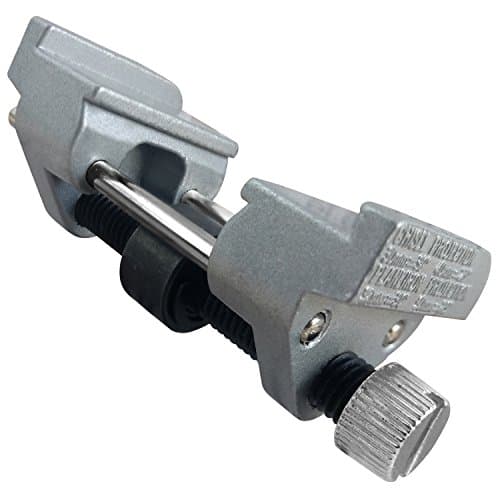
- A honing guide with a projection setting. The guide clamps the chisel and rolls on the stone; how far the blade projects from the guide sets the angle. Set the projection with the jig that comes with the guide and the angle is the same every time, with no skill involved.
- Freehand, with a reference. Faster once learned, and plenty of excellent woodworkers never use a guide. The usual reference is to feel the bevel sit flat on the stone, then lift fractionally for the micro-bevel.
- An angle-setting gauge. A separate jig that reads the angle directly, useful when you are regrinding to a different number rather than maintaining one.
If you are new to this, use a guide and do not feel bad about it. The chisels in our chisel roundupwill all take a razor edge; the variable is whether you can put the same edge back on next week. For the whole sharpening process rather than the angle question — flattening the back, working the grits, the burr — read how to sharpen chisels.
The tools that set the angle
You need two things: something to hold the angle, and something to cut steel at it. The picks below cover both, cheapest first.
The four side by side
Published listing specifications for the four picks above.
| Tool | Job | Published specifications |
|---|
| ATLIN honing guide | Holds the angle | Side-clamping, fits chisels and plane irons, roller guide, angle setting jig |
| King KW65 combination stone | Cuts and polishes | 1000 / 6000 grit water stone, plastic base |
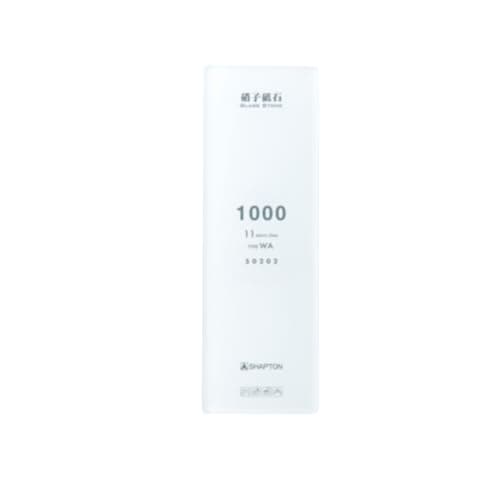
| Shapton GlassStone 1000 | Fast honing | 1000 grit, glass-backed, ceramic abrasive, splash and go |
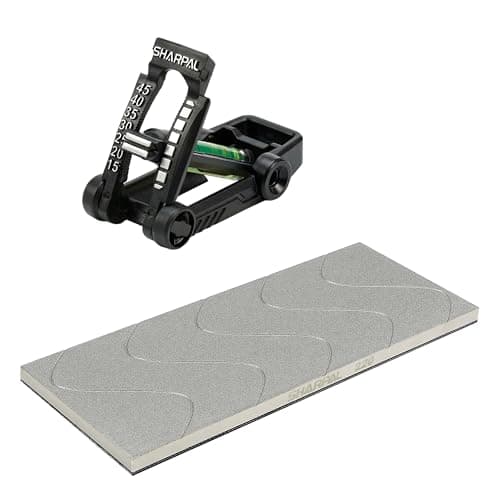
| Sharpal 194H + 145H | Sets angles, flattens stones | Angle guide plus 10 x 4 in. diamond lapping plate |
A hollow grind is a third option
Grinding a chisel on a wheel leaves a slightly concave bevel rather than a flat one, because the wheel is round. That hollow is useful: it gives the bevel two contact points — the heel and the edge — and a bevel resting on two points registers on a stone far more reliably than one resting on a whole flat face. Freehand sharpening gets much easier.
The cost is that a hollow-ground edge has slightly less steel behind it than a flat one at the same nominal angle, so it is a little more fragile. For bench chisels at 25 degrees it is not something most people notice. Wet grinders of the kind we cover in best sharpening system grind on a large wheel, which makes the hollow shallow.
The back matters more than the bevel
An edge is the meeting of two surfaces, and if one of them is not flat the angle of the other is irrelevant. The back of a chisel has to be flat and polished for the first half-inch behind the edge — done properly once, then maintained with a light pass every time you hone.
This is the single most common reason a chisel will not take an edge despite careful work on the bevel. A new chisel is rarely flat enough out of the box, and no bevel angle compensates. Our sharpening stones roundup covers what to flatten it on, and waterstones vs diamond plates covers the choice between the two families.
Japanese chisels are the one real exception
Japanese bench chisels are laminated: a very hard, high-carbon steel edge forge-welded to a softer iron body. That hard edge takes an exceptional edge and is more brittle than a Western chisel's, which is why the conventional honing angle sits at the top of the range rather than the bottom — 30 degrees, often a touch more for a struck chisel.
They also have a hollow ground into the back from the factory, which makes flattening fast but means you must not flatten past the hollow. If you own a set, hone at 30 and resist the temptation to go lower because the steel is good.
Where these numbers come from
The 25-degree figure is Narex's own published statement for its Czech-steel bench chisels, cited in Sources. The remaining angle conventions — 20 for paring, 30 for honing, 30–35 for mortising — are standard shop practice, given here as the trade-off they represent rather than as a tested result: we have not measured edge retention at different angles, we do not run a lab, and our methodology pagesays so plainly. The tool specifications are the manufacturers' published listing specifications. Prices come from the live price feed and carry the date they were pulled.