Skip to content
Dovetail & Dust

HUB 02 · Power Tools

Best Forstner Bits

A Forstner bit is the only bit that drills a flat-bottomed hole with clean walls, overlapping, at an angle, or half off the edge of a board. Which is why the cheap ones disappoint so specifically.

By Stephen V.Updated How we research
#ad

We earn a commission when you buy through our Amazon links, at no extra cost to you. It never changes our rankings, and we say so when the cheaper tool is the better buy. How this works.

Buy the Freud PB-107B if hole quality matters, and the Irwin Marples 14-piece set if having the size matters more. That is the real decision in this category, and it is not the one the boxes are marketed on. The Freud gives you seven forged bits from 1/4 to 1 in with a serrated shear rim; the Irwin gives you fourteen carbon-steel bits up to a full 2 in for less money. One is a better bit, the other is a better shelf. The WEN FB5114is the pick if you want the Irwin's range with a published HSS specification, and the Fisch wave cutter set is the one to buy once if you work in metric and intend never to buy Forstner bits again.

Piece count is how these sets are sold and it is close to the least useful number on the box. A 16-piece set with soft edges and an inconsistent grind is not better value than seven bits that cut cleanly — it is sixteen chances to find out which of them was ground properly. What follows is what to read instead.

What a Forstner bit is for, and what it is not for

A Forstner bit cuts with a continuous or serrated rim that scribes the circumference, and a pair of cutters that pare the waste inside it. That geometry is why it does four things no twist bit, spade bit or auger can:

  • A flat-bottomed hole. A stopped hole for a hinge cup, a shelf pin, a bench-dog hole or a knockdown fitting needs a flat bottom, not a cone.
  • Clean walls in face grain. The rim severs the fibers before the cutters lift them, so the hole does not blow out at the surface. This is what makes it the bit for holes that show.
  • Overlapping and off-edge holes. Because the rim guides the bit rather than a point, a Forstner will cut a hole that overlaps an existing one, or that hangs half off the edge of a board, where a twist bit simply wanders.
  • Angled entry.Same reason — the rim lands before the cutters bite, so it can start on a sloped surface.

What it is not for: deep holes and fast holes. A Forstner has no chip ejection to speak of, so a deep hole means backing out repeatedly to clear it, and the friction builds heat. For a through-hole in construction lumber an auger or a spade bit is faster, cheaper and the right answer. For a long dowel hole, a brad-point twist bit clears its own chips. The Forstner earns its keep on the holes you can see.

The criteria, in the order they matter

  • Steel. Carbon steel, HSS or carbide-tipped, in that order of durability and price. Carbon steel takes a keen edge and loses it quickly, especially if it gets hot; HSS tolerates heat, which is exactly what a big bit in hardwood generates. Three of the five sets here are carbon steel, and that is the honest reason they cost what they cost.
  • Rim design. A plain continuous rim is quiet and clean in softwood. A serrated or wave rim reduces contact area and cuts heat and juddering, which is what keeps a 1-1/2 in or 50 mm bit controllable in hard maple. Above about 1 in, the rim design matters more than the steel.
  • The sizes you actually use. Most furniture work lives between 1/4 in and 1 in, plus one or two large sizes for hardware. 35 mm matters specifically if you fit euro hinges. A set that covers your real sizes well beats a set that covers every size badly.
  • Shank diameter. A reduced shank lets a 2 in bit run in a 3/8 in chuck. A uniform large shank is convenient on a drill press and awkward on a small cordless drill.

The speed rule that decides how long any of these last

Forstner bits want to run slow, and the bigger the bit the slower it goes. The rim is cutting at the circumference, so the rim speed climbs with diameter at the same spindle RPM — a 2 in bit at the speed that suits a 1/4 in bit is a burnishing tool, not a cutting one. Burned edges are the most common way a new set gets ruined, and it is almost always the drill press pulley rather than the bit at fault.

That is also why a drill press beats a hand drill for anything above about 1 in: not because the hand drill lacks power, but because it lacks a slow speed and a quill to keep the bit square. Our drill press roundup goes through the speed ranges each machine publishes, and the same page explains why the slowest step on the pulley chart is the one that matters for large bits and hole saws.

Prices below come from our live price feed and carry the date they were pulled. Forstner sets discount erratically, and the gap between the premium and budget ends of this page is large enough that the current number should drive the decision.

The short answer

Quick picks

#ProductBest forScorePrice
01
Freud Freud PB-107B Forstner Bit Set (7 pc, 1/4–1 in)
Freud PB-107B Forstner Bit Set (7 pc, 1/4–1 in)

Seven sizes from 1/4 to 1 in, forged rather than cast, with the serrated shear rim that makes a Forstner bit cut instead of scrape. The set that covers the holes a furniture maker actually drills.

Best overall
8.4
$92.97Amazon
02
Irwin Irwin Marples Forstner Bit Set (14 pc, 1/4–2 in)
Irwin Marples Forstner Bit Set (14 pc, 1/4–2 in)

Fourteen sizes up to 2 in with a reduced shank that fits a 3/8 in chuck, in carbon steel. The honest middle of this category: enough range to stop improvising, cheap enough to accept that the edges are consumable.

Best size coverage for the money
7.2
$68.79Amazon
03
Fisch Fisch Wave Cutter Forstner Bit Set (16 pc, 12–50 mm)
Fisch Wave Cutter Forstner Bit Set (16 pc, 12–50 mm)

The set you buy once. Sixteen metric sizes from 12 to 50 mm, 90 mm long, with the wave-cutter rim Fisch is known for — made in Austria and priced accordingly.

Best premium set
9.0
$256.83Amazon
04
WEN WEN FB5114 Forstner Bit Set (14 pc, 1/4–2 in)
WEN FB5114 Forstner Bit Set (14 pc, 1/4–2 in)

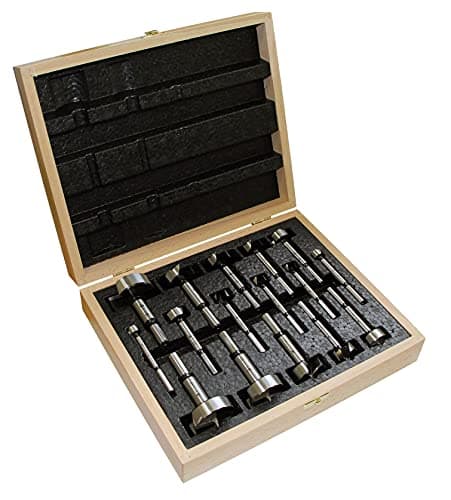
Fourteen imperial sizes to 2 in, a uniform 3/8 in shank, serrated rims on the larger bits and a case — the budget set whose published specification sheet actually says HSS.

Best budget set
8.2
$47.04Amazon
05
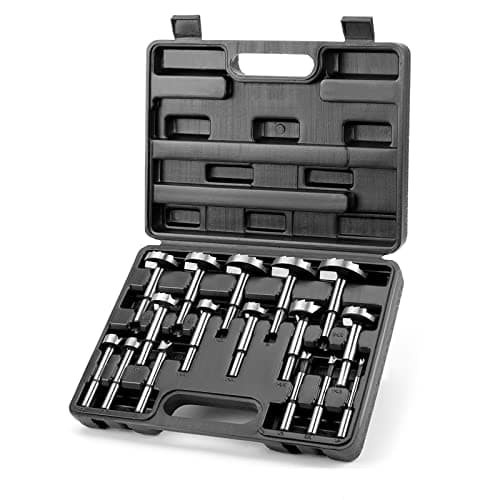
Comoware Comoware Forstner Bit Set (16 pc, 1/4–2-1/8 in)
Comoware Forstner Bit Set (16 pc, 1/4–2-1/8 in)

Sixteen carbon-steel bits to 2-1/8 in for less than the price of two Freud bits. Ranked last on purpose, and still the right answer for one specific buyer.

Cheapest way to own the sizes
6.8
$47.99Amazon

#ad · Live prices from the Amazon Product API, as of October 11, 2026. Where we have no verified live price, we show none — we would rather leave a gap than print a number that has rotted.

In detail

The picks, in full

01
Freud Freud PB-107B Forstner Bit Set (7 pc, 1/4–1 in)

Best overall

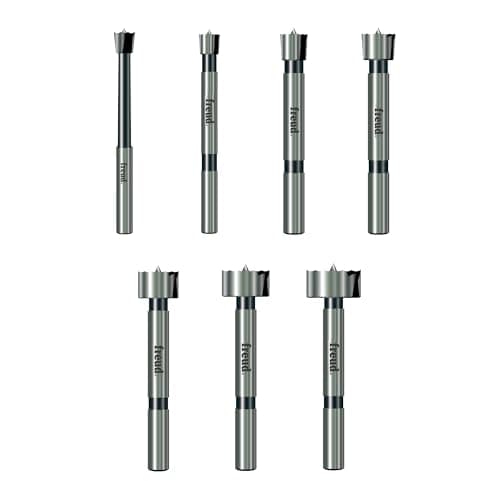
Freud PB-107B Forstner Bit Set (7 pc, 1/4–1 in)

7 bits, 1/4–1 inSerrated shear rim3-1/2 in overall length1/4–3/8 in shanks
8.4/10

Seven sizes from 1/4 to 1 in, forged rather than cast, with the serrated shear rim that makes a Forstner bit cut instead of scrape. The set that covers the holes a furniture maker actually drills.

Hole quality
10
Edge retention
9
Size range
6
Build
9
Value
8

Pros

  • The double-ground serrated rim slices the circumference ahead of the cutters, which is what keeps the edge of the hole crisp in face grain
  • Freud states the bits are forged from hardened steel rather than cast, and that is the difference you feel after a hundred holes
  • Covers 1/4, 3/8, 1/2, 5/8, 3/4, 7/8 and 1 in — the sizes that come up in joinery, plugs, dowels and hardware
  • Shanks step from 1/4 to 3/8 in with diameter, so the small bits still run true in a hand drill

Cons

  • Stops at 1 in, so hole saws or a separate large bit are still needed for anything above that
  • No case in this configuration, and loose Forstner bits blunt each other in a drawer
  • Costs more than 14- and 16-piece sets that look like better value on a size count alone

Don't buy this if…

…the job is a few big through-holes in construction lumber. A hole saw or an auger bit is the cheaper and faster tool there.

$92.97View on Amazon

Price as of October 11, 2026. Prices change — Amazon's is the one that counts.

#ad · we may earn a commission from this link to Freud PB-107B Forstner Bit Set (7 pc, 1/4–1 in)

02
Irwin Irwin Marples Forstner Bit Set (14 pc, 1/4–2 in)

Best size coverage for the money

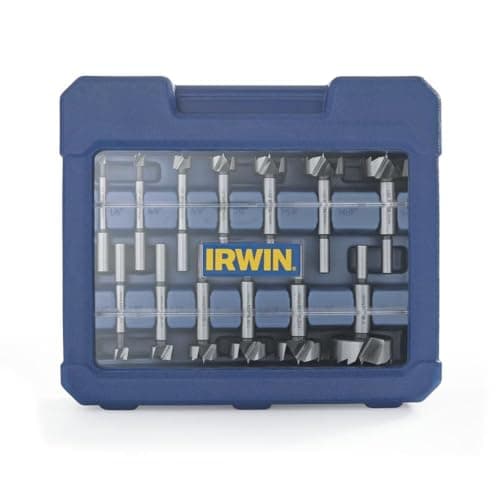
Irwin Marples Forstner Bit Set (14 pc, 1/4–2 in)

14 bits, 1/4–2 inCarbon steelReduced 3/8 in shankTwo 1/4 in bits
7.2/10

Fourteen sizes up to 2 in with a reduced shank that fits a 3/8 in chuck, in carbon steel. The honest middle of this category: enough range to stop improvising, cheap enough to accept that the edges are consumable.

Hole quality
7
Edge retention
5
Size range
9
Build
6
Value
9

Pros

  • Fourteen sizes from 1/4 in to a full 2 in covers hardware, plugs, hinge cups and most through-holes in one box
  • The reduced shank means the 2 in bit still fits a 3/8 in drill chuck, not just a drill press
  • Irwin includes a second 1/4 in bit, which is the size that gets abused and snapped first
  • Cheap enough to use on plywood and MDF without wincing, which is where Forstner edges die

Cons

  • Carbon steel, not HSS — it loses its edge faster and it will not survive being run hot
  • A 2 in carbon-steel bit in a hand drill is a wrist-breaker; the big sizes want a drill press and a clamped workpiece
  • Edge quality out of the box is inconsistent across a 14-piece set at this price, and some bits want honing before first use

Don't buy this if…

…you drill a lot of hardwood every week. Carbon steel is the wrong economy at that duty cycle — buy fewer, better bits.

$68.79View on Amazon

Price as of October 11, 2026. Prices change — Amazon's is the one that counts.

#ad · we may earn a commission from this link to Irwin Marples Forstner Bit Set (14 pc, 1/4–2 in)

03
Fisch Fisch Wave Cutter Forstner Bit Set (16 pc, 12–50 mm)

Best premium set

Fisch Wave Cutter Forstner Bit Set (16 pc, 12–50 mm)

16 bits, 12–50 mm90 mm lengthWave-cutter rimMade in Austria
9.0/10

The set you buy once. Sixteen metric sizes from 12 to 50 mm, 90 mm long, with the wave-cutter rim Fisch is known for — made in Austria and priced accordingly.

Hole quality
10
Edge retention
10
Size range
9
Build
10
Value
6

Pros

  • The wave rim reduces the contact area as the bit cuts, which is how a 50 mm bit stays out of trouble in dense hardwood
  • Metric sizing in 12 to 50 mm covers 35 mm euro hinge cups and 8 mm dowel holes directly, with no conversion
  • 90 mm overall length gives real depth in a drill press without an extension
  • Fisch publishes a country of manufacture and holds a consistent grind across the set, which the budget sets do not

Cons

  • Metric only — if your project stock and hardware are in inches, every size is a conversion away from what you asked for
  • Several times the price of the Irwin set for the same number of bits
  • A 50 mm bit is well past what a hand drill should be asked to turn, so part of the set assumes you own a drill press

Don't buy this if…

…your work is imperial and you need exact fractional holes. A metric set will get you close and close is the wrong answer for a dowel.

$256.83View on Amazon

$285.3410% off

Price as of October 11, 2026. Prices change — Amazon's is the one that counts.

#ad · we may earn a commission from this link to Fisch Wave Cutter Forstner Bit Set (16 pc, 12–50 mm)

04
WEN WEN FB5114 Forstner Bit Set (14 pc, 1/4–2 in)

Best budget set

WEN FB5114 Forstner Bit Set (14 pc, 1/4–2 in)

14 bits, 1/4–2 inHSS construction3/8 in shankSerrated on larger sizes
8.2/10

Fourteen imperial sizes to 2 in, a uniform 3/8 in shank, serrated rims on the larger bits and a case — the budget set whose published specification sheet actually says HSS.

Hole quality
8
Edge retention
7
Size range
9
Build
7
Value
10

Pros

  • WEN publishes HSS construction at a carbon-steel price, which is the single most useful specification in this category
  • Serrated teeth on the larger bits are the feature that stops a 1-1/2 in bit juddering in hard maple
  • A consistent 3/8 in shank across the set means no chuck changes mid-project
  • The case keeps the set in size order, which is the difference between owning 14 bits and owning a drawer of bits

Cons

  • A uniform 3/8 in shank means the 1/4 in bit has an oversized shank, and some small drills will not like the mass
  • Stock runs thin and the listing has shown low inventory, so availability is less reliable than the Irwin set
  • Center spurs on a set this cheap benefit from a touch-up before the first critical hole

Don't buy this if…

…you need the set to arrive by a specific date. Stock on this one moves, and the Irwin set is the safer order when timing matters.

$47.04View on Amazon

Price as of October 11, 2026. Prices change — Amazon's is the one that counts.

#ad · we may earn a commission from this link to WEN FB5114 Forstner Bit Set (14 pc, 1/4–2 in)

05
Comoware Comoware Forstner Bit Set (16 pc, 1/4–2-1/8 in)

Cheapest way to own the sizes

Comoware Forstner Bit Set (16 pc, 1/4–2-1/8 in)

16 bits, 1/4–2-1/8 inCarbon steelLargest size 2-1/8 inCase included
6.8/10

Sixteen carbon-steel bits to 2-1/8 in for less than the price of two Freud bits. Ranked last on purpose, and still the right answer for one specific buyer.

Hole quality
6
Edge retention
4
Size range
10
Build
5
Value
9

Pros

  • Sixteen sizes to 2-1/8 in is the widest size coverage on this page, by a set that costs less than a single premium bit
  • The right tool for plywood, MDF, plastics and PVC — materials that destroy good edges for no return
  • Having the odd size on the shelf when a project needs it beats owning a better bit in the wrong diameter
  • Cheap enough to keep a second set in the site box without thinking about it

Cons

  • Carbon steel and heat-treated, not HSS or carbide-tipped — expect to hone and expect the edges to be consumable
  • Rim and spur grind are inconsistent across the set; some bits cut cleanly and some chatter out of the box
  • No published tolerance on hole diameter, so dowel and hinge-cup fits should be test-drilled in scrap first

Don't buy this if…

…the holes show in the finished piece. A clean-walled, flat-bottomed hole in face grain is exactly what you are giving up to save the money.

$47.99View on Amazon

Price as of October 11, 2026. Prices change — Amazon's is the one that counts.

#ad · we may earn a commission from this link to Comoware Forstner Bit Set (16 pc, 1/4–2-1/8 in)

The five side by side

Published manufacturer and listing specifications for the five sets ranked above. The steel column is the one that predicts how the set feels after a year.

SetPieces / rangeSteelRimShank
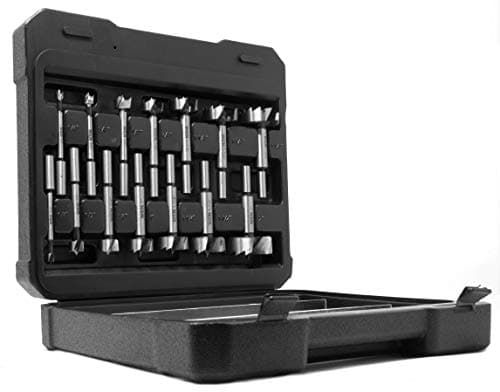
Freud PB-107B7 / 1/4–1 inForged hardened steelSerrated shear edge1/4, 5/16, 3/8 in
Irwin Marples 14-pc14 / 1/4–2 inCarbon steelNot publishedReduced, fits 3/8 in
Fisch wave cutter 16-pc16 / 12–50 mmNot published (Austria)Wave cutterNot published
WEN FB511414 / 1/4–2 inHSSSerrated on larger sizes3/8 in throughout
Comoware 16-pc16 / 1/4–2-1/8 inCarbon steel, heat-treatedNot publishedNot published

Metric or imperial is a real decision, not a detail

The Fisch set is metric only, 12 to 50 mm. If your hardware is metric — and euro hinge cups at 35 mm are the common case — that is an advantage, because the size you need is a size in the set. If your work is imperial, every hole becomes a conversion: 3/4 in is 19.05 mm and the nearest bit in a metric set is 19 mm, which is close and is the wrong answer for a dowel that has to be a press fit.

There is no clever way around this. Buy the system your stock, your hardware and your existing dowels live in. If you genuinely work in both, the cheap route is an imperial set plus the one or two metric sizes your hardware needs, bought individually.

Why carbon steel is not automatically the wrong choice

Three of these five sets are carbon steel, and the reflex is to call that a defect. It is more useful to call it a duty cycle. Carbon steel sharpens easily, holds a fine edge, and gives that edge up quickly under heat. For plywood, MDF, plastics and the occasional construction job — all of which chew edges for no return — a cheap carbon-steel bit you treat as a consumable is a rational purchase, and the Comoware set exists for exactly that reader.

Where it goes wrong is hardwood at volume. Hard maple and white oak generate the heat carbon steel cannot take, and a dulled Forstner does not merely cut slowly — it burnishes, scorches the hole wall and then grabs. If you drill hardwood every week, the Freud or the WEN is the cheaper tool over a year, which is the same argument we make about chisel steel: the purchase price is not the cost.

Honing a Forstner bit, which almost nobody does

A Forstner bit is sharpened on the insideof the rim and on the top faces of the cutters, never on the outside of the rim — grind the outside and you reduce the diameter, and the bit no longer drills the size stamped on it. A small diamond file or a slip stone, a few strokes on each cutter and inside the rim, restores most of a budget set out of the box.

It is worth doing on arrival with any set below about $60, because inconsistent grinding is the real difference between the price tiers. The same sharpening logic we go through in how to sharpen chisels applies: the edge geometry is the tool, and factory edges are a starting point rather than a finished product.

Clamp the work and back the hole

Two habits that make any of these sets perform better than the next tier up. First, clamp the workpiece — a large Forstner that grabs will spin a board, and that is the injury in this category. Second, put a sacrificial backer under a through-hole: the rim exits cleanly into the backer instead of blowing the fibers out of the underside, and the difference on plywood is dramatic.

If the holes are for bench dogs or a vise installation, both habits matter more because the stock is thick and the bit is large. We cover the layout side of that in how to mount a bench vise and the drilling machine itself in the drill press roundup.

The sizes a furniture shop actually reaches for

Buying by piece count hides the fact that most sets contain bits you will never fit in a chuck. The sizes that come up repeatedly in furniture and cabinet work are narrower than any of these boxes:

  • 1/4 in and 3/8 in— dowel holes, shelf pins on an imperial jig, and the pilot recesses for plugged screws. These are the two bits that wear out first, which is why the Irwin set including a second 1/4 in bit is a more thoughtful inclusion than it looks.
  • 1/2 in and 3/4 in— bench-dog holes, through-wires, and the start of a hand-cut mortise when you are drilling out the waste before paring.
  • 35 mm— euro hinge cups, and the one case where a metric set stops being an inconvenience and becomes the correct purchase.
  • One large size, 1-1/2 in to 2 in— cable pass-throughs, lamp bases, and the occasional piece of hardware. Owned for the once-a-project job, not for daily use, which is why a budget bit in this size is a perfectly rational choice.

If that list describes your work, a seven-piece set plus one large bit bought individually beats a sixteen-piece set, and it will cut better holes. The piece count only wins when you genuinely cannot predict which diameter the next project needs.

Where these numbers come from

The piece counts, diameter ranges, steel types, rim designs, shank sizes and overall lengths above are the manufacturers' own published specifications, taken from each product's live listing and the manufacturer's own description, and cited per set in Sources. Where a manufacturer does not publish a figure — rim design on three sets, steel type on the Fisch — the table says so rather than inventing one. We have not measured hole roundness, wall finish or edge life in a lab; we do not have one, and our methodology page says so plainly. Prices come from the live price feed and carry the date they were pulled.
How we picked

We do not run a testing lab

We researched published manufacturer specifications, manuals and spec sheets, ran the arithmetic those specs support, and read owner reviews at volume, then scored each tool against a published rubric. The scores are judgments from documented research — they are not measurements we took, because we do not have a lab and we are not going to pretend we do. Where a number came from a manufacturer's document, we name it and link it in Sources.

Questions

Frequently asked

What is a Forstner bit actually for?
Flat-bottomed holes with clean walls — hinge cups, shelf pins, bench-dog holes, knockdown hardware — plus the awkward cases no other bit manages: holes that overlap an existing hole, holes half off the edge of a board, and holes started on an angled surface. It is not the bit for deep or fast holes.
Are carbide-tipped Forstner bits worth it?
For production work in abrasive sheet goods, yes. For a home shop drilling hardwood and ply occasionally, a good HSS or forged-steel set honed on arrival gives most of the benefit for a fraction of the price, and it can be resharpened with a diamond file rather than sent out.
How fast should I run a Forstner bit?
Slow, and slower as the diameter grows — rim speed rises with diameter at the same spindle RPM, and a large bit run fast burnishes and scorches rather than cuts. Use the slowest useful step on your drill press for anything above about 1 in, and clear chips often because these bits do not eject their own.
Can I use Forstner bits in a cordless drill?
Up to roughly 1 in, with the work clamped and the drill held square. Above that a drill press is strongly preferable: not for power, but because a hand drill cannot run slow enough and cannot keep a large rim square to the surface. A grabbing 2 in bit in a hand drill is how wrists get hurt.
How do you sharpen a Forstner bit?
On the inside of the rim and the top faces of the cutters, with a small diamond file or slip stone. Never on the outside of the rim — that reduces the bit's diameter and it stops drilling the size it is stamped with.

Keep reading

Receipts

Sources

We do not run a testing lab, and we do not pretend to. Our picks come from published manufacturer specifications and manuals, the arithmetic those specs support, and owner reviews read at volume. Where we could not verify something, we say so on the page rather than quietly leaving it out. Read our full method.