Skip to content
Dovetail & Dust

HUB 02 · Power Tools

Table Saw vs Miter Saw

One rips, one crosscuts. Which you buy first depends entirely on whether your work is furniture or framing — and the answer is not the same for everyone.

By Stephen V.Updated How we research
#ad

We earn a commission when you buy through our Amazon links, at no extra cost to you. It never changes our rankings, and we say so when the cheaper tool is the better buy. How this works.

A table saw rips — it cuts along the grain, making a wide board narrower. A miter saw crosscuts — it cuts across the grain, making a long board shorter. If you only remember one thing, remember that, because it decides which saw you need.

Both saws can, with effort, do the other's job. A table saw crosscuts accurately with a sled you build yourself; a miter saw can rip a narrow strip if you are careless enough to try, which you should not be. But each is markedly better at its own job, and buying the wrong one first means fighting your tools on every project.

Here is the decision in one paragraph. If you build furniture and cabinets from boards and sheet goods, buy the table saw first. Furniture work is dominated by ripping parts to width from wider stock, and a table saw with a good fence is the only machine that does that repeatably. If you build decks, trim out rooms, cut framing, or make anything from dimensional lumber that arrives at roughly the right width— buy the miter saw first, because your work is almost entirely cutting long things shorter and at angles.

The third possibility, which people forget: for a shop that mostly breaks down plywood, the right first purchase may be neither. A track saw handles sheet goods better than either saw here. See table saw vs track saw for that comparison.

The short answer

Quick picks

#ProductBest forScorePrice
01
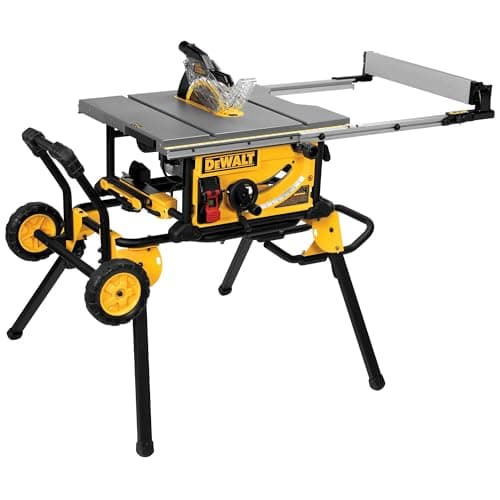
DeWalt DeWalt DWE7491RS 10-in Jobsite Table Saw
DeWalt DWE7491RS 10-in Jobsite Table Saw

The jobsite table saw home shops keep buying. A big rip capacity, a genuinely good fence and a rolling stand make it the do-everything portable saw.

Best overall table saw
8.4
$599.00Amazon
02
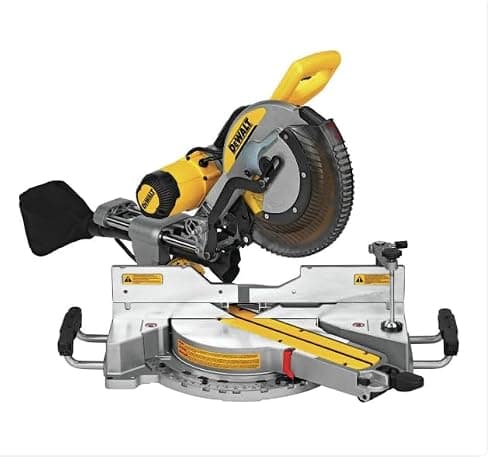
DeWalt DeWalt DWS779 12-in Double-Bevel Sliding Miter Saw
DeWalt DWS779 12-in Double-Bevel Sliding Miter Saw

The crosscut machine most home shops end up with. A 12-inch sliding double-bevel head crosscuts wide boards square and repeatably, which a table saw only does with a sled.

Best crosscut saw
7.4
$399.00Amazon
03
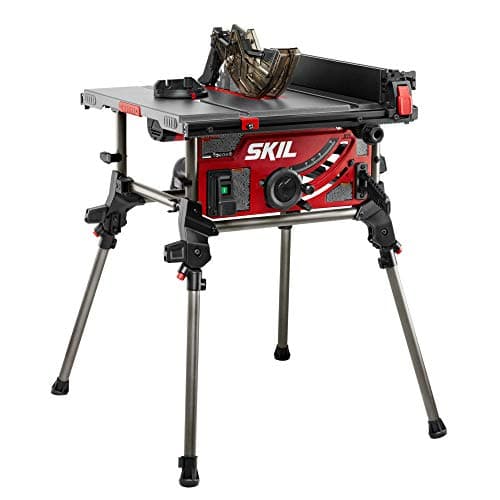
SKIL SKIL 10-in Jobsite Table Saw (TS6307)
SKIL 10-in Jobsite Table Saw (TS6307)

The value table saw. A surprisingly capable jobsite saw with a foldable stand at a price that makes it the easy budget pick.

Best value table saw
7.6
$302.68Amazon
04
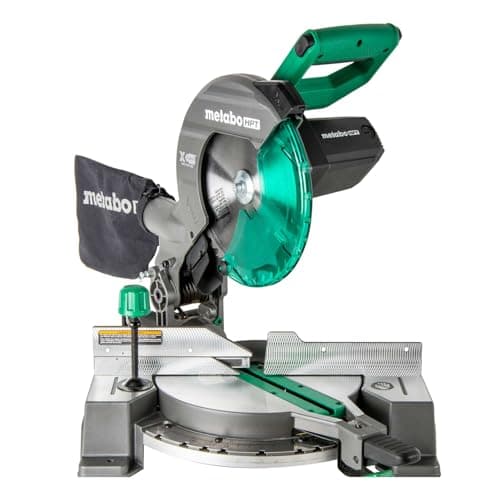
Metabo HPT Metabo HPT C10FCG2 10-in Compound Miter Saw
Metabo HPT C10FCG2 10-in Compound Miter Saw

The cheapest saw that crosscuts accurately. Single bevel, no slide, 10-inch blade — the entry-level answer for a shop whose stock is narrow.

Best budget crosscut
6.6
$139.00Amazon

#ad · Live prices from the Amazon Product API, as of Sep 1, 2026. Where we have no verified live price, we show none — we would rather leave a gap than print a number that has rotted.

In detail

The picks, in full

01
DeWalt DeWalt DWE7491RS 10-in Jobsite Table Saw

Best overall table saw

DeWalt DWE7491RS 10-in Jobsite Table Saw

10 in blade32.5 in ripRolling stand15 A
8.4/10

The jobsite table saw home shops keep buying. A big rip capacity, a genuinely good fence and a rolling stand make it the do-everything portable saw.

Rip capacity
9
Fence
9
Portability
8
Build
8
Value
8

Pros

  • Excellent rack-and-pinion fence for a portable saw
  • 32-1/2 inch rip handles most sheet-goods cuts
  • Rolling stand makes a heavy saw movable by one person

Cons

  • Loud universal motor, like all jobsite saws
  • Not the dead-flat cast-iron surface of a cabinet saw

Don't buy this if…

you have a dedicated shop and want the quietest, most precise cut — a contractor or cabinet saw is the long-term answer.

$599.00View on Amazon

$649.008% off

Price as of Sep 1, 2026. Prices change — Amazon's is the one that counts.

#ad · we may earn a commission from this link to DeWalt DWE7491RS 10-in Jobsite Table Saw

02
DeWalt DeWalt DWS779 12-in Double-Bevel Sliding Miter Saw

Best crosscut saw

DeWalt DWS779 12-in Double-Bevel Sliding Miter Saw

12 in bladeDouble bevel15 A / 3,800 RPMSliding head
7.4/10

The crosscut machine most home shops end up with. A 12-inch sliding double-bevel head crosscuts wide boards square and repeatably, which a table saw only does with a sled.

Crosscut capacity
9
Accuracy
8
Dust handling
4
Build
8
Value
8

Pros

  • Slide plus 12-inch blade covers wide crosscuts a table saw needs a sled to match
  • Double bevel means you cut both ends of a mitred frame without flipping stock
  • 3,800 RPM published no-load speed with a 15 A motor — no shortage of power

Cons

  • Dust collection at the blade is poor on every miter saw, this one included
  • Wants a dedicated station with wings; used on the floor it is far less accurate

Don't buy this if…

you mainly rip boards to width and break down sheets. That is a table saw or track saw job.

$399.00View on Amazon

Price as of Sep 1, 2026. Prices change — Amazon's is the one that counts.

#ad · we may earn a commission from this link to DeWalt DWS779 12-in Double-Bevel Sliding Miter Saw

03
SKIL SKIL 10-in Jobsite Table Saw (TS6307)

Best value table saw

SKIL 10-in Jobsite Table Saw (TS6307)

10 in blade25.5 in ripFoldable stand15 A
7.6/10

The value table saw. A surprisingly capable jobsite saw with a foldable stand at a price that makes it the easy budget pick.

Rip capacity
7
Fence
7
Portability
8
Build
7
Value
9

Pros

  • A lot of saw for the money, including a rolling/folding stand
  • Rip capacity is enough for most furniture-scale work
  • Good first table saw for a garage shop

Cons

  • Fence isn't as refined as the DeWalt's
  • Less rip capacity than the bigger jobsite saws

Don't buy this if…

you regularly break down full sheets solo — the wider-ripping DeWalt earns its premium there.

$302.68View on Amazon

$329.998% off

Price as of Sep 1, 2026. Prices change — Amazon's is the one that counts.

#ad · we may earn a commission from this link to SKIL 10-in Jobsite Table Saw (TS6307)

04
Metabo HPT Metabo HPT C10FCG2 10-in Compound Miter Saw

Best budget crosscut

Metabo HPT C10FCG2 10-in Compound Miter Saw

10 in bladeSingle bevel15 A40T blade incl.
6.6/10

The cheapest saw that crosscuts accurately. Single bevel, no slide, 10-inch blade — the entry-level answer for a shop whose stock is narrow.

Crosscut capacity
6
Accuracy
7
Dust handling
4
Build
7
Value
9

Pros

  • Costs a fraction of a sliding saw and is accurate for narrow stock
  • Light enough to carry with one hand and stow on a shelf
  • Ships with a 40-tooth carbide blade, so first cuts are clean

Cons

  • No slide, so crosscut width is limited
  • Single bevel means flipping the workpiece for opposing mitres

Don't buy this if…

you crosscut wide shelving or 1x12 stock — you will hit the width limit on day one.

$139.00View on Amazon

$179.0022% off

Price as of Sep 1, 2026. Prices change — Amazon's is the one that counts.

#ad · we may earn a commission from this link to Metabo HPT C10FCG2 10-in Compound Miter Saw

Head to head, job by job

Ripping a board to width

Table saw, decisively.The fence sets the width and the board rides against it; every cut is identical. A miter saw physically cannot do this safely — the blade descends onto stationary stock, and ripping requires the stock to move past the blade.

Crosscutting a long board to length

Miter saw, decisively. You bring the saw to the board rather than the board to the saw, which for anything over about 3 feet is far easier and far safer. A table saw can crosscut with a sled or the mitre gauge, but a 10-foot board on a table saw is an awkward, two-person operation.

Cutting angles and compound mitres

Miter saw. That is the whole reason for the name. Setting a repeatable 45 degrees on a table saw means a sled or a jig; on a miter saw it is a detent.

Breaking down sheet goods

Table saw, and only just. Neither saw is really the right tool. A miter saw cannot take a sheet at all. A table saw can, if you have outfeed support and help. A track saw does it better than either.

Joinery — dados, rabbets, tenons

Table saw. With a dado stack or repeated passes, a table saw cuts grooves, rabbets and tenon cheeks accurately. A miter saw can nibble a shallow trench with a stop block, but it is a workaround, not a method.

The accuracy difference nobody mentions

A miter saw's accuracy depends on its fence being straight and its detents being true, and on the stock being pressed flat against both fence and table. A table saw's accuracy depends on the fence being parallel to the blade. These are different failure modes: a miter saw that is slightly off produces a cut that is not quite square, which shows up as a gap in a mitred corner. A table saw that is slightly off produces a cut that is not quite parallel, which shows up as a tapered part — and, more importantly, as kickback risk. Both are checkable in ten minutes with a good square, and both are worth checking the day the saw arrives.

Cost and space, honestly

A capable jobsite table saw and a good sliding miter saw cost roughly the same. Space is where they differ: a table saw on a folding stand stores in about 2 × 2 feet; a miter saw is smaller in itself but only works properly on a station with support wings either side, which in practice occupies a whole wall. Many shops that own both end up building the miter saw into a bench along one wall and rolling the table saw out to the middle when needed.

What we recommend

Furniture and cabinets:table saw first — the DeWalt DWE7491RS if budget allows, the SKIL TS6307 if it does not. Add a miter saw later for breaking stock to rough length. Trim, framing, decks, home projects:miter saw first — the DeWalt DWS779 if you cut wide stock, the Metabo HPT C10FCG2 if your stock is narrow and the budget is tight. Both, eventually: almost everyone. The order is the only real question.

What we could not verify

We have not run comparative cut tests between these four saws. Blade sizes, rip capacities, amperages and bevel capabilities above are the manufacturers' published specifications. The comparison itself is a mechanical argument about what each saw geometry can and cannot do, not a lab result.
How we picked

We do not run a testing lab

We researched published manufacturer specifications, manuals and spec sheets, ran the arithmetic those specs support, and read owner reviews at volume, then scored each tool against a published rubric. The scores are judgments from documented research — they are not measurements we took, because we do not have a lab and we are not going to pretend we do. Where a number came from a manufacturer's document, we name it and link it in Sources.

Questions

Frequently asked

Can a miter saw replace a table saw?
No. A miter saw cannot rip — it cannot cut a board narrower along its length — and ripping is most of what furniture and cabinet work requires. They are complementary, not alternatives.
Can a table saw replace a miter saw?
Mostly, with a crosscut sled you build yourself. The sled makes a table saw genuinely excellent at square crosscuts and repeatable at angles. What it will not do is handle a 10-foot board comfortably, which is where a miter saw is simply the right tool.
Which saw is safer?
A miter saw is generally considered the more forgiving of the two, because the workpiece is clamped and stationary and the blade returns to a guarded rest position. Table saw kickback — where the blade grabs the workpiece and throws it back — is the more serious risk and the reason riving knives and blade guards exist. Neither is safe if you remove the guards.
Do I need a sliding miter saw?
Only if you cut wide stock. A non-sliding 10-inch saw crosscuts roughly 6 inches wide; a 12-inch sliding saw roughly doubles that. If your work is 1x4 trim, the cheaper saw is genuinely enough. If you crosscut shelving or 1x12 boards, you need the slide.

Keep reading

Receipts

Sources

We do not run a testing lab, and we do not pretend to. Our picks come from published manufacturer specifications and manuals, the arithmetic those specs support, and owner reviews read at volume. Where we could not verify something, we say so on the page rather than quietly leaving it out. Read our full method.