Skip to content
Dovetail & Dust

HUB 02 · Power Tools

Best Finish Nailer for Woodworking

One number decides this purchase before any brand does: the gauge. Everything else — angled or straight, corded air or a battery — is about where the nose has to reach and what you already own.

By Stephen V.Updated How we research
#ad

We earn a commission when you buy through our Amazon links, at no extra cost to you. It never changes our rankings, and we say so when the cheaper tool is the better buy. How this works.

Buy the Metabo HPT NT65M2S if you have a compressor. It is a 16-gauge straight finish nailer that drives 1 to 2-1/2 in. nails, which covers nearly everything a furniture shop fires, and it is the cheapest tool here a professional would be happy to pick up. The budget pick is the NuMax SFN64 — the cheapest nailer on this page that genuinely does the job, same 16 gauge and same nail range, in a lighter die-cast body. Buy the Metabo HPT NT65MA4 instead if you are hanging real trim and want 15 gauge, and the DEWALT DCN660B if you already own 20V MAX batteries and never want to drag a hose again.

Gauge is the whole decision

A finish nailer is defined by the diameter of the fastener it drives, and in practice there are only two answers: 15 gauge and 16 gauge. Both are substantially thicker than the 18-gauge brad most hobby shops start with, and that thickness is the entire point. A finish nail has enough shank to hold a joint closed on its own while glue cures, and in a lot of trim work it is the only thing holding the piece up.

16 gauge is the woodworking answer. It holds far better than an 18-gauge brad, leaves a hole that disappears under a dot of filler, and the guns are lighter and slimmer at the nose — which matters when you are nailing a face frame to a carcase and the tool has to fit between a clamp and a wall. If you build furniture, cabinets, boxes and shelving, buy 16 gauge and stop reading.

15 gaugeis the trim carpenter's answer. The nail is thicker again, it holds more, and 15-gauge guns are almost always angled, which is the real reason to own one: an angled magazine lets the nose reach into an inside corner that a straight magazine physically cannot. The costs are a bigger hole to fill, a heavier tool, and a nail stiff enough to split a thin or brittle molding instead of following the grain around a knot.

There is no third option worth agonizing over. If you find yourself wanting something smaller, you want a brad nailer, and that is a different purchase — we settle it on brad nailer vs finish nailer, and rank the 18-gauge field on best brad nailer.

Angled or straight

Magazine angle is not a quality signal and it is not a performance signal. It changes two things: where the nose can physically go, and which nails you buy forever afterwards.

A straight magazine sits in line with the body. It is simpler, the tool balances better in the hand, and straight 16-gauge nails are the most widely stocked fastener in this class. A straight gun cannot get its nose into a tight inside corner, because the magazine hits the adjacent surface first.

An angled magazine rakes the strip back so the nose can tuck into a corner the straight tool bounces off. That is worth real money if you are installing crown, door casing or built-ins. In a furniture shop it is worth very little, and you pay for it in nail availability: angled strips are collated at a specific angle and not every brand interchanges.

The practical rule: furniture and cabinets, buy straight; installed trim, buy angled. If you genuinely do both, a straight 16-gauge gun plus a separate 18-gauge brad nailer covers more real situations than one angled 15-gauge gun does.

Air or battery

A pneumatic finish nailer is a simple object: a piston, a trigger valve and an aluminum body. That is why the three pneumatic tools on this page cost a fraction of the cordless one, and why they tend to outlive the shops that bought them. The cost is the system behind them — a compressor, a hose, and the noise and floor space that come with both. If you do not own a compressor yet, cost the whole package before you decide; our air compressor roundup exists for exactly this moment, and a small quiet trim compressor is the normal partner for a nailer like these.

A cordless finish nailer removes the hose, the compressor and the wait, and it is transformative if your work moves around — installing a bookcase in a room, trimming a door, working on site. You pay a large multiple, you carry roughly double the weight at the end of your arm, and on most cordless platforms there is a brief spin-up before the first shot. The DEWALT DCN660B here is a bare tool, which is the right way to buy one: if you already have 20V MAX batteries the price is reasonable, and if you do not, it is not.

What the gun will not fix

Three failures get blamed on the nailer and are not the nailer.

Nails blowing out the side of a miter. That is aim and grain, not power. A nail follows the grain once it is in; fired into the end grain of a miter it will curve and exit. Nail through the face into the adjoining piece instead, or pin the joint from two directions.

Nails standing proud, or sinking too deep. Every tool here has a depth adjustment, and it needs resetting whenever the wood or the pressure changes. Set it on an offcut of the actual stock, every time. On a pneumatic gun also check the regulator — the published maximum for the NuMax here is 115 PSI, and most 16-gauge finish nailers are happy well below that.

A joint that opens up anyway.Nails are clamps that stay in the work. They are not glue. A face frame pinned with 16-gauge nails and no glue will eventually show a line; the nail's job is to hold the parts in register while the glue does the actual joining. Which glue is a separate question, answered on best wood glue.

Side by side

NailerGaugeMagazinePublished nail rangePower
Metabo HPT NT65M2S16Straight1 to 2-1/2 in.Pneumatic
Metabo HPT NT65MA415Angled1-1/4 to 2-1/2 in.Pneumatic
NuMax SFN6416Straight1 to 2-1/2 in.Pneumatic
DEWALT DCN660B16Angled1-1/4 to 2-1/2 in.20V MAX battery (bare tool)

Every figure in that table is the manufacturer's published specification for the exact SKU we link, and the price beside each row is the live one from our price layer with its own date stamp. We did not fire any of these tools; we do not run a lab, and the methodology page says so in those words.

What to buy, in order

If you own a compressor and build furniture: the NT65M2S. If you own a compressor and the budget is tight: the SFN64, and spend the difference on nails and a decent hose. If you hang trim in finished rooms: the NT65MA4. If you already own 20V MAX batteries and your work moves: the DCN660B.

If you own none of the above and are buying your first nailer for a hobby shop, buy an 18-gauge brad nailer first. It is the one you will reach for most, and the finish nailer is the second purchase, not the first.
The short answer

Quick picks

#ProductBest forScorePrice
01
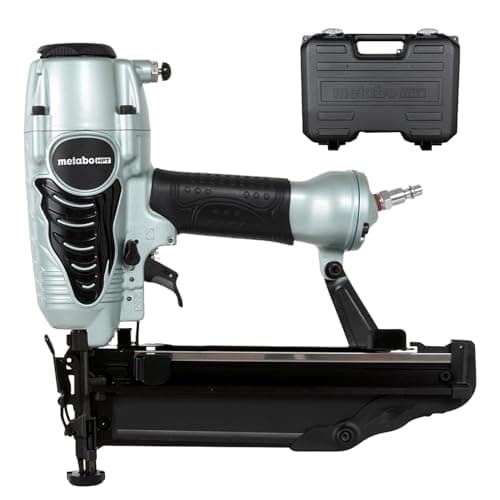
Metabo HPT Metabo HPT NT65M2S 16-Gauge Straight Finish Nailer
Metabo HPT NT65M2S 16-Gauge Straight Finish Nailer

The nailer that sits between a brad gun and a trim gun, and the one most woodworkers should own second. Sixteen gauge holds a face frame; a published 3.7 lb means you can still aim it one-handed.

Best 16-gauge
7.6
$109.00Amazon
02
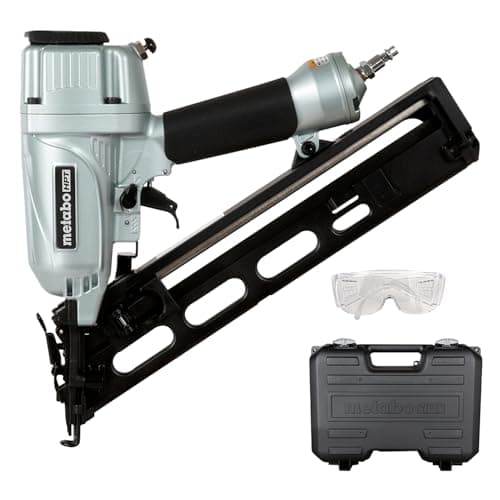
Metabo HPT Metabo HPT NT65MA4 15-Gauge Angled Finish Nailer
Metabo HPT NT65MA4 15-Gauge Angled Finish Nailer

The 15-gauge angled nailer to buy. A 34-degree magazine reaches into a corner no straight nailer can, and the nail is thick enough to hold a door casing on its own.

Best 15-gauge
7.4
$139.00Amazon
03
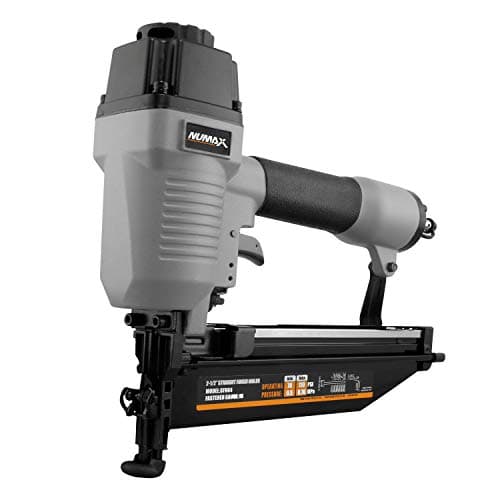
NuMax NuMax SFN64 16-Gauge Straight Finish Nailer
NuMax SFN64 16-Gauge Straight Finish Nailer

A 16-gauge finish nailer for about a third of the Metabo HPT. The right purchase when you are not sure how often you will reach for a finish nailer at all.

Best value
7.4
$59.46Amazon
04
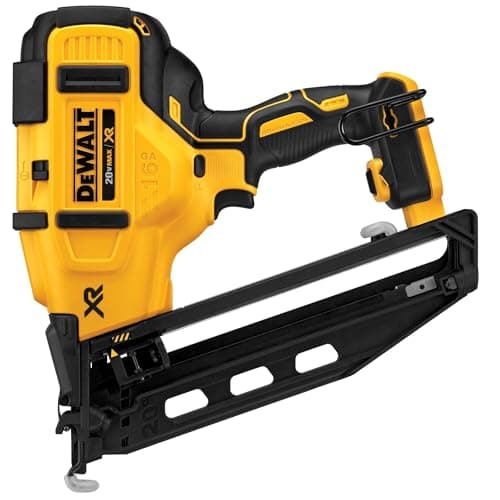
DEWALT DEWALT DCN660B 20V MAX 16-Gauge Angled Finish Nailer (Tool Only)
DEWALT DCN660B 20V MAX 16-Gauge Angled Finish Nailer (Tool Only)

Sixteen gauge, angled magazine, no hose and no compressor. The finish nailer for a shop that does not have an air system and does not want to buy one.

Best cordless
6.8
$348.95Amazon

#ad · Live prices from the Amazon Product API, as of November 21, 2026. Where we have no verified live price, we show none — we would rather leave a gap than print a number that has rotted.

In detail

The picks, in full

01
Metabo HPT Metabo HPT NT65M2S 16-Gauge Straight Finish Nailer

Best 16-gauge

Metabo HPT NT65M2S 16-Gauge Straight Finish Nailer

16 ga., 1 to 2-1/2 in.Straight magazine3.7 lb publishedPneumatic
7.6/10

The nailer that sits between a brad gun and a trim gun, and the one most woodworkers should own second. Sixteen gauge holds a face frame; a published 3.7 lb means you can still aim it one-handed.

Holding power
8
Hole size
6
Reach
6
Handling
9
Value
9

Pros

  • 16-gauge is the smallest nail that holds a joint without glue, which is the whole argument for owning a finish nailer at all
  • At a published 3.7 lb it is half a pound lighter than the 15-gauge angled tool and noticeably easier to place accurately
  • A straight magazine drops the nail where the nose sits, with none of the angled tool's offset to allow for

Cons

  • A straight magazine cannot reach an inside corner the way a 34-degree angled one can — the trade you make for the lighter tool
  • Metabo HPT does not publish operating pressure or air consumption for this exact model, so compressor sizing has to be inferred from the 15-gauge sibling
  • Pneumatic, so the real cost is this plus a compressor and a hose

Don't buy this if…

…you are nailing door casing and baseboard for a living. Those are 15-gauge jobs, and the angled magazine you are giving up is what makes them possible.

$109.00View on Amazon

$179.0039% off

Price as of November 21, 2026. Prices change — Amazon's is the one that counts.

#ad · we may earn a commission from this link to Metabo HPT NT65M2S 16-Gauge Straight Finish Nailer

02
Metabo HPT Metabo HPT NT65MA4 15-Gauge Angled Finish Nailer

Best 15-gauge

Metabo HPT NT65MA4 15-Gauge Angled Finish Nailer

15 ga., 1-1/4 to 2-1/2 in.34-degree magazine100-nail capacity70-120 psi, 4.2 lb
7.4/10

The 15-gauge angled nailer to buy. A 34-degree magazine reaches into a corner no straight nailer can, and the nail is thick enough to hold a door casing on its own.

Holding power
10
Hole size
4
Reach
9
Handling
6
Value
8

Pros

  • The angled magazine is the reason 15-gauge exists: it gets the nose into an inside corner where a straight tool fouls on the adjacent wall
  • A 15-gauge nail is appreciably thicker than a 16 and far thicker than an 18, so it holds structural trim without glue
  • Selective actuation on the tool, so you can lock it to sequential firing and leave it locked

Cons

  • A 15-gauge hole needs filling on anything that gets a clear finish — it is too big to disappear under a coat of oil
  • Published air consumption of 0.045 cu. ft. per cycle at 100 psi is roughly double a brad nailer's, so the small quiet compressors cannot keep up
  • 4.2 lb published and a bulky angled magazine; this is a trim tool, not a hold-the-joint-together tool

Don't buy this if…

…your work is cabinetry and small furniture rather than door casing and baseboard. Inside a cabinet a 15-gauge nail is more hole than you need and more hole than you want to fill.

$139.00View on Amazon

$189.0026% off

Price as of November 21, 2026. Prices change — Amazon's is the one that counts.

#ad · we may earn a commission from this link to Metabo HPT NT65MA4 15-Gauge Angled Finish Nailer

03
NuMax NuMax SFN64 16-Gauge Straight Finish Nailer

Best value

NuMax SFN64 16-Gauge Straight Finish Nailer

16 ga., 1 to 2-1/2 in.100-nail magazine115 max psiDie-cast aluminum
7.4/10

A 16-gauge finish nailer for about a third of the Metabo HPT. The right purchase when you are not sure how often you will reach for a finish nailer at all.

Holding power
8
Hole size
6
Reach
6
Handling
7
Value
10

Pros

  • Cheap enough that owning both a brad nailer and a finish nailer stops being a real decision
  • Takes the same 1 in. to 2-1/2 in. 16-gauge straight nails as the Metabo HPT, which are stocked everywhere
  • Tool-free depth adjustment and a 100-nail magazine at this price are both better than the category average

Cons

  • NuMax publishes no weight and no minimum operating pressure, so the two specs that most affect how it handles and what compressor it needs are unlisted
  • Retailer listings disagree on the nail range — some say 3/4 in. to 2-1/2 in., others 1 in. to 2-1/2 in.
  • Budget nailers are where jam-clearing design is cut; expect to open the nose more often than on the Metabo HPT

Don't buy this if…

…the nailer will be in your hand every week. The Metabo HPT costs twice as much and is the tool you will still be using in ten years.

$59.46View on Amazon

Price as of November 21, 2026. Prices change — Amazon's is the one that counts.

#ad · we may earn a commission from this link to NuMax SFN64 16-Gauge Straight Finish Nailer

04
DEWALT DEWALT DCN660B 20V MAX 16-Gauge Angled Finish Nailer (Tool Only)

Best cordless

DEWALT DCN660B 20V MAX 16-Gauge Angled Finish Nailer (Tool Only)

16 ga., 1-1/4 to 2-1/2 in.Angled magazine20V MAXTool only
6.8/10

Sixteen gauge, angled magazine, no hose and no compressor. The finish nailer for a shop that does not have an air system and does not want to buy one.

Holding power
8
Hole size
6
Reach
9
Handling
6
Value
5

Pros

  • Removes the compressor from the equation entirely, which is a larger saving than the tool price suggests once a hose, fittings and floor space are counted
  • An angled 16-gauge magazine gets the reach of a trim nailer with the smaller hole of a 16
  • No hose to drag across a finished panel, and nothing cycling in a shared garage while you work

Cons

  • Bare tool: a 20V MAX battery and charger are extra, and the real price is well over twice a comparable pneumatic
  • DEWALT does not publish a weight, a magazine capacity or a collation angle for this model on its own product page
  • Cordless nailers are front-heavy with a battery fitted, which you feel on overhead and awkward-angle work

Don't buy this if…

…you already own a compressor for other reasons. The hose is the only problem this solves and you are paying a great deal to solve it.

$348.95View on Amazon

Price as of November 21, 2026. Prices change — Amazon's is the one that counts.

#ad · we may earn a commission from this link to DEWALT DCN660B 20V MAX 16-Gauge Angled Finish Nailer (Tool Only)

How we picked

We do not run a testing lab

We researched published manufacturer specifications, manuals and spec sheets, ran the arithmetic those specs support, and read owner reviews at volume, then scored each tool against a published rubric. The scores are judgments from documented research — they are not measurements we took, because we do not have a lab and we are not going to pretend we do. Where a number came from a manufacturer's document, we name it and link it in Sources.

Questions

Frequently asked

What is the best finish nailer for woodworking?
A 16-gauge straight pneumatic gun, and the Metabo HPT NT65M2S is the cheapest one a professional would be happy with. Sixteen gauge holds a face frame or a cabinet together while glue cures, the straight magazine balances better in the hand, and straight 16-gauge nails are the easiest fastener in this class to buy anywhere.
Is 15 gauge or 16 gauge better for a finish nailer?
Neither is better; they do different work. Fifteen gauge holds more and almost always comes with an angled magazine that reaches into inside corners, which is why trim carpenters use it. Sixteen gauge leaves a smaller hole, is lighter, is slimmer at the nose and is the right default for furniture, cabinets and boxes.
Can a finish nailer replace a brad nailer?
Not really. A 16-gauge nail is noticeably thicker than an 18-gauge brad, so it holds much better and splits thin or delicate stock much more readily. Most shops end up with both, and the brad nailer gets used more often. We lay the two side by side on brad nailer vs finish nailer.
What compressor do I need for a finish nailer?
A small one. A finish nailer uses a tiny amount of air per shot, so tank size matters far less than it does for a sander or a spray gun — a 1 to 6 gallon pancake or quiet trim compressor keeps up with continuous work. Check the nailer's published operating pressure first; the NuMax here publishes a 115 PSI maximum. Our air compressor page ranks the field.
Why do my finish nails bend and come out the side?
Because a nail follows the grain once it enters, and fired into end grain — the inside of a miter, for instance — it will curve and exit the face. Change the angle of attack so the nail crosses the grain rather than running along it, and nail through the face of one piece into the adjoining one rather than through the joint line.
Is a cordless finish nailer worth it?
If your work moves around, yes. If it happens at a bench, no. The cordless tool costs a large multiple of a comparable pneumatic one and weighs roughly twice as much, and both of those are permanent. Buy cordless as a bare tool on a battery platform you already own, which is how the DEWALT DCN660B here is sold.

Keep reading

Receipts

Sources

We do not run a testing lab, and we do not pretend to. Our picks come from published manufacturer specifications and manuals, the arithmetic those specs support, and owner reviews read at volume. Where we could not verify something, we say so on the page rather than quietly leaving it out. Read our full method.