Skip to content
Dovetail & Dust

HUB 02 · Power Tools

The Best Router Bits

Ranked for a home shop, with the honest advice about sets: buy a cheap one to learn your habits, then replace the three bits you actually use.

By Stephen V.Updated How we research
#ad

We earn a commission when you buy through our Amazon links, at no extra cost to you. It never changes our rankings, and we say so when the cheaper tool is the better buy. How this works.

Almost nobody uses more than six router bit profiles regularly, and almost everybody buys fifteen. That is the whole shape of this category. A large boxed set is a cheap way to discover which profiles you reach for; it is a poor way to own the ones you reach for daily. The strategy that works is to buy a set, use it for a year, notice which three or four bits are worn and which are still shiny, and then replace the worn ones with proper bits.

The specification that matters most is not the profile, it is the shank. The same bit on a 1/2-inch shank is substantially stiffer than on a 1/4-inch shank, because resistance to bending rises steeply with diameter. Less flex means less chatter and a cleaner cut, especially on a wide profile taking a real bite. If your router accepts a 1/2-inch collet — most mid-size machines in our router roundup do — buy 1/2-inch shanks. If you only own a trim router, you are on 1/4-inch and that is fine, but stay away from large-diameter profiles.

The second thing worth knowing is that the difference between a cheap bit and a good one is mostly the carbide: how thick it is, how well it is ground, and how well the bit is balanced. Thin carbide dulls sooner and cannot be resharpened economically. A well-ground, well-balanced bit cuts a surface you can finish straight off the router, which saves sanding time on every single edge. That is a real return, and it is why one good round-over is a better purchase than five mediocre profiles.

Finally: bits are consumables that behave like tools. Keep them clean — pitch build-up makes a sharp bit behave like a blunt one — take shallow passes, and respect the maximum RPM printed on the packaging for large-diameter bits. Our router bit guide explains each family in detail if you are still working out what you need.

The short answer

Quick picks

#ProductBest forScorePrice
01
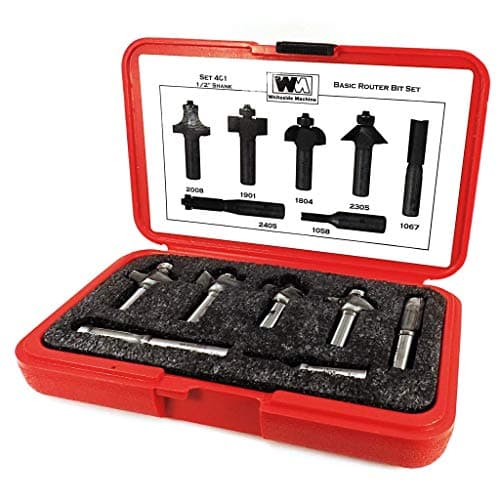
Whiteside Whiteside 401 Basic Router Bit Set (7 pc, 1/2 in shank)
Whiteside 401 Basic Router Bit Set (7 pc, 1/2 in shank)

Seven bits chosen because they are the seven you use, from a maker whose grind and balance are the reason people stop buying bargain sets.

Best overall set
8.6
$141.35Amazon
02
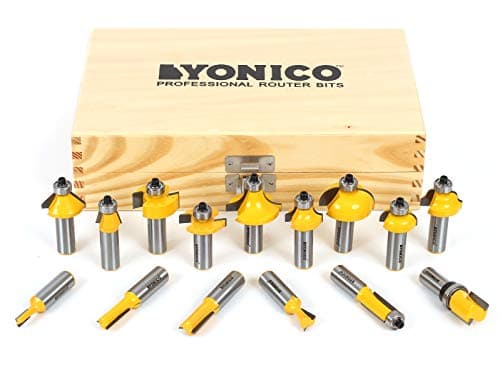
Yonico Yonico 17150 Router Bit Set (15 pc, 1/2 in shank)
Yonico 17150 Router Bit Set (15 pc, 1/2 in shank)

The sensible way to find out which profiles you actually use. Fifteen carbide-tipped bits for less than three good ones, and genuinely usable while you learn.

Best value set
7.6
$49.95Amazon
03
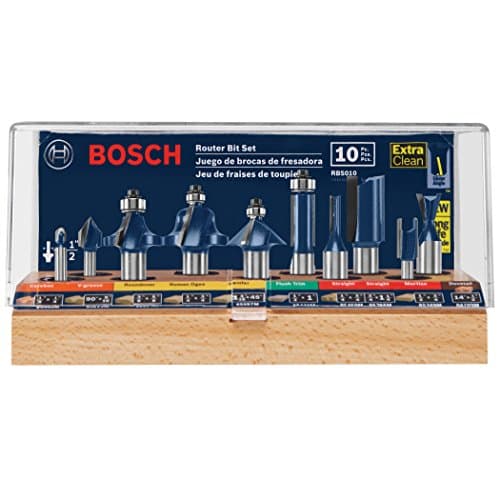
Bosch Bosch RBS010 Router Bit Set (10 pc, 1/4 + 1/2 in shanks)
Bosch RBS010 Router Bit Set (10 pc, 1/4 + 1/2 in shanks)

The set to buy if you own both a trim router and a mid-size one — it ships both shank sizes, so every machine in the shop has bits that fit.

Best for mixed-shank shops
7.8
$180.78Amazon
04
Whiteside Whiteside RU5150 Spiral Upcut Bit (1/2 in, 1/2 in shank)
Whiteside RU5150 Spiral Upcut Bit (1/2 in, 1/2 in shank)

The single bit that most improves a shop's mortises. A solid-carbide upcut spiral shears the fibers and lifts chips clear instead of packing them in the slot.

Best spiral bit
8.6
$81.47Amazon
05
Freud 34-110 Quadra-Cut Round-Over Bit (1/4 in radius)

A four-cutter round-over that leaves a surface you can finish straight off the router — the profile you will use more than any other, done properly.

Best edge-forming bit
8.6
Check price →
06
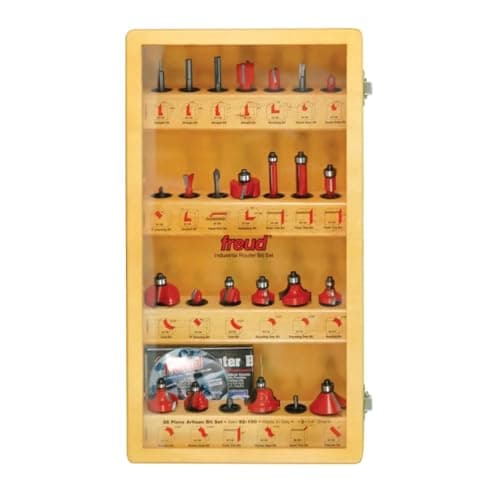
Freud Freud 92-100 Artisan Router Bit Set (26 pc)
Freud 92-100 Artisan Router Bit Set (26 pc)

A serious 26-bit collection from a maker that sells single bits for real money. The buy-everything-at-once option for a shop that already knows it routs a lot.

Best large set
8.6
$514.72Amazon

#ad · Live prices from the Amazon Product API, as of Sep 1, 2026. Where we have no verified live price, we show none — we would rather leave a gap than print a number that has rotted.

In detail

The picks, in full

01
Whiteside Whiteside 401 Basic Router Bit Set (7 pc, 1/2 in shank)

Best overall set

Whiteside 401 Basic Router Bit Set (7 pc, 1/2 in shank)

7 pieces1/2 in shankCarbide tippedStraight, round-over, flush, cove
8.6/10

Seven bits chosen because they are the seven you use, from a maker whose grind and balance are the reason people stop buying bargain sets.

Cut quality
9
Carbide
9
Set contents
9
Balance
9
Value
7

Pros

  • Every bit in the box is one a working shop reaches for — no filler profiles padding the count
  • 1/2-inch shanks throughout, so the whole set is the stiffer version of each bit
  • Thick carbide that can be professionally resharpened rather than binned

Cons

  • Costs several times a 15-bit bargain set for less than half the bit count
  • 1/2-inch shanks only, so nothing in the box fits a 1/4-inch-only compact router

Don't buy this if…

your only router is a trim router with a 1/4-inch collet — none of these will fit it.

$141.35View on Amazon

Price as of Sep 1, 2026. Prices change — Amazon's is the one that counts.

#ad · we may earn a commission from this link to Whiteside 401 Basic Router Bit Set (7 pc, 1/2 in shank)

02
Yonico Yonico 17150 Router Bit Set (15 pc, 1/2 in shank)

Best value set

Yonico 17150 Router Bit Set (15 pc, 1/2 in shank)

15 pieces1/2 in shankCarbide tippedRound-over, cove, chamfer, dovetail, flush trim
7.6/10

The sensible way to find out which profiles you actually use. Fifteen carbide-tipped bits for less than three good ones, and genuinely usable while you learn.

Cut quality
7
Carbide
6
Set contents
9
Balance
7
Value
9

Pros

  • Covers the whole profile spread at once, so you can discover your habits before spending properly
  • 1/2-inch shanks, which is unusual at this price and makes the bits noticeably steadier
  • Wooden case keeps them located and identifiable

Cons

  • Thinner carbide than a premium bit — expect a shorter working life and limited resharpening
  • Finish off the bit is good rather than glassy; a light sanding pass is often wanted

Don't buy this if…

you already know the three profiles you run constantly. Buy those three properly instead of fifteen adequately.

$49.95View on Amazon

Price as of Sep 1, 2026. Prices change — Amazon's is the one that counts.

#ad · we may earn a commission from this link to Yonico 17150 Router Bit Set (15 pc, 1/2 in shank)

03
Bosch Bosch RBS010 Router Bit Set (10 pc, 1/4 + 1/2 in shanks)

Best for mixed-shank shops

Bosch RBS010 Router Bit Set (10 pc, 1/4 + 1/2 in shanks)

10 pieces1/4 in and 1/2 in shanksCarbide tippedStraight, trim, edging, dovetail
7.8/10

The set to buy if you own both a trim router and a mid-size one — it ships both shank sizes, so every machine in the shop has bits that fit.

Cut quality
8
Carbide
8
Set contents
8
Balance
8
Value
7

Pros

  • Both shank sizes in one box solves the two-router problem most shops end up with
  • Bosch's own profile selection leans practical — straight, flush trim, edge forming, one dovetail
  • Hard case with located slots, so bits are not rattling loose in a drawer

Cons

  • Ten bits across two shank sizes means fewer usable profiles per router than a single-shank set
  • Priced above the bargain sets without matching the carbide of a specialist bit

Don't buy this if…

you only own one router. A single-shank set gives you more profiles for the money.

$180.78View on Amazon

Price as of Sep 1, 2026. Prices change — Amazon's is the one that counts.

#ad · we may earn a commission from this link to Bosch RBS010 Router Bit Set (10 pc, 1/4 + 1/2 in shanks)

04
Whiteside Whiteside RU5150 Spiral Upcut Bit (1/2 in, 1/2 in shank)

Best spiral bit

Whiteside RU5150 Spiral Upcut Bit (1/2 in, 1/2 in shank)

1/2 in cutting diameter1/2 in shank1-1/2 in cutting lengthSolid carbide, upcut
8.6/10

The single bit that most improves a shop's mortises. A solid-carbide upcut spiral shears the fibers and lifts chips clear instead of packing them in the slot.

Cut quality
9
Carbide
10
Chip clearing
10
Versatility
7
Value
7

Pros

  • Clears chips upward, which is exactly what a deep mortise needs to stay cutting cleanly
  • Shearing helix leaves far less tear-out than a straight bit in figured stock
  • Solid carbide rather than a brazed tip, so the whole edge is the hard material

Cons

  • Upcut geometry can lift and fray fibers at the top surface of a visible cut
  • Costs as much as several straight bits for one profile

Don't buy this if…

your cuts are shallow grooves in plywood with a visible top face — a down-cut or compression bit is the better choice there.

$81.47View on Amazon

Price as of Sep 1, 2026. Prices change — Amazon's is the one that counts.

#ad · we may earn a commission from this link to Whiteside RU5150 Spiral Upcut Bit (1/2 in, 1/2 in shank)

05

Best edge-forming bit

Freud 34-110 Quadra-Cut Round-Over Bit (1/4 in radius)

1/4 in radius1/4 in shank4 cuttersPerma-Shield coating
8.6/10

A four-cutter round-over that leaves a surface you can finish straight off the router — the profile you will use more than any other, done properly.

Cut quality
10
Carbide
9
Finish
10
Versatility
6
Value
8

Pros

  • Four cutters instead of two — two shear the profile and two clean it, which shows in the finish
  • Round-over is the one profile nearly every project wants, so it earns its keep immediately
  • Non-stick coating slows the pitch build-up that makes a bit burn

Cons

  • One radius only — a different edge size means another bit
  • 1/4-inch shank, so it is less rigid than the same profile on a 1/2-inch shank

Don't buy this if…

you bought a multi-bit set that already includes a 1/4-inch round-over and you are still learning which profiles you like.

Check price on Amazon →

We don't have a verified live price for this right now, so we aren't showing one.

#ad · we may earn a commission from this link to Freud 34-110 Quadra-Cut Round-Over Bit (1/4 in radius)

06
Freud Freud 92-100 Artisan Router Bit Set (26 pc)

Best large set

Freud 92-100 Artisan Router Bit Set (26 pc)

26 piecesCarbide tippedFreud Artisan rangeFitted case
8.6/10

A serious 26-bit collection from a maker that sells single bits for real money. The buy-everything-at-once option for a shop that already knows it routs a lot.

Cut quality
9
Carbide
9
Set contents
10
Balance
9
Value
6

Pros

  • Depth of profile coverage that stops you ordering a bit mid-project
  • Freud's carbide and grind, rather than a generic import set's
  • Works out cheaper per bit than assembling the same range individually

Cons

  • A large outlay for bits you may never use — most shops run six profiles constantly
  • Sets this size encourage buying breadth before you have earned the depth

Don't buy this if…

this is your first router. Learn which six bits you reach for before buying twenty-six.

$514.72View on Amazon

Price as of Sep 1, 2026. Prices change — Amazon's is the one that counts.

#ad · we may earn a commission from this link to Freud 92-100 Artisan Router Bit Set (26 pc)

How to choose router bits

Start with the six profiles that do the work

A straight bit in 1/4 and 1/2 inch for dados and grooves. A flush-trim or pattern bit for template work. A 1/8 or 1/4-inch round-over for edges. A chamfer for the tidy alternative to a round-over. A rabbeting bit with interchangeable bearings. That short list builds cabinets, shelves, boxes and most furniture. Everything beyond it is either decorative or job-specific, and can wait until a project demands it.

Set or singles?

Buy a set if you are new and do not yet know your habits — the information is worth more than the bits. Buy singles if you already know: a shop that routs edges daily is better served by one excellent round-over than by fifteen average bits, and a shop cutting mortises wants a proper spiral rather than whatever straight bit came in the box.

Carbide grade and resharpening

Premium bits carry thicker carbide, which means the edge can be professionally reground several times over its life. Budget bits carry thin carbide and are effectively disposable. Neither is wrong; they are different economics. If you rout occasionally, disposable is cheaper. If you rout constantly, a resharpenable bit costs less per cut and, crucially, cuts better for more of its life.

Spirals versus straight bits

A straight bit chops; a spiral shears. The spiral leaves a cleaner wall and, in the up-cut form, drags chips out of a deep slot instead of packing them in. For mortising in particular the difference is not subtle. Spirals cost more — often solid carbide rather than a brazed tip — so the sensible approach is straight bits for general grooving and one good spiral for joinery.

Bit diameter, speed and safety

A wide bit's cutting edge travels much farther per revolution than a narrow one's at the same RPM. That is why every bit maker publishes a maximum speed by diameter, and why a variable-speed router exists. Large panel-raising and rail-and-stile bits are table-only tools that must be slowed down; a small round-over can run at the top of the dial. The number on the packaging is not a suggestion.

Two more habits worth building. Seat the shank fully into the collet, then back it out a couple of millimeters before tightening, so it is not bottomed out. And take multiple shallow passes rather than one deep one — it is faster in practice, because a bit that is not fighting the wood can be fed quicker.

Segmenting by shop and budget

First router, tight budget: a 1/2-inch-shank multi-bit set. You get the whole profile spread, you learn what you use, and nothing in the box is dangerous or useless.

Two-router shop: a mixed-shank set so both machines have bits that fit, then upgrade individual profiles as they wear.

Furniture work: individual premium bits for the profiles you run constantly, plus one good spiral for joinery. At that point the bits are cutting your visible surfaces and the finish quality is worth paying for.

Router table shop: add 1/2-inch-shank joinery bits — rail-and-stile and panel-raising — but only once the table and a router with enough power and a speed dial are in place. Those bits are not safe freehand.

How we ranked these

We are a research site, not a test lab — our methodology page says so plainly. Rankings here come from published manufacturer specifications (shank size, cutting diameter and length, carbide construction, set contents), the makers' own documentation, and the consistent pattern in owner feedback read at volume. We have not measured tool life or surface finish, and we do not publish numbers we did not obtain. Prices come from the live price feed.
How we picked

We do not run a testing lab

We researched published manufacturer specifications, manuals and spec sheets, ran the arithmetic those specs support, and read owner reviews at volume, then scored each tool against a published rubric. The scores are judgments from documented research — they are not measurements we took, because we do not have a lab and we are not going to pretend we do. Where a number came from a manufacturer's document, we name it and link it in Sources.

Questions

Frequently asked

What router bits should I buy first?
Straight bits in 1/4 and 1/2 inch, a flush-trim bit, and a small round-over. Those four cover dados, grooves, template work and edge softening — which is most of what a first year of projects needs. A modest set is a cheap way to get all of them plus a few profiles to experiment with.
Are cheap router bit sets any good?
They are genuinely usable, and they are the cheapest way to find out which profiles you actually reach for. The compromise is thinner carbide, so they dull sooner and cannot be economically resharpened. Buy one to learn your habits, then replace the two or three bits you use constantly with better individual ones.
Is a 1/2-inch shank really better?
Yes, meaningfully. A thicker shank is far stiffer, so it deflects and chatters less — most noticeable on large-diameter bits and deeper passes. Buy 1/2-inch whenever your router takes the collet and the bit is offered in both sizes.
How do I stop router bits burning the wood?
Take shallower passes, keep the feed moving rather than pausing, clean pitch off the bit, and slow the router down for large-diameter bits. Burning is almost always heat from a bit that is either loaded up with resin, taking too much material, or spinning too fast for its diameter.

Keep reading

Receipts

Sources

We do not run a testing lab, and we do not pretend to. Our picks come from published manufacturer specifications and manuals, the arithmetic those specs support, and owner reviews read at volume. Where we could not verify something, we say so on the page rather than quietly leaving it out. Read our full method.