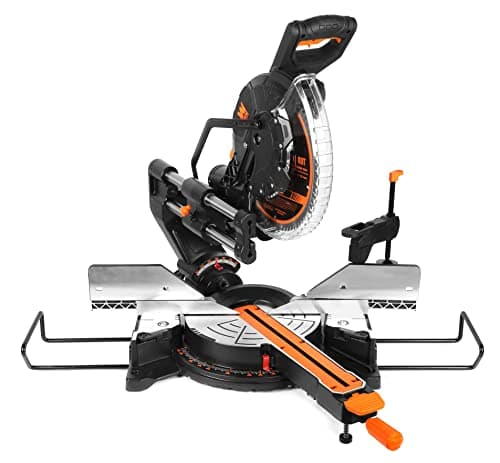
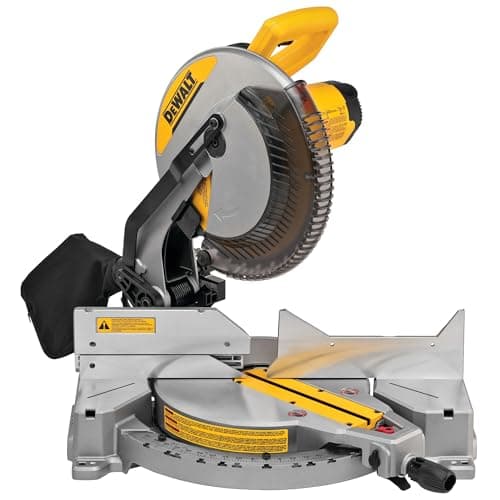
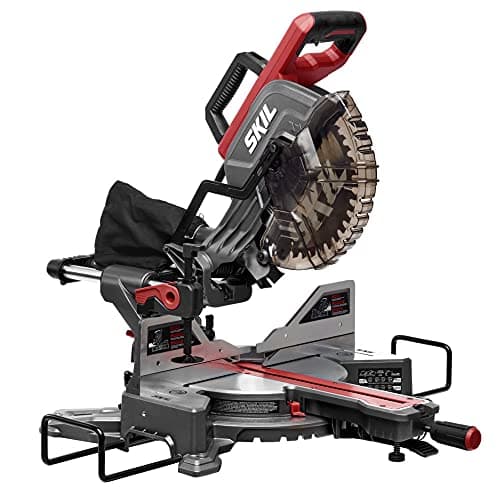
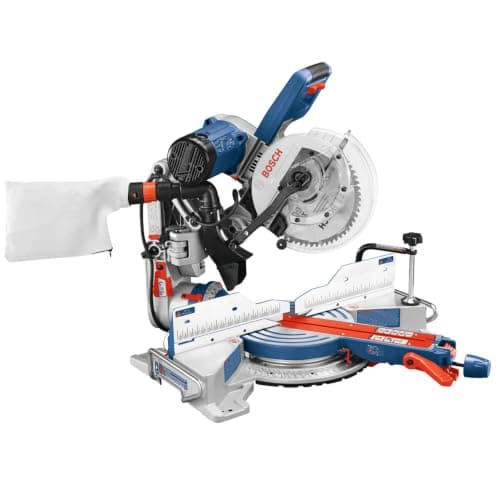
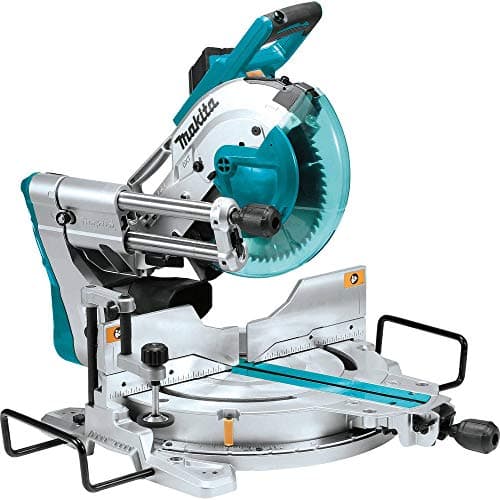
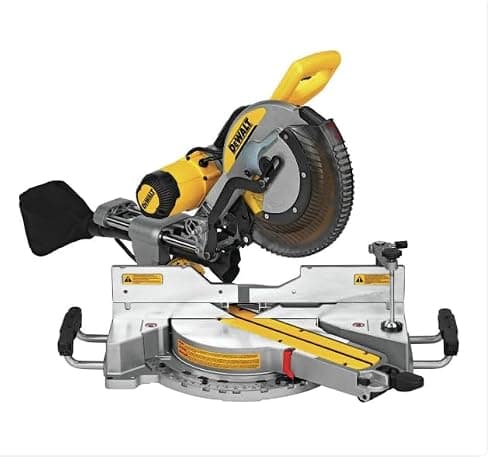
A miter saw is a crosscutting specialist, and the whole buying decision is how wide a board you need to cross. Everything else — slide, blade size, bevel range — is a way of buying capacity. Get the capacity question right and the rest of the specification falls out of it.
Three decisions set the price. Slide or no slide: a non-sliding saw chops straight down, which is simpler, cheaper and holds its alignment better, but limits you to the width the blade can reach. A slider carries the head on rails so it can cross much wider stock. 10-inch or 12-inch blade: bigger blades reach further in a chopping saw, but cost more to replace and can deflect slightly more. Single or dual bevel: a dual-bevel saw tilts both ways, so you cut compound angles without flipping the workpiece — a real convenience on trim, and less critical on furniture.
For a woodworking shop specifically, the priorities are not the same as for a framing crew. You care most about how square and repeatable the cut is, because a table leg cut a degree off shows in the finished piece; you care about how well the saw handles a fine-toothed blade without chipping; and you care about dust, because a miter saw is the worst offender in the shop for throwing chips across the room.
The honest counterpoint is worth stating: a table saw with a crosscut sled does everything a miter saw does, more accurately, and a table saw versus miter saw comparison is a real decision rather than a formality. Where the miter saw wins outright is speed on repetitive crosscuts and on long stock a sled cannot support — trim, framing, and breaking down lumber before it reaches the bench.
How to choose a miter saw
Start with the widest board you actually cut
Measure it. If your work is trim, framing, and stock under about eight inches wide, a 12-inch non-sliding saw covers it for much less money and with one fewer mechanism to knock out of alignment. If you crosscut shelving, wide aprons or glued-up panels, you need a slider and there is no way around it.
Slide mechanisms are not all the same
A conventional rail slider needs clearance behind the saw equal to its slide travel, which in a garage shop usually means the saw cannot sit against a wall. Compact rail and articulating-arm designs solve that by keeping the mechanism inside the saw's footprint. If your bench is against a wall, this is not a detail — it decides where the saw can live.
Accuracy is in the fence and the detents
The specification sheet will not tell you which saws hold a setting. What you can look for is a tall, machined fence in two pieces (so it supports crown and tall stock and slides clear for bevels), positive detents at the common angles with a fine override, and a bevel lock you can reach from the front. Every saw can be squared with a good square and a little patience — the question is whether it stays there.
Blade choice matters more than the saw
The blade in the box is usually a general-purpose one. Fit a fine-toothed crosscut blade — see our saw blade roundup, where the same grind logic applies — and a mid-price saw produces furniture-grade cuts. This is the cheapest upgrade on the page.
Dust, noise and where the saw lives
Miter saws are the worst dust producers in a small shop, because the blade throws waste backwards at speed and the supplied bag catches a fraction of it. The genuinely effective answer is a shop-built enclosure or hood behind the saw connected to a shop vac or collector; the bag alone is not a solution. Plan for it when you decide where the saw goes — our garage layout guide covers the station arrangement.
They are also loud, with a startup surge that will trip a shared circuit if the collector is already running. That is worth checking against your shop's wiring — see workshop power requirements. And wear hearing protection: the peak noise of a miter saw is genuinely damaging over time.
Segmenting by shop and budget
Small garage, occasional use: a 12-inch non-slider on a folding stand. It crosscuts everything a first shop cuts, stores against a wall, and costs half what a slider does.
Hobbyist furniture shop: a 10 or 12-inch dual-bevel slider on a permanent station with wings and a stop block. This is the setup that makes repeat cuts fast and accurate, which is where a miter saw actually earns its floor space.
Trim and installation work: a dual-bevel slider with a laser or shadow line and the lightest weight you can get for the capacity, because it is going in and out of a vehicle.
Tight shop against a wall: pay for the compact rail or glide design. The clearance you save is real floor space.
How we ranked these
Rankings here come from published manufacturer specifications (blade size, motor rating, bevel and miter ranges, slide type, stated crosscut capacities), the makers' manuals, and the pattern in owner feedback read at volume. We have not measured cut squareness or detent repeatability — we do not run a lab, as our methodology page says. Prices update live from the price feed.