One line: a track saw brings the saw to the wood on a guide rail, and a table saw brings the wood to the saw across a fixed table. They overlap enough that a small shop rarely needs both on day one. If you mostly break down sheet goods in a tight space, the Makita SP6000J track saw wins; if you rip a lot of narrow solid stock to width, the DeWalt DWE7491RS table saw is faster and more repeatable. So we rank the track saw first for the small, sheet-goods shop, with the table saw right behind it for solid-stock work.
Both saws make straight cuts with a spinning blade; the difference is what moves. A table saw has a blade fixed in a table with a rip fence, and you push the wood past it — which makes repeated narrow rips of solid stock fast and dead-consistent, because the fence sets the width once and every piece matches. A track saw is a plunge circular saw that rides a guide rail you lay on top of the workpiece — which makes long, splinter-free cuts in full sheets of plywood without wrestling a heavy panel across a table or building an outfeed setup.
For a small or shared shop, that second point often decides it. Breaking down a full sheet of plywood on a jobsite table saw by yourself is awkward and needs room on every side; a track saw does the same cut on a pair of sawhorses or the shop floor and stores flat against a wall. But a track saw is slower for the hundredth identical narrow rip, where a table saw fence simply wins. If dust is a worry in a closed garage, both benefit from collection — see our small-shop dust collector guide.
The short answer
#ad · Live prices from the Amazon Product API, as of Sep 19, 2026. Where we have no verified live price, we show none — we would rather leave a gap than print a number that has rotted.
In detail
Best overall track saw
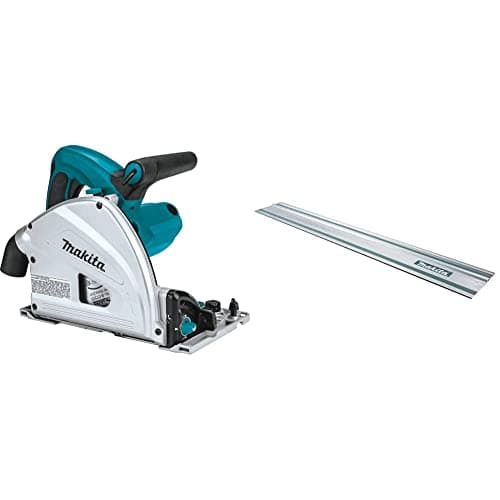
Makita SP6000J Plunge Track Saw
6-1/2 in bladePlunge cut55 in rail incl.12 A
The track saw most small shops buy instead of a table saw. Straight, splinter-free cuts in sheet goods without wrestling a full sheet across a table.
- Cut quality
- 9
- Portability
- 9
- Sheet goods
- 10
- Build
- 8
- Value
- 7
Pros
- +Breaks down full sheets accurately with no outfeed table
- +Near-splinter-free cuts on both faces with the rail
- +Kit includes a guide rail to start cutting immediately
Cons
- −Slower than a table saw for repeated narrow rips
- −Rails and accessories add up
Don't buy this if…
…you mostly rip solid stock to width all day — a table saw is faster and more repeatable for that.
Best overall table saw
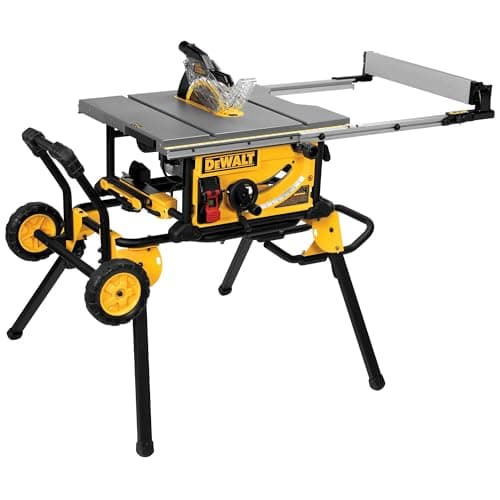
DeWalt DWE7491RS 10-in Jobsite Table Saw
10 in blade32.5 in ripRolling stand15 A
The jobsite table saw home shops keep buying. A big rip capacity, a genuinely good fence and a rolling stand make it the do-everything portable saw.
- Rip capacity
- 9
- Fence
- 9
- Portability
- 8
- Build
- 8
- Value
- 8
Pros
- +Excellent rack-and-pinion fence for a portable saw
- +32-1/2 inch rip handles most sheet-goods cuts
- +Rolling stand makes a heavy saw movable by one person
Cons
- −Loud universal motor, like all jobsite saws
- −Not the dead-flat cast-iron surface of a cabinet saw
Don't buy this if…
…you have a dedicated shop and want the quietest, most precise cut — a contractor or cabinet saw is the long-term answer.
Best value track saw
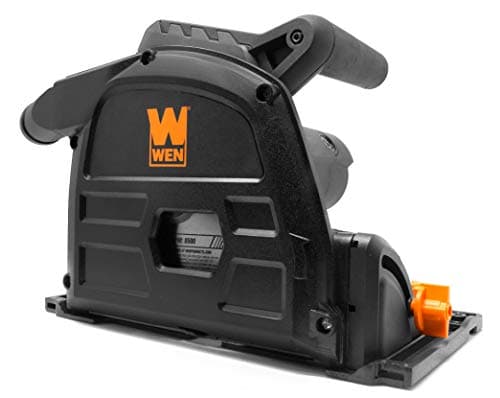
WEN CT1065 Plunge Track Saw
6-1/2 in bladePlunge cut10 ARails included
A budget on-ramp to track-saw cuts. Not as refined as the premium saws, but it delivers the core benefit — straight, clean sheet cuts — for far less.
- Cut quality
- 7
- Portability
- 8
- Sheet goods
- 8
- Build
- 6
- Value
- 9
Pros
- +Gets you accurate guided cuts at an entry price
- +Includes rails to start out of the box
- +Good enough for occasional sheet breakdown
Cons
- −Less refined plunge action and dust collection than premium saws
- −Rail connection and fit aren't as tight as the top brands
Don't buy this if…
…you'll rely on it daily — the Makita's refinement and accuracy are worth the step up for heavy use.
Best value table saw
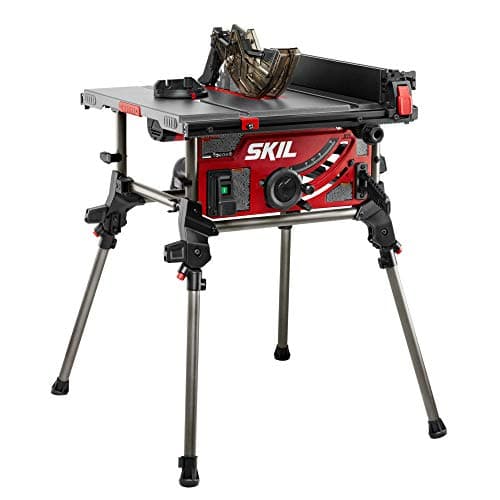
SKIL 10-in Jobsite Table Saw (TS6307)
10 in blade25.5 in ripFoldable stand15 A
The value table saw. A surprisingly capable jobsite saw with a foldable stand at a price that makes it the easy budget pick.
- Rip capacity
- 7
- Fence
- 7
- Portability
- 8
- Build
- 7
- Value
- 9
Pros
- +A lot of saw for the money, including a rolling/folding stand
- +Rip capacity is enough for most furniture-scale work
- +Good first table saw for a garage shop
Cons
- −Fence isn't as refined as the DeWalt's
- −Less rip capacity than the bigger jobsite saws
Don't buy this if…
…you regularly break down full sheets solo — the wider-ripping DeWalt earns its premium there.
Table saw vs track saw: which to buy
The two tools overlap in the middle — both cut a straight line — but they pull apart at the edges of the job. Decide by looking at the material you cut most and the space you have, because those two facts settle it more reliably than any spec sheet.
What each one is best at
A table saw is best at repeated rips of solid stock to an exact width, plus dadoes, tenons and other jig-based joinery — anything where a fixed fence and a flat table pay off over and over. A track saw is best at breaking down full sheets of plywood and MDF into accurate, splinter-free panels safely and by one person, and at long straight cuts on wide boards. Each can limp through the other's work, but neither is happy doing it all day.
Which should you buy first?
For a small shop whose main job is turning sheet goods into cabinets and built-ins, buy the track saw first — the Makita SP6000J gives you clean, straight panel cuts without the floor space or the solo panel-wrestling a table saw demands. If instead you rip a lot of narrow solid lumber to width, buy the table saw first — the DeWalt DWE7491RS and its rack-and-pinion fence repeat a rip faster than any track saw. Most people do not need both on day one; pick the one that matches your work and add the other only when a real job asks for it.
The value options
If budget is tight, the WEN CT1065 delivers the core track-saw benefit — guided, splinter-free sheet cuts — for much less than the premium saws, at the cost of some refinement. The SKIL TS6307 is the value table saw, a capable jobsite unit with a folding stand that rips enough for most furniture-scale work. Both are honest starting points; you can always step up once you know which saw earns its keep in your shop. For where a saw sits among your first purchases, see our essential woodworking tools guide.
How we picked
We do not run a testing lab
We researched published manufacturer specifications, manuals and spec sheets, ran the arithmetic those specs support, and read owner reviews at volume, then scored each tool against a published rubric. The scores are judgments from documented research — they are not measurements we took, because we do not have a lab and we are not going to pretend we do. Where a number came from a manufacturer's document, we name it and link it in Sources.
Questions
Is a track saw better than a table saw for a small shop?+
Often, yes — if your work is mostly breaking down plywood and MDF and space is tight, a track saw gives cleaner sheet cuts than a jobsite table saw and stores flat against a wall. A table saw pulls ahead when you rip a lot of narrow solid stock, because the fence repeats a width instantly. Many small shops start with a track saw and add a table saw later.
Can a track saw replace a table saw?+
For sheet-goods work, largely yes; for repeated narrow rips of solid lumber, not really. A track saw excels at long, straight, splinter-free cuts and portability, but it is slow to set up each identical rip and is not made for narrow pieces or dado work. Whether it replaces a table saw depends entirely on what you build.
Do I need both a table saw and a track saw?+
Most small shops do not, at least not at first. Pick the one that matches your main work — track saw for sheet goods and tight space, table saw for solid-stock ripping and joinery — and add the other only when a real job demands it. Owning both is a convenience, not a requirement.
What is a track saw best for?+
Breaking down full sheets of plywood, MDF and other sheet goods into accurate, splinter-free panels — safely and by one person, without an outfeed table. It is also handy for long straight cuts on wide boards and for trimming doors in place. It is less suited to repeated narrow rips, which is table-saw territory.
Receipts
We do not run a testing lab, and we do not pretend to. Our picks come from published manufacturer specifications and manuals, the arithmetic those specs support, and owner reviews read at volume. Where we could not verify something, we say so on the page rather than quietly leaving it out. Read our full method.