Skip to content
Dovetail & Dust

HUB 02 · Power Tools

Brad Nailer vs Finish Nailer

The two tools look identical and cost about the same. What separates them is the diameter of the nail, and that one number decides both how much the joint holds and how much filling you do afterward.

By Stephen V.Updated How we research
#ad

We earn a commission when you buy through our Amazon links, at no extra cost to you. It never changes our rankings, and we say so when the cheaper tool is the better buy. How this works.

If you are buying one nailer for woodworking, buy an 18-gauge brad nailer. If you are buying a second, make it a 16-gauge finish nailer. A brad is thin enough that the hole disappears under a finish and strong enough to hold parts together while glue cures, which is what a nailer does in furniture work. A finish nailer holds a joint on its own, which is what trim carpentry needs and what cabinetry occasionally needs. The Metabo HPT NT50AE2 is our brad pick, the Metabo HPT NT65M2S the 16-gauge pick, and the NT65MA4 the 15-gauge pick if the work is door casing and baseboard.

The difference is one number

Gauge is wire diameter, and it runs backwards: the bigger the number, the thinner the nail. An 18-gauge brad is thin. A 16-gauge finish nail is thicker. A 15-gauge finish nail is thicker still. Everything else — holding power, hole size, how much splitting you risk in a narrow edge, which compressor you need — follows from that one specification.

“Brad nailer” means 18-gauge in current usage. “Finish nailer” means 15 or 16-gauge. There is also a 23-gauge pin nailer below the brad, which drives a headless pin that holds almost nothing and leaves almost no mark — useful for holding a small molding while glue grabs, useless for anything structural. The three sizes are a continuum of the same trade: holding power on one side, a hole you have to fill on the other.

Which one woodworking actually wants

A furniture maker uses a nailer differently from a trim carpenter. In furniture work the joint is glued, and the nail is a clamp — it holds parts in register for the minutes or hours the glue needs, and contributes little to the finished strength. A glued joint is stronger than the wood around it; the fastener is scaffolding. For that job a brad is ideal, because it holds enough and leaves a hole you can ignore on anything but a show surface.

Trim carpentry is the opposite. A baseboard nailed to a stud has no glue line, so the nail is the joint and it has to resist the board pulling away as the house moves. That takes a 15-gauge nail, and the hole gets filled and painted. The reason the category is confusing is that both tools get sold to both audiences as if the choice were about size rather than about whether there is glue in the joint.

So the honest answer for a woodworker building cabinets, boxes and furniture: an 18-gauge brad nailer covers nearly everything, and the second purchase should be a 16-gauge for face frames, cabinet backs and the occasional piece of trim. A 15-gauge is a trim tool that happens to be sold next to the others. Our brad nailer roundup ranks the 18-gauge field in full.

What each gauge holds, and what hole it leaves

A thicker nail holds more because there is more steel in shear and more friction along the shank. That is why a 15-gauge nail can hold a door casing with no glue and a brad cannot. The cost is proportional: the hole a 15-gauge nail leaves is large enough that it needs filling before any clear finish, and large enough to split a narrow edge if you nail too close to the end.

The brad is the reverse. The hole closes up enough under oil or shellac to be genuinely hard to find, and 18-gauge steel is thin enough to go into a 3/4 in. edge without splitting it most of the time. What it cannot do is hold anything that will be stressed. A brad-nailed butt joint with no glue is a joint waiting to come apart, and nobody should be surprised when it does.

Straight or angled magazine

Brad nailers are almost always straight. Finish nailers come both ways, and the difference is reach rather than performance. A 34-degree angled magazine lets the nose get into an inside corner that a straight magazine cannot reach, because the body of the tool clears the adjacent surface. 15-gauge tools are typically angled, 16-gauge tools come either way.

The trade is that an angled tool is bigger and the nail leaves the nose at an angle you have to allow for when you are placing it precisely. For bench work — where you are usually holding a part with your other hand — a lighter straight tool is easier to aim. For installed trim, angled is worth the bulk. Nails are not interchangeable between them: a 34-degree angled magazine takes angled collated strips, and straight tools take straight ones.

Pneumatic or cordless, and what the compressor costs

A pneumatic nailer is lighter, cheaper and more reliable than a cordless one, and it needs a compressor, a hose and floor space. A cordless nailer costs roughly twice as much, weighs more and removes all three. The honest arithmetic is: if the compressor would exist only to run the nailer, cordless is usually the cheaper and better answer once you price the hose and the space. If you already have air, or want it for other reasons, pneumatic wins on every other axis.

One thing to size correctly if you go pneumatic: a finish nailer uses appreciably more air per shot than a brad nailer does. Metabo HPT publishes 0.045 cu. ft. per cycle at 100 psi for the 15-gauge NT65MA4, which is more than the smallest 1-gallon quiet compressors deliver continuously. Our air compressor roundup covers what each class of compressor can actually feed.

Prices below come from our live price feed and carry the date they were pulled. Picks one and four are 18-gauge brad nailers; picks two, three, five and six are finish nailers, so you can buy either side of the argument from the same ranking.

The short answer

Quick picks

#ProductBest forScorePrice
01
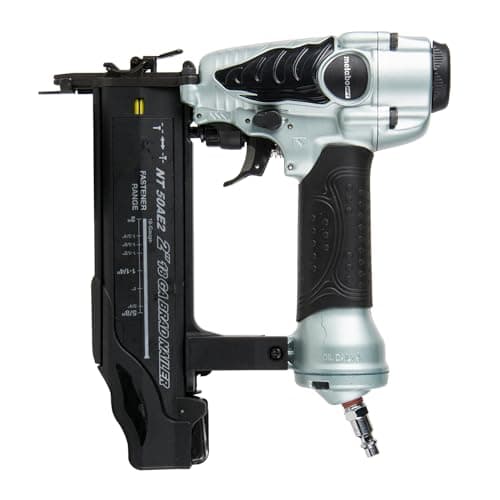
Metabo HPT Metabo HPT NT50AE2 18-Gauge Pneumatic Brad Nailer
Metabo HPT NT50AE2 18-Gauge Pneumatic Brad Nailer

Two and a bit pounds, a hundred brads in the magazine and a five-year warranty. The lightest tool here by a wide margin, which is the spec that matters when your other hand is holding the joint together.

Best overall
8.8
$49.00Amazon
02
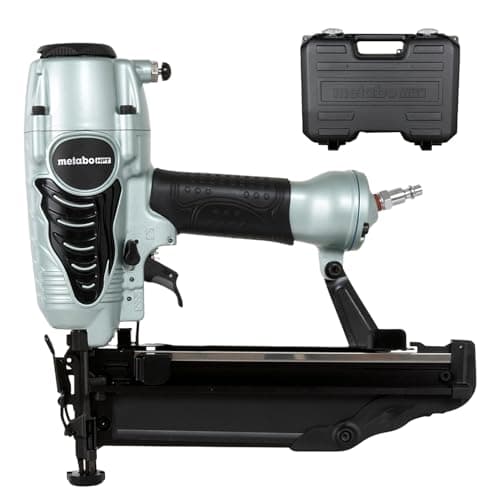
Metabo HPT Metabo HPT NT65M2S 16-Gauge Straight Finish Nailer
Metabo HPT NT65M2S 16-Gauge Straight Finish Nailer

The nailer that sits between a brad gun and a trim gun, and the one most woodworkers should own second. Sixteen gauge holds a face frame; a published 3.7 lb means you can still aim it one-handed.

Best 16-gauge
7.6
$129.00Amazon
03
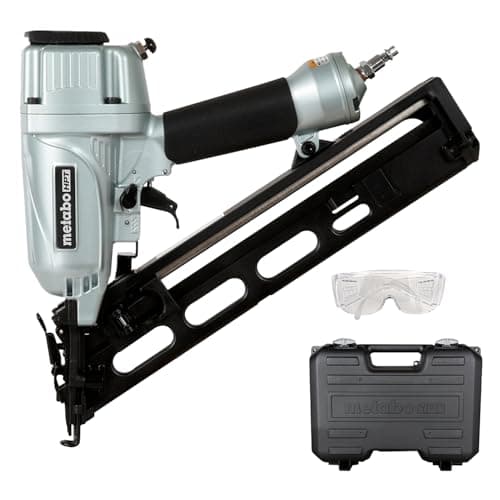
Metabo HPT Metabo HPT NT65MA4 15-Gauge Angled Finish Nailer
Metabo HPT NT65MA4 15-Gauge Angled Finish Nailer

The 15-gauge angled nailer to buy. A 34-degree magazine reaches into a corner no straight nailer can, and the nail is thick enough to hold a door casing on its own.

Best 15-gauge
7.4
$132.00Amazon
04
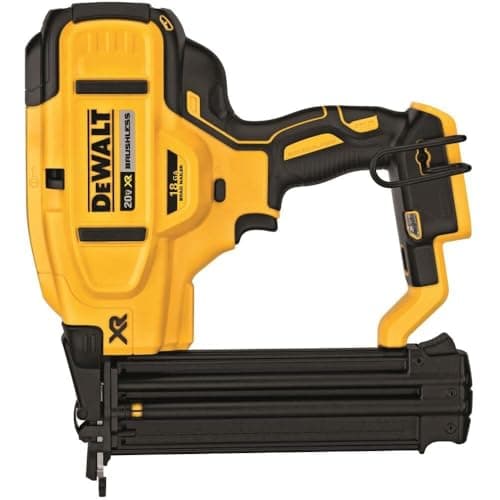
DEWALT DEWALT DCN680B 20V MAX XR 18-Gauge Cordless Brad Nailer (Tool Only)
DEWALT DCN680B 20V MAX XR 18-Gauge Cordless Brad Nailer (Tool Only)

No compressor, no hose, no gas cartridge — you carry the nailer to the work and fire. If the only reason you would own a compressor is to run a brad nailer, this is the tool that makes the compressor unnecessary.

Best cordless
7.6
$301.99Amazon
05
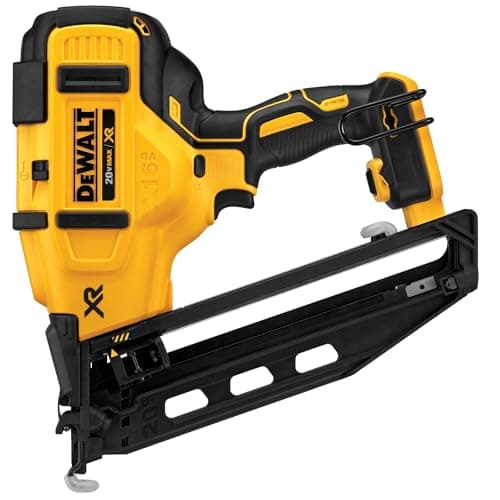
DEWALT DEWALT DCN660B 20V MAX 16-Gauge Angled Finish Nailer (Tool Only)
DEWALT DCN660B 20V MAX 16-Gauge Angled Finish Nailer (Tool Only)

Sixteen gauge, angled magazine, no hose and no compressor. The finish nailer for a shop that does not have an air system and does not want to buy one.

Best cordless
6.8
$349.99Amazon
06
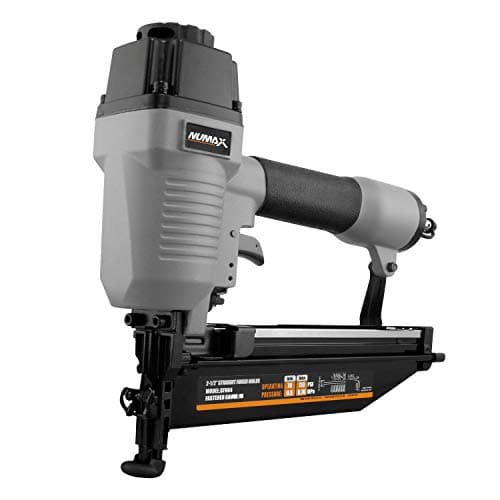
NuMax NuMax SFN64 16-Gauge Straight Finish Nailer
NuMax SFN64 16-Gauge Straight Finish Nailer

A 16-gauge finish nailer for about a third of the Metabo HPT. The right purchase when you are not sure how often you will reach for a finish nailer at all.

Best value
7.4
$59.46Amazon

#ad · Live prices from the Amazon Product API, as of October 18, 2026. Where we have no verified live price, we show none — we would rather leave a gap than print a number that has rotted.

In detail

The picks, in full

01
Metabo HPT Metabo HPT NT50AE2 18-Gauge Pneumatic Brad Nailer

Best overall

Metabo HPT NT50AE2 18-Gauge Pneumatic Brad Nailer

18 ga., 5/8-2 in.100-brad magazine2.2 lb70-120 psi
8.8/10

Two and a bit pounds, a hundred brads in the magazine and a five-year warranty. The lightest tool here by a wide margin, which is the spec that matters when your other hand is holding the joint together.

Nail placement
8
Depth consistency
9
Jam handling
8
Handling
10
Value
9

Pros

  • At a published 2.2 lb it is light enough to aim one-handed while the other hand holds the parts in register
  • Selective actuation switch is on the tool, so you can lock it to sequential firing and leave it there
  • 360-degree adjustable exhaust points the air blast away from the workpiece instead of across it

Cons

  • Rated to 2 in. brads, where the DEWALT and the BOSTITCH both take 2-1/8 in. — a real limit on thicker face frames
  • It is a pneumatic, so the honest price is the nailer plus a compressor, a hose and somewhere to keep both
  • The same selective actuation switch puts bump firing one flick away, and bump firing is the trigger mode OSHA and NIOSH tie to unintended discharges

Don't buy this if…

…you do not own a compressor and do not want one in the shop. A cordless nailer costs more up front and is still the cheaper answer if the compressor would exist only to feed it.

$49.00View on Amazon

$109.0055% off

Price as of October 18, 2026. Prices change — Amazon's is the one that counts.

#ad · we may earn a commission from this link to Metabo HPT NT50AE2 18-Gauge Pneumatic Brad Nailer

02
Metabo HPT Metabo HPT NT65M2S 16-Gauge Straight Finish Nailer

Best 16-gauge

Metabo HPT NT65M2S 16-Gauge Straight Finish Nailer

16 ga., 1 to 2-1/2 in.Straight magazine3.7 lb publishedPneumatic
7.6/10

The nailer that sits between a brad gun and a trim gun, and the one most woodworkers should own second. Sixteen gauge holds a face frame; a published 3.7 lb means you can still aim it one-handed.

Holding power
8
Hole size
6
Reach
6
Handling
9
Value
9

Pros

  • 16-gauge is the smallest nail that holds a joint without glue, which is the whole argument for owning a finish nailer at all
  • At a published 3.7 lb it is half a pound lighter than the 15-gauge angled tool and noticeably easier to place accurately
  • A straight magazine drops the nail where the nose sits, with none of the angled tool's offset to allow for

Cons

  • A straight magazine cannot reach an inside corner the way a 34-degree angled one can — the trade you make for the lighter tool
  • Metabo HPT does not publish operating pressure or air consumption for this exact model, so compressor sizing has to be inferred from the 15-gauge sibling
  • Pneumatic, so the real cost is this plus a compressor and a hose

Don't buy this if…

…you are nailing door casing and baseboard for a living. Those are 15-gauge jobs, and the angled magazine you are giving up is what makes them possible.

$129.00View on Amazon

$179.0028% off

Price as of October 18, 2026. Prices change — Amazon's is the one that counts.

#ad · we may earn a commission from this link to Metabo HPT NT65M2S 16-Gauge Straight Finish Nailer

03
Metabo HPT Metabo HPT NT65MA4 15-Gauge Angled Finish Nailer

Best 15-gauge

Metabo HPT NT65MA4 15-Gauge Angled Finish Nailer

15 ga., 1-1/4 to 2-1/2 in.34-degree magazine100-nail capacity70-120 psi, 4.2 lb
7.4/10

The 15-gauge angled nailer to buy. A 34-degree magazine reaches into a corner no straight nailer can, and the nail is thick enough to hold a door casing on its own.

Holding power
10
Hole size
4
Reach
9
Handling
6
Value
8

Pros

  • The angled magazine is the reason 15-gauge exists: it gets the nose into an inside corner where a straight tool fouls on the adjacent wall
  • A 15-gauge nail is appreciably thicker than a 16 and far thicker than an 18, so it holds structural trim without glue
  • Selective actuation on the tool, so you can lock it to sequential firing and leave it locked

Cons

  • A 15-gauge hole needs filling on anything that gets a clear finish — it is too big to disappear under a coat of oil
  • Published air consumption of 0.045 cu. ft. per cycle at 100 psi is roughly double a brad nailer's, so the small quiet compressors cannot keep up
  • 4.2 lb published and a bulky angled magazine; this is a trim tool, not a hold-the-joint-together tool

Don't buy this if…

…your work is cabinetry and small furniture rather than door casing and baseboard. Inside a cabinet a 15-gauge nail is more hole than you need and more hole than you want to fill.

$132.00View on Amazon

$189.0030% off

Price as of October 18, 2026. Prices change — Amazon's is the one that counts.

#ad · we may earn a commission from this link to Metabo HPT NT65MA4 15-Gauge Angled Finish Nailer

04
DEWALT DEWALT DCN680B 20V MAX XR 18-Gauge Cordless Brad Nailer (Tool Only)

Best cordless

DEWALT DCN680B 20V MAX XR 18-Gauge Cordless Brad Nailer (Tool Only)

18 ga., 5/8-2-1/8 in.20V MAX brushlessTool only, no batterySequential or contact trigger
7.6/10

No compressor, no hose, no gas cartridge — you carry the nailer to the work and fire. If the only reason you would own a compressor is to run a brad nailer, this is the tool that makes the compressor unnecessary.

Nail placement
9
Depth consistency
8
Jam handling
9
Handling
6
Value
6

Pros

  • Nothing to drag: no hose to catch on a bench leg, nothing to bleed down, no compressor cycling in a shared garage
  • Tool-free depth adjustment, tool-free jam release and a stall release lever for resetting the driver blade
  • Low nail lockout stops it dry-firing, which is how the nose usually ends up denting the last piece of a project

Cons

  • Sold as a bare tool — budget a 20V MAX battery and charger on top unless you already run the platform
  • By far the heaviest tool on this page once a battery is on it; DEWALT does not publish a weight, and retailer listings put it around 5.3 lb
  • Costs a multiple of a comparable pneumatic before the battery, which is the price of losing the hose

Don't buy this if…

…you already have a compressor running for other tools. The hose is the only problem this solves, and you are paying a lot to solve it.

$301.99View on Amazon

Price as of October 18, 2026. Prices change — Amazon's is the one that counts.

#ad · we may earn a commission from this link to DEWALT DCN680B 20V MAX XR 18-Gauge Cordless Brad Nailer (Tool Only)

05
DEWALT DEWALT DCN660B 20V MAX 16-Gauge Angled Finish Nailer (Tool Only)

Best cordless

DEWALT DCN660B 20V MAX 16-Gauge Angled Finish Nailer (Tool Only)

16 ga., 1-1/4 to 2-1/2 in.Angled magazine20V MAXTool only
6.8/10

Sixteen gauge, angled magazine, no hose and no compressor. The finish nailer for a shop that does not have an air system and does not want to buy one.

Holding power
8
Hole size
6
Reach
9
Handling
6
Value
5

Pros

  • Removes the compressor from the equation entirely, which is a larger saving than the tool price suggests once a hose, fittings and floor space are counted
  • An angled 16-gauge magazine gets the reach of a trim nailer with the smaller hole of a 16
  • No hose to drag across a finished panel, and nothing cycling in a shared garage while you work

Cons

  • Bare tool: a 20V MAX battery and charger are extra, and the real price is well over twice a comparable pneumatic
  • DEWALT does not publish a weight, a magazine capacity or a collation angle for this model on its own product page
  • Cordless nailers are front-heavy with a battery fitted, which you feel on overhead and awkward-angle work

Don't buy this if…

…you already own a compressor for other reasons. The hose is the only problem this solves and you are paying a great deal to solve it.

$349.99View on Amazon

$369.995% off

Price as of October 18, 2026. Prices change — Amazon's is the one that counts.

#ad · we may earn a commission from this link to DEWALT DCN660B 20V MAX 16-Gauge Angled Finish Nailer (Tool Only)

06
NuMax NuMax SFN64 16-Gauge Straight Finish Nailer

Best value

NuMax SFN64 16-Gauge Straight Finish Nailer

16 ga., 1 to 2-1/2 in.100-nail magazine115 max psiDie-cast aluminum
7.4/10

A 16-gauge finish nailer for about a third of the Metabo HPT. The right purchase when you are not sure how often you will reach for a finish nailer at all.

Holding power
8
Hole size
6
Reach
6
Handling
7
Value
10

Pros

  • Cheap enough that owning both a brad nailer and a finish nailer stops being a real decision
  • Takes the same 1 in. to 2-1/2 in. 16-gauge straight nails as the Metabo HPT, which are stocked everywhere
  • Tool-free depth adjustment and a 100-nail magazine at this price are both better than the category average

Cons

  • NuMax publishes no weight and no minimum operating pressure, so the two specs that most affect how it handles and what compressor it needs are unlisted
  • Retailer listings disagree on the nail range — some say 3/4 in. to 2-1/2 in., others 1 in. to 2-1/2 in.
  • Budget nailers are where jam-clearing design is cut; expect to open the nose more often than on the Metabo HPT

Don't buy this if…

…the nailer will be in your hand every week. The Metabo HPT costs twice as much and is the tool you will still be using in ten years.

$59.46View on Amazon

Price as of October 18, 2026. Prices change — Amazon's is the one that counts.

#ad · we may earn a commission from this link to NuMax SFN64 16-Gauge Straight Finish Nailer

Brad against finish, side by side

Published specifications for the three gauges, from the manufacturers' own listings for the tools ranked above.

18-gauge brad16-gauge finish15-gauge finish
Typical nail range5/8–2-1/8 in.1–2-1/2 in.1-1/4–2-1/2 in.
Holding powerLowest — a clamp, not a jointHolds a glued joint on its ownHolds an unglued joint
Hole to fillOften none under a finishSmall, fills easilyNeeds filling before clear finish
MagazineStraightStraight or 34° angledUsually 34° angled
Split risk in a narrow edgeLowModerateHigh
Air per shotNot published; materially less than a 15-gaugeNot published for the NT65M2S0.045 cu. ft./cycle at 100 psi

Which tool for which job

JobGaugeWhy
Holding a glued miter while it cures18The glue is the joint; the nail only has to stop it sliding
Cabinet back into a rabbet18Thin stock, no load, and the hole is never seen
Face frame to a carcase16Needs to resist being pulled off while the glue sets
Shoe molding and small trim18 or 1616 if it has to stay put without glue, 18 if it is glued
Door casing, baseboard, crown15No glue line, real movement, needs the thickest nail
Small molding you cannot clamp23 pinInvisible, holds nothing — a third hand, not a fastener

Nails are not an afterthought

Collation is where people get caught. An angled magazine takes angled strips at the magazine angle; a straight magazine takes straight strips. Buying the wrong box is a common and annoying mistake, and the strips are not convertible. Check the angle printed on the tool before ordering nails, and buy the gauge and the collation together.

Length matters more than it looks. The working rule for a nailer is that at least two-thirds of the nail should be in the part you are fastening to, which for 3/4 in. stock into 3/4 in. stock means something in the 1-1/4 in. to 1-1/2 in. range. Longer is not better: a nail driven near the end of a board is more likely to split it, and a nail that is too long for the joint finds its way out the other face.

Safety: the trigger mode is the decision

Both tool types usually offer two actuation modes. Sequential requires the nose to be pressed and then the trigger pulled, one nail per pull. Contact (or bump) firing drives a nail every time the nose touches something while the trigger is held. Contact firing is faster across a floor and it is the mode tied to unintended discharges — OSHA and NIOSH both single it out.

For bench woodworking there is no reason to use it. You are not nailing hundreds of feet of sheathing, your other hand is frequently within a few inches of the nose, and the time saved is nothing. Set the tool to sequential and leave it there. Keep the spare hand well back from the nose regardless, because a brad hitting hard grain can deflect and come out the side of a board.

Where a nailer is the wrong tool

A nailer does not replace a joint. If a cabinet needs to carry weight, it needs joinery: a dado, a pocket screw, a dowel or a mortise and tenon. Nails hold parts while glue cures and hold trim that carries no load, and a carcase assembled with brads and no glue will rack itself apart.

For load-bearing assembly our pocket hole jig roundup covers the fastest strong option, wood joint types explained covers what each joint is actually for, and how long to clamp wood glue covers the timings that decide whether you need the nail as a clamp at all.

Where these numbers come from

Nail ranges, magazine angles, weights, operating pressures and air consumption above are the manufacturers' published specifications, taken from the maker's own product page where it publishes one — dewalt.com for the DCN660B, Metabo HPT's published figures for the NT65MA4 — and from the live retail listing otherwise, cited per product in Sources. Where a maker publishes nothing, we say so: DEWALT lists no weight, magazine capacity or collation angle for the DCN660B, NuMax lists no weight or minimum pressure for the SFN64, and Metabo HPT publishes no air consumption for the NT65M2S. Holding power is a mechanical consequence of nail diameter, not a figure we have measured — we do not run a lab, and our methodology page says so plainly.
How we picked

We do not run a testing lab

We researched published manufacturer specifications, manuals and spec sheets, ran the arithmetic those specs support, and read owner reviews at volume, then scored each tool against a published rubric. The scores are judgments from documented research — they are not measurements we took, because we do not have a lab and we are not going to pretend we do. Where a number came from a manufacturer's document, we name it and link it in Sources.

Questions

Frequently asked

Should I buy a brad nailer or a finish nailer first?
A brad nailer, if the work is furniture, boxes and cabinets. In glued-up work the nail is a clamp rather than a joint, and 18-gauge holds plenty while leaving a hole you can ignore. If the work is installed trim with no glue line, start with a 15 or 16-gauge finish nailer instead.
Can a brad nailer be used for trim?
For small, light trim that is also glued, yes. For baseboard, door casing and crown molding, no — those carry real movement with no glue line and need a 15-gauge nail. The brad will hold them for a while and then it will not.
What is the difference between 15 and 16-gauge finish nailers?
A 15-gauge nail is thicker, so it holds more and leaves a bigger hole; 15-gauge tools are usually angled, which reaches into inside corners a straight tool cannot. 16-gauge is the better choice for cabinetry and furniture, 15-gauge for installed trim.
Do I need a compressor for a nailer?
Only for a pneumatic one. If the compressor would exist purely to run the nailer, a cordless tool is often cheaper overall once you count the hose, fittings and floor space. If you want air anyway, pneumatic tools are lighter, cheaper and more reliable.
Will an 18-gauge brad split 3/4 inch stock?
Rarely in the face, occasionally near an end or in dense hardwood. The thinner the nail the lower the risk, which is one of the real advantages of 18-gauge. Stay at least a nail length back from the end of a board, and in difficult grain drill a pilot or switch to a 23-gauge pin.
Are brad nails strong enough to hold a cabinet together?
With glue, yes — the glue is doing the work and the brads hold registration while it cures. Without glue, no. A brad-nailed carcase with dry joints will rack and come apart; that is a joinery problem and needs a joint, not a longer nail.

Keep reading

Receipts

Sources

We do not run a testing lab, and we do not pretend to. Our picks come from published manufacturer specifications and manuals, the arithmetic those specs support, and owner reviews read at volume. Where we could not verify something, we say so on the page rather than quietly leaving it out. Read our full method.