Give up on collecting lathe shavings and put every dollar into collecting lathe sanding dust. Shavings are a housekeeping problem you can sweep. Sanding at the lathe produces fine airborne dust at close range, straight into your face, and that is a health problem you cannot sweep.
That is a genuinely different answer from every other machine on this site, and it comes from how a lathe works. On a table saw or a planer, the waste leaves the cutter in a predictable direction into an enclosure. On a lathe the workpiece spins and the tool moves along it, so the ejection point travels the length of the bed and the ejection direction changes with every cut and every tool angle. There is no fixed place to put a port.
Why the shavings are not worth chasing
Roughing and gouge work throws long shavings and ribbons. They are heavy, they fall quickly, and they would clog a collector's inlet faster than almost anything else in the shop even if you could catch them. Turners who try to collect them generally end up with a hose that blocks and a floor that still needs sweeping.
There is a second reason to let them go: they are large. Large particles are the ones your nose and throat filter out. They make a mess, not a hazard. The particles that reach deep into the lungs are the ones you cannot see, and at the lathe those come almost entirely from abrasives, not from gouges. The mechanism is set out in wood dust health risks.
The sanding stage is the whole problem
Sanding a spinning workpiece is close to a worst case. The piece is turning at speed, the abrasive is generating fine dust continuously, your hands and therefore your face are within a foot or two of it, and the rotation flings the dust outward in a plane. A turner sanding a bowl without collection is standing in a cloud of exactly the fraction that matters.
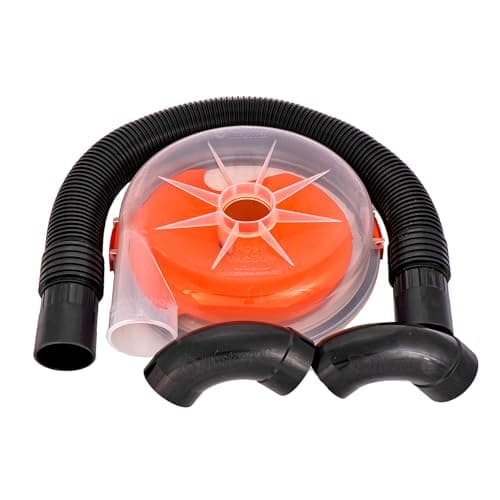
This is where a movable hood earns its keep. A large-mouth hood on an articulated arm or a flexible stand, positioned behindthe workpiece so the rotation throws dust into it, catches a meaningful share — and unlike a fixed port it can be repositioned for every piece, which is the only way to track a moving source. The important detail is mouth size and proximity: capture velocity falls off very quickly with distance, so a big hood two inches away beats a small one a foot away by a wide margin.
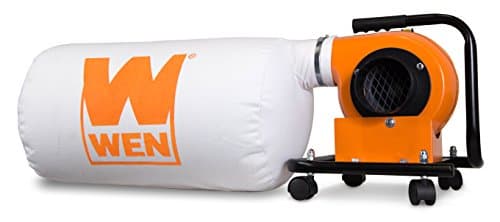
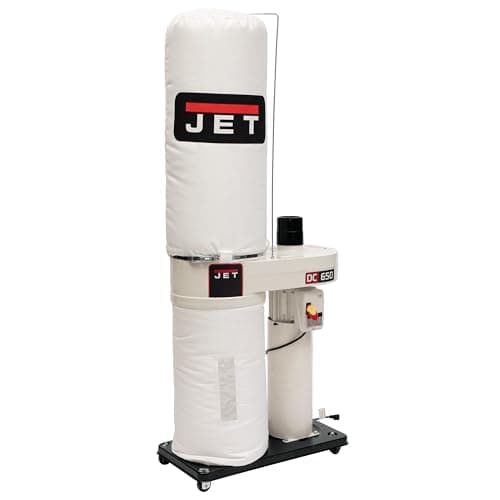
Run that hood on a dust collectorrather than a vac. A wide hood is a large opening, and a large opening needs volume, not suction. A 4-inch line to the hood carries about 349 CFM at the velocity chips need — the arithmetic is in our CFM and duct chart — and going to 5 or 6-inch more than doubles that if your collector can pull it.
What a shop vac is actually good for at the lathe
Not the hood. A vac at the end of a wide hood is moving almost no air across the mouth, because a vac trades volume for pressure. Where a vac genuinely helps at a lathe is a narrow nozzle held close to a specific operation — power sanding with an angle drill, or cleaning the piece and the bed between stages. Small opening, close range: that is a vac's strength.
The two things every turner should have regardless
- A respirator or powered face shield. At the lathe you are inside the dust cloud rather than downwind of it, and no hood catches everything from a moving source. This is the machine where respiratory protection is least optional of anywhere in the shop.
- Ambient air filtration. Whatever the hood misses stays airborne for hours. An air filtration unit running during the session and for a good while afterwards is the only thing that removes it, and the fine fraction is exactly what these units are rated for.
Some turned species make this more pressing than others. Exotic hardwoods in particular have well-documented sensitizing and irritant effects, and turners get a heavier exposure than most woodworkers because of the sanding.
A note on bowl work versus spindle work
Spindle turning between centers keeps the work in one place along the bed and the dust in a fairly consistent plane, so a hood positioned once can cover a whole session. Bowl and faceplate work is harder: the piece is larger in diameter, the tool rest moves around it, and the dust plane changes as you work across the face. Expect to reposition the hood several times per bowl, and accept that capture will be worse than on spindle work no matter what you do.
What we could not verify
We found no published CFM requirement for a wood lathe from a source we were willing to cite, which is why our CFM chart has no row for one. We have not measured capture rates for any hood at any distance. The duct-carrying figures quoted are arithmetic from published transport velocities, shown as such on that page. The rest of this guide describes how the machine and the airflow behave, and it is reasoning, not measurement.