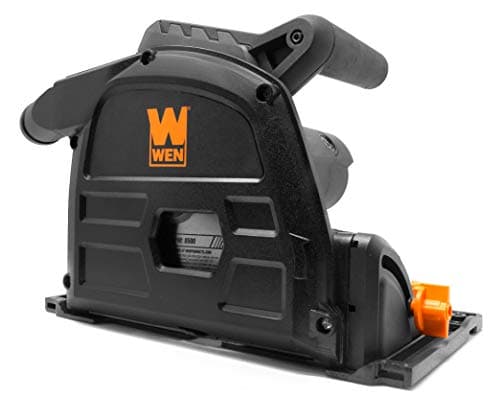
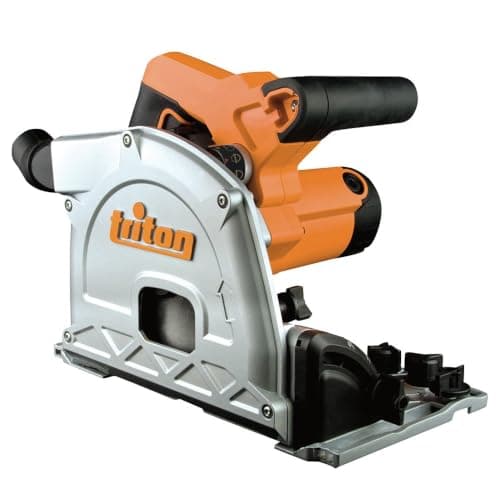
For cutting plywood, buy a plunge track saw, and the one to buy is the Triton TTS1400. It is for anyone who breaks down sheets alone in a one-car shop or a driveway: Triton publishes a 1,400 W motor on a 6-1/2 in. blade, the plunge action and depth stop behave properly on sheet goods, and it takes common 165 mm blades so consumables stay cheap. The budget pick is the WEN CT1065— the cheapest saw on this page and the only one that includes rails in the box, which matters because on the Triton the rails are a separate purchase.
If you already own a table saw with a decent fence and an outfeed, you do not need either — skip to the table saw section. Prices beside each pick come from our live price layer rather than from this article, last checked November 23, 2026.
The problem is not the cut. It is the sheet.
A 4 x 8 ft sheet of 3/4 in. plywood weighs somewhere around 60 lb and is almost exactly the most awkward object a one-person shop handles. Every honest discussion of cutting plywood starts there, because the accuracy of the cut is mostly decided by whether you can control the sheet while you make it.
That leads to a rule that sounds like a cliche and is not: break the sheet down where it lies, then take the parts to the machine. Lay the sheet on a sacrificial sheet of rigid foam insulation on the floor, or on a sawhorse-and-batten grid, set the saw depth to just clear the plywood, and cut it into pieces you can lift. Then the table saw does the accurate final cuts on parts it can actually handle.
Everything below is a way of doing that first step.
Route one: a track saw, which is a circular saw that cannot wander
A track saw is a plunge-action circular saw that rides in a slot on an aluminum rail. The rail has a rubber splinter guard along its edge that the blade trims flush the first time you use it, so the rail edge sits exactly on the cut line — you align the rail to your marks and the cut goes there, with no offset arithmetic. Because the blade plunges down through the work rather than being pushed into it, the saw starts the cut in the middle of a sheet as easily as at the end.
The Triton TTS1400 is the sensible middle of that market: a published 1,400 W, which is at the top of the class for the money, with a proper depth stop and a plunge action that does not bind. Fit and finish is a clear step below the German saws, and the rails are extra. Budget for them before you compare prices with anything else on this page.
The WEN CT1065is the on-ramp: a 10 A, 6-1/2 in. plunge saw with rails included, at roughly a third of the Triton. The plunge action and the dust collection are less refined and the rail connection is not as tight, but it delivers the thing you are buying — a straight, clean sheet cut — and for four sheets a year that is the correct purchase. Our track saw roundup ranks the premium end of this field, including what the Festool money actually buys.
Route two: a circular saw and a straightedge, which costs a fifth as much
This is how plywood was cut for fifty years before track saws existed, and it still works. A full-size circular saw running against a clamped straightedge produces a cut as straight as the straightedge, and the only real differences from a track saw are that you have to measure the offset from the blade to the shoe edge, the splinter guard is not there, and the dust goes everywhere.
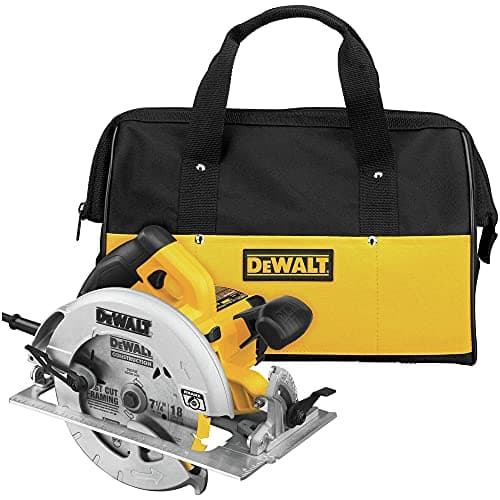
The DEWALT DWE575SB is the saw for the job: one of the lightest full-size circular saws made, with an electric brake that stops the blade in a fraction of the coast-down time. Light matters here, because fatigue is what makes a hand-guided cut wander, and the brake matters because you are making a lot of short cuts on a floor-level sheet.
Two things make this route much better for almost no money. First, fit a high-tooth-count blade — the geometry in best table saw blade for plywood applies identically to a circular saw. Second, remember that a handheld saw exits through the top face, which is the opposite of a table saw, so the sheet is cut good-face-down. Getting that backwards is the single most common reason a careful cut still chips.
Our circular saw roundup ranks this field properly, and circular saws under $200 is where most of it sits.
Route three: the table saw, if the sheet can get to it
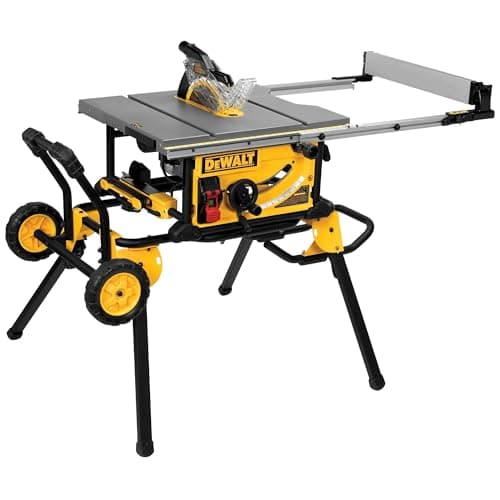
A table saw makes the most accurate and most repeatable cut of anything here, because the fence does not depend on your hands. The DEWALT DWE7491RS is the jobsite saw home shops keep buying for exactly that reason: a rack-and-pinion fence that is genuinely good for a portable saw, 32-1/2 in. of rip capacity, and a rolling stand that lets one person move it.
The catch is the one in the first section. Pushing a full sheet across a benchtop saw, alone, is unsafe and inaccurate, and 32-1/2 in. of rip capacity does not change the fact that the other 60 lb of the sheet is cantilevered off the back of a small table. With an outfeed table and a second pair of hands it is the best tool on this page. Without either, break the sheet down first and then use it — table saw vs track saw works through that trade in detail, and table saw vs circular saw covers the cheaper version of the same decision.
Route four: the jigsaw, for the cuts nothing else makes
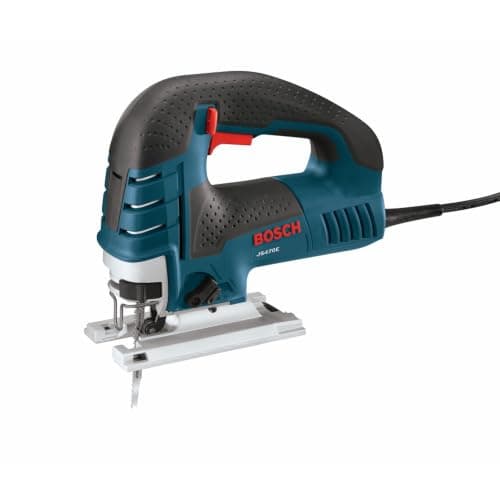
The Bosch JS470E is not a sheet-breakdown tool and it is on this page because plywood work always eventually needs a cutout: a sink opening, a cable hole, a rounded corner on a plywood case. Bosch publishes a 7.0 A motor at 3,100 strokes per minute with a 45-degree bevel and variable speed, and the power headroom is why it does not bog in 3/4 in. material where cheaper jigsaws stall and wander.
For plywood, use a downcut blade in a jigsaw. A standard jigsaw blade cuts on the upstroke, which tears the top face — the face you are looking at. A reverse-tooth blade cuts on the downstroke and leaves the top clean, at the cost of a rougher underside and a saw that wants to lift off the work. Our jigsaw roundup covers that field.
Side by side, as published
| Saw | Published motor | Blade | Guided? | Best for |
|---|
| Triton TTS1400 | 1,400 W | 6-1/2 in. (165 mm) | Yes, rails sold separately | Breaking sheets down alone |
| WEN CT1065 | 10 A | 6-1/2 in. | Yes, rails included | Occasional sheet work |
| DEWALT DWE575SB | Corded; amperage not published | 7-1/4 in. | No — needs a straightedge | Cheapest straight cut |
| DEWALT DWE7491RS | 15 A | 10 in. | Fence, 32-1/2 in. rip | Accurate final cuts |
| Bosch JS470E | 7.0 A, 3,100 SPM | Jigsaw blade | No | Cutouts and curves |
Every figure above is the manufacturer's own published number for the exact model we link. DEWALT rates the DWE575SB with an electric brake and a 57-degree bevel but publishes no amperage for it, so the table says so rather than converting one figure into another. We did not cut a test sheet, measure a kerf or time a breakdown — there is no lab here, which the methodology page states plainly.
What to buy, in order
A shop that breaks down sheets more than a few times a year and does it alone: the Triton TTS1400 plus rails. The same job four times a year, or a first guided saw: the WEN CT1065. The cheapest competent answer, where the money goes into a good blade and a clamped straightedge instead of a rail system: the DEWALT DWE575SB. The accurate final cuts on parts you can lift: the DEWALT DWE7491RS. The cutouts: the Bosch JS470E.
Two more things that cost almost nothing and matter more than the saw. Put a sheet of rigid foam insulation under the plywood and set the blade to cut about a millimetre into it — the sheet is supported across its whole area, nothing drops, and the cut is backed the entire length. And fit the right blade: a 24-tooth framing blade in a circular saw will chip plywood no matter which saw is holding it.
Sheet goods also make the finest dust in the shop, because the glue line is part of what you are cutting. If you are cutting plywood indoors, a respirator is not optional, and wood dust health risks sets out why, sourced to IARC, OSHA and NIOSH rather than to us.