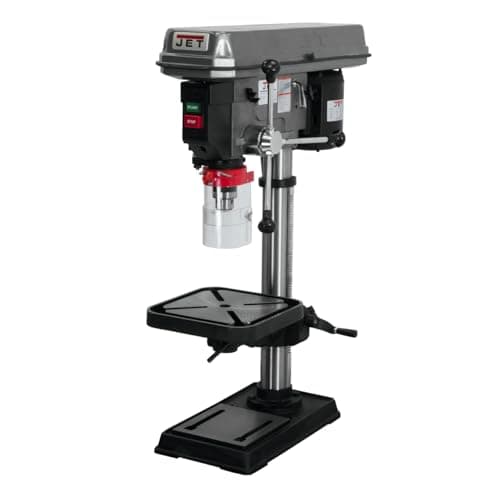
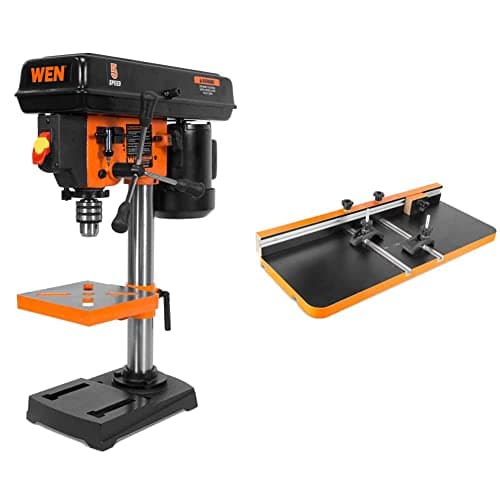
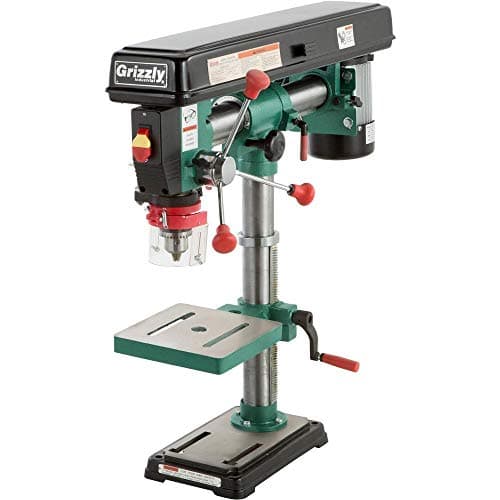
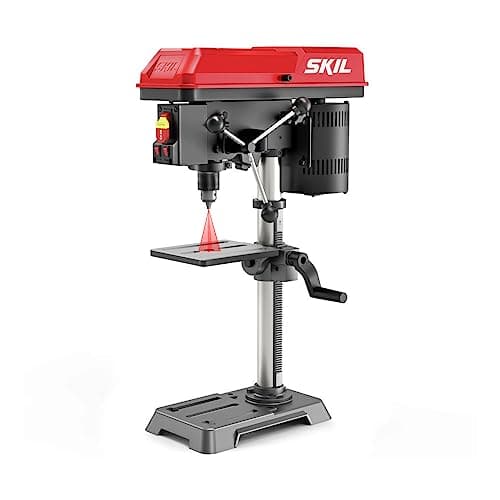
A drill press is not a more powerful drill. It is a machine that guarantees the hole is square to the surface, at a repeatable depth, in the same place every time. That is the entire value proposition, and it is why shelf pins line up, dowel joints close, and chair legs sit at the angle you intended. It is also the machine that makes a large Forstner bit usable, because those bits need a slow spindle and a square quill more than they need power.
The specification that decides what you can do is swing— twice the distance from the chuck center to the column. A 10-inch drill press reaches five inches in from the edge of a board. That sounds small until you try to bore the middle of a cabinet side, at which point it is the only number that matters. Buy more swing than you think you need; it is the specification people regret most.
The second is speed range. Wood wants slower speeds than most people run, especially with large forstner bits and hole saws, where too much speed burns the edge of the hole and the bit. A machine with a wide, easily changed range is genuinely more useful than one with more horsepower, because in woodworking you are rarely power-limited — you are heat-limited.
The third is quill travel: how far the chuck can descend in one stroke. Short travel means repositioning mid-hole on deep work, which is where accuracy is lost. And the fourth is not on the spec sheet at all: the cast table on almost every drill press is too small and has a hole in the middle. A shop-made plywood auxiliary table with a fence and a sacrificial insert is the upgrade that turns a metalworking machine into a woodworking one, and it costs an afternoon.
How to choose a drill press for wood
Swing: measure your widest workpiece
Halve the widest board you will need to bore into the middle of, and that is the minimum reach you need from column to chuck. Eight and 10-inch machines are fine for edge boring, shelf pins and small parts. Thirteen to 15 inches starts covering real casework. If you need to reach the middle of a wide panel, a radial-arm design is the only benchtop answer.
Speed range beats horsepower
Large-diameter bits need low RPM. A big forstner bit run at drill-press speeds intended for twist drills will scorch the wood and blue the bit's rim. Look for a machine whose lowest speed is genuinely low and whose speed changes are easy enough that you will actually make them — a stepped-pulley machine with an awkward cover gets left on one speed, which defeats the point.
Quill travel and the depth stop
Quill travel determines how deep you can go in one stroke; the depth stop determines whether every hole is the same depth. For dowel joinery and shelf pins the depth stop is used more than anything else on the machine, so a positive, easily set stop is worth more than an extra half inch of travel.
The table is your problem to solve
Every drill press in this price range ships with a small cast table. Build an auxiliary table: a plywood or MDF top, a fence, a replaceable insert under the bit, and hold-downs. It stops blow-out on the underside, gives you a fence to register against for repeat holes, and turns the machine into something you can use one-handed. It is the single best thing you can do to a drill press and it costs the price of an offcut.
What a drill press does in a wood shop
Beyond drilling straight holes: shelf-pin rows with a fence and a stop, dowel joinery when you do not own a doweling jig, forstner-bored mortises roughed out before chisel work (see our mortise and tenon guide), angled holes for chair legs with the table tilted, and — on the machines that oscillate — spindle sanding of curves.
Two things it does not do well. It is not a mortiser unless you fit a mortising attachment, and those attachments ask more of a light machine's quill and column than they were designed for. And it is not a metalworking machine at wood speeds — if you plan to drill steel, check the low end of the speed range carefully.
Segmenting by shop and budget
First shop, small budget: an 8 or 10-inch benchtop machine plus a shop-made table. It handles shelf pins, dowels and small parts, which is most of what a first shop drills.
Hobbyist shop: a 13 to 15-inch machine with a wide speed range. This is the one that stops being the limiting factor, and the extra swing pays for itself the first time you bore a cabinet side.
Small shop, no floor space: consider a combination drill press and spindle sander — two machines on one bench footprint, and the sanding function is genuinely useful if you cut curves.
Wide panels: a radial-arm benchtop press. It trades some rigidity for reach that nothing else on a bench can match.
How we ranked these
From published manufacturer specifications — swing, motor rating, speed count and range, quill travel, table size — plus manuals and the consistent pattern in owner feedback read at volume. We have not measured runout or table flatness; we do not run a lab, and our methodology page is explicit about that. Prices are live from the price feed.