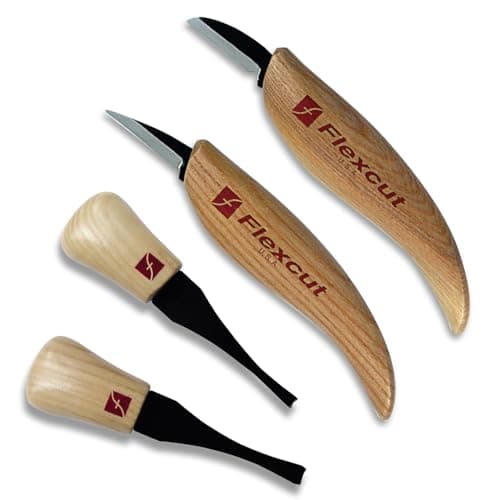
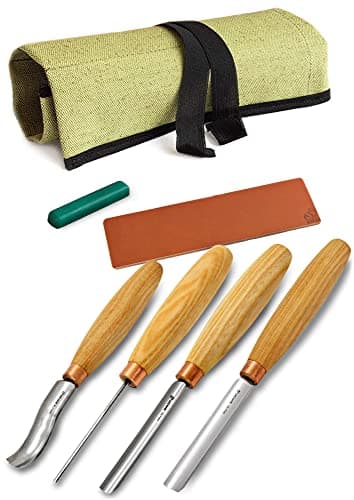
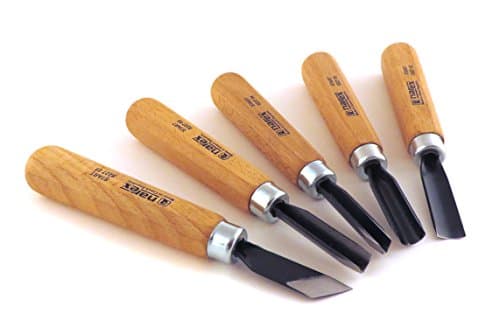
Buy the Narex 869200 five-piece starter set if you want to carve, or the Flexcut KN600 if what you actually want to do is whittle. Those are two different hobbies that use two different tools, and picking the wrong one is the most common and most expensive mistake in this category. The Narex set gives you the five profiles that cover relief and detail work; the Flexcut set gives you two knives and two palm tools, made in the USA, sharp enough to use the minute you open the box.
Which kind of carving, before which brand
"Wood carving tools" covers four jobs that barely overlap, and the tools are not interchangeable between them.
Whittling is done with knives, in your hands, usually in basswood, usually sitting down. The tools are a general-purpose cutting knife and a detail knife, and almost nothing else. Relief carving cuts a design into the face of a panel using gouges and a V tool, driven by hand pressure or a mallet. Spoon and bowl carvinghollows a curve, which needs a bent or spoon gouge that can reach inside the hollow without the handle fouling the rim — a straight gouge physically cannot do this. Lettering lives almost entirely on a V tool and a skew.
That is why this page ranks a knife set, three gouge sets at three price points, a palm set and a spoon-carving kit rather than six versions of the same thing. Decide which of the four you are doing first; the ranking after that is straightforward.
Sweep numbers, in one section
Carving tools are specified by a sweep number and a width — "a 7 mm No. 8". The sweep is how deep the curve of the cutting edge is, on a scale that is near-standard across Swiss and Sheffield makers: No. 1 is a flat chisel, No. 2 and No. 3 are very shallow, No. 5 is a moderate curve, No. 8 and No. 9 are deep U-shapes, No. 11 is a veiner that cuts a narrow channel, and No. 12 and No. 13 are V-parting tools specified by angle rather than radius. The width is the measurement across the edge.
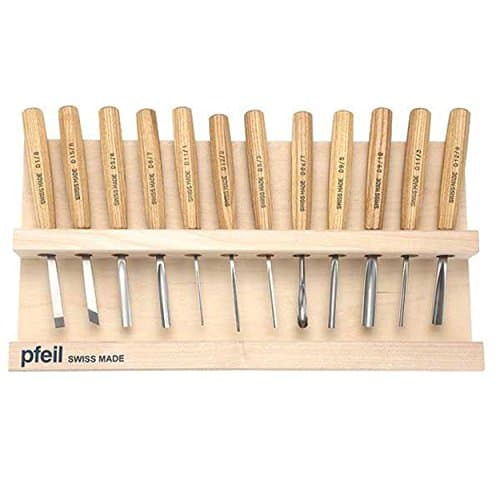
You do not need to memorize that. What matters when you buy is the spread: a useful set gives you something flat or shallow for clearing a background, something at No. 5 or so for general shaping, a deep gouge for hogging waste, a veiner for fine lines and a V tool for defining an edge. The Narex set does that in five pieces. Both Flexcut sets do it in four and nine. The twelve-piece pfeil set does it with two sizes in each of the useful sweeps, which is what the extra money buys.
A set of twelve near-identical shallow gouges in twelve widths is padding. Count the distinct sweeps, not the tools.
Palm, intermediate or full size: the mallet question
Handle length decides how the tool is driven, and it is the specification most buyers do not notice.
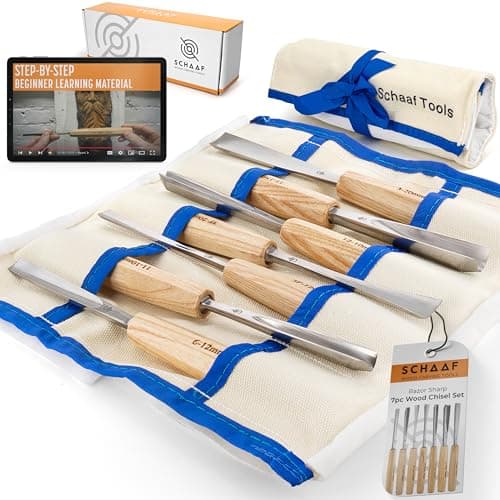
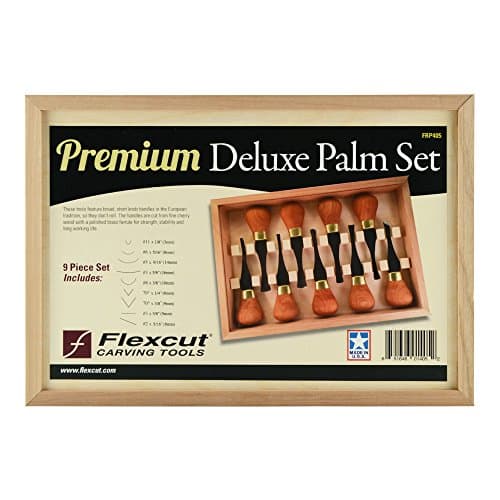
Palm tools are about 5 to 6 in. long with a mushroom handle that sits in the heel of your hand. They are pushed, not struck, and they are the right tool for detail and for carving in your lap. Hitting one with a mallet will split the handle. Intermediatetools — the pfeil set here is 8 in. overall with 3-1/2 in. blades — are held in two hands or tapped with a light mallet. Full-size tools are 9 to 11 in. and are built to be struck properly, which is what you need for anything big or in hardwood. The Schaaf set is the full-size entry on this page for that reason.
If you plan to drive them with a mallet, it should be a round carving mallet rather than a joiner's mallet: a round face lets you strike from any angle without rotating your wrist to find a flat. Our woodworking mallet roundup ranks both shapes and explains where each one belongs.
These are not the chisels on the bench
Worth being explicit, because the mistake runs in both directions. Our bench chisel rounduptells readers to skip sets sold as "wood carving sets" if what they want is joinery, and the same warning applies the other way: a bench chisel is a straight, flat, square-edged tool for paring a joint to a line, and it will not cut a curve. A carving gouge has a curved edge and bevels ground to suit a sweep, and it is poor at chopping a mortise.
If you came here because you need to clean out a dovetail or square a mortise, what size chisels do I need is the page you want instead. If you came here to carve, nothing in the bench-chisel range helps you.
There is a third family that shares the word "gouge" and is also not this one. A lathe gouge works on wood that is already moving, on a long handle that acts as a lever against the tool rest, and it is sharpened on a grinder rather than honed on a stone — our wood turning tools roundup ranks those. Nothing on this page belongs anywhere near a lathe.
Sharp out of the box matters more here than anywhere else
On a bench chisel, arriving dull is an inconvenience: the back is flat and the bevel is straight, so a beginner with a stone and a honing guide can fix it in twenty minutes. On a carving gouge it is a genuine barrier. The edge is a curve, the outside bevel follows that curve, and there is usually an inside bevel too. A flat stone cannot touch the inside of a flute, and a honing guide cannot hold a curved edge at all — you need curved slipstones, a shaped strop, and the knack of rolling the tool through the stroke at a constant angle.
That is a real skill, and it is a terrible first thing to learn. It is why the Flexcut sets and the pfeil set are ranked where they are: all three are sharpened by the maker and work immediately. It is also why the Schaaf set, which is the best value on the page by price, has the lowest out-of-box score — its own listing tells you to sharpen it first, and that is honest of them.
If you buy a set that needs sharpening, buy a leather strop and honing compound at the same time. Stropping is most of carving-tool maintenance: a dozen passes on a charged strop between sessions keeps an edge that would otherwise need stones. Our sharpening stones roundupcovers the abrasives, with the caveat that flat stones only handle a carving tool's outside bevel.
Steel: carbon and chrome-vanadium, not HSS
Every carving tool on this page is carbon steel or an alloy carbon steel, and that is not a cost compromise. A carving edge is thin, curved and refined to a polish; it needs a steel that will take that polish and that you can bring back on a strop in thirty seconds. High speed steel is harder to sharpen by hand and offers nothing in return on a tool that is never getting hot.
Within carbon steels, the published hardness is the figure worth comparing. Flexcut publishes HRC 59-61 for its blades; one retailer publishes 55 HRc for the Narex carving steel; Schaaf publishes a Cr-V 60 grade, and pfeil publishes chrome-vanadium without a hardness. Higher holds an edge longer and is slower to bring back. All of them rust: wipe a thin film of oil on anything carbon-steel before it goes in a drawer, and keep the tools in a roll so the edges never touch each other. Prices below come from our live price feed and carry the date they were pulled.
The six side by side
Published manufacturer and retailer specifications for the six sets ranked above. Read the size column first — it tells you whether the tools can be struck — and the "arrives sharp" column second.
| Set | Tools | Size class | Arrives sharp |
|---|
| Narex 869200 | 5: 3 gouges, V tool, skew | Approx. 6-1/8 in., hand pressure | Usable, benefits from honing |
| Flexcut KN600 | 4: 2 knives, gouge, V tool | Knives and palm tools | Yes, maker-honed |
| Schaaf 7-pc | 7 gouges and chisels | Full size, mallet-driven | No — sharpen first |
| Flexcut FRP405 | 9 palm tools | Palm, hand pressure only | Yes, maker-honed |
| pfeil 12-pc intermediate | 12 across 7 sweeps | 8 in., two hands or light mallet | Yes, hand-sharpened |
| BeaverCraft SC01 | Radial gouges, bent gouge, chisel | Hand pressure | Usable; strop included |
Which set for which kind of carving
| What you want to make | Buy | Why |
|---|
| Figures and small objects, in your hands | Flexcut KN600 | Whittling is a knife job; the two knives plus a gouge and V tool cover it |
| A design cut into a panel (relief) | Narex 869200 | Three sweeps plus a V tool and skew is the complete relief vocabulary |
| Spoons, kuksas, small bowls | BeaverCraft SC01 | The bent gouge reaches inside a hollow where a straight gouge bottoms out |
| Larger work, hardwood, mallet-driven | Schaaf 7-pc | Full-size handles are the only ones built to be struck |
| Serious detail work, already carving | Flexcut FRP405 | Nine sweeps is where you stop making one gouge do another's job |
| Buying once, for decades | pfeil 12-pc | Hand-sharpened Swiss tools on square tangs, with two sizes per useful sweep |
Wood matters as much as the tools
A sharp gouge in the wrong wood feels like a blunt gouge. Carve basswood (linden) or butternut to start: they are soft, even-grained and close to grainless in how they cut, which means your mistakes are your own rather than the board's. Basswood is what almost every carving class uses and what almost every carving blank is sold as.
Avoid oak, ash and anything with strong open grain while you are learning — the tool follows the grain instead of your line, and the result reads as bad carving when it is really bad material choice. Avoid plywood entirely; the glue lines blunt an edge fast. Cherry, walnut and maple all carve beautifully and all demand a properly sharp tool and more force than basswood does.
Two safety habits, and they are specific to this tool
Carving injuries are nearly all to the hand holding the work, and nearly all of them come from the same two mistakes.
Never let the cut travel toward the hand holding the wood. This sounds obvious and is routinely violated, because the most comfortable grip for a knife cut is often the one that points the blade at your thumb. Turn the work rather than reversing the cut, and when you must pull a cut toward yourself, use a knife grip designed for it with your thumb braced behind the blade and not in front of it.
Clamp or cradle panel work; do not hold it.For relief carving, the work goes in a vise or on a bench hook with a stop, so both hands are on the tool — one driving, one steering the edge. That second hand is also the brake that stops a gouge skating out of the cut. A thumb guard and a cut-resistant glove on the non-tool hand are cheap and worth wearing for knife work; neither substitutes for a cut that points somewhere safe.
What to buy alongside the set
Three things, in order of how much difference they make. A leather strop with honing compound, which is most of carving-tool maintenance and the cheapest item here. A set of basswood blanks, so your first cuts happen in the material the tools were designed for. And a way to hold the work— a bench hook with a stop for relief, or a vise for anything three-dimensional, which is covered on our woodworking vise roundup.
What not to buy yet: a honing guide. The guides that make bench-chisel sharpening repeatable cannot hold a curved edge, so they do nothing for a gouge. Curved slipstones that match your sweeps are the equivalent purchase, and they are worth making a second trip for once you know which sweeps you actually use.
Where these numbers come from
Tool counts, sweeps, widths, blade and overall lengths, steel grades and hardness figures are the makers' and retailers' published specifications, cited per set in Sources: Woodcraft's published contents for the pfeil intermediate 12-piece set (8 mm chisel, 8 mm skew, No. 5 gouges at 3 and 8 mm, a 7 mm No. 8, No. 9 gouges at 5 and 10 mm, 1 and 3 mm veiners, a 7 mm No. 8 spoon gouge, No. 12 V tools at 2 and 8 mm, 3-1/2 in. blades, 8 in. overall, chrome-vanadium, hand-sharpened); the published contents of the Flexcut KN600 (KN12 cutting knife, KN13 detail knife, FR306 No. 6 sweep 5/16 in. gouge, FR307 70-degree 1/4 in. V tool, ash handles, high carbon spring steel at HRC 59-61); and the live Amazon listing specifications for the Narex, Schaaf, Flexcut FRP405 and BeaverCraft sets.
Four gaps are stated rather than filled. Narex's own site could not be reached from our build machine(TLS handshake failure), so the Narex figures are retailers' reproductions of its specification, and those retailers disagree on whether the skew is single- or double-bevel — the Amazon listing says double. Flexcut's steel is published as high carbon spring steel at HRC 59-61 by Flexcut and as 1095 by retailers, so the hardness is reported and the alloy name is not. Schaaf does not publish the individual sweeps and widths in its seven-piece set in a form we could verify. And BeaverCraft publishes no steel grade or hardness for the SC01 kit. No sweep, hardness or dimension on this page has been guessed to fill one of those gaps.
We have not tested edge retention or sharpness in a lab — we do not have one, and our methodology page says so plainly. Prices come from the live price feed and carry the date they were pulled.