Skip to content
Dovetail & Dust

HUB 02 · Power Tools

The Best Wood Lathes for a Home Shop

Swing decides what you can turn; mass decides how pleasant it is. Here are the mini and midi lathes worth owning, and the two specs that actually separate them.

By Stephen V.Updated How we research
#ad

We earn a commission when you buy through our Amazon links, at no extra cost to you. It never changes our rankings, and we say so when the cheaper tool is the better buy. How this works.

Two numbers describe a lathe and almost nothing else matters. Swing is twice the distance from the spindle center to the bed, and it caps bowl diameter. Distance between centers caps spindle length. Everything else — variable speed, reversing, banjo design — improves the experience. Swing and bed length decide whether the machine can do the work at all.

The honest split is this. If you want to turn bowls, buy swing: a 10-inch machine tops out at a 10-inch bowl blank, and 10 inches is smaller than it sounds once you have hollowed it. If you want to turn spindles — table legs, chair parts, tool handles, stair balusters — buy bed length, because a 21-inch bed covers most furniture parts and a 12-inch bed does not.

The third factor, and the one buyers underestimate, is mass. A lathe spins an unbalanced lump of wood at speed. The machine's own weight is what absorbs that vibration; a light lathe transmits it into the bench and into the cut. This is why a heavy midi lathe with a smaller swing often turns better than a light machine with a bigger one — and why every lathe here should be bolted down rather than set on rubber feet.

Budget honestly. The lathe is roughly half the cost of turning. You also need turning tools, a chuck, a faceplate, and — non-negotiably — a way to sharpen. Turning tools dull within minutes of use, and a dull gouge is both frustrating and dangerous. Read our sharpening system roundup before you set the budget.

The short answer

Quick picks

#ProductBest forScorePrice
01
RIKON RIKON 70-105 10 x 18 Mini Wood Lathe
RIKON 70-105 10 x 18 Mini Wood Lathe

The best-balanced first lathe. Ten inches of swing and eighteen between centers covers small bowls, spindles and tool handles, and the half-horse motor is honest about what it will do.

Best overall for a first lathe
7.2
$399.99Amazon
02
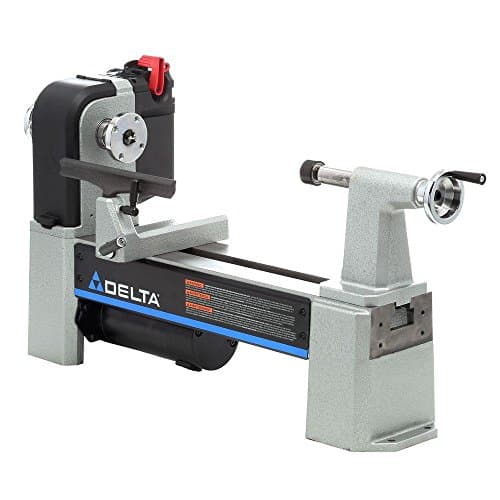
Delta Delta Industrial 46-460 12-1/2-Inch Variable-Speed Midi Lathe
Delta Industrial 46-460 12-1/2-Inch Variable-Speed Midi Lathe

The lathe that defined the midi class. Electronic variable speed across three belt ranges means you can slow a heavy blank down without stopping to move a belt.

Best midi lathe
8.2
$965.90Amazon
03
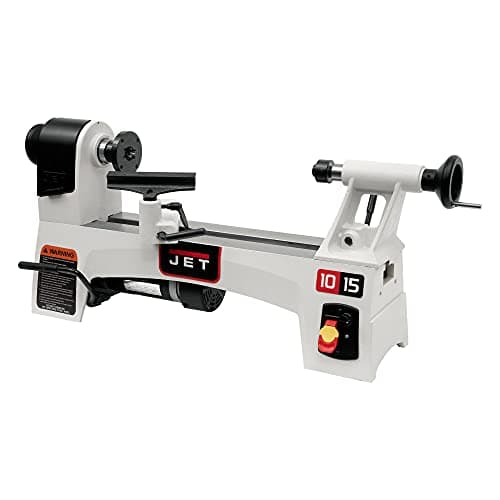
JET JET JWL-1221VS 12 x 21 Variable-Speed Wood Lathe
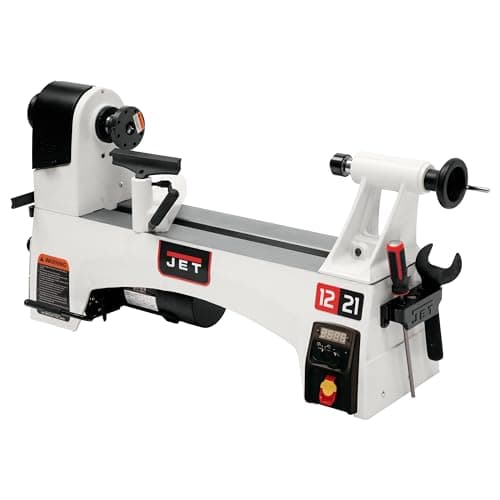
JET JWL-1221VS 12 x 21 Variable-Speed Wood Lathe

A full horsepower on a midi frame, with the longest bed here. If you turn spindles — table legs, chair parts, tool handles — the 21 inches between centers is the spec that decides it.

Best for spindle work
8.6
$989.99Amazon
04
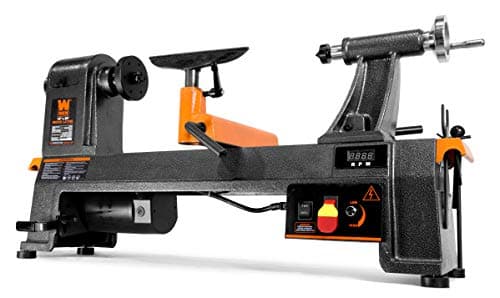
WEN WEN 34035 14 x 20 Variable-Speed Benchtop Wood Lathe
WEN 34035 14 x 20 Variable-Speed Benchtop Wood Lathe

The biggest swing on this page for the least money. Fourteen inches takes a serious bowl, and six amps is enough motor to turn one — provided you accept a lighter machine than the premium brands.

Best swing per dollar
8.0
$779.30Amazon
05
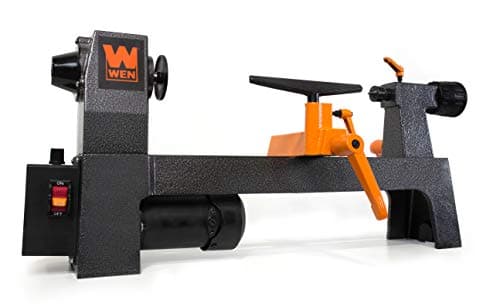
WEN WEN 3421 8 x 12 Variable-Speed Mini Benchtop Wood Lathe
WEN 3421 8 x 12 Variable-Speed Mini Benchtop Wood Lathe

The cheapest way to find out whether you like turning. 3.2 amps and eight inches of swing is genuinely limited, but pens, handles and small spindles do not care.

Best budget
6.2
$238.48Amazon

#ad · Live prices from the Amazon Product API, as of Sep 1, 2026. Where we have no verified live price, we show none — we would rather leave a gap than print a number that has rotted.

In detail

The picks, in full

01
RIKON RIKON 70-105 10 x 18 Mini Wood Lathe

Best overall for a first lathe

RIKON 70-105 10 x 18 Mini Wood Lathe

10 in. swing18 in. between centers1/2 HPMini lathe
7.2/10

The best-balanced first lathe. Ten inches of swing and eighteen between centers covers small bowls, spindles and tool handles, and the half-horse motor is honest about what it will do.

Capacity
7
Power
6
Speed control
6
Build
8
Value
9

Pros

  • Capacity covers the two things beginners actually turn — small bowls and spindles
  • Heavy enough for its class that it does not walk across the bench
  • Priced well below the midi lathes without giving up much usable capacity

Cons

  • Half a horsepower will bog in a large out-of-round blank — take lighter cuts
  • Belt-change speeds rather than electronic variable speed

Don't buy this if…

you already know you want to turn 12-inch bowls. Swing is the one spec you cannot work around.

$399.99View on Amazon

Price as of Sep 1, 2026. Prices change — Amazon's is the one that counts.

#ad · we may earn a commission from this link to RIKON 70-105 10 x 18 Mini Wood Lathe

02
Delta Delta Industrial 46-460 12-1/2-Inch Variable-Speed Midi Lathe

Best midi lathe

Delta Industrial 46-460 12-1/2-Inch Variable-Speed Midi Lathe

12-1/2 in. swingVariable speedThree belt rangesReversing
8.2/10

The lathe that defined the midi class. Electronic variable speed across three belt ranges means you can slow a heavy blank down without stopping to move a belt.

Capacity
8
Power
8
Speed control
9
Build
9
Value
7

Pros

  • Variable speed within each belt range covers everything from roughing to finishing
  • 12-1/2 in. swing takes a genuinely useful bowl size
  • Reversing is a real advantage for sanding a bowl without chasing tear-out

Cons

  • Costs roughly twice a capable mini lathe
  • Heavy — this is a machine you place once

Don't buy this if…

you are not certain turning will stick. Buy a mini lathe, find out, and sell it for most of what you paid.

$965.90View on Amazon

Price as of Sep 1, 2026. Prices change — Amazon's is the one that counts.

#ad · we may earn a commission from this link to Delta Industrial 46-460 12-1/2-Inch Variable-Speed Midi Lathe

03
JET JET JWL-1221VS 12 x 21 Variable-Speed Wood Lathe

Best for spindle work

JET JWL-1221VS 12 x 21 Variable-Speed Wood Lathe

12 in. swing21 in. between centers1 HPVariable speed
8.6/10

A full horsepower on a midi frame, with the longest bed here. If you turn spindles — table legs, chair parts, tool handles — the 21 inches between centers is the spec that decides it.

Capacity
9
Power
9
Speed control
9
Build
9
Value
7

Pros

  • 21 in. between centers covers most furniture-scale spindle work without an extension
  • A full horsepower means it does not stall in a heavy roughing cut
  • Variable speed with a digital readout takes the guesswork out of matching speed to diameter

Cons

  • The longest bed here also means the largest footprint
  • Priced against the Delta at a similar swing — the choice is bed length versus reversing

Don't buy this if…

bowls are your interest. Swing matters for bowls; bed length does not.

$989.99View on Amazon

Price as of Sep 1, 2026. Prices change — Amazon's is the one that counts.

#ad · we may earn a commission from this link to JET JWL-1221VS 12 x 21 Variable-Speed Wood Lathe

04
WEN WEN 34035 14 x 20 Variable-Speed Benchtop Wood Lathe

Best swing per dollar

WEN 34035 14 x 20 Variable-Speed Benchtop Wood Lathe

14 in. swing20 in. between centers6 A motorVariable speed
8.0/10

The biggest swing on this page for the least money. Fourteen inches takes a serious bowl, and six amps is enough motor to turn one — provided you accept a lighter machine than the premium brands.

Capacity
10
Power
7
Speed control
8
Build
6
Value
9

Pros

  • 14 in. swing beats every other machine here, including ones costing more
  • 20 in. between centers handles most spindle work as well
  • Variable speed across the range, not just belt steps

Cons

  • Less mass than the premium midi lathes, and mass is what damps a wobbling blank
  • A bigger swing on a lighter frame is only usable if the machine is properly anchored

Don't buy this if…

you turn green or badly out-of-round blanks. That is exactly the case where machine mass earns its money.

$779.30View on Amazon

Price as of Sep 1, 2026. Prices change — Amazon's is the one that counts.

#ad · we may earn a commission from this link to WEN 34035 14 x 20 Variable-Speed Benchtop Wood Lathe

05
WEN WEN 3421 8 x 12 Variable-Speed Mini Benchtop Wood Lathe

Best budget

WEN 3421 8 x 12 Variable-Speed Mini Benchtop Wood Lathe

8 in. swing12 in. between centers3.2 A motorVariable speed
6.2/10

The cheapest way to find out whether you like turning. 3.2 amps and eight inches of swing is genuinely limited, but pens, handles and small spindles do not care.

Capacity
4
Power
4
Speed control
8
Build
6
Value
9

Pros

  • Variable speed at this price is unusual and makes learning much safer
  • Light enough to lift onto a bench and put away again
  • Cheap enough that the turning tools and sharpening kit cost more than the lathe

Cons

  • Eight inches of swing rules out bowls of any size
  • Light frame transmits vibration — bolt it down or it will hop

Don't buy this if…

bowls are the reason you want a lathe. This will disappoint you within a week.

$238.48View on Amazon

Price as of Sep 1, 2026. Prices change — Amazon's is the one that counts.

#ad · we may earn a commission from this link to WEN 3421 8 x 12 Variable-Speed Mini Benchtop Wood Lathe

How to choose a lathe

Swing: the one spec you cannot work around

You can turn a short spindle on a long bed. You cannot turn a 12-inch bowl on a 10-inch lathe, at any price, with any technique. Decide the largest diameter you realistically want and buy above it, because outboard turning and bed extensions are workarounds, not solutions.

Variable speed versus belt changes

Speed matters more on a lathe than on any other machine, because safe speed falls as diameter rises. A large out-of-round blank must start slow. On a belt-change machine that means stopping, opening a cover and moving a belt every time — which in practice means people do not do it, and run blanks faster than they should. Electronic variable speed is a safety feature disguised as a convenience feature.

Reversing is for sanding, not turning

A reversing lathe lets you sand a bowl in the opposite direction, which lifts the fibers the forward pass laid down and removes a whole category of visible scratch. It is a genuine quality feature and irrelevant to the cutting itself.

The costs beyond the lathe

Turning tools. A basic set — roughing gouge, spindle gouge, bowl gouge, parting tool, skew — is the minimum. Buy fewer, better tools rather than a large cheap set.

A chuck. Faceplate work gets you started, but a four-jaw scroll chuck is what makes bowl turning practical. It is a significant purchase in its own right.

Sharpening. This is the one people skip and regret. Turning tools are sharpened constantly — a bowl gouge might be touched up three times in one bowl. A grinder with a jig, or one of the wet systems in our sharpening system roundup, is part of the purchase, not an accessory to it.

A face shield. Not safety glasses — a full face shield. A lathe throws material toward your face by design, and a blank that comes apart at speed is a serious event. Glasses protect eyes; they do not protect the rest of your face.

Where a lathe fits in a furniture shop

A lathe is the one machine that produces round parts, and round parts are hard to fake. Table legs, drawer knobs, chair spindles, tool handles and knobs for your own jigs all come off a lathe in minutes. Plenty of furniture makers who never intend to turn a bowl own one purely for that.

What we could not verify

We have not turned on these machines. Swing, distance between centers, motor rating and speed control are the manufacturers' published figures from the current listings; the reasoning about vibration, mass and safe speed is standard turning practice, not a measurement we took.
How we picked

We do not run a testing lab

We researched published manufacturer specifications, manuals and spec sheets, ran the arithmetic those specs support, and read owner reviews at volume, then scored each tool against a published rubric. The scores are judgments from documented research — they are not measurements we took, because we do not have a lab and we are not going to pretend we do. Where a number came from a manufacturer's document, we name it and link it in Sources.

Questions

Frequently asked

What size wood lathe do I need?
For bowls, buy swing — 10 in. is workable, 12 in. is comfortable. For spindles, buy bed length — 18 to 21 in. between centers covers most furniture parts. If you want both and have to choose, a 12-inch midi lathe is the compromise that disappoints the fewest people.
Is a mini lathe good enough to learn on?
Yes, and it is the sensible way to find out whether turning suits you. Every technique transfers directly to a bigger machine. The only thing a mini lathe cannot teach you is how a heavy machine feels through a big out-of-round blank.
Do I need variable speed on a wood lathe?
Strongly recommended. Safe turning speed drops as blank diameter rises, and a machine that makes speed changes easy is a machine on which you actually make them. Belt-change lathes work fine, but they punish laziness.
How much should I budget beyond the lathe?
Plan on roughly the price of the lathe again for tools, a chuck, a sharpening setup and a face shield. That figure surprises people, and it is the reason a cheap lathe with good accessories beats an expensive lathe with none.

Keep reading

Receipts

Sources

We do not run a testing lab, and we do not pretend to. Our picks come from published manufacturer specifications and manuals, the arithmetic those specs support, and owner reviews read at volume. Where we could not verify something, we say so on the page rather than quietly leaving it out. Read our full method.