Skip to content
Dovetail & Dust

HUB 04 · Joinery & Jigs

Pocket Holes vs Dowels

One is fast, visible and needs no clamps. The other is slow, invisible and needs both. Here is which belongs on your project.

By Stephen V.Updated How we research
#ad

We earn a commission when you buy through our Amazon links, at no extra cost to you. It never changes our rankings, and we say so when the cheaper tool is the better buy. How this works.

Pocket screws and dowels solve the same problem — joining two boards without cutting traditional joinery — and they trade off in opposite directions. Pocket holes buy speed and cost you a visible hole. Dowels buy invisibility and cost you time and clamps.

A pocket hole is an angled hole drilled through one part so a screw can drive into the end grain or face of the other. The jig sets the angle and depth; the screw supplies clamping pressure as it drives, which is why no clamps are needed while the glue sets. The joint is mechanical first and glued second.

A dowel jointis two aligned holes and a fluted wooden pin, glued. The strength comes entirely from glue surface area and the mechanical resistance of the dowel to shear. It needs clamping while the glue cures, and it needs both halves drilled accurately — which is what a doweling jig exists to guarantee.

The decision in one paragraph: if the joint will be hidden — inside a cabinet, under a table, behind a face frame — use pocket screws, because they are three times faster and nobody will ever see them. If the joint will be visible from any angle, use dowels, because a plugged pocket hole always reads as a plugged pocket hole. That is genuinely the whole decision for most projects.

The short answer

Quick picks

#ProductBest forScorePrice
01
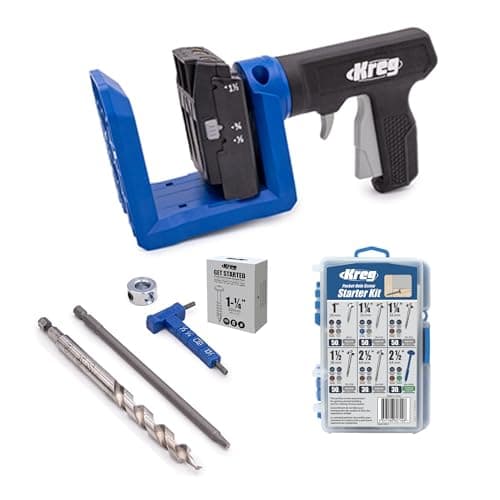
Kreg Kreg 720PRO Pocket-Hole Jig
Kreg 720PRO Pocket-Hole Jig

The pocket-hole jig to buy if you'll use it a lot. An automatic clamp grips any thickness and sets the drill guide in one motion — fast and repeatable.

Best overall
8.6
$149.00Amazon
02
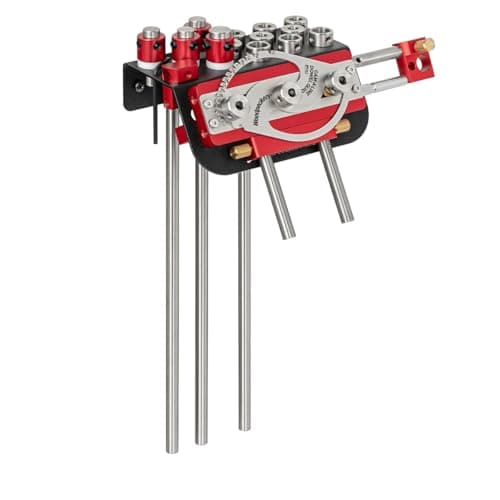
Woodpeckers Woodpeckers Cam-A-Line Dowel Jig, Deluxe Kit
Woodpeckers Cam-A-Line Dowel Jig, Deluxe Kit

The doweling jig that behaves like a machine. A sliding cam keeps three guide bushings evenly spaced, engraved centerlines index off the marks you already made, and four bushing sizes arrive in the box.

Best overall
8.0
$259.99Amazon
03
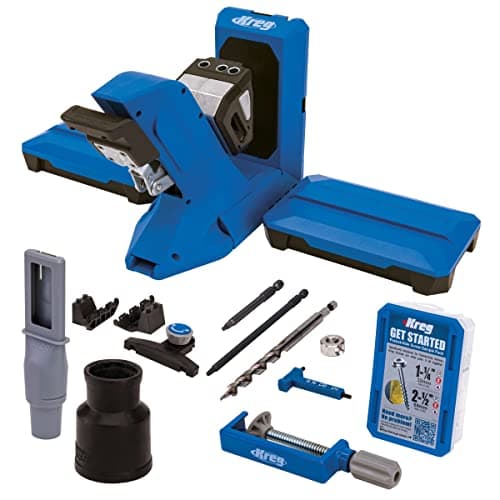
Kreg Kreg 520PRO Pocket-Hole Jig
Kreg 520PRO Pocket-Hole Jig

The value sweet spot. Portable, foldable, with an anti-slip base and enough features for almost anyone — the one most hobbyists should buy.

Best value
8.8
$109.00Amazon
04
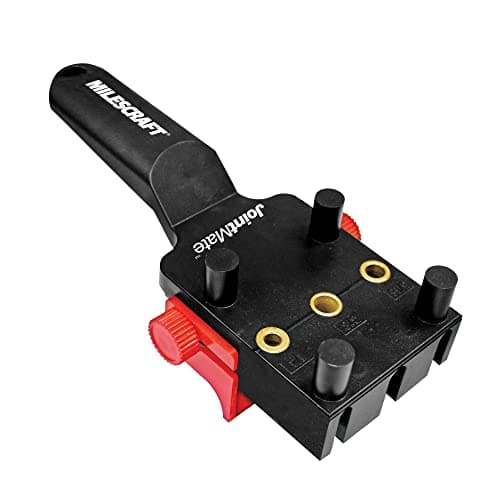
Milescraft Milescraft 1332 JointMate Handheld Dowel Jig
Milescraft 1332 JointMate Handheld Dowel Jig

The cheapest useful dowel jig there is. Three bushing sizes, self-centring pins and a removable fence — it costs less than a bottle of glue and it works.

Best budget
7.0
$7.42Amazon

#ad · Live prices from the Amazon Product API, as of Sep 1, 2026. Where we have no verified live price, we show none — we would rather leave a gap than print a number that has rotted.

In detail

The picks, in full

01
Kreg Kreg 720PRO Pocket-Hole Jig

Best overall

Kreg 720PRO Pocket-Hole Jig

Auto-clampDocking stationMaterial stops1/2–1.5 in stock
8.6/10

The pocket-hole jig to buy if you'll use it a lot. An automatic clamp grips any thickness and sets the drill guide in one motion — fast and repeatable.

Speed
10
Clamping
9
Ecosystem
10
Portability
7
Value
7

Pros

  • Automatic clamp adjusts to stock thickness with no knob-fiddling
  • Docking station with storage and stops speeds up batch work
  • The most refined jig in Kreg's very deep ecosystem

Cons

  • Priciest of the Kreg jigs
  • More jig than an occasional user needs

Don't buy this if…

you'll drill a few pocket holes a year — the 320 or 520PRO does the same joint for much less.

$149.00View on Amazon

Price as of Sep 1, 2026. Prices change — Amazon's is the one that counts.

#ad · we may earn a commission from this link to Kreg 720PRO Pocket-Hole Jig

02
Woodpeckers Woodpeckers Cam-A-Line Dowel Jig, Deluxe Kit

Best overall

Woodpeckers Cam-A-Line Dowel Jig, Deluxe Kit

1/4, 5/16, 3/8, 1/2 in. guides3/4-1-3/4 in. spacingSelf-centering camUSA made
8.0/10

The doweling jig that behaves like a machine. A sliding cam keeps three guide bushings evenly spaced, engraved centerlines index off the marks you already made, and four bushing sizes arrive in the box.

Accuracy
9
Speed
7
Build
9
Versatility
8
Value
7

Pros

  • The cam system sets three bushings to an even spacing at once, so a three-dowel array does not need measuring
  • Four guide sizes, four pins, stop blocks, stop collars and extension rods are all in the Deluxe kit
  • Engraved centerlines align to witness marks on both halves, so the joint indexes from what you drew

Cons

  • Costs more than a pocket-hole system that does a similar job faster
  • Slower than pocket holes for anything that will never be seen
  • The published spacing range tops out at 1-3/4 in. on center, so very wide three-dowel arrays are out

Don't buy this if…

you build shop furniture and painted carcasses. Pocket screws are quicker and nobody will look.

$259.99View on Amazon

Price as of Sep 1, 2026. Prices change — Amazon's is the one that counts.

#ad · we may earn a commission from this link to Woodpeckers Cam-A-Line Dowel Jig, Deluxe Kit

03
Kreg Kreg 520PRO Pocket-Hole Jig

Best value

Kreg 520PRO Pocket-Hole Jig

PortableGripMaxx baseFoldable1/2–1.5 in stock
8.8/10

The value sweet spot. Portable, foldable, with an anti-slip base and enough features for almost anyone — the one most hobbyists should buy.

Speed
8
Clamping
8
Ecosystem
10
Portability
9
Value
9

Pros

  • Anti-slip base holds work steady without a separate clamp
  • Folds up small and travels well
  • Covers the full range of stock thicknesses most projects use

Cons

  • Manual clamping, unlike the 720PRO's automatic action
  • No big docking station for batch production

Don't buy this if…

you build face frames and cabinets all day — the 720PRO's auto-clamp and docking station pay off at that volume.

$109.00View on Amazon

Price as of Sep 1, 2026. Prices change — Amazon's is the one that counts.

#ad · we may earn a commission from this link to Kreg 520PRO Pocket-Hole Jig

04
Milescraft Milescraft 1332 JointMate Handheld Dowel Jig

Best budget

Milescraft 1332 JointMate Handheld Dowel Jig

1/4, 5/16, 3/8 in bushingsSelf-centring pinsRemovable fenceHandheld
7.0/10

The cheapest useful dowel jig there is. Three bushing sizes, self-centring pins and a removable fence — it costs less than a bottle of glue and it works.

Accuracy
6
Speed
7
Build
6
Versatility
6
Value
10

Pros

  • Covers the three dowel sizes that account for nearly all furniture joinery
  • Self-centring pins make edge joints repeatable without measuring
  • Costs so little that trying dowel joinery is a free decision

Cons

  • Handheld means your grip is part of the accuracy
  • No depth stop on the jig — set one on the bit

Don't buy this if…

you need face-frame accuracy. Buy the Woodpeckers and be done arguing with the joint.

$7.42View on Amazon

$7.926% off

Price as of Sep 1, 2026. Prices change — Amazon's is the one that counts.

#ad · we may earn a commission from this link to Milescraft 1332 JointMate Handheld Dowel Jig

Head to head

Speed

Pocket holes, decisively.Clamp the jig, drill two holes, drive two screws — the joint is finished and load-bearing immediately. A dowel joint requires drilling both halves, dry-fitting, gluing, clamping and waiting. On a face frame with twenty joints, that difference is an afternoon.

Appearance

Dowels, decisively.A dowel joint shows nothing on any face. A pocket hole leaves an oval hole that can be plugged, but a plug in an angled hole is an oval of end grain that never quite disappears — fine inside a cabinet, wrong on a visible rail.

Strength

Close enough that it rarely decides. Both are strong enough for furniture loads. Pocket screws are strong in shear and resist pulling apart well; their weakness is racking, because the joint depends on two fasteners rather than a glued area. Dowels distribute load over a larger glued surface and resist racking better with two or more dowels. Neither approaches a well-cut mortise and tenon, which is what you use when strength genuinely is the constraint.

Clamps required

Pocket holes need none; the screw is the clamp. Dowels need real clamping pressure across the joint while the glue cures, which for a cabinet means owning enough bar clamps to hold the whole assembly at once. For a shop just starting out, that is a genuine cost difference.

Cost of entry

Comparable at the bottom, pocket holes cheaper in practice. A basic pocket hole jig and a budget dowel jig cost about the same. The difference is that pocket holes need proprietary screws (an ongoing cost) while dowels need clamps (a bigger up-front cost that you would want anyway).

Repairability

Pocket holes. A pocket screw can be backed out and the joint taken apart, which makes it excellent for shop furniture, jigs and anything that might be modified. A glued dowel joint is permanent.

When to use each, concretely

Use pocket screws for: cabinet carcasses, face frames, shop furniture, jigs, workbenches, anything painted, anything that might be disassembled, and any joint hidden by a top or a back panel.

Use dowels for: visible frames, tables where the underside is seen, furniture in solid hardwood, edge-joining panels for alignment, and anything you would be embarrassed to turn over in front of another woodworker.

Use neither for: chairs. Chairs impose racking loads that neither method handles well over decades. That is mortise-and-tenon territory, and it is worth learning for that one case alone.

A note on doing both

Nothing stops you. A common approach is pocket screws for the carcass (fast, hidden, no clamps) and dowels or traditional joinery for the visible frame. The tools do not conflict and the jigs are cheap enough that owning both is normal.

What we could not verify

We have not conducted destructive strength testing on pocket-hole or dowel joints. The comparison above rests on how each joint transfers load — fasteners in shear versus glued surface area — and on manufacturers' published specifications for the jigs named. It is reasoning, not a test result.
How we picked

We do not run a testing lab

We researched published manufacturer specifications, manuals and spec sheets, ran the arithmetic those specs support, and read owner reviews at volume, then scored each tool against a published rubric. The scores are judgments from documented research — they are not measurements we took, because we do not have a lab and we are not going to pretend we do. Where a number came from a manufacturer's document, we name it and link it in Sources.

Questions

Frequently asked

Are pocket holes stronger than dowels?
They are strong in different ways. Pocket screws hold well in shear and in tension, but the joint depends on two fasteners so it resists racking less well. Dowels spread load over a larger glued area and resist racking better. Both are strong enough for normal furniture; neither matches a mortise and tenon.
Can you use pocket holes on visible furniture?
You can plug them, and the plugs are sold in matching woods — but a plug in an angled hole is an oval of end grain and it stays visible. On anything painted it disappears; on stained hardwood it does not. If the face will be seen, dowels or traditional joinery are the better call.
Do dowel joints need glue?
Yes — a dowel joint is entirely a glue joint. The dowel adds surface area and shear resistance, but without glue it is just a loose pin. Use fluted dowels so glue and air can escape as the dowel is driven.
Which is better for a beginner?
Pocket holes, by some distance. The jig is nearly foolproof, no clamps are required, the joint is immediately solid, and a mistake can be unscrewed. Dowels demand accurate drilling on both halves and a clamping setup, which is more to get right on a first project.

Keep reading

Receipts

Sources

We do not run a testing lab, and we do not pretend to. Our picks come from published manufacturer specifications and manuals, the arithmetic those specs support, and owner reviews read at volume. Where we could not verify something, we say so on the page rather than quietly leaving it out. Read our full method.