Skip to content
Dovetail & Dust

HUB 02 · Power Tools

Best Miter Gauge for a Table Saw

Two specifications decide whether a miter gauge is worth owning: how the angle locks, and how tightly the bar sits in the slot. Everything else on the box is packaging.

By Stephen V.Updated How we research
#ad

We earn a commission when you buy through our Amazon links, at no extra cost to you. It never changes our rankings, and we say so when the cheaper tool is the better buy. How this works.

Buy the Incra Miter 1000SE if you cut angles, and the Kreg KMS7102 if you cut lengths. That one sentence covers most of this page. The 1000SE wins because Incra publishes 41 indexed angle stops and a vernier cursor reading to a tenth of a degree, so a setting you found last month comes back exactly; the Kreg wins on the fence and the swing-away stop, which is what you actually touch when you are cutting forty identical rails. The Incra Miter V27 is the pick if you want the mechanism and nothing else, and it is the cheapest honest upgrade here.

One thing to say before any of it. If almost every crosscut you make is square, the right purchase is not on this page — it is a sheet of plywood and an afternoon building a crosscut sled. A sled rides both miter slots, supports the work on both sides of the blade and cannot drift out of square the way a single-bar gauge can. Nobody selling miter gauges will tell you that. We will, because a sled costs about a fifth of the cheapest gauge below and beats all five at 90 degrees.

What is actually wrong with the gauge that came with your saw

Stock miter gauges fail in two specific places, and knowing which one is annoying you tells you what to buy.

The bar rattles in the slot.A miter slot on a consumer saw is nominally 3/4 in wide by 3/8 in deep, and the real width varies — Incra publishes an adjustment range of 0.740 in to 0.765 in on its bars precisely because slots are not all the same. A stock bar is cut to clear the loosest slot it might meet. That clearance is side play, side play at the bar becomes an arc at the end of the workpiece, and a 0.010 in wobble three feet from the pivot is a gap you can see in a mitered frame. Every gauge below addresses this with expansion disks or set screws that push against both walls of the slot.

The angle is set by eye. A stock gauge has a cast pointer and a stamped scale, usually with detents only at 90 and 45 degrees. Setting 22.5 degrees means lining a thick pointer up with an engraved line and hoping. Worse, the setting is not repeatable: you cannot get back to the number you used yesterday, so a job that spans two sessions needs recalibrating. Indexed gauges replace the pointer with physical detents the gauge drops into, and that is the difference between a scale and a stop.

The criteria, in the order they matter

  • How the angle locks. Indexed detents beat a scale and a lock knob. More detents cover more angles without reading anything, and a vernier cursor fills the gaps between them. This is the single biggest difference between the gauges below.
  • How the bar fits the slot. Count the adjustment points and check whether they push on both walls. Six beats five beats four, and a longer bar resists twist better than a short one.
  • Fence length and the stop.A fence supports the cut-off and gives a stop something to clamp to. If you cut repeat lengths, the stop is the feature you will use every day — and it needs to flip or swing clear so the offcut does not trap against it.
  • Whether it fits your saw at all. Most gauges here need a standard 3/4 by 3/8 in slot. Some older and benchtop saws use 5/8 in slots, and POWERTEC states plainly that its system will not work in those. Measure your slot before you order anything.

Note what is not on that list: the number of degrees of swing, the anodizing color, and the brand. Range past 60 degrees either side matters only for segmented turning and splayed legs, and if that is your work you already know it.

Why three of the five are Incra

Because Incra invented the indexing rack this whole category copies, and it still publishes the most detents at every price point. That is not a brand preference, it is a count: 27 stops on the V27, 41 on the 1000SE, 364 on the 3000SE. Kreg answers with five positive stops and a better fence; POWERTEC answers with a complete system at half the money. If one brand dominating a category bothers you, it should — but the honest read of this one is that the dominance is earned, the same way it is with pocket-hole jigs.

Prices below come from our live price feed and carry the date they were pulled. Miter gauges discount rarely and unevenly, so a figure quoted from memory in this category is usually wrong.

The short answer

Quick picks

#ProductBest forScorePrice
01
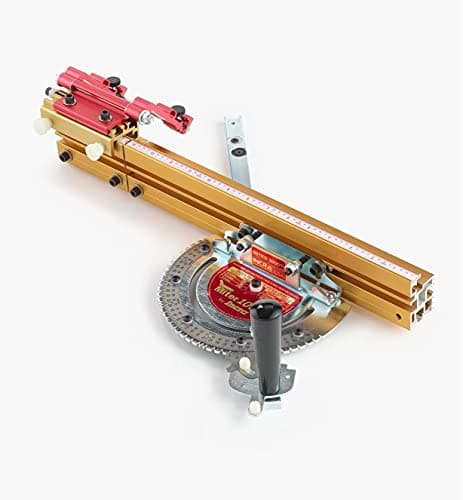
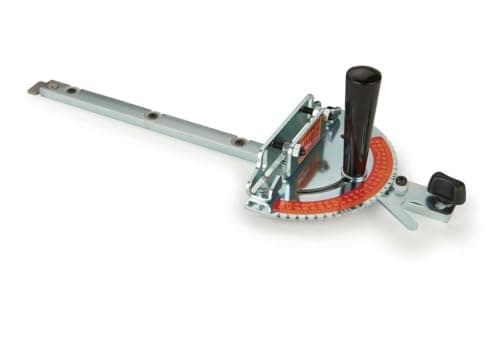
Incra Incra Miter 1000SE Miter Gauge (18–31 in Fence)
Incra Miter 1000SE Miter Gauge (18–31 in Fence)

The gauge that settles the category. Incra publishes 41 indexed stops every 5 degrees over a 180-degree range, a vernier cursor reading to a tenth of a degree between them, and a telescoping fence with a flip stop — so the angle you set is the angle you get back tomorrow.

Best overall
9.0
$165.95Amazon
02
Kreg Kreg KMS7102 Precision Miter Gauge System
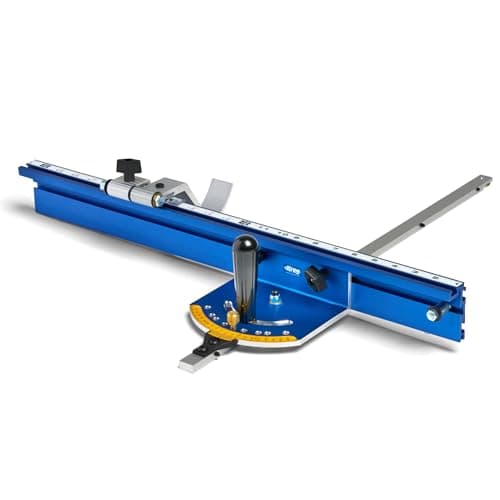
Kreg KMS7102 Precision Miter Gauge System

The one to buy if your crosscuts are mostly square and occasionally not. Kreg publishes positive stops at 0, 10, 22.5, 30 and 45 degrees, a vernier scale reading to a tenth of a degree across a −50 to +50 degree range, and a 24 in fence with a swing-away stop.

Best for repeat crosscuts
8.8
$159.00Amazon
03
Incra Incra Miter V27 Miter Gauge
Incra Miter V27 Miter Gauge

The cheapest honest upgrade on this page. You get Incra's indexed stops — 27 of them, every 5 degrees across plus or minus 60 — and the adjustable bar, and you do not get a fence. For a lot of shops that is exactly the right trade.

Best value
7.8
$77.83Amazon
04
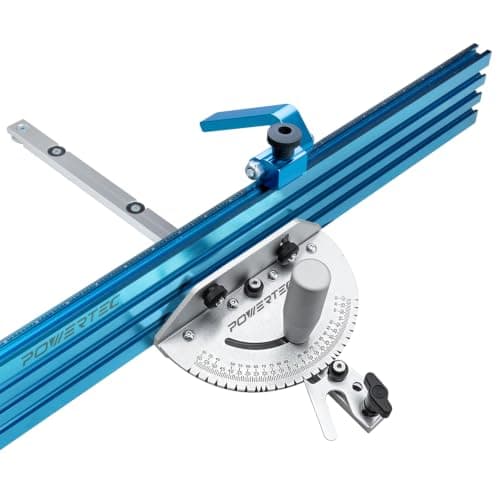
POWERTEC POWERTEC 71391 Miter Gauge System (24 in Fence)
POWERTEC 71391 Miter Gauge System (24 in Fence)

A complete system — gauge, 24 by 3 in T-track fence and a flip stop — at roughly half what the branded systems cost. The compromise is in the finish and the support, not in the concept.

Best complete system on a budget
7.4
$99.99Amazon
05
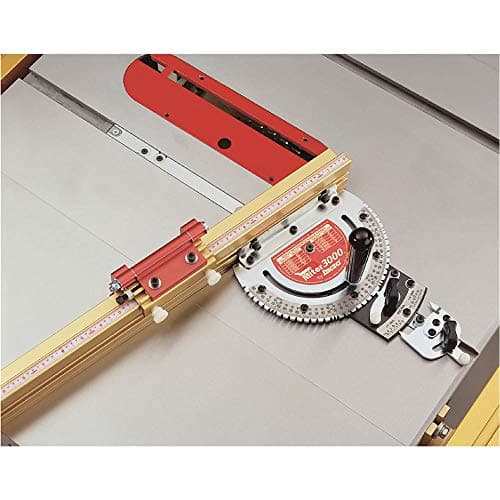
Incra Incra Miter 3000SE Miter Gauge (27–49 in Fence)
Incra Miter 3000SE Miter Gauge (27–49 in Fence)

The wide-crosscut answer. Incra publishes 364 lock-solid stops in 5-degree, 1-degree and half-degree increments, and a fence that telescopes from 27 to 49 in — long enough to support a cabinet side right across the table.

Best for wide crosscuts
9.0
$294.95Amazon

#ad · Live prices from the Amazon Product API, as of October 11, 2026. Where we have no verified live price, we show none — we would rather leave a gap than print a number that has rotted.

In detail

The picks, in full

01
Incra Incra Miter 1000SE Miter Gauge (18–31 in Fence)

Best overall

Incra Miter 1000SE Miter Gauge (18–31 in Fence)

41 stops, every 5°1/10° vernier18–31 in fence3/4 x 3/8 in bar
9.0/10

The gauge that settles the category. Incra publishes 41 indexed stops every 5 degrees over a 180-degree range, a vernier cursor reading to a tenth of a degree between them, and a telescoping fence with a flip stop — so the angle you set is the angle you get back tomorrow.

Angle accuracy
10
Slot fit
10
Fence and stop
9
Build
9
Value
7

Pros

  • Indexed stops drop into a physical detent rather than a scribed line, which is why the setting repeats instead of drifting
  • The vernier cursor covers the gap between stops, so an odd angle is set by reading a scale rather than by guessing
  • Six expansion disks adjust both sides of the bar, which is the part that removes the slop a stock gauge lives with
  • The telescoping fence reaches 31 in and carries a flip stop, so repeat crosscuts come off the stop instead of off a pencil mark

Cons

  • The 5-degree stop spacing means a 7-degree setting still goes through the vernier — the detents only help on common angles
  • Costs more than the entry-level benchtop tools some readers are still saving for, which is a real decision and not a technicality
  • The fence takes up space to the left of the blade; on a small benchtop saw it can overhang the table

Don't buy this if…

…almost every crosscut you make is square and repeatable. A shop-built crosscut sled is more accurate than any miter gauge at 90 degrees and costs a sheet of plywood.

$165.95View on Amazon

Price as of October 11, 2026. Prices change — Amazon's is the one that counts.

#ad · we may earn a commission from this link to Incra Miter 1000SE Miter Gauge (18–31 in Fence)

02
Kreg Kreg KMS7102 Precision Miter Gauge System

Best for repeat crosscuts

Kreg KMS7102 Precision Miter Gauge System

Stops at 0/10/22.5/30/45°1/10° vernier24 in fence−50° to +50°
8.8/10

The one to buy if your crosscuts are mostly square and occasionally not. Kreg publishes positive stops at 0, 10, 22.5, 30 and 45 degrees, a vernier scale reading to a tenth of a degree across a −50 to +50 degree range, and a 24 in fence with a swing-away stop.

Angle accuracy
8
Slot fit
9
Fence and stop
10
Build
9
Value
8

Pros

  • The Swing Stop lifts out of the way and drops back on the same setting, which is the whole point of a stop on a crosscut fence
  • Five bar adjusters take the play out of a 3/4 by 3/8 in slot, and Kreg states the gauge ships factory-calibrated
  • Positive stops sit at the angles furniture actually uses, so the common settings need no reading at all
  • The 24 in fence arrives as part of the system rather than as an upsell

Cons

  • Five positive stops against Incra's 41 — anything other than those five goes through the vernier scale
  • The 50-degree limit either side is less range than the Incra gauges offer, which matters for segmented and splayed work
  • A fixed 24 in fence does not telescope, so wide panels still want a sled

Don't buy this if…

…you cut a lot of unusual angles. This gauge is optimized for repeatable length at common angles, not for dialing in one-off numbers.

$159.00View on Amazon

Price as of October 11, 2026. Prices change — Amazon's is the one that counts.

#ad · we may earn a commission from this link to Kreg KMS7102 Precision Miter Gauge System

03
Incra Incra Miter V27 Miter Gauge

Best value

Incra Miter V27 Miter Gauge

27 stops, every 5°±60° range4 expansion pointsNo fence included
7.8/10

The cheapest honest upgrade on this page. You get Incra's indexed stops — 27 of them, every 5 degrees across plus or minus 60 — and the adjustable bar, and you do not get a fence. For a lot of shops that is exactly the right trade.

Angle accuracy
8
Slot fit
9
Fence and stop
4
Build
8
Value
10

Pros

  • The two things that actually fix a bad miter gauge — indexed detents and a bar that does not rattle in the slot — for the smallest outlay here
  • A universal mounting bracket takes a shop-made wooden fence, which is a zero-clearance fence for the price of an offcut
  • Special stops at plus and minus 22.5 degrees cover eight-sided work without a reading
  • Small enough to leave in the slot on a benchtop saw without fouling the rip fence

Cons

  • No fence and no stop in the box, so repeat lengths need a fence you build or buy separately
  • No vernier cursor — between the 5-degree detents you are back to reading a scale by eye
  • Four expansion points rather than six, and the bar is shorter, so a long or loose slot shows the difference

Don't buy this if…

…you want repeat-length crosscuts out of the box. Budget for a fence and a stop on top, or buy one of the systems above.

$77.83View on Amazon

Price as of October 11, 2026. Prices change — Amazon's is the one that counts.

#ad · we may earn a commission from this link to Incra Miter V27 Miter Gauge

04
POWERTEC POWERTEC 71391 Miter Gauge System (24 in Fence)

Best complete system on a budget

POWERTEC 71391 Miter Gauge System (24 in Fence)

27 angle stops24 x 3 in T-track fenceT-slotted miter barFlip stop included
7.4/10

A complete system — gauge, 24 by 3 in T-track fence and a flip stop — at roughly half what the branded systems cost. The compromise is in the finish and the support, not in the concept.

Angle accuracy
7
Slot fit
7
Fence and stop
8
Build
6
Value
9

Pros

  • Everything needed for repeat crosscuts arrives in one box, which no other gauge near this price does
  • The multi-track fence takes standard 1/4-20, 1/4 in and 5/16 in T-bolt accessories, so shop-made stops and hold-downs bolt straight on
  • The removable T-slot plate lets the bar work in plain 3/4 by 3/8 in slots and in T-slotted ones
  • A laser-engraved scale on the fence makes the flip stop usable without reaching for a tape measure

Cons

  • POWERTEC does not publish an angular tolerance, so the only honest check is the five-cut test on your own saw
  • Machining and anodizing are a visible step below Incra and Kreg, and the knobs are the first thing owners replace
  • POWERTEC states it will not work with the smaller 5/8 in miter slots some older and benchtop saws use — check before ordering

Don't buy this if…

…your saw has a 5/8 in miter slot, or you would rather own a gauge you never think about again. This is the value play, not the lifetime tool.

$99.99View on Amazon

Price as of October 11, 2026. Prices change — Amazon's is the one that counts.

#ad · we may earn a commission from this link to POWERTEC 71391 Miter Gauge System (24 in Fence)

05
Incra Incra Miter 3000SE Miter Gauge (27–49 in Fence)

Best for wide crosscuts

Incra Miter 3000SE Miter Gauge (27–49 in Fence)

364 stops: 5°, 1°, 1/2°27–49 in fenceFlip fence with micro-adjust3/4 x 3/8 in bar
9.0/10

The wide-crosscut answer. Incra publishes 364 lock-solid stops in 5-degree, 1-degree and half-degree increments, and a fence that telescopes from 27 to 49 in — long enough to support a cabinet side right across the table.

Angle accuracy
10
Slot fit
10
Fence and stop
10
Build
9
Value
6

Pros

  • Half-degree detents mean most real-world angles land on a physical stop instead of on a scale reading
  • A 49 in fence supports work a 24 in fence cannot, which is the difference between a crosscut and a wrestling match
  • The flip fence carries micro-adjust, so creeping up on a final length does not mean nudging a stop by hand
  • Same GlideLOCK bar and 0.740 to 0.765 in slot adjustment as the 1000SE, so the fit in the slot is identical

Cons

  • The most expensive thing on this page by a wide margin, and the fence length is most of what you are paying for
  • Needs real table and infeed space — on a contractor saw in a one-car garage it is more gauge than the saw can use
  • A sled still beats it for repeat square crosscuts on sheet goods, at a fraction of the cost

Don't buy this if…

…your saw is a benchtop or jobsite model. The fence will overhang the table badly and you will not get the benefit you paid for.

$294.95View on Amazon

Price as of October 11, 2026. Prices change — Amazon's is the one that counts.

#ad · we may earn a commission from this link to Incra Miter 3000SE Miter Gauge (27–49 in Fence)

The five side by side

Published manufacturer specifications for the five gauges ranked above. Read the stops column first — it is the one that separates them.

GaugeIndexed stopsFine adjustmentFenceSlot
Incra Miter 1000SE41, every 5° over 180°1/10° vernier cursor18–31 in telescoping, flip stop3/4 x 3/8 in, 6 disks
Kreg KMS71025 (0, 10, 22.5, 30, 45°)1/10° vernier scale24 in fixed, Swing Stop3/4 x 3/8 in, 5 adjusters
Incra Miter V2727, every 5° over ±60°None publishedNone — bracket only3/4 x 3/8 in, 4 points
POWERTEC 7139127 angle stopsNone published24 x 3 in T-track, flip stop3/4 x 3/8 in, T-slot plate
Incra Miter 3000SE364, at 5°, 1° and 1/2°Micro-adjust flip fence27–49 in telescoping, flip stop3/4 x 3/8 in, GlideLOCK

Why 45 degrees is the angle that exposes a bad gauge

A four-sided frame needs eight 45-degree cuts, and the errors add. Being half a degree out does not give you one small gap — it gives you four corners that each carry the error, and the last joint closes up two degrees short. This is why miter gauge accuracy gets discussed in tenths of a degree while most other shop settings are discussed in sixteenths of an inch: the geometry multiplies the mistake by eight.

It is also why a detent beats a scale. You are not trying to find 45 degrees once, you are trying to find the same 45 degrees eight times in a row, and then again on the matching frame next week. A physical stop does that. A pointer against an engraved line does not, however carefully you set it.

How to check the gauge you just bought

No gauge is square because the box says so, and that includes the expensive ones. Two checks, in this order:

Set the bar first.Adjust the expansion disks or set screws until the gauge slides along the full length of the slot with no side-to-side movement and no binding. Do this before you look at a single angle — a loose bar makes every angle reading meaningless.

Then run the five-cut test.Crosscut a square-ish offcut of plywood, rotate it 90 degrees, cut again, and keep going for five cuts, labeling each. Measure the width of the final sliver at both ends. The difference, divided by four, is your error per cut, and which end is wider tells you which way to correct. It is the only test that measures the whole system — gauge, bar, slot and blade — rather than one part of it, and it is worth doing on a brand-new gauge before you trust it with project stock.

The sled question, honestly

We said it at the top and it is worth the detail. A crosscut sled rides both miter slots, so it cannot pivot. It supports the workpiece on both sides of the blade, so the offcut does not drop and the cut edge does not splinter out. It carries a zero-clearance kerf, which no miter gauge can. For square crosscuts it is simply the better tool, and shop-built is the normal way to own one.

What a sled cannot do is change angle in five seconds, cut a 22.5-degree miter on a long piece, or stay out of the way when you are mostly ripping. That is the honest division of labor: a sled for square work, a good miter gauge for angles. Many of the shops we would point at have both, and they built the sled first. If you are setting up a saw from scratch, our table saw roundup covers the machine and table saw bladescover the other half of cut quality — a perfect gauge behind a dull blade still tears out.

Never use the miter gauge and the rip fence together

This is the one safety rule specific to crosscutting on a table saw, and it catches people who have used the machine for years. If you crosscut with the gauge while the offcut is against the rip fence, the piece is trapped: it cannot move sideways as the blade releases it, so it binds between the fence and the rising teeth at the back of the blade. That is a kickback with a short, heavy projectile.

The fix is a stop block, not the fence. Clamp a short block to the fence well aheadof the blade, slide the stock up to it, then pull the stock back off the block before you cut — or use the flip stop on the gauge's own fence, which is what three of the five gauges here include and what you are partly paying for. Either way the cut-off ends up free on both sides as it separates.

It is also the reason a miter gauge fence should extend past the blade. A fence that stops short leaves the offcut unsupported at exactly the moment it is cut loose, and an unsupported offcut rotating into the blade is the second most common way this cut goes wrong.

What we are not ranking, and why

There is a tier of unbranded miter gauges on Amazon at roughly half the POWERTEC price. We have not ranked any of them. The reason is specific rather than snobbish: they publish no angular tolerance, no adjustment range for the bar, and often no brand that will exist in two years, so there is nothing to tell you about them that would be true. In a category where the entire value is the published precision, a product with no published precision is not a budget option — it is an unknown. If your budget is at that level, build the sled.

Where these numbers come from

The stop counts, increments, vernier resolutions, fence lengths, slot dimensions and bar adjustment ranges above are the manufacturers' own published specifications, taken from Incra's and Kreg's product pages and the live retail listings, and cited per tool in Sources. We have not measured angular accuracy on a rotary table — we do not have one, and our methodology page says so plainly. Prices come from the live price feed and carry the date they were pulled.
How we picked

We do not run a testing lab

We researched published manufacturer specifications, manuals and spec sheets, ran the arithmetic those specs support, and read owner reviews at volume, then scored each tool against a published rubric. The scores are judgments from documented research — they are not measurements we took, because we do not have a lab and we are not going to pretend we do. Where a number came from a manufacturer's document, we name it and link it in Sources.

Questions

Frequently asked

Is an aftermarket miter gauge worth it?
If you cut angles, yes — the indexed stops and the adjustable bar fix the two things a stock gauge gets wrong, and the setting becomes repeatable. If you almost only crosscut square, a shop-built crosscut sled is more accurate for a fraction of the money, and that is the honest answer even though nobody earns a commission on plywood.
Will any miter gauge fit my table saw?
No. Most of the gauges here need a standard 3/4 in wide by 3/8 in deep miter slot, and POWERTEC states its system will not work in the smaller 5/8 in slots found on some older and benchtop saws. Measure the width and depth of your slot, and check whether it is T-slotted, before ordering.
What is the difference between the Incra Miter 1000SE and the V27?
Mechanism and completeness. The V27 publishes 27 stops every 5 degrees over plus or minus 60 degrees and comes with a mounting bracket but no fence. The 1000SE publishes 41 stops over a full 180 degrees, adds a vernier cursor reading to a tenth of a degree, and ships with an 18 to 31 in telescoping fence and a flip stop. The V27 is the mechanism; the 1000SE is the system.
Do I need a miter gauge if I have a miter saw?
They overlap but they are not substitutes. A miter saw is faster and safer for angled crosscuts on long, narrow stock; a table saw with a good gauge is better on wide panels, on small parts you can hold against a fence, and for any cut where the table saw is already set up. We lay out which tool wins which cut in table saw vs miter saw.
How do I know whether my new miter gauge is accurate?
Set the bar for zero side play first, then run the five-cut test: five successive crosscuts on an offcut, rotating 90 degrees each time, then measure the final sliver at both ends. The difference divided by four is the error per cut. It tests the whole system rather than trusting a factory scale.

Keep reading

Receipts

Sources

We do not run a testing lab, and we do not pretend to. Our picks come from published manufacturer specifications and manuals, the arithmetic those specs support, and owner reviews read at volume. Where we could not verify something, we say so on the page rather than quietly leaving it out. Read our full method.